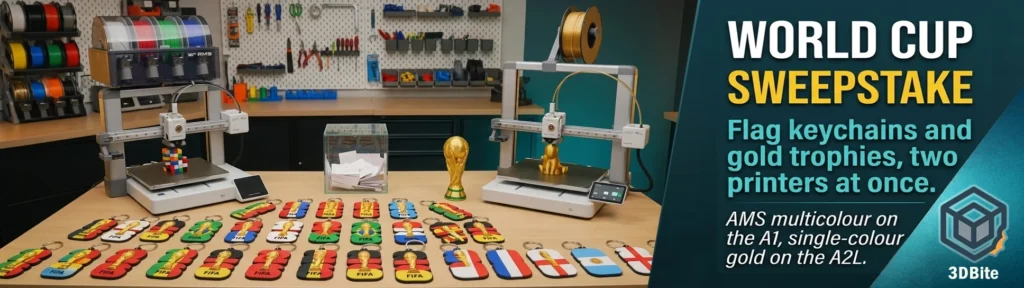
Our office has run a World Cup sweepstake for as long as I can remember — everyone chips in, draws a country out of a hat, and whoever has the eventual winner takes the pot. This year I thought it would be a nice touch to print something physical to go with it rather than the usual scrap of paper with a country name scrawled on it. Two printers, two very different jobs, running in parallel for the first time on a project that actually has a deadline attached to it — the draw happens before the tournament kicks off, so unlike most of what gets covered on this site, this one has a hard finish line.
The keychains
The model is World Cup 2026 Logo Flag Keychains by Lauvi Design on MakerWorld — a genuinely well put together collection that gives every participating nation its own version of the tournament’s “26” logo, coloured in that country’s flag. The design is built specifically around layer-by-layer colour change, which means it is an AMS job through and through. Without that capability, the designer is upfront that the flag colours simply will not display correctly — this is not a model with a sensible non-AMS fallback, unlike a lot of what I cover in the multi-part versus AMS post. The colour transitions here are happening within individual letterforms and fine detail, which is exactly the category of model that needs the AMS rather than physical part separation.
The recommended settings are sensible and broadly in line with what I would have chosen myself for a small functional keychain: 0.20mm layer height, two perimeters, 10–15% infill, PLA, no supports required. Nothing demanding, which is the right call for a model that is going to be printed dozens of times for a sweepstake involving the whole office. The designer has also done something genuinely useful for anyone printing this at volume: raw 3MF files plus print-ready profiles configured directly for Bambu Lab, which has meant minimal setup time per country once the first one was dialled in.
One detail worth flagging for anyone else picking this up for a similar project: the cup element of the logo is supplied as a separate piece for better detail definition, with gluing recommended after printing rather than printing it as a single fused part — a small nod to the same colour-separation logic covered in the multi-part post, even within an otherwise AMS-driven design. And the South Africa flag is a genuine edge case worth knowing about in advance if your sweepstake includes it: that flag uses five colours, one more than a standard four-slot AMS can handle in a single job, so the designer’s solution is to print the red section separately and glue it on. Worth checking the participating nations in your own sweepstake against the model’s colour count before assuming every country prints in a single AMS pass.
Running these on the A1 with the AMS Lite has been straightforward. Small keychain-sized parts with well-prepared print-ready profiles are exactly the kind of job the A1 has handled flawlessly for two years, as covered in the long-term ownership post — load the colours, queue the country, walk away. With dozens of colleagues in the sweepstake, the AMS’s strength here is volume: each flag is a fast print and the colour swaps are exactly the kind of job the AMS exists for, none of the long single-colour runs where purge waste becomes the more significant consideration covered in the AMS arms race post.
The trophies
Alongside the keychains, I am printing trophies for the actual sweepstake winner — single-colour gold, run on the A2L. This is a deliberate split of work between the two machines rather than an arbitrary choice, and it is the first project where the reasoning behind buying the A2L has translated into an actual practical division of labour on the desk.
The trophies are a single-colour job, which plays directly to what the A2L is for in this household — large format and uncomplicated single-colour printing, freeing the A1’s AMS for the genuinely multi-colour work that needs it. Gold PLA on a single-colour print is about as close to a best-case scenario as FDM printing gets: no purge waste, no colour transitions to worry about, no banding risk, just a clean continuous job from start to finish. Running this on the A2L rather than queuing it behind the AMS keychain jobs on the A1 means both printers have been working simultaneously rather than competing for the same machine’s time — exactly the parallel workflow benefit described in the Yoshi build post, just with single-colour trophies instead of multi-part colour sections this time round.
Gold PLA’s reflective, metallic-effect finish does add a small wrinkle worth mentioning for anyone printing something similar — metallic and silk-style filaments can be more prone to visible layer lines and require a touch more care with cooling and speed than a standard matte PLA, a topic covered in more general terms in the silk filament post, though thankfully without any of the trouble described there. A reasonably reputable gold PLA on sensible settings has been printing cleanly on the A2L with no real drama.
The two-printer workflow, properly justified
This project is a small but genuinely satisfying validation of the decision covered across the Kobra X return and the subsequent A2L purchase. Two machines, two genuinely different jobs running at the same time, each suited to what it does best — the AMS-equipped A1 handling the colour-complex small-batch keychains, the large-format A2L handling the clean single-colour trophy run. No file duplication headaches, no profile rebuilding between machines, no ecosystem friction. Exactly the outcome the four-week Kobra X review concluded was the entire point of staying within Bambu rather than introducing a second ecosystem.
Whether my own country draws a decent team this year is an entirely separate question that no amount of printer optimisation can help with. But at least the prize and the participation trinkets are sorted well ahead of kick-off, and there is something quietly satisfying about being able to hand a colleague a printed flag keychain with their drawn country’s colours rather than a scrap of paper. Good luck to whoever pulls the eventual winner — and to the printers, for getting this all done before the deadline.