
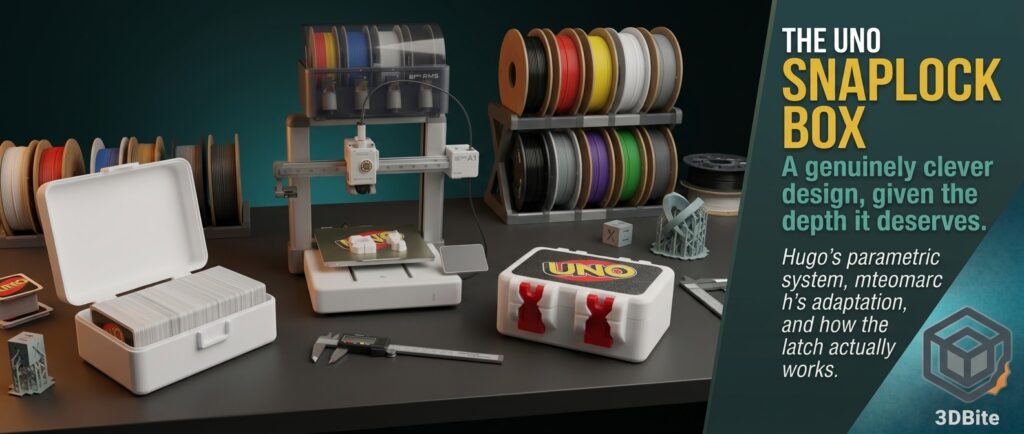
This is one of the earliest project posts on this site, and going back to it after everything covered since — the Nutcracker build, the multi-part Mario series, the BCMU work — it is nowhere near the level of detail those later posts get. That is worth fixing properly rather than just tidying up a paragraph, because the design itself deserves it. The UNO SnapLock Card Box is a genuinely clever piece of parametric engineering with a real lineage behind it, and there is considerably more to say about how it actually works, who actually designed it, and what I would tell anyone attempting it today than the original three-minute version of this post managed.
The design lineage: this is not one designer’s work, it is two
This is worth getting right because the credit chain matters and the original post underplayed it. The underlying mechanism — a full parametric, hardware-free snap-lock storage box system — was designed by a MakerWorld creator called Hugo, published as “SnapLock Storage Boxes (parametric)” and licensed under Creative Commons Attribution-Noncommercial-Share Alike. That base parametric file has been downloaded tens of thousands of times in its own right and forms the foundation for a genuinely large family of derivative boxes across MakerWorld — not just UNO, but Phase 10, Canasta, ONO 99, and various other card game storage solutions, all built on the same core Fusion 360 parametric model.
The specific UNO variant that this post is actually about was adapted by a designer called mteomarch, who took Hugo’s parametric Fusion file and refined it specifically — adding fillets, adjusting draft angles, and tuning the proportions for the exact dimensions of a standard UNO deck. mteomarch’s own description of the process is worth quoting because it explains the whole motivation behind the redesign clearly: having searched extensively for an existing card box that did not require external hardware to assemble, and having found designs that were either not to their liking or needed screws and wire to hold together, they came across Hugo’s parametric system and adapted it into their own series of game boxes. The UNO version became, by a wide margin, the most popular single entry in that whole family — tens of thousands of downloads and well over ten thousand likes on MakerWorld, which places it among the more genuinely successful functional prints in this specific niche.
How the snap-lock mechanism actually works
This is the part the original post skipped entirely, and it is genuinely the most interesting engineering detail in the whole design. The box has no hinges, no screws, no metal or plastic pins to insert, and nothing to lose during assembly. The lid and base each carry a set of moulded latch features — small cantilever hooks printed directly into the geometry — that flex slightly as the lid is pressed onto the base and then click into a positively retained closed position. This is the same fundamental snap-fit principle covered in the orientation for strength post: a cantilever arm that needs to flex repeatedly without cracking at its root, printed in an orientation that keeps the flex happening within the layer plane rather than across it. Hugo’s original parametric design gets this right, which is precisely why the whole family of derivative boxes built on it has been so widely adopted rather than needing constant reinforcement fixes from downstream designers.
One genuinely useful troubleshooting detail surfaced directly in the MakerWorld comments on mteomarch’s listing, and it is worth including here because it is exactly the kind of practical gotcha that never makes it into a design description. A user reported difficulty closing the box, and the reply from mteomarch diagnosed it immediately: the two latches were mirrored the wrong way round relative to each other, meaning the box was fighting itself rather than snapping shut cleanly. The fix was simply reprinting or reorienting the latch pieces so both faced the correct direction. If the assembled box resists closing more than it should, checking latch orientation before assuming a print quality or tolerance problem is the first thing worth doing.
Filament and the multi-colour lid
Red, yellow, black, and white PLA — the classic UNO palette — print the box body and the multi-colour lid logo. The lid artwork is where the AMS genuinely earns its place on this specific project: the layered colour logo on the lid face is exactly the kind of small, geometrically simple, flat multi-colour application that an AMS handles cleanly and efficiently, without the purge-waste concerns covered in the hidden workflow cost post becoming a real issue, since the total colour-change count on a lid this size is modest. For anyone without an AMS, manual filament swaps at the relevant layer heights work identically — it simply takes more attention during the print rather than being fully automated.
Printer and settings
| Setting | Value | Notes |
|---|---|---|
| Printer | Bambu Lab A1 | The A1’s standard 256mm plate comfortably accommodates the box, lid, and any latch test pieces on a single plate |
| Nozzle | 0.4mm | Standard |
| Plate | Textured PEI | — |
| Layer height | 0.20mm | Fine enough to resolve the lid logo detail and the latch geometry cleanly without pushing print time unnecessarily |
| Infill | 15-20% | Default is genuinely adequate — this is a light-duty storage box rather than a structural part |
| Supports | Not required | The parametric design avoids overhangs that would need them, which is part of why it prints so reliably from a default profile |
| Cooling | Full cooling | Sharpens the latch geometry and the lid logo edges — this is one detail worth not skimping on, since a soft, under-cooled latch is more prone to the mirrored-orientation confusion covered above |
| Orientation | Box upright, lid face-up | Standard, no reorientation needed from the default MakerWorld profile |
Print time and material
Across the full multi-colour AMS run on the A1, expect roughly four to six hours and 60-80 grams of filament total across all four colours — a genuinely cheap print at somewhere around £1.50-£2.00 in material, considerably less than most commercial card storage cases cost, and vastly more durable than the flimsy cardboard box UNO actually ships in.
The result
The finished box feels genuinely sturdy — closer to a commercial-grade case than a hobbyist print — and the snap latches work reliably straight off the plate without any tuning, provided the orientation gotcha above is avoided. The lid logo comes out crisp with clean colour separation. Interior space comfortably fits a full UNO deck, and the compact footprint makes it a sensible thing to actually carry rather than a novelty that stays on a shelf.
Availability: a note worth being honest about
Since this post originally went up, a reader flagged in the comments that the listing appears to have come down from MakerWorld. I still have the file downloaded from when I originally printed it, and I am happy to pass it on directly to anyone who wants it — the contact form on this site is the way to reach me for that, exactly as I told the first person who asked. Given how many derivative boxes exist in the same family — Hugo’s base parametric system, and mteomarch’s own wider series covering Phase 10, Canasta, and several other card games — searching MakerWorld for “SnapLock” alongside the specific game name is also worth trying, since the broader parametric ecosystem this box belongs to has proven considerably more resilient than any single listing within it.
What I would change next time
A matte PLA for the box body would give the finished piece a more premium, less obviously-3D-printed look than the standard glossy PLA finish, without changing anything about the latch mechanism or the print settings above. A custom internal insert, sized specifically to keep a shuffled deck more tightly packed rather than sliding around inside the box’s full internal volume, is the other genuine improvement worth making — the base parametric design prioritises universal fit across whatever variant of the box you print, and a project-specific insert dialled in for exactly one deck of cards would tighten that up considerably. Both are small, achievable follow-up prints rather than anything that requires redesigning the working mechanism Hugo and mteomarch have already got right.

Heyyy!! They are gone from MakerWorld.
Can you upload the blank design and the instructions on how to make them?
I have the file downloaded. I can send it to you? Use the contact form on site and I’ll reply with the file!
Hello,
I would like to use as a school project for engineering students next school year. Do you mind sharing the downloaded file with me?
Could you send me the file as well? If you have any of the other files for the game boxes that he used to make that would be great too! Didn’t realize he had taken all his snaplock boxes down 🙁