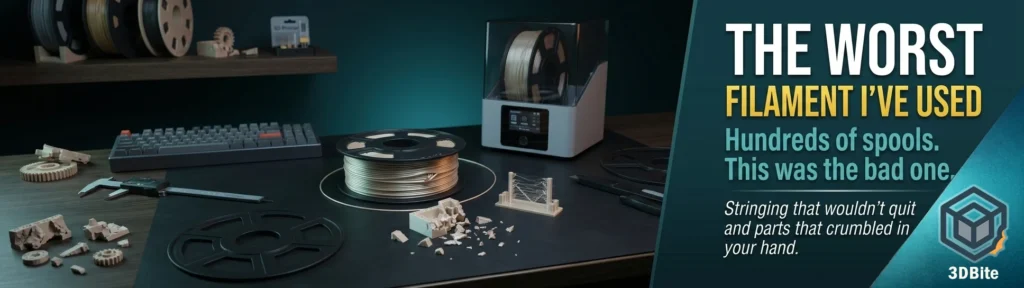
I have been through several hundred spools of filament over the years across more brands than I could list from memory. Most of it has been good. Some of it has been mediocre. Very little of it has been actively bad. Yuaneang silk PLA is actively bad, and this post is the rare one where I am naming a specific product rather than discussing a material category, because the experience was bad enough and consistent enough across the whole spool that it earns the distinction.
I bought it because I liked the colour. That is the entire reason it ended up on the printer rather than any particular research into the brand. Dongguan Yuanyang Plastic Technology is one of the smaller Chinese filament manufacturers, producing a wide catalogue including PLA, PETG, TPU and silk variants under the Yuaneang name, and it is not a brand with anything like the community track record of eSun, Sunlu, or Polymaker. In retrospect that should have been a signal to do more homework before loading a full spool into a project. It was not, and the result was worth writing up properly.
What went wrong, in order
The first problem was stringing, and it was the kind of stringing that did not respond properly to the usual fixes. Temperature reduction helped a little. Retraction tuning helped a little. Slowing travel speed helped a little. None of it got the stringing down to the level I would consider acceptable on a finished piece. It reduced from bad to merely noticeable, and merely noticeable is not where a spool should land after a proper calibration pass.
The second and more serious problem only became apparent once parts had actually finished printing. The material was weak in a way that went beyond ordinary silk PLA softness. Almost crumbly is the right description. Parts that should have had reasonable structural integrity for their size and wall thickness were fragile to the point of failing under handling that any standard PLA+ part would have shrugged off entirely. Edges chipped. Thin sections snapped with very little provocation. It did not feel like a material that had been printed slightly wrong. It felt like a material that was simply not very good to begin with.
What I tried before writing this off
I want to be fair about the effort that went in before reaching the verdict, because silk PLA as a category does have known characteristics that are worth separating from this specific spool’s problems. The additives that produce the glossy silk finish genuinely do make the material more prone to stringing and somewhat more brittle than standard PLA — this is documented consistently across the community, including in Bambu’s own forum threads where experienced users with years of calibration experience describe silk filaments as having worse layer adhesion than standard PLA even after slowing prints down and adjusting temperature and cooling extensively. Some of what I was seeing is, to a degree, just what silk PLA does.
So I gave it the full process rather than writing it off after one bad print. I dried it for several hours, well beyond the standard guidance for a fresh spool, on the basis that moisture-affected filament produces exactly the symptoms I was seeing — boiling moisture causing stringing and surface defects, and brittleness from absorbed water weakening the printed structure. Drying improved things marginally. It did not fix them. I then went through a proper temperature and retraction pass rather than guessing — lower nozzle temperature in line with the standard silk PLA guidance of working below 215°C rather than pushing toward 230°C, increased perimeters and infill to compensate for the inherent fragility as the community troubleshooting guides for silk PLA generally recommend, and reduced print speed to give the layers more time to bond properly. All of this is the correct, methodical response to a filament that is behaving badly, and all of it produced only incremental improvement. The fundamental fragility of the finished parts did not meaningfully change.
Where the moderation lands
This is where I want to be careful rather than simply pile on, because there is a meaningful difference between “silk PLA is a more demanding material category than standard PLA” and “this specific filament is bad.” Both things are true here, and they are not the same claim.
Silk PLA across reputable brands — Bambu’s own Silk PLA, Sunlu’s silk range, Polymaker’s PolyLite Silk — does require more careful calibration than standard PLA+ and does produce a somewhat less robust part than a standard formulation, even when everything is dialled in correctly. That is the trade-off for the shine, and it is one I have made happily with other silk filaments in the past without ending up with parts that crumble. The community guidance on silk PLA consistently points to managed expectations: increase wall count and infill, slow down, watch the temperature window carefully, and accept a part that is somewhat less mechanically robust than the equivalent in standard PLA+.
What I got from Yuaneang went well beyond that managed trade-off. The stringing that would not fully resolve even after a complete calibration pass, combined with a level of brittleness that sits clearly outside what other silk filaments have produced for me under the same kind of treatment, points to something specific about this spool or this brand’s formulation rather than simply the inherent nature of silk PLA as a category. I have had good results with other manufacturers’ silk ranges using broadly similar settings. This is the one that did not respond to the same treatment in the same way.
The honest verdict
I am not going to pretend this was a scientific multi-spool comparison test across batches — it is one spool, bought for the colour, used across several prints with proper calibration effort applied. Within those limits, it is the worst filament I have used in several hundred spools across this hobby. Not the most demanding. Not simply a silk PLA doing typical silk PLA things. Genuinely bad, in a way that no reasonable amount of drying, temperature tuning, or settings adjustment fixed.
The lesson for me, and the practical takeaway for anyone reading this before buying on colour alone: a striking shade from a manufacturer with no real community track record is a gamble, and the gamble does not always pay off. I will stick to eSun, Sunlu, Polymaker, and the other established names for silk PLA going forward, even when an unfamiliar brand has exactly the shade I am after. The colour was nice. Everything else about the spool made it not worth using again.