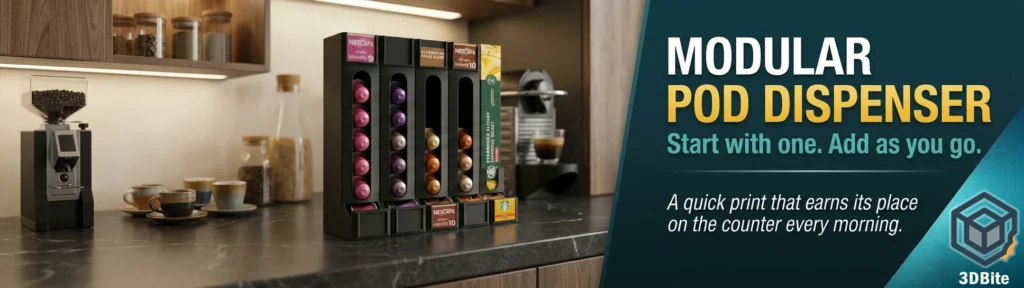
There is a category of print that does not photograph dramatically, does not push your printer to its limits, and does not take days to complete — but earns its place by making something in your daily routine noticeably better. The modular Nespresso pod dispenser is exactly that. It sits on the counter next to the machine, holds however many pods you currently have, and quietly solves the problem of digging through a drawer or a box every morning looking for the right capsule. Simple, clean, and the kind of thing you wonder how you managed without once it is there.
The particular appeal of this model is the modular system. You start with however many columns you need, and when your pod collection grows — and it will — you print another column and clip it on. No reprinting the whole thing, no starting from scratch. That approach to functional design is exactly what 3D printing is well suited for, and it is one of the reasons this model stood out.
The model
The Modular Nespresso Cup Dispenser is free to download on MakerWorld. The design is a countertop dispenser built around a gravity-fed column system — capsules load in at the top and dispense from the bottom, with the next capsule dropping into place automatically as you remove one. Each column holds a full sleeve of Nespresso Original capsules, and the columns connect side by side to build out however wide a dispenser you need.
The modular connection between columns is handled by a clip or slot system built directly into the geometry — no hardware, no glue required for the lateral joins. The whole dispenser sits flat on any countertop surface without wall mounting or adhesive, which makes it straightforward to move, refill, and reposition without committing to a fixed installation.
The model is designed for Nespresso Original capsules. If you use Vertuo pods, the different capsule geometry means you would need a Vertuo-specific variant — there are several on MakerWorld, but this is not one of them. Check your machine before downloading.
Filament
- eSun PLA+ — single colour throughout
A kitchen counter accessory lives indoors, sees no meaningful mechanical stress, and operates at room temperature. PLA+ is the correct choice — no heat resistance requirement, no structural loading, and the surface finish from eSun PLA+ is clean and consistent. One spool of a single colour will cover a multi-column build with material to spare.
Colour choice matters more for this print than for most functional pieces because it is sitting on a kitchen counter every day. I went with a neutral that works against the worktop rather than fighting it. Black and white are the most popular choices in the community for exactly this reason — they sit cleanly against almost any kitchen aesthetic. If your kitchen runs to a particular colour scheme, this is a print that is worth taking five minutes to think about colour before you start rather than defaulting to whatever is on the spool.
Print settings
| Setting | Value used | Notes |
|---|---|---|
| Filament | eSun PLA+ | Single colour throughout all columns |
| Layer height | 0.2 mm | Standard. No fine detail that warrants going thinner |
| Infill | 15% | Display and light functional use — no structural requirement |
| Infill pattern | Grid | Default, left as-is |
| Supports | None | Model is designed to print support-free |
| Walls | 3 | Slightly above default for a cleaner exterior surface on a counter piece |
| Bed | Textured PEI | Standard for PLA on A1 |
| Nozzle temp | 220°C | Standard eSun PLA+ |
| Bed temp | 55°C | No issues with adhesion |
| Speed | Standard A1 PLA profile | No reason to deviate — this is a straightforward print |
The modular system in practice
This is the part worth spending time on because it is what makes the model genuinely well-designed rather than just functional.
Each column is a standalone unit. It holds, loads, and dispenses independently. When you connect two or more columns side by side, the connection is mechanical — the columns locate against each other and hold their position through the clip geometry. The assembled dispenser behaves as a single unit on the counter without any fastening or bonding. If you want to reorganise the columns — reorder by capsule type, separate them, or move one to a different location — you simply pull them apart. Nothing is permanent.
The practical consequence of this is that the dispenser grows with you. When you inevitably add another capsule variety to your rotation — and Nespresso’s range is wide enough that this is more a question of when than if — you print one more column, clip it on, and continue. The unit you already printed does not change. You are not reprinting a larger version of the whole thing; you are extending a system that is already working.
This is the design philosophy that functional printing should aspire to more often. Modular, extensible, no waste. If the first column takes under an hour to print, adding the fourth one takes the same time as the first. The design scales without penalty.
Assembly
There is no assembly in the traditional sense. Each column comes off the plate as a complete, functional unit. Loading pods is straightforward — remove the top cap if the design includes one, drop the capsules in from the top in the correct orientation, and replace the cap. Capsules dispense from the bottom under gravity; the next one drops into place as you remove one from the slot.
Connecting columns requires nothing beyond pressing them together in the correct alignment. The connection geometry handles the rest. If any column feels slightly loose against its neighbour — which can happen depending on print shrinkage and filament brand — a small piece of foam tape on the mating face adds enough friction to keep them seated without affecting functionality. In practice, the eSun PLA+ fit was clean and the columns held their position without any modification.
Scale of the project
This is a quick build by any measure. A single column prints in well under two hours at standard settings on the A1. A three or four column dispenser is a single afternoon’s printing, or an overnight job if you want to run it unattended. Filament consumption is low — this is not a large or densely infilled print. One spool will build a substantial multi-column dispenser and leave enough material for several other projects.
There is no complex preparation, no multi-session planning, no assembly challenge. Load the file, set the profile, print. It is the kind of project you can start on a weekday evening and have on the counter the same night.
Result
It works exactly as it should. Capsules load cleanly, dispense smoothly, and the counter next to the Nespresso machine looks considerably more organised than it did with a box or a drawer in rotation. The gravity-fed system means you never have to rummage — the next capsule is always at the bottom, ready to pull. The modular nature means when the pod collection grew (predictably), adding another column took less time than the original decision of what colour to print it in.
This is the type of print that represents what home 3D printing is genuinely for. Not impressive, not technically demanding, not the kind of thing you photograph for engagement. Just a well-designed solution to a minor daily friction point, printed in an hour, and useful every single morning. The fact that it is free, modular, and expandable makes it close to the ideal functional print.
Model file
Free to download. If you print it, give the designer a boost on MakerWorld — functional prints like this that are genuinely well thought out deserve the recognition.