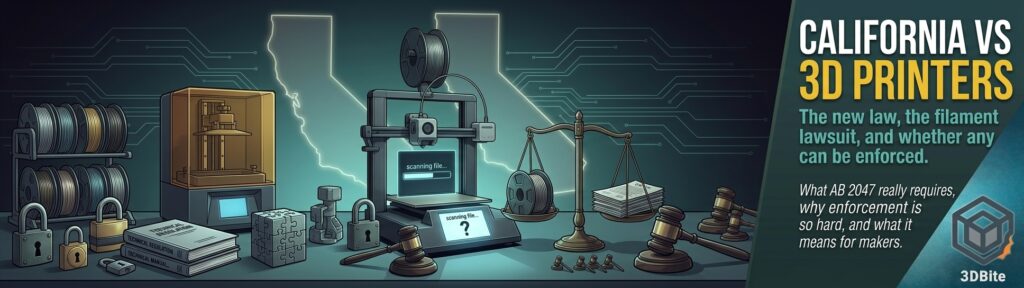
Two things happened within ten days of each other that every maker should know about. On 26 September 2026, California Governor Gavin Newsom signed Assembly Bill 2047, the California Firearm Printing Prevention Act, a law that will eventually require 3D printers sold in the state to include firearm-blocking technology. On 5 October, San Diego County sued filament manufacturer Polymaker, alleging its marketing turned ordinary PLA into a regulated “firearm precursor part”. I find both of these worrying, and not because I think 3D-printed ghost guns are a made-up problem. I find them worrying because I cannot see how either can be enforced in any way that works, and the attempts to make them work have a habit of landing on ordinary makers. This post covers what has actually happened, what other industry writers have made of it, and the practical question I keep coming back to: how could any of this really be policed?
A note on sourcing before we start. I have not read the full complaint or the chaptered text of the bill myself. What follows is drawn from reporting by Tom’s Hardware, 3DPrint.com, 3D Printing Industry, The Register, Techdirt, Bearing Arms and others, and I have attributed claims accordingly. The Polymaker material is allegation, not proven fact.
Part one: the law, AB 2047
AB 2047 was introduced on 17 February 2026 by Assemblymember Rebecca Bauer-Kahan, passed the Legislature on 31 August, and was signed on 26 September as one of ten firearm bills in the same package. It takes effect on 1 January 2027, and California becomes the second state to tie 3D printer sales to blocking technology, after New York. Tom’s Hardware reports that Colorado and Washington have similar bills moving through their legislatures. The bill’s author describes the approach as “upstream”: stop the printer rather than chase the finished object.
The law defines “firearm blocking technology” as hardware, firmware or other integrated measures that stop a printer from proceeding with a print job until the underlying file has been evaluated by a firearm blueprint detection algorithm and judged not to produce a firearm or a machine-gun conversion device. That is the whole technical idea: every file gets checked before the printer will run it.
The version that was signed, though, is a good deal gentler than the one that was introduced, and the reporting is consistent on this. An early draft reportedly included a state-certified roster of approved printers, fines of up to $25,000 per violation and a misdemeanour for disabling the software. Public pushback forced most of that out. What survived is a trigger rather than a mandate.
| Date | What happens |
|---|---|
| 26 September 2026 | AB 2047 signed |
| 1 January 2027 | Law takes effect, but no printer requirement activates yet |
| By 1 July 2027 | California DOJ must begin checking at least quarterly whether ASTM International has published a standard for firearm-blocking technology |
| If a standard appears | DOJ must decide whether it shows the technology is technically feasible, then has about two years to adopt minimum performance requirements |
| About a year after those requirements | Selling a covered printer in California without compliant blocking technology becomes unlawful |
| 1 July 2029 | DOJ’s duty to keep checking ends if no standard exists, and the mandate may never activate |
Several consequences follow from that structure, and they are worth stating plainly. Existing printers are exempt: there is no retrofit requirement and no offence for owning or using a printer without blocking technology, since the law regulates sales and transfers rather than ownership. 3DPrinting.com’s analysis puts the earliest plausible effect on printer sales at 2028, and notes the bill could lapse in 2029 without ever biting. And the whole thing depends on a standard that, as 3D Printing Industry puts it, does not yet exist. One Tom’s Hardware commenter claimed ASTM has publicly said it will not write this standard, and I could not verify that, but the broader point is that the other writers describe it as a standard nobody has commissioned. A cynical reading, shared by several commentators, is that handing the decision to ASTM was a way of passing a bill that cannot actually bind anyone. A less cynical one is that lawmakers recognised they could not write the technical rules themselves.
One change cut the other way. A proposed exemption for industrial printers was removed, so the bill in principle covers every 3D printer sold in California, not just consumer machines. Bearing Arms notes California is the first state to do so with no exemption for industrial machines, and the additive manufacturing trade press has been asking whether that puts the whole industry in the firing line.
Part two: the Polymaker lawsuit
The lawsuit is a different tool aimed at a different target. San Diego County Counsel, acting for the People of California and working with Giffords Law Center, filed a civil complaint against Polymaker LLC on 5 October in San Diego County Superior Court. It seeks disgorgement of profits, civil penalties and injunctive relief. The complaint, as reported, acknowledges that 3D printing filament is not illegal, and says it does not seek to ban filament sales in California.
The theory is the interesting part. California law regulates “firearm precursor parts”, and the county argues that Polymaker’s marketing transformed a general-purpose material into one. The complaint is quoted as saying the people bring the case “to hold Polymaker liable for its strategic business choice to design and market its filaments in order to profit from the illegal manufacture of 3D printed ghost guns in California.” The alleged mechanism is the company’s relationship with a creator known as The 3D Print General, Sean Aranda, who is described in the reporting as a 3D printing expert, author and gun enthusiast banned from YouTube in 2023 over firearm policy violations. The complaint alleges Polymaker supported him and then hired him, first as Head of Customer Experience, and that he directed followers to buy Polymaker filament to print firearms. Affiliate links are part of the argument. It also points to firearm-themed branded products. Polymaker’s own response was not available in the reporting I found, so none of this should be read as established.
What has caught the attention of the trade press is the reach of the theory. Tom’s Hardware’s analysis warns that if the case succeeds, the ramifications extend far beyond 3D-printed firearms: if a manufacturer in Texas can be held civilly liable in California because a YouTuber used its product for something not illegal in his home state, every raw material supplier, software developer and desktop hardware maker could be in the crosshairs. Gadget Review makes a similar point, that pressure could extend to filament makers, slicer developers, affiliate platforms and the wider maker community, and says the case may clarify whether a precursor-part definition can reach a raw material through a pattern of advertising, sponsorships and employment decisions. That is a legal question I am not qualified to answer, but it is a very large question to be settled by a marketing relationship.
I mention Polymaker here because they come up regularly in the filament brands post as a consistently good option, and nothing about this lawsuit changes how their filament prints. This is a dispute about marketing and law, not material quality.
The case for these measures
It would be dishonest to write this post as though the problem being addressed were imaginary. Tom’s Hardware has reported on prosecutions involving 3D-printed firearms, including two brothers convicted of running an operation producing untraceable printed guns and of selling printed conversion devices, and on arrests for selling cheap printed machine-gun conversion kits. Supporters of AB 2047, including the groups that backed it, argue that California has already tackled the first generation of ghost guns and that this is the next step, aimed at future sales of consumer printers with, in their words, minimal disruption to legitimate uses. Printing firearms at home is already restricted in California, and the argument is that a measure on the printer itself closes a gap that file-sharing crackdowns and prosecutions alone cannot. Those are serious motivations, and anyone who dismisses them out of hand is not engaging with the actual harm.
My issue is not with the goal. It is that the mechanism the law reaches for does not work the way its supporters hope, and the next sections explain why.
Part three: how could you possibly enforce this?
This is the question at the heart of it, and the answer from nearly every technically literate source is some version of “badly”. There are only a few ways a printer or a piece of software could decide a file is a gun part, and each has well-documented weaknesses.
| Approach | How it is meant to work | Why it struggles |
|---|---|---|
| Database matching | Compare a print file against a library of known firearm files | Tom’s Hardware notes it is easily defeated by changing the file, such as resizing it or splitting it into pieces for later assembly; it can only catch what is already in the database |
| Trained classifier | An AI model judges whether a shape could be a firearm part | Prone to false positives, as the same reporting notes: barrels, brackets, levers, tubes and other legitimate parts can look similar; Adafruit calls it a classification problem with “enormous false positive and false negative rates” |
| Slicer-level checks | Scan the model as it is prepared | Only works if you use the compliant slicer; open-source slicers and custom workflows can simply skip it |
| Printer firmware checks | Inspect the G-code on the machine | Weakest against modifiable firmware; many desktop printers trace to open-source projects, which Michael Weinberg flags as complicating consistent enforcement of any software blocking |
The Electronic Frontier Foundation has been the most direct critic. In June 2026 it said “there is no world where the mandated technology actually works as intended”, and its arguments, as reported by The Register, cover the same ground: it cannot work for a range of technical reasons, it could sideline open-source tools, and it could create new surveillance concerns by giving vendors reasons to inspect print files. Adafruit’s analysis of the New York bill makes the geometry point vividly: a detection algorithm would need to identify every possible firearm component from raw STL or G-code while not flagging pipes, tubes, blocks, brackets, gears or the millions of legitimate shapes that share properties with gun parts. Techdirt added that the New York language would apply to open-source firmware like Marlin, Klipper and RepRap, which are maintained by volunteers without the resources for compliance.
There is also a plain practical point that the Tom’s Hardware comments section raised, and which I think is hard to argue with. A determined person can build their own printer, which is a well-established hobby, or buy one in a neighbouring state. A law on printers sold in California regulates retail, not capability. The same is true of any single-state measure, and it is one reason this approach looks more like a speed bump for casual misuse than a barrier to a determined one. I would note the supporters’ counter, that raising the effort required still matters at the margin. That is a reasonable argument, but it has to be weighed against the costs below.
The part that worries me most: what compliance would actually look like
If detection is unreliable but a law demands it anyway, the question becomes what a manufacturer would do to look compliant. Several of the analyses reach the same uncomfortable answer. A blocking system checks files against a list of forbidden shapes, lists get updated, and the easiest way to keep a list current is a machine that checks in with a server before it prints. One commentator argues this makes the cloud-connected, closed-firmware printer the natural route to compliance, and the open, offline, self-hosted printer the casualty. That is an opinion piece rather than a finding, but the logic is hard to dismiss, and it connects to concerns this site has already covered: the OrcaSlicer versus Bambu Studio post discussed the Auth Control firmware worry, and the Bambuddy deep dive covers why many people care about running their printers locally. A mandate that can only really be met with cloud scanning gives manufacturers a regulatory reason to lock the ecosystem down further, and it hands them a justification that is hard to argue against in public.
The false-positive problem is the everyday version of the same worry. A printer that refuses to run a legitimate file, because it resembles a restricted shape, is a printer making an opaque decision about what you are allowed to make, with no obvious appeal. The free STL sites post covered how many functional models are tubes, brackets, levers and housings. Anyone who prints practical parts, as I do, is printing exactly the kind of geometry that a crude classifier would find ambiguous.
How could manufacturers be held to account, and what could they realistically do?
Here is where the honest answer is that the options are limited, and the realistic ones mostly operate on the margins rather than at the printer.
| Measure | What it can do | What it cannot do |
|---|---|---|
| Moderate model-sharing platforms | Thingiverse added automated tools to detect and block gun file uploads before they go live, after an NYPD investigation found hundreds of weapon-related files | Cannot see files that never touch a public platform |
| Scan at the cloud or slicer | Manhattan DA Alvin Bragg has asked companies including Bambu Lab to build AI that scans CAD files before printing | Only covers users who stay inside the vendor’s ecosystem |
| Detection software as a product | Vendors exist; one 3DPrinterOS and Montclair State University project describes analysing CAD files and blocking jobs that match a database, with optional printer firmware | Inherits all the database and classifier weaknesses above |
| Restrict marketing and sponsorship | The Polymaker case tests whether companies can be held liable for how they promote products | Does nothing about people who never saw the marketing, and raises the reach questions above |
| Forensic traceability after the fact | Researchers are studying toolmarks left by printer hardware, embedded digital fingerprints in printed parts, and chemical fingerprinting that might link a part to a filament brand | Helps investigators after a crime, and does not prevent anything |
That last row is interesting for this site specifically, because it points at filament as a traceability surface, which is a different thing from the “precursor part” theory in the Polymaker case, but sits in the same neighbourhood. None of it amounts to a way of making a printer refuse a gun part reliably, which is what the law’s definition of blocking technology imagines. The honest summary is that the available tools can raise friction, catch the careless and help investigators, but none can do what the statute’s wording describes.
Holding manufacturers to account is also unclear in the signed law. The reporting says the signed version has no criminal penalties, no fines, no manufacturer attestation and no public compliance list, and nothing is required of anyone until the ASTM trigger fires. I could not confirm from the reporting what the enforcement mechanism for the eventual sales rule would be, so if you sell printers or want to understand your own exposure, read the chaptered text (Civil Code section 3273.633 according to one analysis) rather than relying on summaries, mine included.
What this means for people who just print
- Nothing changes for your current printer. There is no retrofit and no ownership offence, and the sales rule has not activated.
- The real effect, if any, is years away. The earliest plausible impact is 2028, and the mandate may lapse without ever applying.
- The signals to watch are procedural. Whether ASTM commissions a standard, what the California DOJ does from July 2027, and how the New York process and the other states’ bills develop.
- The Polymaker case is the one with immediate stakes for the industry. Its outcome will say a lot about how far a state can reach upstream into suppliers.
- Vendors may build for the strictest market. Manufacturers often prefer one product for everyone rather than a California version, so what California eventually requires could shape printers sold elsewhere too. That is speculation, but it is a pattern with other regulation.
I am writing from the UK, where the law is different, and I have not researched how British rules would interact with any of this. But Bambu, Polymaker and the rest sell worldwide, and the next big shift post argued that the future of consumer printing is increasingly about software, ecosystems and connectivity. Regulation that rewards connectivity and central control pushes in a direction that makes the ecosystem questions covered in the Prusa versus Bambu editorial considerably more important. It also sits alongside the other legal pressure on Bambu covered in the Stratasys verdict post, a reminder that growth in this industry now draws scrutiny from many directions at once.
Where I land
I understand why legislators want to do something, and I do not think the people who backed this bill are acting in bad faith. A printed firearm or conversion device is a real harm, and “make the tool refuse” is an intuitive answer. But the more I read, the less convinced I am that the tool can be made to refuse in any way that is reliable, private and open at the same time. The signed law seems to have quietly acknowledged that by making itself conditional on a standard that does not exist, and the pressure on suppliers through the Polymaker case looks like an attempt to get at the same goal by another route. My concern is that the practical pressure ends up on ordinary makers and ordinary manufacturers: more surveillance of files, more locked-down firmware, more legal risk for anyone who sells or promotes a general-purpose material. The supporters’ case, that raising the barrier still reduces harm at the margin, is a fair one, and it deserves an honest answer rather than a dismissal. The honest answer, I think, is that we do not yet have the evidence that these measures raise the barrier meaningfully, and we do have good evidence of what they cost.
This is an early post on a story that will keep moving, and I will update it as the Polymaker case progresses and as ASTM, the California DOJ and the other states make their moves.