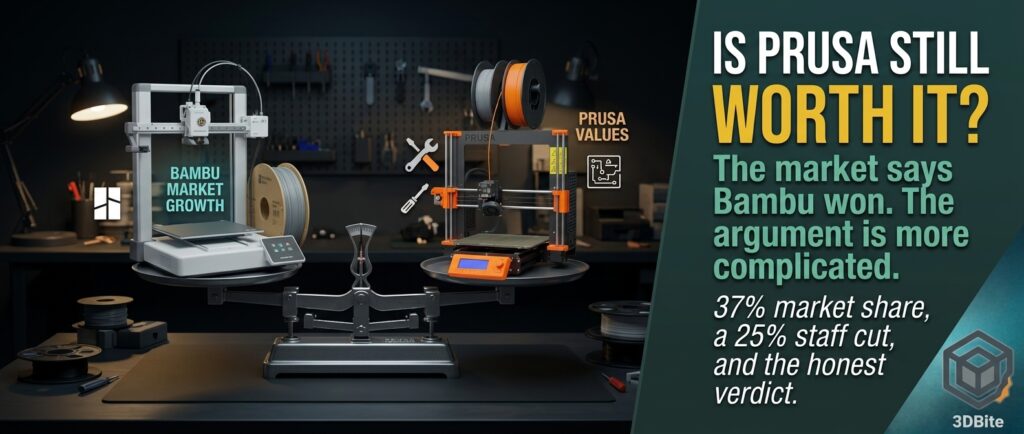
The X1 Carbon EOL post asked whether a discontinued machine still mattered. This post asks a bigger, blunter version of the same question about an entire company. Prusa Research spent a decade being the answer to “which 3D printer should I buy” — the MK3S+ was, for years, the default recommendation for anyone entering this hobby seriously. In 2026, that is no longer true for most buyers, and the numbers behind that shift are considerably starker than most casual observers realise. My own view going into this, stated plainly: Bambu is killing it. Having gone through the actual data properly, that view holds up — but the honest, complete picture is more interesting than a simple “Bambu won” headline, and it is worth the full deep dive rather than the quick take.
The numbers, stated without softening
Start with market share, because this is where the argument is most objectively settled. Bambu Lab claimed the top spot in global entry-level 3D printer shipments during 2025, overtaking longtime leader Creality, holding a 37% share of the sub-$2,500 segment according to market intelligence firm Context. That is not a company clawing into second place — that is outright market leadership in the category that defines the hobby’s growth. Independent surveys of active printer owners in early 2026 go further still, putting Bambu’s share of the $1,000-$5,000 prosumer bracket — historically Prusa’s own territory — above 40%. A Swiss retailer’s own 2026 sales data, cited by 3Druck, found that in the first four months of the year almost every second printer sold came from Bambu Lab, with the previous leader Creality down to roughly one in four. This is not a slow, contested market share shift playing out over years. It happened fast, and it happened comprehensively.
The harder, more human number sits on the other side of that same story. Prusa’s own community forum surfaced the news directly: the company laid off nearly 25% of its development staff, attributed to financial issues, with 2025 described internally as worse than 2024 — despite the CORE One being launched and in full production throughout that entire year. That is a genuinely brutal detail. The product that was supposed to be Prusa’s answer to Bambu’s CoreXY dominance was on sale for the whole of 2025, and the year was still worse than the one before it. One forum member’s own reaction captures the mood precisely: “Upsetting news, but on the cards with companies like Bambu breaking into the market with their beginner friendly models at comparatively cheap prices. People just want to print rather than tinker, and Bambu do have that cracked.”
Why this happened: Prusa was late, twice
This is the pattern worth naming directly rather than dancing around. Bambu launched the X1 Carbon in 2022 with a CoreXY motion system, an enclosed chamber, and print speeds that made every existing consumer machine look sluggish by comparison. Prusa’s response — the CORE One, its first enclosed CoreXY machine — did not arrive until late 2025, roughly three years later. Fabbaloo’s own reporting on Prusa’s subsequent MK4S price cuts states the dynamic plainly: Bambu’s speed and format caught many existing manufacturers without equipment to match, including Prusa Research, and competitors eventually raised their speeds and shifted to similar enclosed CoreXY formats as a direct, reactive response rather than a leading move. Prusa did the same thing. It just did it three years after the market had already decided what a modern desktop printer should look like.
The same lateness pattern is repeating with Prusa’s INDX toolchanger system, described directly by a community member on Prusa’s own forum as late — “just like their Core One was. It allowed the competition time to get into that space and establish themselves with ‘neat’ solutions.” This connects directly to the multicolour architecture posts already covered on this site — the Vortek H2C, the Sovol M1D, the LightMake L4, the Creality SparkX i8 — all of which have already staked out genuinely different approaches to the exact multi-material waste problem that INDX is trying to solve. Prusa is not entering an empty field this time either. It is entering a field that Bambu and half a dozen fast-moving competitors have already been experimenting in for over a year.
The genuine case for Bambu having won, on the merits
Stripping away the market share numbers and looking purely at the hardware and software experience, the case is still strong. Every comparison researched for this post agrees on the same core facts: Bambu’s machines arrive factory-calibrated and print reliably within minutes of unboxing, while the MK4S — even in its current, mature form — still requires manual bed levelling verification on setup and needs the CORE One or XL specifically to get enclosed printing at all. On raw speed, the MK4S tops out around 200mm/s on quality settings against Bambu’s headline 500mm/s figures across the A1, A1 Mini, and X1 Carbon, and up to 600-1000mm/s claims on the H2D. Prusa’s own counter-framing — quoting volumetric flow (24mm³/s with the high-flow nozzle) rather than raw speed, and pointing to an 8-minute Benchy as the practical outcome that number produces — is a genuinely fair alternative way to describe printer performance, and it is worth taking seriously rather than dismissing as spin. But it is also, transparently, the framing of a company that knows it cannot win a straight speed comparison and has chosen the metric it can compete on instead.
At near enough every price tier, Bambu also offers more features per dollar. The Bambu P2S Combo, with AMS and an enclosed CoreXY frame, runs at roughly $799. The Prusa MK4S assembled, single-colour, open-frame, sits at roughly $929 — more money for meaningfully less machine on paper. Multi-colour printing tells a similar story: the AMS’s RFID auto-detection and smooth colour-swap experience is consistently rated as the more polished multi-material workflow against Prusa’s MMU3, which most current guides describe as considerably fussier to set up and maintain reliably. And the out-of-box reliability gap — the thing that actually determines whether a new hobbyist’s first month goes well or badly — is where Bambu’s advantage compounds fastest, because a smooth first experience turns into a recommendation to a friend, and that is precisely the mechanism behind the market share numbers above.
The genuine case that Prusa has not actually lost anything that matters to a specific buyer
This is where the picture gets more complicated than a simple scoreline, and it is worth taking seriously rather than treating as a consolation prize. Every source researched for this post, without exception, converges on the same framing when asked which brand is “better”: it depends entirely on what the buyer actually values, and the two companies are not really competing on the same axis at all. One detailed comparison states this as bluntly as it can be stated: “Bambu is the appliance approach: closed ecosystem, hardware that just works, software that gets out of your way, optimised for ‘press button, get part.’ Prusa is the engineer’s tool: open-source firmware, hand-soldered electronics, deep customisation, optimised for ‘understand your machine and make it perfect.'”
The specific, concrete advantages Prusa retains are real rather than sentimental. Prusa publishes everything — firmware, schematics, slicer source code, repair manuals — and that transparency is not an abstract virtue when weighed against the exact concerns raised in the AGPLv3 investigation post and the ecosystem post on this site. A Prusa machine bought today will still have community firmware development, third-party parts, and full repair documentation in ten years, regardless of what happens to the company commercially. The X1 Carbon EOL post already demonstrated the practical cost of the alternative model — a machine with a genuinely finite firmware support window set by the manufacturer rather than by the community. Support quality is another area where Prusa is consistently rated ahead, described as “responsive, knowledgeable support with live chat and comprehensive documentation,” against Bambu’s support receiving “mixed reviews” despite genuine improvement. And a Prusa machine retains value differently — not because of hype-driven secondhand demand the way Bambu machines currently do, but because of a reputation and an upgrade-kit culture that means an older MK3S+ can be meaningfully modernised rather than simply superseded.
The kit-build option is a genuinely distinct thing Bambu does not offer at any price — Prusa’s Core One is roughly $1,099 assembled or $799 in kit form, and for makers who specifically want to build and understand their own machine rather than unbox a finished appliance, that option simply does not exist anywhere in Bambu’s current lineup. And for genuine multi-material engineering work — different materials in a single print, not just different colours — the Prusa XL’s tool-changer is described as genuinely superior to AMS, with soluble-support engineering prints and mixed rigid-flexible assemblies named specifically as the use case where the XL earns its considerably higher price relative to a comparable AMS setup.
Where this actually lands: Bambu won the market, not the argument
This is the distinction worth landing on properly rather than picking one side and stopping. Bambu has, decisively and by every measurable metric, won the mainstream market — the shipment numbers, the market share figures, and Prusa’s own internal financial pain all confirm that beyond reasonable dispute. For the overwhelming majority of people buying a first or second 3D printer in 2026 — the audience this site’s own beginner printers post was written for — Bambu is very clearly the correct recommendation, and every comparison source agrees on this without meaningful dissent.
What Bambu has not won, and structurally cannot win by simply being the better appliance, is the argument for openness, repairability, and independence from a single manufacturer’s platform decisions — the exact argument this site has been tracking since the AGPLv3 investigation. The community consensus quoted across multiple sources is genuinely the correct summary: “Prusa for repairability, ownership, privacy and long-term value; Bambu for speed and ease.” Those are not competing claims about the same thing. They are answers to two different questions, and a buyer who genuinely cares about the second question — the one this site keeps returning to whenever Bambu’s platform decisions get scrutinised — has not actually lost anything by Bambu’s market dominance, because Prusa’s specific value proposition was never primarily about competing on speed and convenience in the first place.
My honest verdict
Bambu is killing it, and the data backs that up more emphatically than I expected going into this research — a market leadership position built in roughly three years against companies with a decade or more of head start, and a direct competitor laying off a quarter of its development staff in the same period is about as unambiguous a scoreline as this industry produces. For anyone asking “should I buy a Bambu or a Prusa” as a practical, unqualified question in 2026, the honest answer for most people is Bambu, and this site’s own equipment — the A1 and A2L — reflects exactly that conclusion in practice rather than just in theory.
But “Prusa is still worth it” and “Bambu has won” are not actually contradictory statements, and I think that nuance matters enough to state plainly rather than softening for the sake of a cleaner headline. Prusa is still worth it specifically for the buyer who has read the AGPLv3 investigation, thought seriously about what happens to a closed platform’s decisions over a decade of ownership, and decided that openness and repairability are worth a real premium in speed, convenience, and up-front cost. That buyer is a minority of the market — which is exactly why Prusa’s finances are under genuine pressure while Bambu’s are not — but a minority position being commercially smaller does not make it wrong for the specific person it is right for. Bambu won the market. Prusa has not lost the argument for the people that argument was always actually for.