There are now an overwhelming number of filament brands available, and if you are new to 3D printing or even a few years in, it can be surprisingly difficult to know what is genuinely good and what is simply well marketed. Most brands claim tight tolerances, consistent extrusion, vibrant colours, and excellent layer adhesion. In reality, a large proportion of them are good enough for general use, but only a handful stand out when you are printing regularly and start to notice the small differences.
This is not a lab-controlled comparison on its own — it started as personal experience across a range of prints, materials, and scenarios, and this revised version adds the independent tolerance testing and community data that backs that experience up, or in a couple of places, genuinely complicates it. This reflects what actually matters when you are printing day to day rather than chasing theoretical performance gains, with real numbers attached where they exist.
The reality of filament brands
The gap between filament brands is much smaller than it used to be. A few years ago, there were very obvious differences between budget and premium materials. Today, even lower-cost brands can produce very respectable results. That said, there are still meaningful differences that show up over time.
The biggest factors are consistency and predictability, exactly as the cheap PLA post covers from the manufacturing-process angle. A filament that prints well once is not necessarily a good filament. What you want is something that behaves the same way every time you load it — and diameter tolerance, more than any other single number, is what actually predicts that behaviour rather than the marketed material name or colour range.
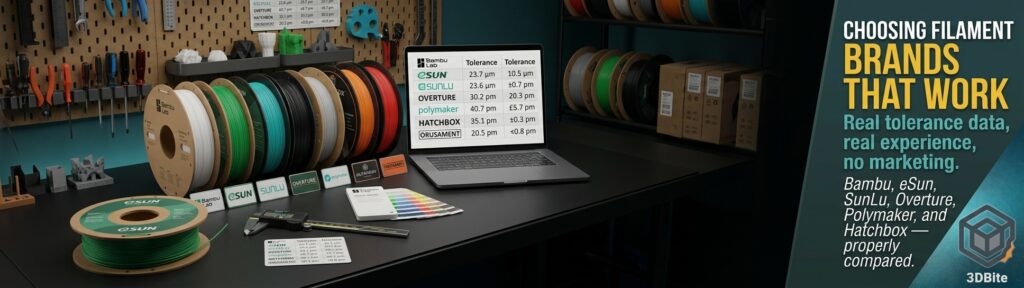
Diameter tolerance: the number worth actually checking
Every brand claims a tight tolerance on the box. What they claim and what independent testing actually measures are frequently different things, and the gap between those two numbers is where a lot of the “some spools are great, some are terrible” frustration in this hobby actually comes from.
| Brand | Claimed tolerance | Independently measured tolerance | Notes |
|---|---|---|---|
| Prusament | ±0.02mm | ±0.02mm, verified — QR code links to actual per-spool production data | The only brand offering genuine spool-level QA documentation rather than a batch average |
| Polymaker PolyLite | ±0.02mm | ±0.02mm, confirmed in independent testing | Named the consistency benchmark across multiple 2026 test roundups |
| Overture | ±0.02mm | ±0.02mm, generally delivered | Vacuum-sealed with desiccant as standard; a genuine bulk/decorative-work value pick |
| Bambu Lab PLA Basic | Not always separately quoted | ±0.01mm in one 8-brand lab tolerance test — the tightest of the group tested | RFID auto-detection and AMS-tuned profiles are the real convenience advantage beyond raw tolerance |
| SUNLU | ±0.02mm | ±0.02mm in some tests; described elsewhere as “hit-or-miss” with reported QC variance between spools | Sources genuinely disagree here — one detailed OEM comparison rates it as AMS-equivalent to Bambu’s own filament, another flags inconsistent quality control |
| Hatchbox | ±0.02-0.03mm | ±0.03mm measured; some spools reported averaging 1.69mm actual diameter | Extremely widely used with a genuinely strong community reputation (40,000+ reviews, 83% five-star on Amazon) despite the wider tolerance |
| eSUN PLA+ | ±0.02-0.03mm | Roughly 7 in 10 rolls tested “excellent,” the remaining 3 in 10 needing profile adjustment | The batch inconsistency is real and worth knowing, but the failure rate is low enough that it remains a sensible default |
| Unbranded/marketplace spools | Rarely stated honestly | Frequently drifts well beyond ±0.05mm | Loose tolerance causes under/over-extrusion and is a common cause of false AMS runout errors |
The honest takeaway from that table: at the top end (Prusament, Polymaker, Overture, Bambu’s own PLA Basic), the differences are genuinely marginal and mostly invisible in a finished print. The real risk sits at the bottom — unbranded marketplace spools with no stated or honestly-measured tolerance at all, which is exactly where the cheap filament post found the two-to-three-times increase in first-layer failures.
Moisture control and packaging
This is another factor that is often overlooked, and it varies more between brands than the diameter numbers alone suggest. Some brands arrive perfectly dry and vacuum sealed with desiccant, while others can feel slightly compromised out of the box. This becomes more noticeable with materials like PETG, covered in depth in the PETG materials post, but even PLA can be affected, as the filament drying post covers.
Packaging quality genuinely differs by brand rather than being an afterthought. Prusament ships in a sealed cardboard box with a desiccant packet, with the QR code linking to the exact production batch’s own diameter measurements. ColorFabb uses a double-barrier metalised foil bag, described as practically impermeable — the best moisture protection of any brand commonly available. Overture and eSUN both use vacuum-sealed polyethylene bags with desiccant, which is a good barrier though the bags themselves can occasionally puncture in transit. Bambu Lab’s own spools are sealed specifically for AMS compatibility — if you are not running an AMS, the guidance is to transfer the spool into your own dry storage immediately once opened rather than leaving it in the original packaging, since that packaging is optimised for the AMS environment rather than long-term shelf storage. Hatchbox, SUNLU, and Inland generally use simpler plastic bags, which is adequate for typical storage but offers less of a genuine barrier than the foil or vacuum-sealed options above.
Colour accuracy is also more variable than people expect. The same named colour from different brands can look completely different, and even between batches from the same brand there can be subtle shifts — the real-world example further down this post covers exactly this problem in detail.
Bambu Lab filament
Bambu Lab filament is, in many ways, the benchmark for ease of use within the Bambu ecosystem. The biggest advantage is how well it integrates with the printers themselves. Profiles are well tuned, material definitions are accurate, and AMS behaviour is predictable — RFID auto-detection means the printer already knows what is loaded without any manual profile selection. That independently measured ±0.01mm tolerance in the 8-brand test cited above is genuinely the tightest of the group tested, and consistency across multiple spools is excellent — you rarely find yourself compensating for temperature or extrusion differences, which becomes particularly valuable on longer prints or multi-material setups.
Colour accuracy is also strong. What you see in the product listing is generally very close to what you get, which connects to the physical swatch point covered further down — Bambu is the brand actually doing something about the colour-guessing problem that affects the rest of the market.
The practical downsides remain real. Cost is higher than most alternatives, especially buying one or two spools at a time, and shipping on small orders adds to that further — the recent bulk-discount threshold change covered in the Bambu filament price drop post has genuinely improved this specific problem, dropping the discount threshold from four rolls to two. Availability is still an issue, particularly for popular colours, which makes it difficult to rely on as your only source. For critical prints or specific colours — red especially, for reasons covered below — Bambu Lab filament is still the one I reach for.
eSun — my default choice
eSun has become my default filament for a very simple reason: it consistently delivers good results at a sensible price. Around 75% of my filament stock is eSun, built up over time through repeated positive experience rather than a deliberate decision at the start. Independent testing backs this up with a specific caveat worth knowing: one detailed test found roughly 7 out of 10 eSun PLA+ rolls performing excellently straight out of the box, with the remaining 3 in 10 needing a profile adjustment for diameter-related stringing. That is not a dealbreaker at this price point, but it is worth knowing that eSun’s batch consistency, while good, is not quite at Polymaker or Prusament’s level — the trade you are making for the price and availability is a small, occasional need to recalibrate rather than a guarantee of zero variance.
One of the biggest advantages is availability. eSun is widely available on Amazon, which means quick delivery and, for Prime members, no additional shipping cost — making it easy to top up stock without planning ahead, and often with discounts and bundle deals that push the cost down further. Once settings are dialled in, they carry across multiple spools with minimal adjustment.
SunLu and Overture
SunLu and Overture sit slightly differently in the workflow — used when looking for something specific rather than as the primary materials. Both are widely available, offer a wide colour and material range, and are useful when you need something not readily available from a usual supplier.
Overture specifically earns a stronger and more consistent reputation across independent sources than the personal experience alone suggested — multiple 2026 comparisons independently name it the best value pick in its category, with genuinely verified ±0.02mm tolerance, vacuum-sealed packaging with desiccant as standard, and a build plate adhesion sheet included in every order that reviewers describe as genuinely useful. It is, on the research, a stronger and more consistently reliable brand than “solid rather than exceptional” gives it credit for.
SunLu is the one brand in this comparison where sources genuinely disagree, and it is worth presenting that disagreement honestly rather than picking a side. One detailed comparison specifically framed as testing SunLu as a Bambu OEM equivalent found side-by-side prints between SunLu and genuine Bambu filament on the same Bambu printer with equivalent profiles showing no detectable difference in output quality — with ±0.02mm diameter accuracy and neatly wound spools among the most AMS-compatible third-party options available, the only functional gap being the absence of an RFID chip for auto-detection. A separate comparison, by contrast, describes SunLu’s quality control as “hit-or-miss,” with some spools performing excellently and others performing poorly. Both of these can be true simultaneously — a brand can have a genuinely good median spool with more batch-to-batch variance than the tightest premium options, and that is a reasonable way to read the conflicting data rather than assuming one source is simply wrong.
Two brands worth adding to the rotation: Polymaker and Hatchbox
These did not feature in the original version of this post, and the research makes clear they should. Polymaker’s PolyLite range is named the consistency benchmark across a genuinely large number of independent 2026 comparisons — verified ±0.02mm tolerance matching Prusament, at a meaningfully lower price than Prusament itself. For anyone who has been treating Bambu-versus-eSun as the only real decision, Polymaker is worth a proper look specifically for functional and colour-critical work where eSun’s occasional batch variance would be a genuine problem.
Hatchbox is the brand with the most interesting gap between its measured numbers and its actual reputation. Its independently measured tolerance, at ±0.03mm, is genuinely wider than Overture or SUNLU’s ±0.02mm claims — and yet it carries over 40,000 Amazon reviews with an 83% five-star rating, and reviewers consistently report it as the cleanest-winding, least-tangle-prone spool they have used across multiple printer brands. The lesson worth taking from Hatchbox specifically: diameter tolerance is one input into reliability, not the whole story. Spool winding quality — covered in the cheap filament post as the second major failure mode alongside diameter variance — clearly matters enough on its own that a slightly wider diameter tolerance has not dented Hatchbox’s real-world reputation at all.
Colour matching — a gap in the market
One area where Bambu Lab stands out is the availability of physical colour swatches. Being able to see and handle actual filament samples makes a significant difference when choosing colours — screens are unreliable, lighting varies, and product images are often edited or inconsistent. With physical swatches, you can compare colours directly under your own lighting conditions and make a genuinely informed decision rather than gambling on a product photo.
It is surprising more manufacturers do not offer this, given how important colour is for decorative and gift work specifically — the multi-part seasonal builds covered throughout this site’s project posts live or die on colour matching across several spools. Most other brands rely entirely on product images, which frequently are not accurate representations of the final printed colour. If more manufacturers offered swatch sets, it would remove a genuine amount of the trial-and-error currently baked into filament buying.
Real-world example: PLA red variations
A good example of why brand choice matters is PLA red. On paper, PLA red should be a standard, consistent material. In reality, it varies significantly between brands, both in colour and behaviour. YouSu PLA Red specifically is particularly temperature sensitive — printed too hot, the colour shifts noticeably towards orange, especially visible on the first few layers, where temperatures are often slightly higher to ensure good bed adhesion.
This kind of behaviour is frustrating precisely because it is not obvious until the finished print, by which point several hours have already been committed to the job. Because of this, Bambu Lab PLA Red is the one I use whenever colour accuracy actually matters — it is far more stable across a range of temperatures and produces a consistent, true red finish. This is a genuine example of where paying a premium makes sense: for general printing, a cheaper filament is fine, but for colour-critical work, the consistency of a higher-end material is worth the difference.
What I actually use — the simple breakdown
Stripped back, the actual usage pattern is fairly simple. Bambu Lab is used for critical prints and situations demanding maximum reliability or colour accuracy — the safe option when no risk should be taken. eSun is the everyday filament, covering the majority of printing needs with the best balance between cost and performance. SunLu and Overture are used when something specific is needed — a particular colour, material, or quick availability. Polymaker, on the strength of the research behind this revision, is worth adding as the option to reach for specifically when a functional or colour-critical part needs tighter consistency than eSun’s occasional batch variance can guarantee, without paying Prusament’s full premium.
This combination works because it gives flexibility without overcomplicating things — a small, reliable mix of known brands, each doing the specific job it is genuinely best at, rather than a single brand loyalty stretched across every use case.
Where to buy, and when premium is actually worth it
Amazon carries the widest selection of the mainstream brands covered above — eSun, SUNLU, Hatchbox, Overture — with the fastest Prime shipping and, for the volume most hobbyists buy at, the best prices. Specialist retailers like MatterHackers carry a more curated premium lineup (Polymaker, Fillamentum, ColorFabb) with stronger in-house support and documentation for anyone specifically shopping at that tier.
Premium filament — Prusament or Bambu Lab specifically, typically £24-40 per kilogram — earns its price in three genuine scenarios: precision prints where tolerances tighter than ±0.03mm are actually visible in the finished result, functional parts that need documented, verifiable material properties rather than a marketing claim, and AMS or multi-material systems where a poorly wound or loosely toleranced spool causes genuine feed failures rather than just a cosmetic issue. For pure decorative prints, gifts, or hobby work generally, the mid-tier brands covered throughout this post are more than adequate, and the difference in the finished object is genuinely difficult to spot.
What’s next
This post remains the starting point for a deeper series that has, since it was first published, actually materialised properly — the PLA, PETG, and TPU materials posts now cover the chemistry, real mechanical numbers, and brand-by-brand testing data for each material individually, and the silk PLA and dual colour PLA posts cover the specialty categories that a brand-level comparison like this one was never going to do justice to on its own. The goal remains a library of reliable, experience-based guidance to come back to when choosing materials for a specific project — this post is the brand-level starting point; the materials series is where the deeper, per-material detail actually lives.