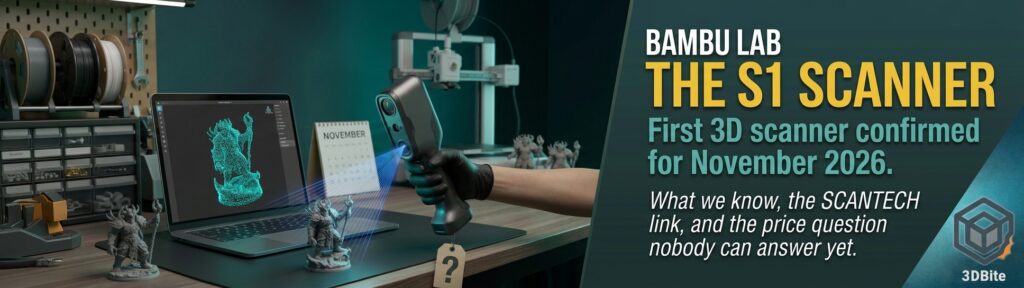
On 12 October 2026 Bambu Lab officially teased its first 3D scanner, the S1, with a launch pencilled in for November 2026. It follows the pattern of the last few weeks: a filing turns up at the FCC, the internet speculates, and then the company puts a name and a month on it. In the H3C rumours post I described the S1 as something known only from an FCC label and a drawing. That is now out of date. This post pulls together what Bambu has actually said, what the regulatory paperwork adds, and what the trade press has made of it, including the question the Tom’s Hardware coverage raised about price.
One housekeeping point first. Bambu has published a teaser, not a product. Nothing here comes from hands-on use, and every claim about specifications below is either from Bambu’s own page, from regulatory filings, or clearly marked as inference.
What Bambu Lab has actually said
| Item | Status | Detail |
|---|---|---|
| Name | Official | Bambu Lab S1 3D Scanner |
| Tagline | Official | “Easy in Hand. Pro in Every Scan.” |
| Launch window | Official | “November 2026, Coming soon”, with no exact day |
| Positioning | Official | Described as the company’s first 3D scanner, with “pro-level scanning precision” |
| Form factor | Shown in the teaser | A handheld body with a grip and a multi-lens window at the front |
| Price | Not published | Nothing yet |
| Scanning technology, accuracy, resolution | Not published | Blue laser, infrared, structured light or a mix is not stated |
| Colour capture | Not published | Unknown |
| Software and workflow | Not published | How it connects to Bambu Studio or MakerWorld is not stated |
Bambu’s own framing, reported across the coverage, is that scanning follows naturally from its printers and the R1 laser as a step towards a personal manufacturing hub, with professional-grade tools made accessible. That is the same strategic language this site has tracked since the R1 launch post and the UV printer post. One practical detail is that the November date comes from the teaser image rather than from Bambu’s website, and Bambu has not said whether November means the reveal, the start of pre-orders or the start of shipping. Those are very different Novembers.
What the regulatory paperwork adds
The S1 appeared in an FCC filing dated 22 September 2026 under ID 2A6J8-DS001, about three weeks before Bambu acknowledged it. The public parts of the filing confirm four things: the name, the category (“3D Scanner”), a 60W power rating, and 5GHz Wi-Fi supporting 20, 40 and 80MHz channel widths. German outlet 3Druck adds detail from the SGS North America certification of the same date: a nameplate of 20V at 3A, a specific absorption rate test for handheld use with a maximum of 3.81 W/kg for hands and limbs, and a restriction to indoor use. The hand test is useful evidence on its own, because it is only done for devices held in the hand while they transmit, which backed up the handheld reading before the teaser confirmed it.
What does that tell us? Two cautious inferences, both flagged by other writers. The label lists no battery, and a 60W mains-style input suggests the S1 may be powered from the wall or a power brick rather than running on a battery pack. And with Wi-Fi on board, scans may be sent wirelessly to a computer, which is a different arrangement from a scanner tethered by a cable. Tom’s Hardware also noted that the drawing’s flat spot on the body might indicate a screen, although the teaser render does not settle it. None of this is confirmed, and the 60W figure alone says nothing about the light source or how much of that power goes into scanning.
The SCANTECH connection
The most interesting background is who is probably building it. On 29 January 2026, Bambu Lab’s parent company signed a framework agreement with SCANTECH, a Hangzhou-based industrial 3D scanner maker listed on the Shanghai STAR Market, which sells internationally as SCANOLOGY. According to reporting on the deal, the two firms committed to jointly design and develop consumer-grade scanners, with SCANTECH handling manufacturing and Bambu handling sales. Information shared with investors in May reportedly described a five-year term, development overseen by senior managers from both companies, and first revenue expected during 2026.
Neither the FCC filing nor the teaser mentions SCANTECH, so the link between the S1 and this deal is circumstantial, though most outlets treat it as the likeliest explanation. It also fits a pattern in the market: Creality and Anycubic build scanners in-house, Elegoo works with Revopoint, and Bambu appears to have chosen an industrial specialist. One more detail is worth remembering. A trade outlet’s July post said the first product was expected to begin deliveries in August 2026. August passed without a scanner, so the schedule has already slipped at least once, and “November” is a target rather than a guarantee until pre-orders actually open.
The price question, and where “expensive” comes from
Tom’s Hardware’s coverage raised the price worry by pointing at SCANOLOGY’s own range. SCANTECH’s 3DeVOK MT Gen2 is a wired composite scanner released in 2026 that uses both blue and infrared lasers, carries the same 60W input rating as the S1 label, and is officially priced at $8,299. Tom’s Hardware is careful about what to draw from that. A matching power number proves nothing about shared technology, and a platform with an $8,299 price tag looks unlikely to underpin a consumer product if Bambu wants to keep consumer-friendly pricing. So the honest reading is not “the S1 will cost $8,299”. It is that the only hard number we have matches an expensive industrial scanner, and that is a reason not to assume the price will be low.
Other coverage supplies the market context. All prices below are as reported by Makers101 in October 2026, so check current figures before relying on them.
| Scanner | Type | Reported price | Claimed accuracy |
|---|---|---|---|
| Bambu Lab S1 | Handheld, probably | Not announced | Not announced |
| Creality Pika | Pocket, phone-first | $699 list | 0.03mm |
| Revopoint POP 4 | Handheld | About $839 listed, discounted on the day checked | Up to 0.03mm single-frame |
| EINSTAR Rockit | Wireless blue laser | $1,899 | Not stated here |
| Creality Sermoon P1S | All-in-one blue laser with onboard processing | $2,299 list, $2,099 early-bird | Up to 0.02mm |
| SCANOLOGY 3DeVOK MT Gen2 | Wired industrial composite | $8,299 | Industrial class |
Forum guesses on Bambu’s own community pages cluster around $1,000, with a few expecting closer to $2,000, and one writer notes forum estimates for scanners in this class run from $1,500 to $4,000. All of that is guesswork. If the S1 follows Bambu’s habit of pricing aggressively, as it did with the P1S and, more recently, the R1 laser, it would land in the lower-middle of that range. If it is a re-badged industrial platform with a consumer shell, it could land higher. Until a number appears, I would not plan around either.
Why the software matters more than the accuracy figure
The recurring point in the coverage, and in the community reaction it quotes, is that accuracy is not the real battleground. Consumer scanners already reach impressive figures on paper. What they lack is a beginner experience as smooth as a modern printer, and Tom’s Hardware’s own piece describes the usual friction: PC requirements, intensive scan cleanup and resurfacing in CAD, which is why scanning remains a niche within a niche. The most-upvoted community reply in the Reddit announcement thread, as reported by Makers101, simply hoped it would be easy to use for non-professionals with good results out of the box.
That matches what the 3D scanners post concluded about the workflow: the scan is the easy part, and turning a mesh into a clean, printable, correctly dimensioned part is where most hobbyists stall. A scanner captures shape, and you still do the modelling. It is also why a phone-based option like the one in the STL Buddy post can be a sensible way to test whether scanning is useful to you before buying hardware.
One speculative thought about Bambu’s strategy, labelled as my inference rather than anything Bambu has said. Recent Bambu Studio releases have added the sort of tools a scanning workflow needs: improved mesh defect diagnostics in 2.7.0, and faster model repair during texture import in 2.8.4, covered in the 2.8.3 and 2.8.4 post. That could be coincidence, but a scanner that exported straight into a slicer already good at repairing meshes would be a coherent product.
The cloud question
One piece of advice from the coverage is worth adopting early. Makers101 suggests checking, before you buy, whether S1 scan processing runs locally or requires Bambu’s cloud, pointing to the controversy in May 2026 over Bambu’s legal notice about an OrcaSlicer fork that bypassed its cloud features. This site has followed that thread in the OrcaSlicer versus Bambu Studio post and the AGPLv3 investigation post. Scans of your own belongings, or of your home, are the kind of data many people would rather not send to a server by default, so the answer is worth knowing at launch rather than discovering afterwards.
Don’t confuse it with Creality’s S1
A practical warning. Creality already sells a scanner called the Sermoon S1, which has been on the market for some time. The two are unrelated products from competing companies, and search results for “S1 scanner” will mix them up for months. Check the brand before trusting any specification, price or review.
One more oddity: the S1 is already a contest prize
Domechy reports that, in the comments under its teaser post, Bambu said the S1 is now part of the prize pool for MakerWorld’s “Make for Good” accessibility design contest. Submissions run to 15 November, the review period runs to 17 December and winners are announced on 18 December. At the time of that report, the contest page itself still listed only the A1 Combo as the grand prize, so the S1 prize rests on Bambu’s comment alone. If it is confirmed, it would suggest Bambu expects to have units to give away by late December, which is consistent with a November launch.
Timeline
| Date | Event |
|---|---|
| 29 January 2026 | Framework agreement signed with SCANTECH to develop a consumer-grade scanner |
| May 2026 | Investor information reportedly describes a five-year term and first revenue in 2026 |
| July 2026 | A trade outlet says deliveries are expected from August; none appear |
| 22 September 2026 | S1 appears in FCC filing (ID 2A6J8-DS001) and SGS certification |
| 12 October 2026 | Bambu officially teases the S1 for November 2026 |
| November 2026 | Target launch month, with no day, price or specification published |
| About 21 March 2027 | End of the standard 180-day FCC confidentiality window, which some online readers have mistaken for a launch date |
Should you wait for it?
That depends entirely on how soon you need one, and I would not take the decision on speculation. The sensible reading across the coverage is simple. If you have a part you need scanned before December, buy a proven scanner now. If you were already shopping and can wait a few weeks, the S1’s price and specifications will be known soon enough that waiting costs little. If you scan once or twice a year, dedicated hardware may not be worth it at all, since phone-based scanning or an occasional rental covers a lot. And if you cannot yet model in CAD, learning that will do more for your results than any scanner, because the scan is only the starting point.
What to watch for
- The exact November date, and whether it is a reveal, pre-orders or shipping.
- The price, which will settle whether this is a consumer product or an industrial one in a friendlier shell.
- The scanning technology and the accuracy figure, and whether “pro-level” holds up against handheld scanners already on sale.
- Whether a computer is required, and whether processing is local or cloud-based.
- How scans reach Bambu Studio and MakerWorld, and how much cleanup the software does automatically.
- Independent reviews, which matter more than any launch-day claim for a first-generation product.
The summary
Bambu Lab has confirmed a handheld 3D scanner for November 2026, with the tagline “Easy in Hand. Pro in Every Scan”, and nothing else. Regulatory filings add a 60W rating, Wi-Fi and a hand-held radio test, and an industrial partnership with SCANTECH explains where the hardware likely comes from. The honest unknowns are the ones that matter most: price, accuracy, software and whether it needs a computer. The price worry has a basis, since the only comparable figure is an $8,299 industrial scanner with a matching power rating, but that is a reason for caution rather than a prediction. As with the H3C and the other September filings, the sensible approach is to treat this as a confirmed product with an unconfirmed specification, and to wait for the numbers.