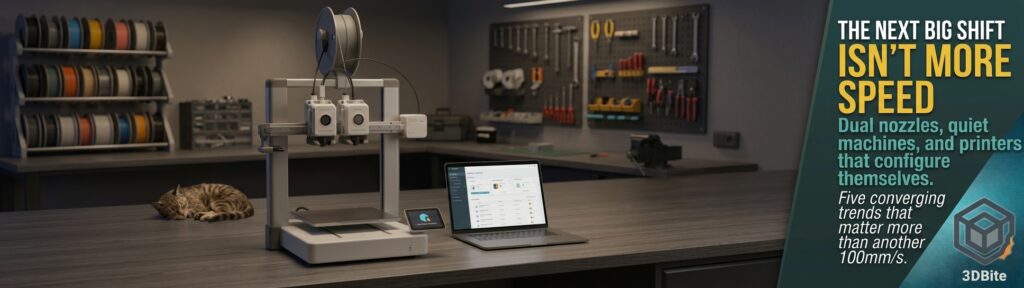
Speed was the battleground for the last two years of this hobby, and it is genuinely won. CoreXY motion systems and high-flow hotends that justified a four-figure price tag not long ago have trickled all the way down to budget machines, and prints that used to take six hours routinely finish in two. That fight is over, and the industry knows it — 2024 was speed’s breakout year, 2026 is the year fast printing simply became normal printing. Which means the interesting question is no longer “how much faster can this get.” It is: what is actually going to define the next real generation of consumer machines, now that raw speed has stopped being a meaningful differentiator between one printer and the next. Having gone through the current state of the industry properly, the answer is not one single thing. It is five converging trends, none of them flashy on a spec sheet, all of them genuinely more consequential for daily use than another 100mm/s.
Dual nozzle is becoming the baseline, not the premium feature
Bambu’s own roadmap is the clearest signal of where this is heading. The X2D, launched April 2026 as the successor to the X1 line, ships with a mixed direct-drive and Bowden dual nozzle as standard rather than as an optional upgrade path. The P2S brought a quick-swap nozzle and improved airflow control to the mid-tier P-series the same way. This is not the same story as the multi-colour AMS conversation this site has covered extensively — a single nozzle switching between materials with a purge cycle attached, exactly the mechanism the hidden workflow cost post and the recent Stratasys verdict post both cover in depth. Dual nozzle is a genuinely different architecture: two independent hotends, each with its own melt zone, capable of running rigid and flexible materials, or model and soluble support, simultaneously rather than sequentially.
What makes this the more interesting shift than the Vortek-style toolhead-swap system covered in the H2C post is that dual nozzle solves a problem no amount of clever single-nozzle purge reduction ever fully will: two materials genuinely active at the same time, with zero cross-contamination risk because they never share a melt zone at all. As this becomes standard rather than premium — moving from the X-series flagship down to the mid-tier P-series within a single product cycle — the practical ceiling of what a home workshop can produce in one uninterrupted job rises considerably, without needing a toolchanger’s mechanical complexity or an AMS’s purge waste to get there.
Reliability has quietly become the actual product
This is the trend that gets the least credit precisely because it is invisible when it works. Auto bed levelling, auto Z-offset, input shaping calibration, and increasingly nozzle pressure tuning now run themselves on modern hardware without any manual intervention — the exact automation this site has covered repeatedly, from the calibration routine post to the maintenance guide‘s observation that HMS-driven prompts have turned printer upkeep from a vigilance exercise into a follow-the-prompts one. The newest machines genuinely work out of the box in a way that simply was not true even three years ago: plug in, load filament, tap print.
The consequence of this is bigger than convenience. Printing success rates for genuine beginners are measurably up, and the skill barrier that used to gatekeep this hobby is measurably down. That is quietly reshaping who actually owns a 3D printer — not the person willing to spend a weekend learning bed levelling by hand, but anyone willing to unbox a machine and follow a guided setup. For an industry that has spent a decade being intimidating to newcomers, that shift matters more for the hobby’s actual future than any headline speed figure ever will.
Quieter machines are the trend nobody is marketing loudly
This one is worth taking seriously because the physics behind it is well understood and the fix is already proven, just not yet universal. Almost all the audible noise a 3D printer produces comes from three sources: stepper motors, cooling fans, and the vibration those two transmit into the frame and whatever surface the printer sits on. Standard stepper drivers can run as loud as 78dB — comparable to a passing truck — while modern silent drivers using StealthChop or SpreadCycle technology bring that down to around 60dB, an 18dB reduction that genuinely changes whether a printer can run overnight in a bedroom or a shared living space without being disruptive. Belt tension alone, tightened properly, has been measured dropping printer noise from 80dB to 65dB on its own.
This connects directly to the mechanical discipline covered in the ghosting and ringing post — the same vibration that causes visible ringing in a print is the vibration a printer’s frame radiates as audible noise, and a well-tensioned, well-isolated machine is quieter for exactly the same underlying mechanical reasons it prints more cleanly. There is even a genuinely interesting security research angle worth flagging here: published research into acoustic side-channel attacks on 3D printers has demonstrated that a printer’s sound alone can reveal meaningful information about what it is printing, simply from the pattern of motor and fan noise over time. That is a strange but real illustration of just how much information is encoded in a printer’s noise profile — and it is exactly the noise profile that silent drivers, better mechanical isolation, and enclosed designs are now engineering away, for reasons that have nothing to do with security and everything to do with a machine that can genuinely run in a family home without becoming background stress.
Workflow ecosystems are becoming the actual competitive battleground
This is the trend with the most direct evidence behind it, and industry analysts are saying it plainly rather than hinting at it. Chinese equipment manufacturers have moved well beyond copying Western designs and are now shipping capable systems at 30-50% lower price points with steadily improving reliability — which is accelerating hardware commoditisation and forcing established manufacturers to compete on ecosystem value rather than raw machine specifications. The strategic conclusion drawn from that observation is direct: companies need to move up the stack toward intelligence and automation, or find themselves in an increasingly brutal hardware price war against well-capitalised competitors who can match the specs for less money.
This is precisely the territory the self-hosted tools covered on this site occupy — Bambuddy, Spoolman, and Manyfold, covered in the tool comparison post, are not printer accessories in the traditional sense. They are the workflow layer sitting on top of the hardware, and increasingly that layer — job queuing, filament tracking, print history, fleet management — is where genuine differentiation lives once the printers themselves have converged on similar capability. The OrcaSlicer versus Bambu Studio post made a version of this same argument from the slicer angle: the underlying slicing engine is now close to identical between competing tools, and the actual decision comes down to ecosystem integration, calibration depth, and workflow fit rather than which one technically slices a model better. Expect this to intensify rather than settle — the printer is becoming commodity hardware, and the software wrapped around it is becoming the product.
Material intelligence: filament that tells the printer what it actually is
This is the least visible trend of the five and arguably the most consequential for print reliability specifically. By 2026, filament makers are publishing considerably better print settings than they did even a couple of years ago, and slicer profiles now support a genuinely wider range of materials out of the box — the specialty filaments that felt risky without a tuned printer, dry storage, and real patience a few years back are increasingly usable without that same level of manual tuning, because the profile data feeding the slicer has matured alongside the hardware.
Bambu’s RFID system, covered throughout this site’s materials posts and the filament brands post, is the most visible current form of this — a spool that tells the printer exactly what it is, what temperature it needs, and how much remains, without the user selecting a profile manually. That is a genuinely early version of what “material intelligence” is heading toward: filament and printer talking to each other directly, with the settings, drying requirements, and even predicted print behaviour increasingly derived from the material itself rather than manually configured by the person loading it. Combine that with the AI-driven process planning and real-time parameter adjustment industry forecasts are pointing toward — print path optimisation, failure prediction, and automatic material-specific tuning happening in the background rather than through a manually maintained settings profile — and the destination is a printer that increasingly configures itself correctly for whatever has actually been loaded, rather than relying on the user to have picked the right preset.
Why none of this looks like a spec sheet number
This is worth naming directly, because it explains why this shift is genuinely harder to market than the speed war that preceded it. Print speed is a single number that fits neatly on a product page and photographs well in a comparison chart. Reliability, quietness, ecosystem depth, and material intelligence are all diffuse, cumulative properties that only become visible over weeks and months of actual ownership rather than in a five-minute unboxing video. A printer that never needs manual bed levelling, never wakes the household at 2am, and correctly configures itself for whatever filament gets loaded is a genuinely better product than one that prints 50mm/s faster and requires constant babysitting to get there — but that improvement does not headline a press release the way a bigger speed number does.
That mismatch between what markets well and what actually improves daily ownership is exactly why this shift is worth naming explicitly rather than waiting for the industry’s own marketing to catch up to it. The printers that win the next few years of this hobby will very likely not be the ones with the biggest number on the box. They will be the ones that have quietly stopped requiring you to think about them at all — running reliably, running quietly, integrating cleanly into whatever workflow already exists around them, and correctly handling whatever material happens to be loaded without being told. That is a considerably less exciting sentence than “500mm/s,” and it is also, genuinely, the more important one.