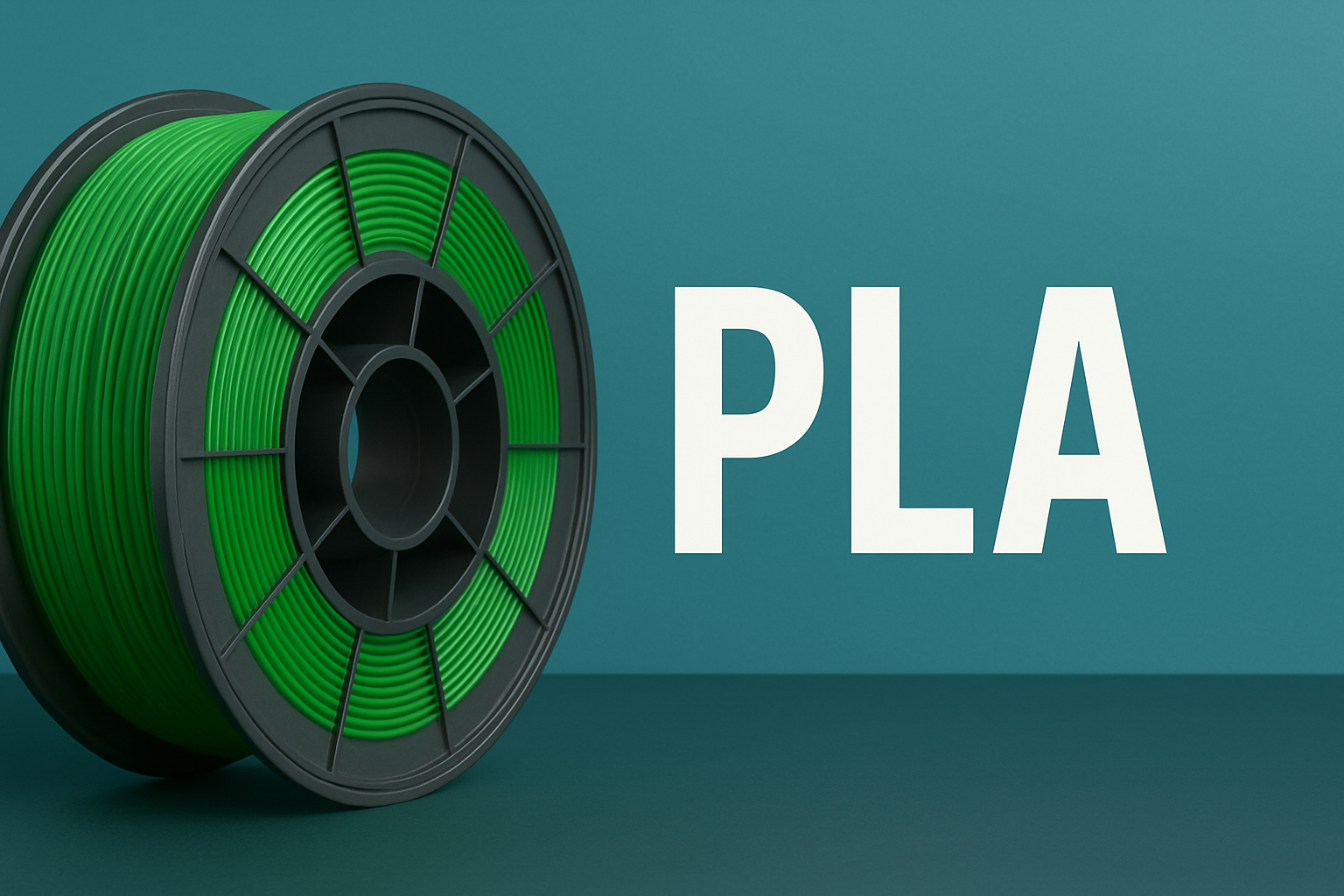
PLA is the material almost every 3D printing conversation starts with, and it deserves more depth than that starting-point status usually gets. It is easy to work with, prints at moderate temperatures, gives clean results, and rarely causes problems — which is exactly why it gets taken for granted. This is the properly detailed version of what PLA actually is: the chemistry that makes it behave the way it does, real mechanical numbers rather than vague descriptions, and enough practical detail to know exactly when it is the right material and when it genuinely is not. These notes are based on long-term use across the Bambu Lab A1 and A2L.
What PLA actually is
PLA stands for polylactic acid. Unlike most plastics, it is genuinely plant-derived — corn starch in the Americas, sugarcane in much of Asia and Europe. The starch ferments into lactic acid, and that lactic acid polymerises into the plastic that eventually becomes filament. That biological origin is real, not marketing spin, but it comes with a caveat worth stating plainly: PLA is compostable only under industrial composting conditions, at sustained heat and humidity a garden compost heap simply does not provide. A PLA offcut in a drawer or buried in soil will not meaningfully break down within any timeframe that matters to you.
Commercial PLA filament is also very rarely the neat, unmodified polymer. Manufacturers add pigments, matting agents, silk-effect additives, flow modifiers, and impact modifiers to tune printability and appearance, which is exactly why two spools both labelled “PLA” from different brands can print noticeably differently despite sharing the same base chemistry. Standard PLA and PLA+ are the two labels you will encounter most. PLA+ typically adds impact modifiers to reduce the brittleness pure PLA is known for, and for everyday functional printing it is generally the better default — it is the formulation eSun PLA+ and most mid-range brands are built around.
Key properties
| Property | PLA | PETG (for comparison) | ABS (for comparison) | ASA (for comparison) |
|---|---|---|---|---|
| UV resistance | Poor — yellows and becomes brittle | Moderate — degrades with sustained exposure | Poor — degrades rapidly | Excellent |
| Heat resistance (HDT) | ~55°C | ~70°C | ~98°C | ~95-100°C |
| Glass transition temperature | 55-65°C | ~80°C | ~105°C | ~100°C |
| Tensile strength | ~50-65 MPa | ~40-55 MPa | ~34-40 MPa | ~44-50 MPa |
| Elongation at break | 3-6% | 15-25% | Higher, tougher | Moderate |
| Impact resistance | Poor — brittle, shatters rather than bends | Good — 3-4x PLA | Good | Good |
| Water/moisture resistance | Poor — absorbs and degrades | Good | Moderate | Good |
| Warping tendency | Very low | Low | High | Moderate |
| Enclosure required | No | No | Yes | Strongly recommended |
| Print temperature | 190-220°C | 220-260°C | 220-260°C | 240-260°C |
| Fumes during printing | Low, minimal odour | Low | High | Moderate |
The most counter-intuitive line in that table is tensile strength. PLA actually beats PETG and ABS on raw tensile numbers — it genuinely resists more pulling force before breaking. What it does not do is bend first. It shatters. This is the distinction that trips up a lot of people comparing filaments on spec sheets alone: PLA is strong in the sense a glass rod is strong, and PETG is tougher in the sense a plastic ruler is tougher. Both descriptions are true, and they answer different questions.
The glass transition temperature: the number that explains most of PLA’s behaviour
PLA’s glass transition temperature — the point where the polymer shifts from a rigid glassy state to a soft, rubbery one — sits at roughly 55-65°C depending on the specific formulation. Below that, PLA is a stiff, somewhat brittle solid. Above it, it softens progressively. Almost every practical PLA limitation traces back to this single number. It is why a PLA print left on a sunny windowsill or in a hot car warps and loses its shape — one documented account describes exactly this: a PLA trinket left on a sun-facing windowsill had gone soft and lost its shape by the following summer. It is why PLA cannot go anywhere near a dishwasher, which runs its cycle well above that threshold. And it is why the hot weather concerns covered in the summer printing post apply specifically to PLA rather than every filament equally — a warm workshop pushes the printer’s own thermal management closer to the same threshold that governs the finished part.
Mechanical behaviour in practice
PLA’s brittleness is the property that most directly shapes what it is and is not good for. Elongation at break for standard PLA typically sits at 3-6% — meaning it deforms very little before snapping outright, in contrast to PETG’s 15-25%. A PLA part dropped from waist height onto a hard floor has a real chance of shattering rather than surviving. This is not a flaw so much as a direct trade for what PLA does well: rigidity, dimensional accuracy, and clean surface detail. A part that needs to stay perfectly still under load — a jig, a display stand, a precisely-fitting enclosure — benefits from PLA’s stiffness. A part that will get dropped, flexed, or knocked around benefits from PETG’s willingness to bend rather than break, exactly as the orientation for strength post covers from the layer-adhesion angle.
Moisture is the other side of PLA’s chemistry worth taking seriously. It absorbs moisture more slowly than PETG or nylon, but it is not immune, and wet PLA produces the same surface bubbling and weakened layer adhesion covered in the filament drying post. A spool that has sat open for a couple of weeks, or lived in the AMS through a long multi-colour project, is worth a drying pass before it goes anywhere near a print you actually care about.
Printing PLA: settings and practical tips
| Setting | Recommended range | Notes |
|---|---|---|
| Nozzle temperature | 190-220°C, 205-215°C is the reliable middle ground | Trend toward the lower end for silk and specialty additive blends, which need less heat to flow properly |
| Bed temperature | 50-70°C | Depends on the specific plate — check the plate type selected in the slicer matches what is actually on the printer |
| Layer height | 0.16-0.24mm on a 0.4mm nozzle | PLA tolerates the full range well; finer heights for detail, coarser for speed |
| Cooling | Part cooling fan at 100% | Cooling is consistently the single biggest factor in PLA surface quality — more so than most other settings on this list |
| Infill | 15-25% for general use | See the infill patterns post for pattern selection matched to the expected load |
| Walls | 2-3 perimeters | Increase for anything genuinely load-bearing |
| Speed | Standard A1/A2L PLA profile | PLA is one of the more forgiving materials to run at the high speeds these machines are capable of |
A few things worth doing consistently. Use a clean textured plate for reliable adhesion — the maintenance guide covers plate care properly, and PLA is genuinely forgiving of plate condition compared to PETG or ABS. Avoid pushing bed temperature too high, which can soften the first layer given how close PLA’s glass transition sits to typical bed temperature ranges. Enable ironing for flat visible surfaces where a smoother finish matters. And use supports sparingly, since PLA-on-PLA supports can weld on firmly enough to scar the surface underneath — the PETG interface technique covered elsewhere on this site sidesteps that entirely.
Post-processing
PLA takes paint well once properly prepped, sands cleanly through a progressive grit sequence, and accepts an epoxy coating for a genuinely glass-like finish — all covered in detail in the PLA polishing post and the painting guide. The one thing PLA specifically cannot do, despite persistent online advice claiming otherwise, is acetone vapour smoothing. That technique works on ABS because acetone genuinely dissolves ABS’s surface chemistry. PLA’s chemistry does not react the same way, and attempting it produces a gummy, unevenly softened surface rather than the smooth finish ABS achieves. If a smooth, layer-line-free surface is the goal, sanding and epoxy coating are the reliable routes for PLA — not a solvent bath.
Real-world use cases
Household organisers and everyday items
Storage trays, cable clips, drawer dividers, small brackets that live indoors and never see genuine stress — this is PLA’s natural home. Nothing here needs impact resistance or heat tolerance beyond room temperature, and PLA’s dimensional accuracy means these parts fit and function exactly as designed.
Gifts, display pieces, and detailed models
The multi-part seasonal builds and figurine projects covered across this site’s project posts are almost entirely PLA, and for good reason. PLA’s clean surface finish, its wide colour range, and its compatibility with silk and dual-colour effects — covered in the silk PLA post and the dual colour PLA post — make it the obvious choice for anything where appearance is the point rather than mechanical toughness.
Prototypes and draft parts
Before committing a design to a stronger, harder-to-print material, PLA is the sensible first pass — cheap, fast to iterate with, and forgiving of a settings mistake in a way a nylon or polycarbonate test print never is. Check fit, check proportions, adjust the design, and only move to PETG or an engineering material once the geometry is settled.
Educational and low-stakes functional printing
PLA’s low printing temperature and minimal odour make it the sensible default in classrooms, offices, and any shared space where ventilation is limited, which is a genuine safety consideration alongside a convenience one — the fumes and ventilation post covers why PLA sits at the low-risk end of the emissions spectrum compared to ABS specifically.
PLA vs the alternatives: when to reach for something else
| Scenario | Best choice | Why |
|---|---|---|
| Indoor, decorative, no mechanical stress | PLA | Easiest material, best surface detail, no functional disadvantage indoors |
| Functional part that takes load or gets dropped | PETG | Bends rather than shatters, 3-4x PLA’s impact resistance |
| Outdoor, direct sunlight, long-term | ASA | PLA yellows and becomes brittle outdoors within months |
| Near a heat source, in a hot car, on a sunny sill | PETG or ASA | PLA’s ~55°C glass transition is comfortably within reach of everyday warm environments |
| High mechanical stress, engineering-grade strength | Nylon or PC | See the nylon and polycarbonate posts |
Which PLA to buy
Bambu Lab’s own PLA Basic is the most reliable starting point on any Bambu printer — RFID auto-detection through the AMS, tested profiles, and consistent colour matching across the range, at a higher per-spool cost than most third-party options. For daily-driver printing, eSun PLA+ has been the standard on this desk for two years, and it sits alongside Hatchbox and Polymaker as the names that come up repeatedly in independent testing for consistent diameter tolerance and predictable behaviour spool to spool. Prusament sits at the premium end, with every spool carrying a QR code linking to its own measured production data — genuinely useful for anyone chasing the tightest possible dimensional consistency, though the price reflects that extra quality control. The cheap filament post covers where the genuine value line sits and why the cheapest unbranded spools are usually false economy once diameter variation and winding quality are accounted for.
Summary
PLA’s properties sit deliberately in the middle of the FDM materials range — stiffer than flexible packaging polymers, easier to print than ABS, and less heat-resistant than either PETG or genuine engineering materials. That middle position is exactly why it remains the sensible default: it trades away heat resistance and impact strength for print reliability and clean results, and for the overwhelming majority of what actually gets printed in a home workshop, that is the right trade. Reach for PETG when impact resistance or slightly better heat tolerance genuinely matters, reach for ASA or the engineering materials when the application demands it, and keep PLA as the default for everything else — which, in practice, ends up being most things.