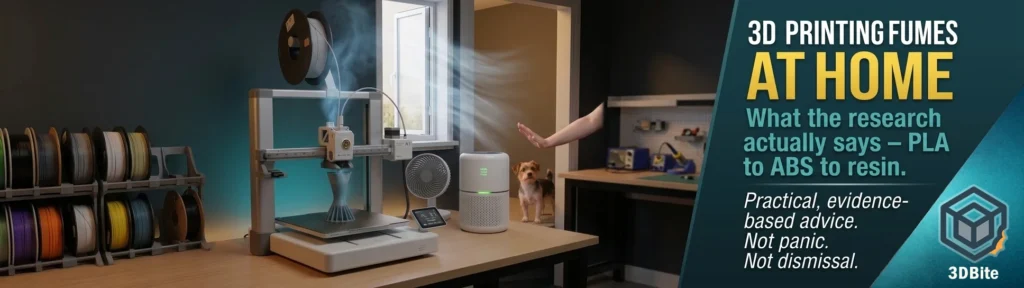
There is a version of this post that opens with “don’t panic, PLA is basically harmless.” There is another version that opens with EPA warnings and peer-reviewed studies on carcinogens. Neither is quite right, and the truth sits in the space between them — which is where most genuinely useful safety information lives. The research on 3D printer emissions is more developed than most guides acknowledge, and the honest answer to “should I be worried?” is: it depends on what you are printing, at what temperature, for how long, in what room, with what ventilation. This post goes through each of those variables and tries to give you a real picture rather than a reassuring one.
Two things come off a 3D printer: particles and gases
When filament melts through a hot nozzle, the heat breaks down the polymer chains and releases two categories of material into the air. The first is ultrafine particles — UFPs — in the 1 to 100 nanometre size range. The second is volatile organic compounds, VOCs, which are gases released from the heated plastic. Both categories have been studied in peer-reviewed research, and both matter, but for different reasons and at different levels of concern depending on the material.
UFPs are the more physically interesting problem. At 1–100nm, they are smaller than the particles that a standard dust mask filters. They penetrate deep into the lungs, into the alveoli where gas exchange happens, and research cited by the US EPA found they can be harder to clear from the body than larger solid particles. The number of UFPs emitted per minute varies enormously by filament — studies have measured emission rates from around 10⁸ to 10¹¹ particles per minute depending on material and temperature. That range spans three orders of magnitude. What you print matters far more than whether you print.
VOCs are gases, and the specific compounds emitted depend on what chemicals are present in the filament formulation. Some VOCs are essentially inert. Others are irritants. A small number are classified as probable or suspected carcinogens, and the filament type is the biggest determinant of which category you are dealing with.
PLA: low risk, not no risk
PLA is the filament most people print most of the time, and the research is broadly reassuring — with one caveat worth knowing. PLA’s main VOC emission is lactide, which is not inherently harmful in the concentrations typical desktop printing produces. Total VOC emission rates for PLA sit around 10 micrograms per minute in measured studies, which is significantly lower than ABS. A 2017 comparison published in peer-reviewed research found a laser printer in a standard office produced higher VOC emission rates than a 3D printer running PLA. If PLA’s emissions were your threshold for concern, the laser printer in the meeting room would demand more attention.
The caveat is formaldehyde. A 2025 review published in the Journal of Exposure Science and Environmental Epidemiology found that one of two PLA filaments tested produced formaldehyde concentrations that exceeded the UKHSA guideline, averaged over a 30-minute exposure window. Formaldehyde is the compound present in that sharp smell some PLA produces at higher temperatures, and it is an irritant with a known short-term exposure guideline for good reason. The variation between filaments was significant — one exceeded the limit, one did not, using the same nominal material type. Brand and formulation matter. Higher temperatures produce more emissions. PLA extruded at 220°C is generating more breakdown products than PLA extruded at 200°C.
The practical position on PLA: it is the safest common FDM material, and occasional printing in a room with normal air exchange is unlikely to be a meaningful risk for a healthy adult. A longer print run in a sealed room with no ventilation is a different proposition, particularly if the room is small. The sensible habit — open the window, keep some air moving — turns a theoretical low risk into a negligible one.
ABS: the material that genuinely warrants respect
ABS is where the research stops being reassuring and starts being specific. The primary VOC emitted by ABS is styrene, which comes from the breakdown of the acrylonitrile-butadiene-styrene polymer itself. Styrene is classified by the IARC as a possible human carcinogen, and the EPA as a probable one. The distinction between possible and probable is a technical risk-classification detail; what matters practically is that styrene is not a compound you want to breathe regularly, and ABS printing produces it consistently.
Measured styrene emission rates from ABS printing range from around 10 to 110 micrograms per minute across published studies. Total VOC emission rates for ABS come in at 25 to 175 micrograms per minute — up to seventeen times higher than PLA’s roughly 10. The 2025 Journal of Exposure Science review specifically found that styrene during ABS printing exceeded UKHSA guidelines at the concentrations studied. A 2024 study found that prolonged ABS printing in poorly ventilated spaces can cause lasting respiratory damage, particularly for children, sensitive individuals, and animals.
UL and OSHA guidelines both recommend ventilation systems including HEPA and carbon filtration for any environment where ABS printing occurs. Those are industrial guidelines written for professional settings, but the underlying chemistry does not care whether the printer is in a factory or a spare bedroom. If you are printing ABS regularly in your home, proper ventilation is not a nice-to-have.
The smell is the signal. ABS has a distinctive sharp chemical smell when printing. If you can smell it in the room, the VOC concentration in that room is elevated. That does not mean the concentration is immediately dangerous — the smell threshold is lower than the harm threshold — but it is an indicator that your ventilation is not adequate to clear what the printer is producing.
ASA: same family, same concerns
ASA — acrylonitrile styrene acrylate — shares significant chemistry with ABS. It also contains styrene in its polymer chain. Its emission profile is similar to ABS, which means the same concerns about styrene exposure apply. ASA’s advantage over ABS in printing is UV stability and reduced warping, both of which are properties the polymer offers after printing. During printing, the emissions picture is comparable. Treat ASA the same way as ABS in terms of ventilation requirements.
PETG: significantly better than ABS
PETG lands in a much better position than ABS on emissions, and notably better than most guides give it credit for. One comprehensive study measuring TVOC emissions across multiple materials found PETG produced approximately 0.2 micrograms per minute — a figure so low it is effectively at the noise floor of the measurement. The chemistry makes sense: PETG is a glycol-modified polyester without styrene in its formulation, so the specific carcinogen concern from ABS does not apply.
PETG still produces ultrafine particles during printing, and sensible ventilation remains the right practice. But PETG is the material I would be comfortable running overnight in a well-ventilated room in a way I would not be with ABS. For anyone looking for a stronger functional material than PLA without the emissions concerns of ABS, PETG is the practical choice, and the safety picture supports it.
Nylon and carbon fibre composites
Nylon filaments produce caprolactam as their primary VOC emission — a compound that also appears in some wood-fill and specialty filaments. Caprolactam emission rates in published studies range from 2 to 180 micrograms per minute, which is a very wide range reflecting variation between specific nylon formulations and print temperatures. It is less studied than ABS styrene emissions but not negligible, and nylon’s higher printing temperatures tend to drive higher emission rates.
Carbon fibre composite filaments introduce a separate concern: the physical particles from the chopped CF itself. Print any CF-fill material and you are heating and extruding a composite that contains fine fibres. The abrasive wear this causes on nozzles is the topic of the abrasive filaments guide. The inhalation concern is the other side of that same coin — fine carbon or glass fibres released during printing are a respiratory concern independent of the VOC chemistry. The research on this specific area is less developed than VOC studies, but the precautionary logic is sound: if you are printing CF regularly, active ventilation is the right posture regardless of what the full literature eventually establishes.
Resin printing: a different and more serious category
Resin printing sits in its own category and deserves being treated differently from FDM. Photopolymer resins contain reactive monomers and photoinitiators that are genuinely hazardous — skin sensitisers, mucous membrane irritants, and potential carcinogens among the specific compounds involved. Uncured resin is the most hazardous state. Liquid resin on skin can cause dermatitis and sensitisation that makes subsequent exposures progressively worse. Inhaling resin vapour from an open vat is not a brief irritation — it is exposure to a mix of reactive chemicals for the full duration of the print.
If you print resin: nitrile gloves every time, never latex. A respirator rated for organic vapours during resin changes and wash steps, not just a dust mask. Dedicated ventilation that exhausts outside rather than recirculating. A UV wash and cure station rather than sun exposure in an open space. This is not overcaution — it is the basic hygiene that the chemistry demands. The casual handling of uncured resin that a lot of online content depicts is genuinely a habit that causes harm over time.
Open-frame printers in a home context
The A1 and A2L are open-frame bed slingers. They have no enclosure, no built-in filtration, and no barrier between the printing surface and the room air. This places them at the less favourable end of the spectrum for emissions management — not because they produce more emissions than an equivalent enclosed printer would using the same filament, but because the emissions go directly into the room rather than being captured and filtered before they reach room air.
Bambu’s enclosed machines — the P series and H series — have filter upgrade options specifically for this reason: HEPA filtration for particles and activated carbon for VOCs. Those filters are doing a real job and the research supports using them. An enclosed printer with an active HEPA and carbon filter running is meaningfully better for indoor air quality during printing than an open-frame machine in the same room with the same filament. This is one of the few dimensions where enclosed machines are genuinely better than open-frame for PLA and PETG, where the chamber heating argument does not apply.
For the A1 and A2L specifically: the practical response is ventilation. Open the window before starting a print session. Position a fan to draw air out of the room or toward an open window rather than simply circulating it. Do not sit directly beside the printer during long runs. Bambu’s own PLA Pure, as noted in the PLA Pure post, achieved UL GREENGUARD certification with its emissions test specifically conducted on open A1 and A2L hardware — the reasoning being that open-frame machines represent the worst case, so GREENGUARD compliance on an A1 is a reasonable indication of safety. That certification exists and means something, even if the broader “PLA is perfectly safe” framing overstates matters slightly.
Children, animals, and higher-risk individuals
The 2024 research specifically names children, sensitive individuals, and pets as populations at elevated risk from 3D printer emissions — and this is not a legal disclaimer. Children’s bodies are smaller, so an equivalent ambient concentration represents a proportionally higher dose. Their respiratory systems are still developing and are more susceptible to particulate deposition. A child who sits in a room printing ABS regularly is exposed in a way that the adult-focused exposure guidelines do not fully capture.
Birds are the standout animal case. Avian respiratory systems are anatomically designed for extraordinarily efficient gas exchange — which is why birds respond to airborne compounds far more rapidly and at far lower concentrations than mammals. The same principle that made canaries valuable in coal mines applies here. If you keep birds, printing in the same room — particularly ABS or anything with VOC emissions — is not a calculated risk. It is simply not something to do. Even PLA printing in close proximity to birds over extended periods is inadvisable given how little formal research exists on avian exposure to FDM emissions specifically.
Dogs and cats are less acutely sensitive than birds but more sensitive than adults, particularly to the particulate fraction that settles at floor level where they spend most of their time. Keeping them out of the room during printing and for a period afterward is the conservative and defensible approach.
What actually helps: the practical hierarchy
Ventilation is the most effective single measure and the cheapest. An open window with directional airflow out of the room dilutes and removes both UFPs and VOCs. The concentration of any airborne emission is directly proportional to how quickly fresh air replaces the room air. A large room with an open window is a fundamentally different environment from a small room with the door closed, even running identical hardware.
Not being present during printing is underrated as a safety measure. Sitting at the desk with a printer running two feet away for six hours is a higher cumulative exposure than starting the same print and leaving the room. The A1 and A2L both support unattended printing, as covered in the safety post. For emission management, letting the machine run in a ventilated room while you are elsewhere is a meaningful practical reduction in exposure regardless of what material is in the nozzle.
Air purifiers with genuine HEPA filtration rated for the room size, combined with activated carbon — not just carbon-coated paper — address both the particle and VOC fractions. HEPA alone handles particles but not gases. Carbon alone handles VOCs but not particles. For ABS or ASA printing, the combination is worth having in the room. For PLA in a well-ventilated space, a decent air purifier is a comfort measure rather than a necessity.
Temperature discipline matters more than most guides cover. Every 5–10°C increase in print temperature drives meaningfully higher emissions — this is why printing PLA at 220°C in a sealed room is a worse situation than printing it at 205°C with the window open. Running materials at the lower end of their functional temperature range reduces emissions, and the quality cost is often negligible. The nozzle temperature settings in the filament profiles post are worth revisiting with this in mind.
The material-by-material summary
PLA: lowest common risk, but not zero. Open a window. Do not print in a sealed room for hours. Avoid pushing the temperature higher than needed.
PETG: similar to PLA in practice, very low VOC emissions. Normal ventilation adequate.
ABS and ASA: take seriously. Ventilation is not optional. If you print these regularly at home, a proper enclosure with HEPA and carbon filtration is the right investment. Keep children and animals away from the printing area.
Nylon and PA: elevated emissions at printing temperature. Active ventilation, ideally directional exhaust to outside. Handle CF-fill variants with extra care regarding particle inhalation.
Resin: different league. Full PPE every time. Never without ventilation. Never near children or animals.
The overall framing that holds across all of this: the research is real, the risk for most home PLA printing is low but not zero, and ABS in a poorly ventilated home is a genuine concern that the community has historically undersold. Open the window. It costs nothing and the difference it makes is not trivial.