
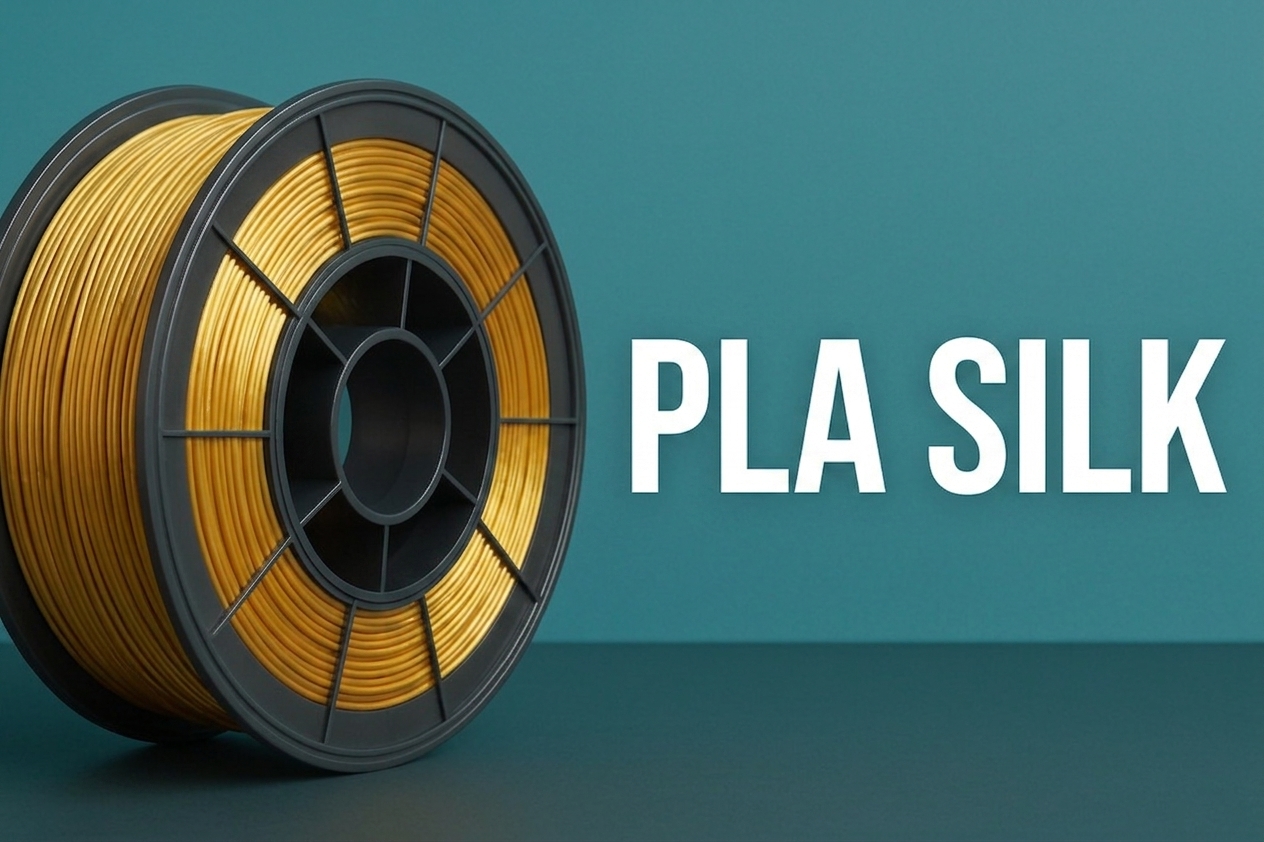
The worst filament post on this site was about one specific bad spool, not the category it belonged to. Yuaneang’s silk PLA strung more than any material should, crumbled where it should have held, and ended up being the single worst experience across several hundred spools over the years. That post was careful to draw a line between “this spool was bad” and “silk PLA as a category is bad,” and it is time to actually give that category the fair, separate evaluation it was owed. I do use silk PLA, just selectively, and the honest answer to whether it is worth the hype is: for the right project, genuinely yes. For anything else, no, and knowing which is which is the entire point of this post.
What actually makes it silk
Silk PLA is standard PLA with additives — typically a blend involving elastomers and specific optical modifiers — mixed in during manufacture to change how light bounces off the finished surface. Standard PLA has a flat or lightly satin finish. Silk PLA looks almost metallic, with a genuine shine that can be striking under the right light. Critically, this is not just a surface coating or a post-processing trick — it is baked into the material itself, and it has a real, useful side effect beyond just looking shiny: it conceals layer lines considerably better than standard PLA does, because the reflective surface breaks up the visual pattern that a layer line would otherwise create. A silk print with visible layer lines still reads as smooth and glossy at normal viewing distance in a way a matte PLA print with the same layer height would not.
The trade-off for that shine, and it is a real and consistent trade-off rather than something specific to any single bad spool, is brittleness. The same additives that produce the reflective surface reduce impact resistance compared to standard PLA or PLA+. This is not a manufacturing defect. It is the actual chemistry of what makes silk PLA silk — you are trading some mechanical toughness for optical properties, and every credible source on this material says the same thing in slightly different words: it is a “show” filament, not a “go” filament.
What genuinely needs to change in the settings, and why
Silk PLA needs slightly more heat than standard PLA to fuse its layers properly, and this is worth understanding rather than just following as a rule. Standard PLA prints comfortably in the 190-210°C range. Silk needs closer to 205-230°C depending on the specific brand, because if the layers do not fuse properly at a lower temperature, the print does not just lose some of its shine — it becomes genuinely fragile on top of the brittleness the additives already introduce. Print silk PLA too cold and you get the worst of both properties: dull and weak, rather than shiny and merely somewhat brittle.
Speed needs to come down from your standard PLA profile, and cooling needs a genuinely different approach than you might expect. Full part cooling fan speed, which is usually the right call for standard PLA, can actually work against silk PLA specifically — cooling the surface too aggressively crystallises it before the shine effect has properly formed, reducing the shimmer intensity you bought the filament for in the first place. Starting around 60% fan speed and adjusting from there, rather than defaulting to maximum cooling, is the right instinct for this material specifically.
Line width is the setting most people never think to touch and genuinely should for silk specifically. Printing at 110-120% of nozzle diameter rather than the standard 100% produces broader, more reflective surfaces that show off the silk effect considerably better than a standard-width line does. And for the specific case of vase mode single-wall prints, silk PLA is close to the ideal application — the continuous, uninterrupted surface that vase mode produces maximises the light reflection the material is capable of, in a way a walled, infilled print with visible seams and layer transitions cannot match.
Where the brand actually matters, and why the Yuaneang experience was not typical
This is the part that most directly separates the earlier bad-spool review from a fair category assessment. Reputable silk PLA brands print with genuinely good dimensional consistency — SUNLU’s silk range is documented at roughly ±0.02-0.04mm diameter tolerance depending on the specific spool tested, and Polymaker’s silk offerings sit at the tighter end of that range with correspondingly more uniform shimmer across a large print. That tolerance is what determines whether a spool tangles, jams, or extrudes consistently, exactly as covered in the cheap filament post — and it is entirely independent of whether the material is silk, matte, or standard PLA. A well-manufactured silk spool from eSun, SUNLU, or Polymaker behaves like a well-manufactured spool of anything else, with the brittleness trade-off being the only genuinely inherent-to-silk characteristic layered on top.
What went wrong with the Yuaneang spool — stringing that would not resolve even after a full calibration pass, and brittleness that went well beyond what silk PLA as a category should produce — points to a specific manufacturing quality problem with that spool or that brand, not evidence that silk PLA is inherently unworkable. The lesson from that post stands: an unfamiliar brand with no real community track record, bought purely for a specific colour, is a gamble regardless of whether the filament happens to be silk, matte, or standard. Stick to brands with an established reputation specifically in silk formulations, and the category behaves considerably better than one bad spool might suggest.
What it is genuinely good for
Display pieces, gifts, and anything where the object is meant to be looked at rather than used functionally are where silk PLA earns its price premium. Ornaments, themed decorative parts, cosplay props, architectural models, and tabletop miniatures where a sophisticated, almost cast-metal glow adds genuine value to the finished piece — this is exactly the category where the shine is not a gimmick but the actual point of choosing the material. Vase-mode decorative pieces specifically, as covered above, are close to the ideal application, since the material’s core strength and its printing method align perfectly.
It is also genuinely useful as a cheat for hiding print quality issues on a display piece — if a model has slightly inconsistent layer lines from a less-than-perfectly-tuned profile, printing it in silk conceals that far more effectively than a matte or standard finish would. This is not a reason to skip calibration, but it is a real and useful side benefit for anyone printing decorative work where a bit of forgiveness on surface consistency is welcome.
What it is genuinely bad for
Anything that needs to bear load, flex repeatedly, or survive an impact should not be silk PLA, and this is not a hedge — it is the consistent, specific advice across every source researched for this post. Never use it for supports, gears, brackets, or any functional part that needs to take genuine mechanical stress. The brittleness is real and it is not a defect to be calibrated away; it is the chemistry the material trades for its shine. If a project needs both visual shine and genuine mechanical toughness in the same part, the honest answer is that silk PLA cannot give you both, and a multi-part approach — printing the visible, decorative section in silk and the structural section in PLA+ or PETG, joined as covered in the multi-part printing post — is a better solution than hoping one material does both jobs.
What I actually use it for
My own use of silk PLA has settled into a fairly narrow lane, and it is worth being specific about it rather than leaving it vague. Seasonal display pieces where a bit of shine genuinely lifts the finished result, small decorative accents on multi-part builds where the silk section is not load-bearing, and the occasional gift where the recipient will notice the shine more than they would notice a perfectly matte, technically superior surface. I do not reach for it on anything that will be handled roughly, given to a child, or used as anything other than a display object. That is a narrower use case than the marketing around silk filament suggests, and it is exactly the discipline that keeps the material genuinely useful rather than a recurring source of disappointment.
So, worth the hype?
Yes, for the specific and fairly narrow category of prints it is actually suited to — and no, if you expect it to behave like a slightly shinier version of your everyday PLA+ across every kind of project. The category is not the problem the Yuaneang spool suggested it might be. A well-chosen brand, printed at a slightly higher temperature with tuned cooling and a wider line width, produces a genuinely impressive result for decorative work, and that result is worth the modest price premium over standard PLA when the project actually calls for shine. What it is not, and never will be regardless of brand or settings, is a drop-in replacement for standard PLA on anything that needs to survive being dropped, flexed, or leaned on. Know which category your print falls into before loading the spool, and silk PLA earns its reputation rather than undermining it.
The show-vs-go framing is the bit that finally stuck for me. Once I stopped treating silk as “PLA but prettier” and started treating it as a deliberate optical trade for toughness, the fails made sense — snaps at thin walls, hinge tabs, and anything that gets flex. The layer-line camouflage is real though: at normal viewing distance a 0.2 mm silk vase looks cleaner than the same mesh in matte PLA, which is exactly when the shine earns its keep. We keep the same rule when picking materials for display pieces at luphra.com — silk for shelf/photo stuff, standard or PETG when the part has to survive handling.