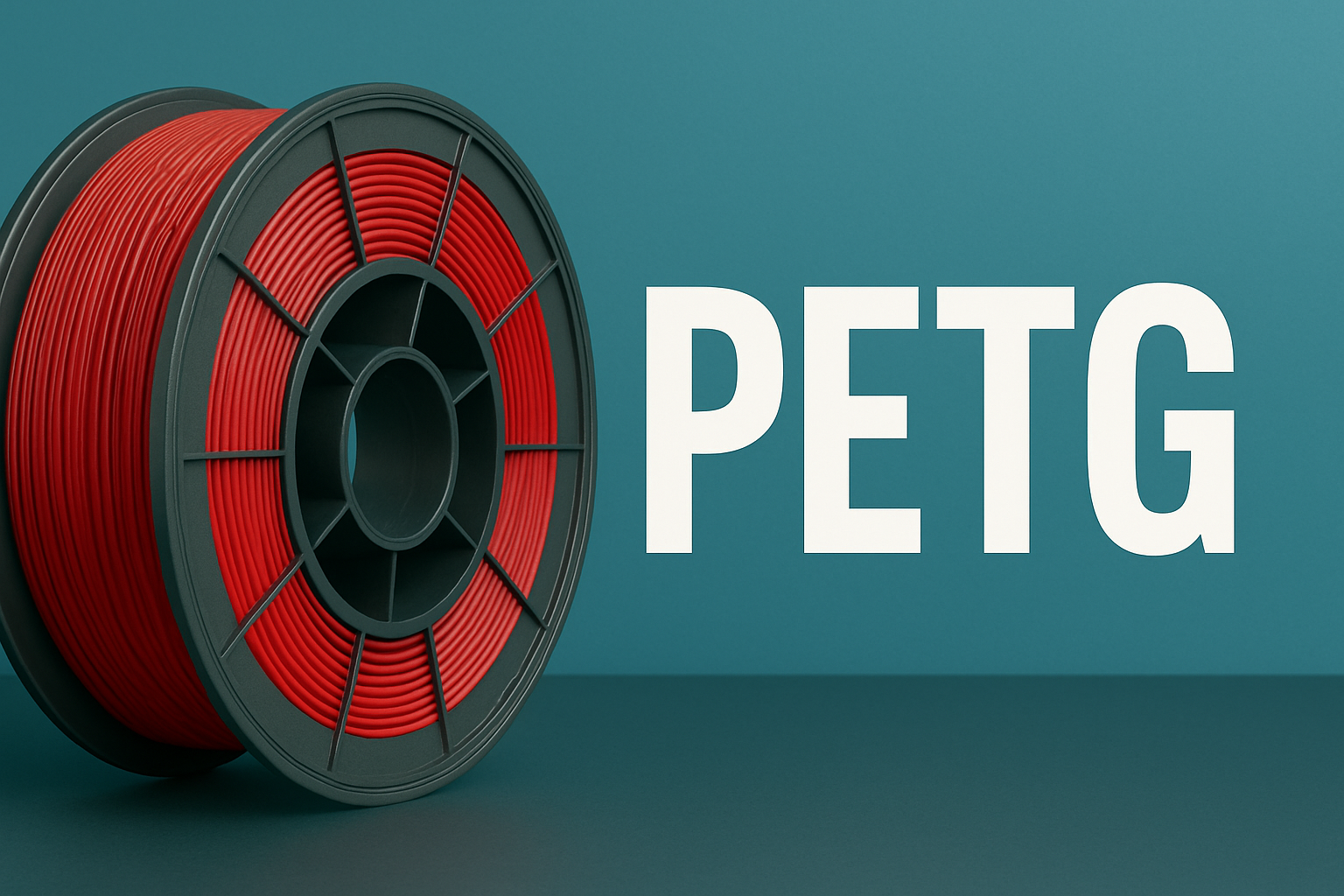
PETG is my preferred material whenever a print genuinely needs to survive real use rather than just sit on a shelf looking good. It handles mechanical stress, moisture, and warmer environments better than PLA, and it does this while remaining considerably easier to print than the true engineering materials covered in the nylon and polycarbonate posts. This is the properly detailed version of what PETG actually is, why it behaves the way it does, and which brands are genuinely worth buying — replacing the much thinner notes this post originally carried.
What PETG actually is
PETG stands for polyethylene terephthalate glycol-modified, and the base material is genuinely familiar even if the acronym is not — PET is the exact same polymer used to make disposable water bottles and food packaging film. Standard PET, on its own, is difficult to 3D print: it crystallises readily as it cools, which makes it brittle, prone to warping, and inconsistent to extrude through a nozzle. The “G” is where the interesting engineering happens. Adding glycol during manufacture disrupts that crystallisation process, keeping the material amorphous rather than semi-crystalline. That single modification stabilises melt behaviour, improves layer bonding, and produces PETG’s low-shrinkage, low-warp printing character — the polymer chemistry doing most of the practical work that makes PETG usable in the first place.
The framing that comes up repeatedly, and holds up under scrutiny, is that PETG bridges PLA and ABS — it takes PLA’s comparative ease of printing and combines it with strength, chemical resistance, and moisture tolerance closer to ABS, without ABS’s warping problems or the enclosure it typically needs.
Key properties
| Property | PETG | PLA (for comparison) | ABS (for comparison) | ASA (for comparison) |
|---|---|---|---|---|
| Tensile strength | ~40-55 MPa | ~50-65 MPa | ~34-40 MPa | ~44-50 MPa |
| Elongation at break | 15-25% | 3-6% | Higher, tougher | Moderate |
| Impact resistance | Good — 3-4x PLA | Poor — shatters rather than bends | Good | Good |
| Heat deflection temperature | ~70°C (deformation from ~80°C per CNC Kitchen testing) | ~55°C | ~98°C | ~95-100°C |
| UV resistance | Moderate — degrades with sustained exposure | Poor | Poor | Excellent |
| Water/moisture resistance | Good, but absorbs airborne moisture readily during storage | Poor | Moderate | Good |
| Chemical resistance | Good | Poor | Moderate | Good |
| Bed adhesion | Very strong — often too strong on textured PEI | Moderate | Poor without enclosure | Poor without adhesive aid |
| Enclosure required | No | No | Yes | Strongly recommended |
| Fumes during printing | Low, odourless | Low | High | Moderate |
The heat deflection figure deserves a specific callout. CNC Kitchen’s controlled testing of Prusament PETG found deformation genuinely beginning around 80°C, with functional failure following shortly after — and the inside of a parked car on a summer day routinely exceeds that. Ventilation grilles, dashboard-mounted holders, and any part living under a bonnet printed in standard PETG will deform in exactly this scenario. That is not a flaw in the material; it is simply a temperature ceiling worth knowing before choosing PETG for a specific automotive or high-heat application over ASA.
Why it bonds to plates so aggressively
This is the single most common frustration new PETG printers run into, and it traces directly back to the same amorphous chemistry that makes PETG print so cleanly in the first place. That structure gives PETG excellent adhesion to almost any surface it contacts while still warm, including the build plate itself. On a textured PEI plate specifically, PETG can bond firmly enough that removing the finished part risks damaging either the print or the plate coating. A thin layer of glue stick as a release agent, or switching to a smooth rather than textured plate, breaks that direct bond without meaningfully affecting first-layer quality — worth doing as a default for PETG rather than only reaching for it after a part has already fused on too firmly to remove.
When I use PETG
Functional brackets and load-bearing parts
PETG’s genuine impact resistance advantage over PLA — roughly three to four times better, per multiple independently sourced tests — makes it the sensible default for anything that will be handled, stressed, or knocked regularly rather than just displayed. A bracket printed in PLA that fails will shatter. The same bracket in PETG bends, and often survives.
Outdoor items in mild conditions
PETG’s moderate UV and moisture resistance make it reasonable for parts facing occasional or indirect sun and rain — plant pot liners, garden clips, anything that will get wet regularly without being permanently exposed to direct sunlight. For sustained, serious outdoor exposure, ASA is the better material; PETG will eventually fade and weaken under years of direct sun in a way ASA specifically resists.
Clear and translucent applications
PETG’s transparent and translucent variants are genuinely good, and eSUN’s clear PETG specifically is called out repeatedly in independent testing as outperforming many competitors for light diffusers, display cases, and anything where translucency matters. This connects directly to the transparent printing guide already on this site — PETG is the material that guide is built around.
Food-adjacent items, with the same caveats that apply everywhere
PET is already an approved food-contact material at the base polymer level — it is why PET bottles and containers are standard in commercial food packaging — and PETG inherits that food-safe chemistry. The same caveats covered in the food safety post about layer-line porosity, nozzle contamination, and printer hygiene apply just as much to a PETG print as a PLA one. The base polymer being food-safe does not automatically make a printed object food-safe.
Printing PETG: settings that actually matter
| Setting | Recommended range | Notes |
|---|---|---|
| Nozzle temperature | 230-260°C, with 235-250°C the reliable middle ground for most brands | Range varies genuinely by brand — Eryone’s standard PETG runs 215-230°C, notably lower than most, while Overture, Hatchbox, and Prusament sit in the 235-250°C band. Check the specific spool rather than assuming a universal number |
| Bed temperature | 75-85°C | — |
| Layer height | 0.20 or 0.24mm | — |
| Cooling | 40-60% part cooling fan | Meaningfully lower than PLA’s 100% — one of the most commonly forgotten settings when switching materials |
| Retraction | Around 4mm on a direct-drive setup, tuned per brand | eSUN PETG specifically has been documented printing cleanly at 240°C with 4mm retraction and minimal stringing |
| Print speed ceiling | 150-200mm/s for standard formulations | Standard PETG becomes volumetric-throughput limited beyond this. High-flow/rapid formulas (Bambu PETG HF, Polymaker’s newer formula, SUNLU High Speed) are specifically reformulated to hold quality at 300-600mm/s if genuine speed matters |
| Infill | 20-35% for general functional use | See the infill patterns post for pattern selection matched to expected load |
| Walls | 3 for anything genuinely load-bearing | — |
A first layer needs a genuinely clean plate — a quick IPA wipe before printing resolves most adhesion inconsistency on PETG specifically, more so than on PLA, because PETG’s stickiness makes it less forgiving of surface contamination.
Tips for best results
Reduce cooling to avoid brittle layers — PETG needs meaningfully more dwell time at temperature than PLA for the layers to bond properly, and over-cooling produces a part that looks fine but delaminates more easily than it should. Slow down bridges to prevent curling, since PETG’s slower cooling behaviour makes it more prone to bridge sag than PLA at the same speed — the bridging post covers the specific adjustment. Use a small Z-hop to avoid dragging and stringing, since PETG’s stickiness that makes it bond so well to plates also makes it more prone to catching on already-printed features during travel moves. And store PETG dry, since it absorbs moisture considerably faster than PLA — the filament drying post covers PETG’s specific drying schedule.
Limitations, and why they exist
PETG strings more than PLA if cooling is set too high relative to what the material needs, which is somewhat counterintuitive coming from a PLA-first workflow where more cooling almost always helps stringing — this is one of the clearest cases where the standard PLA fix does not transfer directly, and it is covered properly in the stringing post. It can fuse to textured plates without a release agent, as covered above. And bridging is genuinely weaker than PLA at comparable settings, a direct consequence of PETG staying workable for longer after leaving the nozzle — an advantage for layer bonding and a disadvantage for an unsupported bridge trying to solidify quickly enough to hold its own shape.
Which PETG to buy
Independent testing in 2026 has converged on a fairly consistent picture across multiple reviewers, and it is worth being specific about where each brand actually wins rather than treating them as interchangeable.
Prusament PETG comes up repeatedly as the best-in-class for genuine mechanical parts, with the tightest documented diameter tolerance in the category — Prusament is the only brand offering per-spool QA documentation via a QR code on the label, rather than a batch-average claim. CNC Kitchen’s own controlled testing used Prusament specifically as the reference material for establishing PETG’s real heat deflection ceiling. It costs more, and for anything genuinely load-bearing or safety-relevant, that cost is well justified.
Polymaker (branded PolyLite or the newer reformulated PETG) is named the strongest all-round mechanical performer in several independent test batches, and its PolyLite PETG is specifically credited with superior UV and temperature resistance in multi-month outdoor exposure testing relative to other standard PETG — genuinely useful if a part is going to see occasional outdoor time but doesn’t justify a full switch to ASA.
eSUN PETG+ is the one that has been the daily driver on this desk, and the independent testing backs up why: eSUN dries its PETG before sealing it, and it genuinely prints clean straight from the bag where some other brands arrive already damp enough to string. One documented test found eSUN’s clear/transparent PETG variant specifically outperforming many competitors for light diffusion applications. The trade-off, worth knowing honestly: legacy eSUN spools have been measured in the field at 1.71-1.73mm actual diameter against a claimed 1.75mm — a real and measurable deviation, though the brand’s more recent PETG+ formulations have tightened this considerably.
Hatchbox and Overture both earn consistent “reliable everyday value” verdicts across independent reviewers — good colour range, dependable vacuum-sealed packaging, and a track record described by one reviewer as having “never given us a bad spool.” Hatchbox strings slightly more than Polymaker at higher print speeds, a settings-fixable rather than fundamental issue. Overture is repeatedly named the best value pick for beginners and general mechanical parts specifically.
Fiberlogy stands out specifically for mechanical applications, with a low-friction PTFE-infused PETG variant aimed directly at moving mechanical parts rather than general printing. For anything where PETG needs to do a genuine mechanical job rather than just look presentable, it is worth the search.
The single factor every reviewer agrees matters more than brand: moisture. PETG’s worst enemy is not the logo on the spool but whether it has been dried properly and stored correctly — a poorly stored premium spool will underperform a properly dried budget one every time.
PETG vs the alternatives
| Scenario | Best choice | Why |
|---|---|---|
| Functional part, indoor, moderate stress | PETG | Better impact resistance and heat tolerance than PLA at only a small printing difficulty increase |
| Decorative, no mechanical demand | PLA | Cleaner surface detail, dimensionally more predictable |
| Sustained outdoor, direct sun, long-term | ASA | PETG’s UV resistance is moderate, not durable across years |
| Near a heat source, car interior, above ~80°C | ASA or a genuine engineering material | PETG’s own documented deformation threshold sits close to typical car-interior temperatures |
| High-speed printing without quality loss | An HF/rapid PETG formula specifically | Standard PETG throughput-limits around 150-200mm/s |
Summary
PETG is the step most people take once PLA’s limitations become a genuine problem rather than a theoretical one — a part that keeps warping in a warm room, a bracket that keeps snapping under load, a container that needs to survive being wet regularly. It gets most of the way to ABS’s durability without ABS’s warping and enclosure demands, at a printing difficulty barely above PLA. Understanding the amorphous chemistry behind its plate adhesion, its cooling requirements, and its genuine 80°C deformation ceiling is what turns “PETG is a bit fussier than PLA” from a vague impression into settings and material choices you can actually predict.