Written 17 November 2026. This is a preview, not a review: I haven’t seen or used a Quadro. Everything here comes from Co Print’s own pages, the live Kickstarter campaign (read on 17 November), press coverage and creator videos. Nobody paid for this post, and Co Print hasn’t seen it.
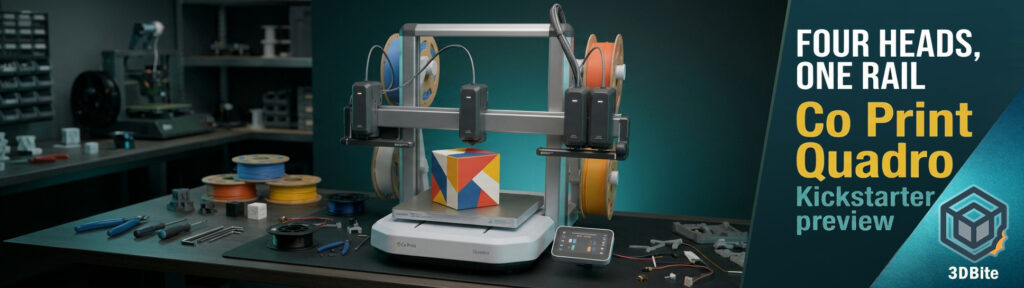
Most multi-colour printers solve the same problem in one of two ways. Either you push different filaments through one nozzle and flush the old colour out every time, which is what my A2L and its AMS do, or you swap whole toolheads in and out of a dock, which is what the Snapmaker U1 and Prusa XL do. Co Print’s Quadro tries a third way. It puts four complete toolheads on one X-axis, all of them there all the time, and slides whichever one it needs into the middle.
Co Print says that gets a colour change down to about a second. The Kickstarter has raised £345,587 against a £7,492 goal, from 600 backers, with 20 days still to run. Co Print is showing it at Formnext in Frankfurt this week. So it’s worth slowing down and separating three things: what the machine demonstrably is, what Co Print says it does, and what is still only promised.
Who Co Print are
If the name rings a bell, it’s probably from ChromaSet, the multi-material add-on kit Co Print crowdfunded in 2023, or MFM before that in 2021. The company has offices in Istanbul and London and has made printer add-ons since 2019. It says it has shipped to more than 10,000 makers in 64 countries. In March 2026 Quadro was on the Forbes Türkiye startup list. The Kickstarter page is registered in London.
That history cuts both ways. Co Print has delivered physical products to backers before, which plenty of first-time printer campaigns can’t say. But Quadro is its first complete printer, and a whole machine is a far bigger job than a kit that bolts onto someone else’s. ChromaSet also shipped late, a point I come back to further down.
How four heads share one rail
Co Print calls the layout IQEX, short for Independent Quad Extruder. A normal IDEX printer has two heads on one X-axis, each on its own belt and motor. Quadro takes that idea to four. Each head has its own belt, stepper motor and belt tensioner, and the X-axis carries four stacked belts. Add two synchronised motors on Y and one on Z, and the machine has seven motors.
When a head isn’t printing it parks in a QDock, a station at each end of the axis that holds up to three heads. Co Print says the dock seals the parked nozzle so it doesn’t ooze and lets it cool to around 140 °C. Each head starts reheating about 30 seconds before it’s needed, while the current head is still printing.
The heads can’t pass each other, though. They stay in order, T1 to T4 from left to right, so if T3 is printing, T1 and T2 must be parked on the left and T4 on the right. That’s why each dock has room for three. It also explains why the changes Co Print quotes get longer with distance: T1 to T2 takes 1.00 s, T1 to T3 takes 1.40 s and T1 to T4 takes 1.57 s.
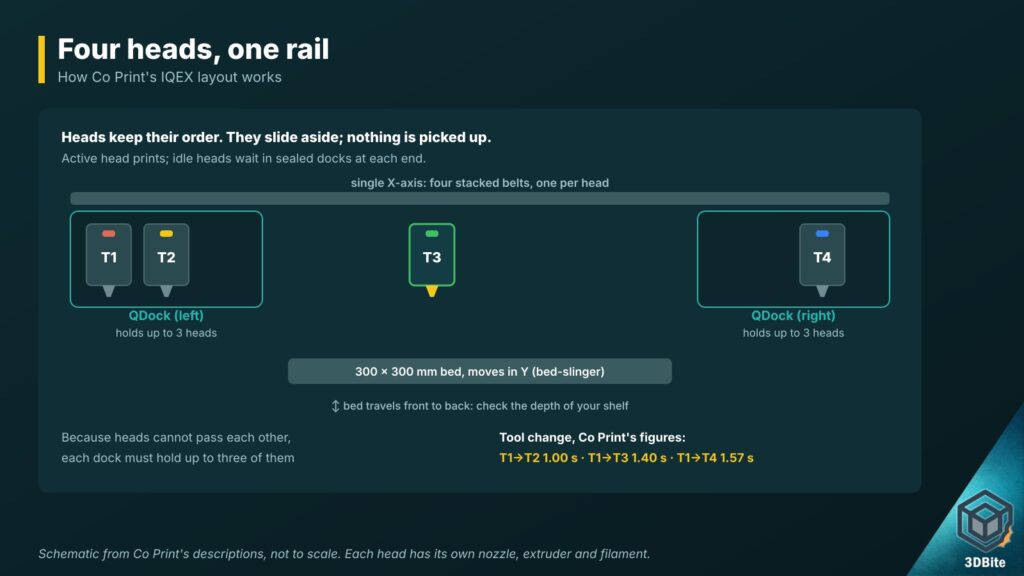
All3DP’s Matthew Mensley wrote about the design when it was announced in January. He noticed that the X-axis looks unusually long, which is what you’d expect when the axis has to hold docks at both ends as well as the print area.
The spec sheet
| Item | Co Print’s figure |
|---|---|
| Build volume | 300 × 300 × 300 mm |
| Motion | Bed slinger, open frame, about 70% metal |
| Toolheads | Four, independent, on one X-axis |
| Max speed / acceleration | 600 mm/s, 10,000 mm/s² |
| Hotend | 300 °C, 24 mm³/s (Co Print PLA at 220 °C) |
| Nozzles | Hardened steel, 0.2 / 0.4 / 0.6 / 0.8 mm (all four the same size for now) |
| Bed | 305 mm PEI spring steel, load-cell mesh levelling |
| Screen and camera | 4.3 inch 800 × 480 touchscreen, 1080p camera |
| Footprint | About 780 × 620 × 515 mm |
| Filament | 1.75 mm, any brand |
| Firmware / slicer | QuadrOS on Klipper; Co Slicer (OrcaSlicer fork) |
Before every print it runs a calibration routine. That covers offset calibration between the heads against a reference point at the back right, a bed mesh from a load cell, input shaping and automatic flow-rate calibration. A “Full Self-Check” button runs the lot. Each head also has QLight LEDs, so you can see which colour is loaded where.
What actually happens at a colour change
It helps to put the three approaches side by side. A single-nozzle machine with a feeder, like my A2L with its AMS, retracts the old filament, loads the new one and purges until the colour runs clean. On a busy four-colour print that happens hundreds of times, which is where most of the waste and most of the extra hours come from.
A conventional tool changer such as the Snapmaker U1 drops one head in a dock and picks up another. That takes about five seconds on the U1, or around ten once you include the prime, and there’s no colour flush because each head only ever holds one filament. Quadro also skips the flush, but it doesn’t pick anything up. The next head just slides along the axis.
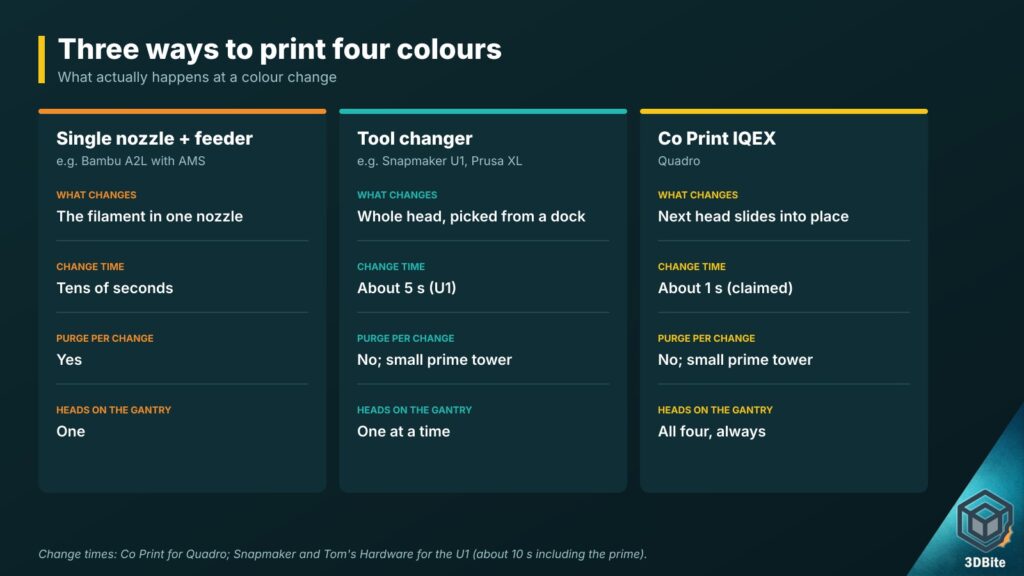
One small point the marketing is quiet about: Quadro still prints a small prime tower to settle the nozzle pressure after a change. “Zero Waste Mode” moves that priming into the model’s infill on compatible prints. It’s a setting you switch on, not the default, and it won’t suit every model.
We covered why manufacturers are moving away from purge-based multi-colour in The Industry Is Quietly Moving Toward Tool Changers. Quadro is another sign that this shift is real.
Re-reading the waste and speed claims
Co Print leads with “up to 90% less waste” and “up to 70% faster”. Both come from its own tests on five four-colour models. The comparison machines are an “A2L reference” single-nozzle printer and a “U1 reference” tool changer. The most detailed set of numbers I found, for a four-colour chameleon model, was reported by Yanko Design:
| Machine | Print time | Filament wasted |
|---|---|---|
| Single nozzle (A2L reference) | Just over a day | 180.7 g |
| Tool changer (U1 reference) | 10 h 5 min | 44.65 g |
| Quadro | 9 h 34 min | 34.16 g |
I worked the numbers out myself. Against the single-nozzle machine, Quadro wasted about 81% less filament and took at least 60% less time. Against the tool changer the gap is much smaller: about 23% less waste and roughly 5% less time, which is 31 minutes on a ten-hour print.
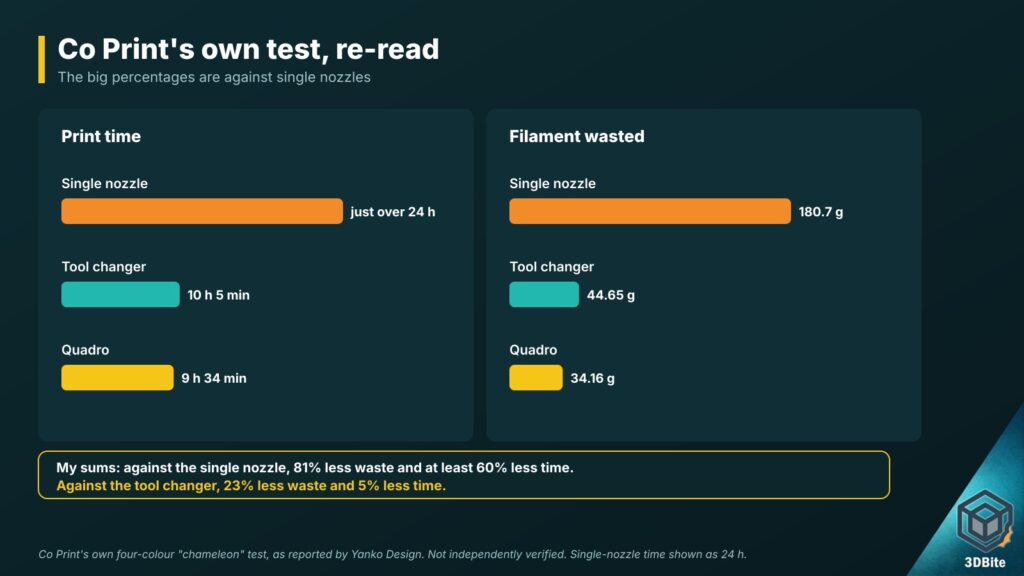
That’s the most useful thing I can tell you about this machine. The headline percentages are mostly a win over purge-based printers, and every tool changer gets that win. The advantage over the U1, its nearest rival, is real if the numbers hold, but it’s modest. And they are still Co Print’s numbers. Manufactur3D pointed out that the test conditions haven’t been published, Co Print’s own guide doesn’t name the machine it compared against, and the comparison charts on the product page showed “0%” placeholders when I looked.
Software: Klipper underneath, a lot still to come
QuadrOS runs on what Co Print calls “unforked Klipper”, which is a good sign for anyone who likes to tinker. Co Print says the QuadrOS source “will follow”, with no date and no licence named so far. The slicer, Co Slicer, is an OrcaSlicer fork that is already on GitHub for Windows, macOS and Linux. There’s also a Co Print phone app for Android and iOS.
Here’s what Co Print says works today:
- Four-colour and multi-material printing with one head per filament
- Dual printing, where heads 1 and 2 and heads 3 and 4 print two copies of a two-colour model at once
- Copy mode (the FAQ says mirror mode works too; Yanko and Manufactur3D say mirror is still in development)
And here’s what is promised as a free update, “with the goal” of being ready by delivery:
- Mixed nozzle sizes across the four heads (currently “in testing”)
- CMYK full-colour printing
- Print farm management tools
- Failure detection from the camera, which the campaign says will only ship once it’s reliable
It can’t run four separate jobs at once, by the way. The heads share an axis and a bed, so the most it can do is two copies.
Mixed nozzle sizes are the feature I’d most like to see. A 0.2 mm nozzle for detail and a 0.6 mm for infill on the same print is exactly what Bambu is chasing on its H-series machines, which we covered in Mixed Nozzle Sizes Are Coming to the H2D, H2C and X2D. For now, though, it’s a promise.
Materials and the enclosure
On the open frame Co Print lists PLA, PETG, TPU 95A, PVA and PLA-CF. ABS and ASA need the optional enclosure, which is £97 as an add-on or included in the Complete Pack. The materials list makes a better case than the colours do. With one head per filament, PVA supports and a TPU part next to a PLA one don’t need any flushing between them.
The enclosure details are vaguer. The FAQ says it has built-in filtration. Co Print’s own enclosure blog post says it contains fumes and recommends ventilating the room. Those two statements don’t quite agree, so if you print ABS indoors, ask before you rely on it. Co Print also says not to print PLA with the enclosure on, and in reply to a backer’s comment admitted that the enclosure’s dimensions haven’t been published yet. If you’re weighing up enclosed machines more generally, Are Enclosed Printers Becoming the Default? covers the trade-offs.
What the design gives up
Every multi-colour approach has costs, and Quadro’s are fairly easy to see.
It’s a bed slinger. A 300 mm bed travelling front to back needs depth on your bench, and Co Print’s 780 × 620 mm footprint doesn’t say whether it includes that travel. Measure your shelf before you back it. A moving bed is also a known limit on speed for tall, thin parts, whatever the 600 mm/s headline says.
You also have four hotends to maintain. Four nozzles can clog, four heater cartridges can drift, four sets of belts need tension, and the offsets between four heads have to stay calibrated. Co Print names four-head alignment as a risk in its own Risks section, which I respect. The automatic calibration before each print is its answer. Whether that holds up after six months of daily use is the question I’d most like a long-term owner to answer.
Spool handling is basic. There’s nothing like an AMS here: spools sit on side holders and feed through PTFE tubes. That’s fine, but it means four spools on the outside of the machine and no automatic refill when a spool runs out. The optional dryers (£29 each, or four in the Complete Pack) help with damp filament but don’t change that.
Finally, four colours is the limit. A U1 is also four, but InfiMech’s MX Pro goes to eight, and AMS-style machines go well beyond that if you don’t mind the purge.
Price, and what UK backers actually pay
| Tier | GBP | USD | Notes (17 November) |
|---|---|---|---|
| Super Early Bird | £489 | $649 | Printer only; 66 of 500 left |
| Early Bird | £529 | $699 | Printer only |
| Complete Pack | £678 | $899 | Adds enclosure, four dryers, four-hotend kit, extra plate |
| Duo | £943 | $1,249 | Two printers |
| Farm Pack | £1,811 | $2,399 | Four printers plus extras; 50 available |
The planned retail price for the printer alone is $899. Co Print also says that if the campaign passes $500,000, every backer gets a free extra hotend.
Those pledge prices don’t include shipping, which is charged after the campaign through PledgeBox, or import VAT and duties. Units ship from China. For a UK backer, 20% import VAT on the £489 tier alone is about £98 by my arithmetic, before shipping and any handling fee from the courier. Estimated delivery is February 2027, in pledge order, with people who reserved first at the front of the queue.
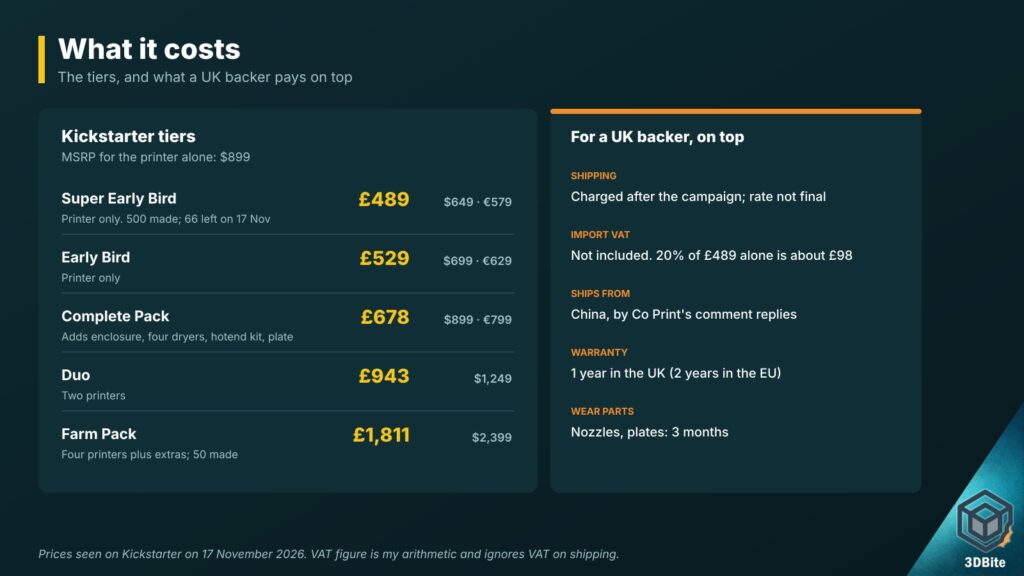
The warranty is one year in the UK and two in the EU, with three months on wear parts such as nozzles and plates. Co Print promises a reply from UK and US support within one business day. CE, FCC and UKCA certification is listed as “in progress”.
How it compares
| Co Print Quadro | Snapmaker U1 | InfiMech MX Pro | LightMake L4 | |
|---|---|---|---|---|
| Approach | Four heads on one X-axis, slide aside | Tool changer, heads docked | Tool changer | Four heads on one gantry, linear motors |
| Heads | 4 | 4 | 8 | 4 |
| Build volume | 300 mm cube | 270 mm cube | 300 mm cube | 354 × 370 × 386 mm |
| Frame | Bed slinger, open | CoreXY | Enclosed, heated chamber | Gantry |
| Price seen | From $649 / £489 (Kickstarter) | $999 list, $699 Black Friday | From $549 (Kickstarter) | From $1,299 (Kickstarter) |
| Status | Kickstarter, ships Feb 2027 (est.) | Shipping | Kickstarter | Kickstarter |
Right now the awkward comparison for Co Print is the U1. It’s a CoreXY machine you can buy today, and its Kickstarter shipped ahead of schedule to more than 20,000 backers. At its Black Friday price it costs about the same as Quadro’s Early Bird tier, without the wait. One Austrian backer made a similar point in the comments, that the U1 was cheaper on Kickstarter. Quadro’s counter is the bigger build volume, faster changes and slightly less waste. Whether that’s worth a three-month wait and the crowdfunding risk is your call. I’d want to see independent tests first.
InfiMech’s MX Pro is the other one to watch. It has twice the heads and an enclosed heated chamber at a lower super early bird price, but InfiMech is newer to this, and its pricing has already caused controversy. The LightMake L4 is the closest idea to Quadro, also four permanent heads on one gantry, but it costs twice as much and comes from a first-time maker.
Track record and risk
Co Print’s Risks section is better than most. It names production scaling, keeping four heads aligned, software that isn’t finished, certification and customs. It says the machine has been in development for two years, that a pilot production line is running with a manufacturing partner in China, and that units are already with reviewers.
The history is mixed. ChromaSet was due in March 2024, and a later campaign update pushed it to the end of August after a change to the ChromaHead board. Co Print’s own store has 34 reviews on KCM, 71% of them five stars. The complaints are mostly slow shipping, missing brackets and waits of several days between support replies. None of that is unusual for a small hardware company, and some of it may have improved since. But it’s the right context for a promised February 2027 delivery.
On the review units: the first hands-on video I found is TheLayeredWorkshop’s first look on 12 November. It says the channel is working closely with the Co Print team, and I couldn’t see a sponsorship disclosure in the description. That doesn’t make the video wrong, but it isn’t an independent review, and I haven’t found one with measured results yet.
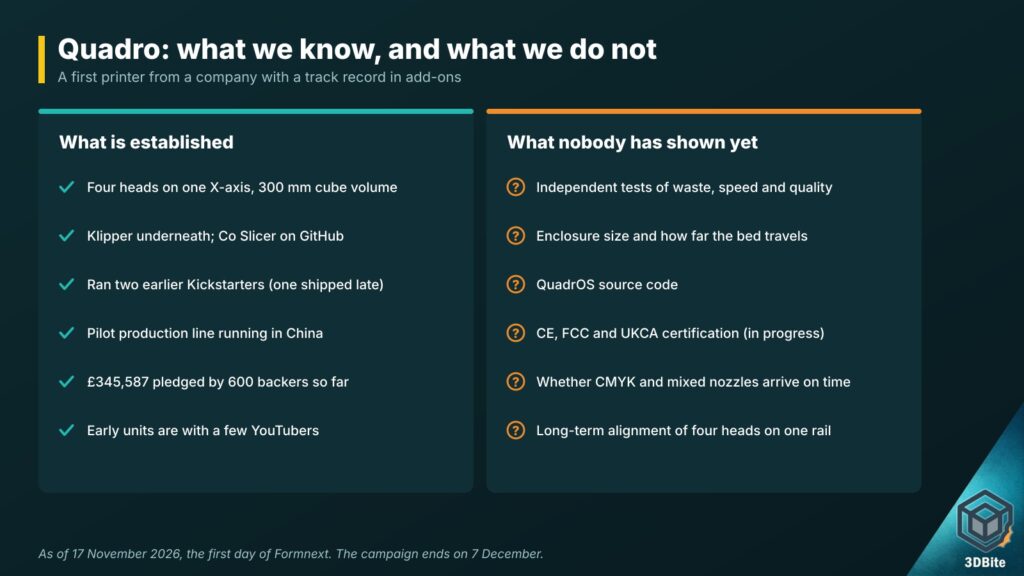
Where the evidence is thin
- Every figure for speed, waste and tool-change time comes from Co Print. The test settings and the comparison machines haven’t been published in full.
- No independent review with measured print quality, accuracy between heads or noise exists yet.
- The enclosure’s filtration is described two different ways in Co Print’s own material, and its size isn’t published.
- Mirror mode, mixed nozzle sizes, CMYK and farm tools are all still in development.
- The QuadrOS source and its licence haven’t been published.
- Certification for the UK, EU and US is not finished.
- Shipping costs haven’t been confirmed.
My take
I like the idea. Keeping four heads on the axis permanently gets rid of the docking and pickup step that slows other tool changers down, and Co Print has clearly thought about the details: the sealed docks, the timed preheat and the calibration before each print. Running it on Klipper and an OrcaSlicer fork, instead of a closed system, is the right call, and it fits the argument we made in Closed vs Open Ecosystems.
But I own an A2L, the machine Co Print chose to compare against, and I know where its waste comes from. Any tool changer will beat it on waste. The question that matters is whether Quadro beats the tool changers enough to justify the wait and the risk. On Co Print’s own figures, the answer is “a bit”.
If you want multi-material printing (PVA supports, TPU and PLA in one part) on a 300 mm bed, already back crowdfunded hardware, and are comfortable with a bed slinger, the Super Early Bird at £489 is a reasonable bet from a company that has delivered before, even if late. If you want something that works this Christmas, look at the U1. If you’re unsure, there’s no harm waiting for the first independent reviews. The campaign runs until 7 December, and the printer will have a retail price after that.
Before you back it, check:
- That you have the bench depth for a 300 mm bed slinger.
- That you’ve budgeted for shipping plus import VAT, which is around £98 on the cheapest tier.
- That you’d be happy with it even if mixed nozzles, CMYK and mirror mode arrive late.
- That you can afford to wait past February 2027 if it slips.
- That you’re comfortable maintaining four hotends instead of one.
Sources and further reading
- Co Print: Quadro product page
- Kickstarter: Co Print Quadro campaign, rewards, Risks section, FAQ and comments (read 17 November 2026)
- Co Print: QDock station and sealed toolhead parking
- Co Print: Quadro vs AMS-style printers
- All3DP: Co Print previews Quadro (Matthew Mensley)
- GitHub: CoPrintSlicer
- 3Dnatives: InfiMech MX series
- Yanko Design: Co Print Quadro coverage, including the chameleon test figures
- Manufactur3D: Co Print Quadro coverage
- TheLayeredWorkshop (YouTube): Quadro first look, 12 November 2026
- Tom’s Hardware: Snapmaker U1 review
- 3DBite: The Industry Is Quietly Moving Toward Tool Changers
- 3DBite: Snapmaker U1 Tool Changer 3D Printer
- 3DBite: InfiMech MX Pro
- 3DBite: The LightMake L4