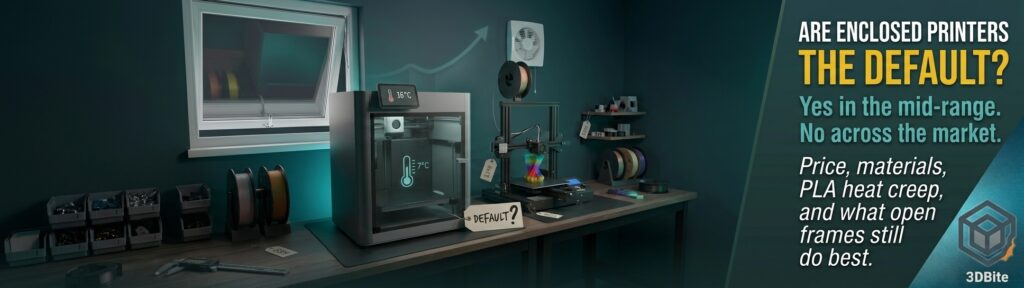
Read enough 2026 buying guides in a row and you start to notice a change in grammar. A few years ago the enclosed printer was the special case, the thing you bought when you had outgrown PLA and wanted to try ABS. Now, in a surprising number of roundups, it is the open-frame printer that arrives with a qualifier attached: “no chamber”, “PLA and PETG only”, “the open frame rules out ABS and ASA”. The box with the door has quietly become the unmarked option. I own two open-frame machines, an A1 and an A2L, and I am happy with both, so I came to this question with a personal stake and, I will admit, a mild suspicion that the fashion was running ahead of the physics. Having spent some time going through how the market actually looks, my answer is more qualified than a headline. Enclosed printers are becoming the default, but only above a certain price, and the more interesting story is why, and what the default really means once you look inside the box.
A word on evidence before the argument
I went looking for hard market data on how many enclosed printers are sold compared with open ones, and I did not find anything I would trust. A couple of sites quote confident percentages about enclosure market growth and premium sales share without saying where the numbers come from, and I have left them out. What can be observed reliably is the shape of the product lineups, the prices, and what reviewers recommend. That is weaker than sales data, and it is shaped by the incentives of roundup sites, many of which carry affiliate links, so treat “the guides all say this” as evidence of the conversation rather than of the market. With that caveat, here is what the lineups show.
The case that the answer is yes
The strongest evidence is the price floor. An enclosed CoreXY used to mean spending real money. One 2026 guide describes Elegoo’s Centauri Carbon as a fully enclosed CoreXY machine at a price that would previously have bought you an open-frame bed slinger, at around $300. Bambu’s P1S, the printer that pushed enclosed machines into the sub-$1,000 mainstream, is now discounted to roughly $400 with its successor available, and Creality’s K1C is listed at the same level. The wider picture, from one buyer’s guide reviewed this month, is a tier of enclosed machines stacked up between about $300 and $700.
| Printer | Enclosure | Approximate US price |
|---|---|---|
| Elegoo Centauri Carbon | Passive, fully enclosed CoreXY | About $299 to $315 |
| Bambu Lab P1S | Passive, enclosed | About $399 while stock lasts |
| Creality K1C | Passive, enclosed | About $399 |
| Bambu Lab P2S | Enclosed with Active Airflow and filtration | About $549 |
| Anycubic Kobra S1 ACE 2 Pro Combo | Enclosed, with multicolour included | About $574 |
| QIDI Q2 | Enclosed, heated chamber up to 65°C | About $580 |
| Bambu Lab X2D | Enclosed, 65°C active chamber, HEPA and carbon filtration | About $649 |
| Creality K2 Pro Combo | Enclosed, 60°C active chamber, multicolour | About $1,049 |
| Prusa CORE One+ | Enclosed, up to 55°C active chamber | About $1,199 |
These are approximate US list prices taken from a buyer’s guide that carries affiliate links and says prices vary by region and sale period, so use them as a sketch of the landscape rather than a price list. The sketch is clear enough. Another guide puts it more bluntly: enclosed CoreXY machines have largely replaced open bed slingers at the enthusiast level, and between $500 and $1,500 nearly everything worth buying is enclosed. A third guide’s own ranking has an enclosed machine, the Bambu P2S, as the best choice for most people. If you accept that the people writing these guides reflect how the market thinks, the middle of the market has moved decisively.
There is a quieter shift under the headline one too. The enclosure itself is evolving from a passive shell into an actively managed environment. A heated chamber at 55 to 65 degrees was once a prosumer feature. Now the X2D offers 65 degrees with filtration for $649, QIDI sells a 65 degree chamber machine for around $580, and Prusa and Creality both offer active chambers in the 55 to 60 degree range. The same buyer’s guide describes CoreXY motion, active chamber heating, AI failure detection and multi-filament printing as no longer premium features but the baseline. That is a stronger claim than “enclosures are common”, and it matters for what comes next.
The case that the answer is no
Now the counter-evidence, which is more interesting than it first looks. Open frames have not gone away, and some of the most telling 2026 launches are open.
- Bambu itself keeps shipping open frames. The A2L, which I own, arrived in 2026 at $469 with a 330 by 320 by 325mm bed, the volume of the H2C for far less money. Bambu lists it for PLA, PETG, TPU and PVA, with no chamber, and the buyer’s guide calls it the best plate per dollar on its page. The A1 and A1 mini remain the “just works” beginner recommendations, with the A1 mini at about $220.
- Elegoo dropped the enclosure on purpose. The Centauri 2 Combo takes the Centauri Carbon’s CoreXY motion and 256mm cube, removes the enclosure and adds four-colour printing for about $329. The guide notes the trade-off is that the open frame rules out ABS and ASA, and that it is aimed squarely at buyers who want multicolour for less.
- The newest toolchangers treat the box as optional. The Snapmaker U1, at about $899, sells its enclosure lid separately, and the guide notes ABS and ASA need it. Creality’s new K3 toolchanger opened pre-orders at $849 with no heated chamber on the base model and an enclosure lid sold separately.
- Cheap multicolour bed slingers are thriving. The Kobra 3 V2 Combo and the SparkX i7 are both open frame, both under about $400, and both pitched on multicolour rather than materials.
- Large volume stays open. The Kobra 3 Max V2 offers a 420 by 420 by 500mm bed in an open frame for about $899, and Anycubic itself steers buyers to PLA, PETG and TPU on it.
Put those together and a more careful statement emerges. Manufacturers are not treating the enclosure as mandatory. They are treating it as a lever. When they want to chase materials capability, they add it. When they want to chase multicolour, volume or price, they leave it off, and several are offering it as an optional extra. That is not what a settled default looks like. It is what a feature that has become cheap enough to add or remove at will looks like.
Why the box spread
If enclosures are optional on paper, why do they dominate the middle of the market? I think several forces are working at once, and not all of them have anything to do with printing ABS.
The cost collapsed. This is the simple one. A pre-assembled CoreXY with an enclosure now costs about what an open bed slinger did, so the enclosure is no longer a premium that buyers have to justify. When a feature is nearly free, it spreads.
Materials ambition. People buy printers for the things they hope to print, not just the things they currently do. A buyer who thinks they might one day want ASA brackets or carbon-fibre parts will pay for the capability up front. The guides play to this, with entire roundups organised around ABS and ASA readiness. The A1 enclosure post and the nylon post cover why those materials genuinely need warmth and shelter, and it is a real need for the people who have it.
Noise and the living room. One guide makes a point that rarely gets airtime: enclosures mean quieter operation, fewer drafts ruining prints, and a machine that does not look like a science project in your living room. Printers are moving out of garages and into shared spaces, and a closed shell is a cheap way of making a printer acceptable to the rest of the household. The P2S, for example, is listed with carbon and particle filtration at around 42 decibels.
Safety and filtration as a selling point. A shell invites a filter. Built-in carbon and HEPA filtration, as on the X2D and the Prusa CORE One, turns the enclosure into a safety feature as well as a thermal one. I would be careful about leaning too hard on this, for reasons I return to below.
Competitive pressure. Once Bambu made the P1S a mainstream enclosed machine and Prusa answered with the CORE One, rivals had to match. Nobody wanted to be the brand whose headline printer was missing a door. The same dynamic is now playing out with active chamber heating.
Integration. A shell is a convenient place to put things. Cameras, airflow flaps, filtered exhaust, chamber sensors and AI monitoring all have an obvious home inside an enclosed machine. As printers have become systems rather than frames, the enclosure has become the chassis for the system.
The part the guides gloss over: PLA does not love a warm box
Here is where my suspicion that fashion was outrunning physics comes from. The overwhelming majority of printing, mine included, is PLA and PETG, and PLA is the material that dislikes a hot enclosure most. Its glass transition sits around 60 degrees, and if the chamber gets warm enough, the cold end of the hotend can heat soak, the filament softens too high up and the nozzle jams. That is heat creep, and the heat creep post explains the mechanism. The reviewers know this, which is why the advice about PLA in an enclosure is oddly contradictory depending on which guide you read.
| What the guides say about PLA in a box | Source type |
|---|---|
| An open frame prints PLA and PETG better and cheaper, so skip the enclosure if that is all you print | A buyer’s guide that tested enclosed machines |
| PLA prints fine in an enclosure provided the chamber stays under about 40°C, and most modern enclosed CoreXY printers ship with a vented lid or chamber fan | An enclosed-printer buyer’s guide |
| With the lid on, PLA can cause heat creep, so the lid must come off for PLA sessions on that particular machine | A review of a budget enclosed printer |
| The Prusa CORE One is engineered so PLA and PETG print with the door fully closed | A buyer’s guide summarising the design |
| The P2S uses an Active Airflow flap that switches between fresh air and recirculation, so ABS and ASA can print door closed and PLA does not cook | A buyer’s guide summarising the design |
Read as a set, those entries tell a clear story. The passive box is a compromise: it helps the materials that want warmth and can quietly harm the one most people print. The more expensive machines resolve the contradiction with engineering, using actively managed airflow, so the chamber can be warm for ABS and cool for PLA. The cheapest enclosed machines resolve it with a note telling you to take the lid off. So “enclosed by default” is accurate as a description of the cabinet and slightly misleading as a description of the experience, because the thing that makes the cabinet work for PLA is the airflow management inside it. The A1 enclosure post made much the same point about retrofitting a box to an open printer, which Bambu itself does not recommend for the A1.
An enclosure is not a ventilation system
One more caution, because the filtration marketing deserves scepticism. A closed shell and a built-in carbon filter feel reassuring, and for the right materials they genuinely help. But one 2026 guide cautions that even on a capable machine like the P2S, ABS and ASA release volatile organic compounds when melted, and that you should keep the room well ventilated even with a built-in carbon filter. A door that stays shut does not make fumes disappear, and an enclosed machine in a small room can concentrate them. The fumes and ventilation post covers the underlying safety picture. Enclosures can be part of a sensible approach to air quality, but treating them as a substitute for ventilation would be a mistake, and it is a mistake the marketing quietly invites.
The enclosure is turning into climate control
If I had to pick the single most important trend underneath the question, it is that the unit of competition is shifting from “does it have a door” to “how well does it manage the air inside”. The X2D at $649 with a 65 degree chamber and filtration is the clearest sign. It is a P2S with the two upgrades buyers keep asking for, and it sits only $100 above it. When active chamber heating arrives at that price, the passive box starts to look like a transitional technology, a stage on the way to something else. The next big shift post argued that the future of consumer printing is about reliability, dual nozzles and environment rather than raw speed, and the chamber is part of that.
It also has a consequence for the shared chamber problem I covered in the multi-tool printers post. The more a machine is a sealed, managed environment, the more everything that happens inside it, from laser smoke to resin vapour, becomes the printer’s problem. A sealed chamber is a strength for printing and a liability for anything messy.
What this means for people like me
I print mostly PLA, with some PETG, on an A1 and an A2L, both open. Having thought it through, I do not feel I am missing anything by not owning an enclosed machine, and the evidence supports that. PLA and PETG print well in the open, the machines are quiet and fast, I can reach everything, and I do not have to worry about heat creep from a warm chamber. The A2L in particular gives me a very large bed for the money. If I started needing ASA or nylon, I would buy a machine designed for it rather than try to turn an A-series into something it was not built to be, which is the advice from the A1 enclosure post. The open frame is not a lesser tier for me. It is the right tool for what I do.
I would not tell a newcomer the same thing without a few questions first, because for them the enclosed option has real advantages that I have taken for granted.
| If this is you | Lean towards | Why |
|---|---|---|
| You mostly print PLA and PETG and want the best value | Open frame | It prints those materials better and cheaper, and you avoid heat creep |
| You want a very large bed on a budget | Open frame | Volume per dollar is where open bed slingers still lead |
| You want cheap multicolour | Open frame is fine | The budget multicolour machines are mostly open |
| You might want ABS, ASA, nylon or carbon fibre | Enclosed, ideally with a heated chamber | Those materials need warmth, and a passive box may not be enough for the hard ones |
| Your printer lives in a shared room or flat | Enclosed | Quieter, fewer drafts, and the option of filtration |
| You have children or pets near the printer | Enclosed | The shell keeps hands and hair away from moving parts |
| You expect to grow into heavier use | Enclosed, mid-range | You are paying little extra for headroom you may use later |
Where I think this goes
Here are my own predictions, which are reasoning from the lineups rather than anything I can prove, so read them as informed guesses with my confidence attached.
- Likely: the enclosed CoreXY price floor keeps falling. If a fully enclosed machine can be had for about $300 now, I expect it to become the default for any new mid-range launch within a year or two.
- Likely: active chamber heating becomes standard above roughly $500. The X2D and the QIDI Q2 already point there, and competitive pressure will do the rest.
- Likely: open frames survive in three places: the cheapest entry machines, very large bed slingers, and budget multicolour. The 2026 launches I listed suggest manufacturers have worked this out.
- Plausible: the enclosure becomes modular. The U1 and K3 both sell the lid separately, which is a clever hedge. It lets a maker ship one machine at a lower price and sell the enclosure to those who need it.
- Uncertain: whether Bambu’s A-series eventually gains an enclosed sibling at the A2L’s price, or whether the company keeps the line open and the P-series enclosed as a deliberate split.
Verdict
Are enclosed printers becoming the default? In the mid-range, yes, and the reasons are mostly sound: the cost collapsed, the machines are quieter and more capable, and a managed chamber is a genuine step forward for anyone who wants to print beyond PLA. Across the whole market, no. Open frames are still being launched by the same companies that make the enclosed ones, and they are being launched on purpose, for buyers whose priorities are price, volume or multicolour. The honest framing is that the enclosure has stopped being a feature and become an option that manufacturers can switch on and off, and that the interesting competition has moved on to what happens to the air inside the box.
For me, the practical conclusion is reassuring. If you print PLA and PETG, which most of us do most of the time, an open printer is not a compromise, and the fashion for enclosures is not a reason to replace a machine that works. If you can see yourself printing engineering materials, the enclosed mid-range has never been better value, and you will likely be glad of it. Buy for what you actually print, not for what the best-of lists happen to test.
Sources and further reading
- 3DPrinting.com: Best 3D Printers 2026 buyer’s guide (reviewed 19 October 2026)
- 3D Print Gear Lab: Best enclosed 3D printers 2026
- Filamino: Best enclosed 3D printers 2026
- Sigma Filament: Enclosed 3D printer buyer’s guide 2026
- PrintingXYZ: Best enclosed 3D printers 2026
- FilamentMap: Best 3D printers for home, workshop or business in 2026
- 3D Maker Engineering: Best 3D printers of 2026
- Direct Macro: Enclosed vs open 3D printers