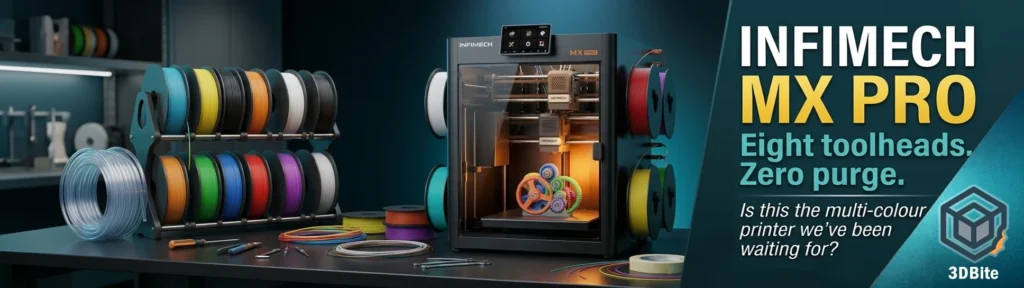
I wrote a post not long ago titled Are We Entering the AMS Arms Race? — a survey of every multi-material system in the market and a wishlist for the machine that does not yet exist: more than four colours, near-zero purge waste, accessible price, good ecosystem. The conclusion was that nobody had built that machine yet. That may be about to change. The InfiMech MX Pro has arrived on Kickstarter with eight toolheads, inductive heating, smart offset calibration, and a blob detection system — and it is directly answering the brief that the AMS arms race has been building toward. I have not printed on it. I cannot review it. But I find it genuinely exciting and I want to talk about why.
Who is InfiMech?
InfiMech is a subsidiary of Flying Bear, a Chinese 3D printer manufacturer with a longer history in the market than their name recognition in the English-speaking community might suggest. Flying Bear has been producing FDM printers since around 2018 and has a solid following in the German and Eastern European maker communities in particular. InfiMech was established as a separate brand focused on higher-specification machines, and they already have the TX in the market — a Klipper-based enclosed CoreXY machine with a hardened steel nozzle and active chamber heating. It is not a first product from a company that does not know how to build printers. The MX Pro is ambitious, but it is not a garage startup making promises on a slide deck.
The Kickstarter campaign is live now. No price has been announced at the time of writing — deposits are being taken on InfiMech’s own store, and the campaign page collects email signups. Pricing is the single biggest open question about this machine, and it is the one that will determine whether it is genuinely competitive or merely technically interesting.
The core architecture: passive nozzle swap, not full toolhead swap
The MX Pro is described as a tool changer, but the specific architecture is worth being precise about because it is different from the Snapmaker U1 and the Prusa XL in an important way. Similar to the INDX system, it is not the entire toolhead that is swapped but only the passive nozzles. This is a meaningful distinction. On the U1, each of the four toolheads is a complete independent unit — motor, extruder, hotend, filament — and the machine docks and picks up the entire assembly. On the MX Pro, a single shared carriage with its own motor and drive system swaps only the nozzle tip. The filament for each colour stays attached to its own passive nozzle unit. The carriage picks up the appropriate passive nozzle for each colour and drives it from above.
This approach has specific advantages. Eight full independent toolheads would be heavy, mechanically complex, and expensive to engineer with the precision required for consistent print quality at speed. Eight passive nozzle units — without individual motors, extruders, or electronics — are lighter, simpler, and cheaper to manufacture at equivalent precision. The single active carriage handles all the mechanical work. The passive nozzles are passive by design. It is the same logic that makes the Anycubic Kobra X’s ACE Gen 2 architecture interesting: solving the colour change problem with an elegant mechanical trade-off rather than brute-force hardware duplication.
Inductive heating: the genuinely novel element
The MX Pro’s hotend heating system is the most technically distinctive feature in the specification. According to InfiMech, temperature measurement at the hotend is contactless and without separate cabling, which should improve the reliability of the heating control. The nozzles are heated via induction, which the manufacturer describes as fast and contactless. The hotend is heated inductively, not with a resistance heater, using a current-carrying coil, which is intended to enable particularly fast heating.
Inductive heating in an FDM context is not entirely new in the research literature — it has been explored as a high-speed heating alternative for years — but it has not appeared in a consumer FDM product before at any meaningful scale. The claim of contactless temperature measurement alongside inductive heating is particularly interesting. Standard hotends use a thermocouple or thermistor wired directly to the heater block. Contactless temperature measurement — likely infrared or inductive sensing — removes the wire connection between the stationary carriage electronics and the swappable passive nozzle, which is exactly what you need when the nozzle is a passive unit being picked up and set down repeatedly during printing. The wiring problem for a swappable heated nozzle is non-trivial, and contactless measurement is an elegant engineering solution to it.
How fast “particularly fast heating” translates in practice — and whether the inductive system maintains precise temperature control equivalent to a traditional resistance heater at FDM print speeds — is something only independent testing will confirm. The physics of inductive heating support the speed claim. The precision and consistency claims require real-world validation.
Smart offset calibration
One of the persistent challenges in any tool changer system is nozzle offset — the physical position of each nozzle tip varies slightly between toolheads, and if those offsets are not precisely calibrated and compensated, colour transitions will show visible misalignment on the finished print. The Snapmaker U1 addresses this with its kinematic coupling system, engineered to align toolheads within 0.04mm repeatably. InfiMech’s solution is a smart offset calibration system — a so-called smart offset calibration is designed to align the nozzles with each other in order to avoid visible offsets when changing tools. According to the manufacturer, any discrepancies between the individual print nozzles regarding the approach position and the actual extrusion point are detected.
The calibration approach suggests active measurement and software compensation rather than purely mechanical precision. If the system measures and corrects offsets in real time or at calibration intervals, it can potentially achieve equivalent alignment accuracy with less stringent mechanical tolerances — which is useful for managing manufacturing cost on eight passive nozzle units.
Blob detection
Blob detection is the error monitoring feature. It is designed to detect when the 3D model is stuck to the print head, preventing faulty print processes from continuing. A blob — the accumulation of molten filament on the nozzle that can occur during a failed print or a problematic filament transition — is one of the most damaging failure modes in FDM printing. A blob that is not detected quickly can be dragged across the print, embedded in subsequent layers, or cause the nozzle to crash into the print bed. InfiMech’s blob detection monitors for this condition and halts the print rather than letting a detected failure propagate. This is the same category of AI monitoring that Bambu’s camera-based systems perform, but implemented at the hotend level rather than through visual camera analysis.
Build volume and variants
The InfiMech MX 3D will be available in several model versions with a build volume of up to 300 × 300 × 300 millimetres and also with a heated chamber. The 300mm build volume is a meaningful step up from the Kobra X’s 260mm and puts it directly in the territory between Bambu’s A-series (256mm) and H-series (350mm). Based on the marketing images, there will probably be an open and a closed variant with chamber heating.
An enclosed variant with active chamber heating at 300 × 300 × 300 mm and eight toolheads is a compelling specification even on paper. The chamber heating opens up engineering materials — ABS, ASA, Nylon — without the limitations of open-frame printing. Eight toolheads means eight colours of those materials simultaneously without any purge waste between transitions. If the price is right, this is the specification gap I described in the AMS arms race post: more than four colours, near-zero waste, engineering material capability, all in one machine.
The Kickstarter question
The community reaction to the MX Pro announcement has been interested but appropriately cautious. The German 3D printing community forum observation captures the measured sentiment well: everyone can see the run on the U1 and wants a piece of the cake. But the fact that there are so few tool changers shows that it is not so easy, and I trust established companies more than a small manufacturer like InfiMech. With Snapmaker and the U1, I only took the risk when the first pre-production devices were well tested.
This is the right framing. The same forum commenter adds the manufacturer risk point: with smaller manufacturers, in the event of insolvency, spare part supply dries up. Especially if not too many devices were sold, you can’t even hope for third-party suppliers. InfiMech as a Flying Bear subsidiary is a more established entity than a pure Kickstarter startup — Flying Bear has been shipping printers for years and has genuine manufacturing infrastructure. But it is not Bambu, Prusa, or Snapmaker in terms of community support depth and parts availability track record.
The Kickstarter dynamic deserves specific attention. Bambu Lab’s community trust damage from the OrcaSlicer controversy is a recent reminder that ecosystem decisions made after a product launches can significantly affect the ownership experience. The MX Pro’s Klipper-based TX sibling suggests InfiMech is at least open-firmware aligned, which is the right directional signal. Whether the MX Pro itself runs on open or proprietary firmware — and whether InfiMech’s post-launch behaviour matches the open-ecosystem expectations of the community backing them on Kickstarter — are questions that only time answers.
The price question: everything depends on this
No price has been confirmed. This is the central unknown for the MX Pro and the variable that determines whether this machine is genuinely competitive or merely aspirationally interesting. The benchmark comparisons are straightforward:
| Machine | Max colours | Architecture | Build volume | Price (approx) |
|---|---|---|---|---|
| Bambu A1 Combo | 4 | AMS Lite filament switcher | 256³ mm | ~£350 |
| Anycubic Kobra X | 19 (expandable) | ACE Gen 2 integrated | 260³ mm | ~£259 |
| Snapmaker U1 | 4 | Tool changer — 4 full toolheads | 270³ mm | ~£800 |
| Bambu H2S Combo | Up to 20 (AMS chained) | Single nozzle, large format | 350 × 320 × 325 mm | ~£1,299 |
| Prusa XL (5-tool) | 5 | Tool changer — 5 full toolheads | 360 × 360 × 360 mm | ~£2,100 |
| InfiMech MX Pro | 8 | Passive nozzle changer, inductive heating | 300³ mm | TBC — Kickstarter pricing pending |
The MX Pro needs to land below the Prusa XL’s price to be genuinely interesting to the broad hobbyist market — the XL’s five toolheads at £2,100 represents the established ceiling for accessible tool changers. At £1,200–£1,500 for the MX Pro, it becomes very compelling. At £800–£1,000, it potentially reshapes the tool changer market the way the Snapmaker U1 reshaped the four-colour tool changer market. At above the XL’s price, the established reputation of Prusa becomes the safer bet.
My honest take
I want this machine to succeed. Eight colours with no purge waste and a 300mm build volume with an optional heated chamber is the specification I described wanting in both the A1 owner wishlist post and the AMS arms race roundup. The passive nozzle architecture is clever — it is the right approach for managing the complexity and cost of eight colour units on a single carriage. The inductive heating is genuinely novel and if it delivers on the speed and contactless measurement claims, it addresses the wire-connection problem inherent to swappable heated nozzles in an elegant way.
The cautions are real. InfiMech is a small manufacturer. The MX Pro is their most ambitious product by a significant margin. The Kickstarter model puts early backers in the position of funding development rather than buying a finished product — and 3D printer Kickstarters have a mixed track record even from established manufacturers. The ecosystem around a new machine from a smaller brand takes time to develop, and the first year of ownership is always the year where the community knowledge base is thinnest and support resources are most limited.
But the same logic that applied to the Snapmaker U1 applies here: if InfiMech delivers what the MX Pro’s specification promises, at a price that makes eight-colour tool changing accessible, they will have built the machine that has been missing from this market. The U1 proved there is a community that was ready to back exactly that kind of promise with real money. The MX Pro is aiming higher — eight colours versus four, inductive heating versus kinematic couplings — and if the price is right, I suspect the community response will reflect that ambition.
Watch the Kickstarter pricing announcement closely. That number tells you everything about whether InfiMech has priced this as a market-changing product or a niche engineering showcase. If it lands sensibly — and I am hopeful — this is the machine that moves the multi-colour printing conversation forward in the way the U1 started it.
Follow the InfiMech MX at Kickstarter and at infimech.com for pricing and campaign updates.