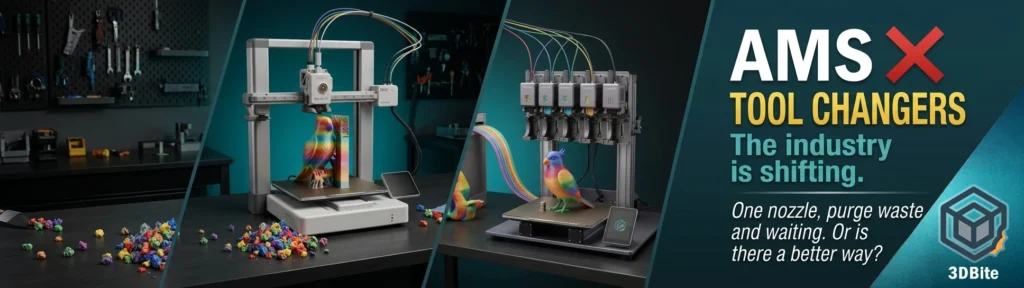
The shift is quiet because it has not announced itself dramatically. There has been no single product launch, no single review, no single moment where everyone agreed the paradigm changed. Instead there has been a gradual accumulation of signals: the Snapmaker U1’s record-breaking Kickstarter, the InfiMech MX Pro’s eight-toolhead announcement, the Elegoo CANVAS at $55, Bambu Lab’s own Vortek system acknowledging that the purge waste problem is real, the AMS arms race covered in the earlier post. Each one individually is a data point. Together they are a direction.
The direction is this: the desktop 3D printer space is now undergoing another significant shift. Two years ago it was high-speed 3D printing, then in the past year it was filament swapping systems for multicolour printing. In each case, one manufacturer launched a system that worked effectively with the new tech and the other manufacturers had to quickly follow or be left behind. Now, just as most manufacturers have or are about to announce filament swapping systems, there is another change taking place: waste-free multicolour 3D printing.
This post is an attempt to think through what that shift actually means — for the technology, for the market, and for the specific question that any hobbyist with an AMS-equipped printer needs to answer honestly: is a tool changer something I need, something I want, or something that looks impressive on a spec sheet but does not change much about my actual printing life?
What AMS-style systems still get wrong
The AMS was a genuine step change when Bambu introduced it. Before the AMS, multi-colour FDM printing was the province of enthusiasts who were willing to tune a Prusa MMU or pay for a Palette and accept that it would require patience. The AMS made four-colour printing accessible, reliable, and fast enough to be a standard part of a hobbyist workflow rather than a special occasion. That achievement is real and should not be undersold.
But the AMS’s fundamental architecture contains a waste and time cost that no amount of slicer optimisation fully solves. The physics are straightforward and immovable: for every single colour change on a layer, the machine must physically cut the filament, retract it all the way out of the Bowden tube, feed the new colour in, wait for temperature stabilisation, and then undergo a purging process to flush the old molten plastic out of the hotend. If your printhead is spending 60% of its operational time parked over a purge chute, ejecting plastic waste, or building massive, useless prime towers, your machine is not fast.
The waste numbers are documented and reproducible. Waste: purge blocks, purge towers, and printer poop can use startling amounts of filament compared to the part you actually wanted. The extreme cases — 500 grams of waste for an 800-gram multi-colour print — represent a specific type of complex figurine with many colour transitions across many layers. Most prints are not this extreme. But the direction is consistent: every colour change wastes material, and prints with many colour changes waste a lot of it.
There are also the failure modes that AMS-style systems accumulate over time. A long filament path from external AMS unit to nozzle has more points of potential failure than a short dedicated path. Humidity in the AMS affects filament quality during long jobs. Mid-print jams during a colour change terminate the job on some systems rather than pausing for recovery. These are not catastrophic failure modes — they are manageable with good habits — but they are failure modes that the tool changer architecture eliminates rather than manages, because each toolhead’s dedicated filament path is shorter and simpler than the shared long path of an AMS system.
What tool changers actually solve
The tool changer’s core insight is that the purge waste problem is not a software problem or a filament problem or a settings problem. It is an architecture problem. If every colour change requires flushing the shared melt zone, the only way to eliminate the waste is to eliminate the shared melt zone. Tool changers do exactly this: each colour has its own dedicated nozzle, its own melt zone, and its own filament path. When the colour changes, the toolhead changes. There is nothing to flush because the new nozzle has never had the previous colour in it.
A major advantage of parking inactive tools is the elimination of ooze. The most advanced systems perfect this by ensuring each toolhead is actively sealed when docked. This prevents material contamination and allows for multi-colour printing without wasteful purge blocks, saving both time and filament. The Snapmaker U1 documented this in Tom’s Hardware’s independent test: a print with 776 colour swaps was ten hours faster than the equivalent on a Bambu A1 with AMS, with only a 4-gram prime tower compared to significantly more waste on the AMS machine. Those ten hours are not recovered through firmware improvements or slicer settings. They are the direct product of an architecture that does not require a purge cycle.
The speed advantage compounds predictably. A 35-second colour swap on the Kobra X’s ACE Gen 2 (already significantly better than the AMS’s 90+ seconds) versus a 3–5 second tool change on a Prusa XL represents another order of magnitude of improvement. The E3D toolchanger prints a four-filament object in 25% of the time it takes an auto loader like the AMS. The Prusa XL is way faster than that with a toolchange taking only 3–5 seconds vs the E3D taking 15–20 seconds. On a print with many colour changes, 3–5 seconds per swap rather than 35–90 seconds per swap is the difference between a print that takes an afternoon and one that takes days.
Tool changers also open material combinations that AMS-style systems handle poorly. Because each toolhead has its own temperature — set independently — you can print ABS from one nozzle and PLA from another in the same job. You can combine flexible TPU with rigid PLA without the AMS Lite’s TPU compatibility limitations. You can use water-soluble PVA as dedicated support material in one toolhead while the main material runs in another, with zero cross-contamination between them. The material combination case for tool changers goes well beyond colour: it is about printing genuinely different materials in a single job without compromise.
The economics: does the maths actually work?
This is the question I have been thinking about most carefully and the one that most people skip past when discussing tool changers. The argument is usually framed as architecture: tool changers are better, therefore buy one. But the correct question for a hobbyist is not “which architecture is theoretically superior” — it is “given how I actually print, does the tool changer’s efficiency advantage pay back its cost premium over the AMS?”
Let us do the arithmetic honestly.
eSun PLA+ costs approximately £12–£15 per kilogram. A heavily contested figure in community discussions is the average purge waste per colour change. The realistic range for a standard Bambu AMS setup with optimised slicer settings is 0.5–1.5 grams per colour change depending on the colour pair and the model geometry. Call it 1 gram per change as a working average for a reasonably optimised setup.
At £13 per kg, 1 gram of eSun PLA+ costs £0.013. A hundred colour changes generates approximately 100 grams of purge waste, costing approximately £1.30. A thousand colour changes — a complex multi-colour figurine project, several prints — generates approximately £13 of waste. At a standard monthly print volume for an active hobbyist doing regular multi-colour work, annual purge waste in pure material terms might total £50–£150 depending on complexity and frequency.
The Snapmaker U1 costs £800. The Bambu A1 Combo costs £350. The cost premium for moving from AMS printing to tool changer printing is approximately £450 at the entry level, assuming you are replacing rather than supplementing. At £100 of annual waste savings, the payback period is 4.5 years in material alone. At £150 of annual waste, it is 3 years.
That calculation makes the tool changer look like a marginal financial proposition if filament saving is the only metric. But filament is not the only metric, and this is where the analysis gets more interesting.
Time is also a cost. If you print one multi-colour job per week with an average of 100 colour changes — modest but realistic for an active multi-colour printer — the AMS generates approximately 90 minutes of swap overhead per job at 90 seconds per change. The tool changer at 5 seconds per change generates approximately 8 minutes. The difference is 82 minutes per print, or roughly 70 hours per year. If your time is worth anything, that gap is meaningful.
At a very conservative valuation of time — say £5 per hour for hobby activities, far below any professional rate — 70 hours is worth £350 per year. At that rate the tool changer pays back in approximately 18 months when time and material savings are combined. At higher print volumes or higher personal time valuation, the payback is faster. At lower print volumes, it is slower or never.
| Scenario | Annual waste cost | Annual time saved | Time saved at £5/hr | Combined annual saving | Payback period (£450 premium) |
|---|---|---|---|---|---|
| Light multi-colour (1 print/week, 50 changes) | ~£30 | ~35 hours | ~£175 | ~£205 | ~2.2 years |
| Moderate (2 prints/week, 100 changes) | ~£75 | ~70 hours | ~£350 | ~£425 | ~1.1 years |
| Heavy (3+ prints/week, 200+ changes) | ~£150+ | ~140+ hours | ~£700+ | ~£850+ | <1 year |
The table tells an interesting story. For light multi-colour users — one print per week, relatively simple models — the tool changer is a two-year payback proposition. Reasonable but not compelling. For heavy multi-colour users — three or more multi-colour prints per week with many transitions — the payback is under a year and the case becomes genuinely strong. The question is which category you fall into.
The honest classification: need vs want
Let me be direct about my own situation before making any general claims. I print multi-colour work regularly but not constantly. Looking at a typical month, I have probably run four to eight multi-colour AMS jobs, ranging from simple two-colour functional pieces to complex figurines with 200+ colour changes. Using the moderate scenario above, the tool changer would save me approximately £35 per month in combined time and material — enough to justify the cost premium over roughly 13 months. That puts me at the boundary between “want” and “need.”
The honest classification for most active Bambu hobbyists is probably closer to want than need. The AMS works. The waste is real but not ruinous at typical eSun prices. The time overhead is meaningful but not so large that most people are waiting impatiently for swaps to complete on most jobs. The tool changer is a better architecture for the problem. But better does not mean necessary, and the distinction matters when the cost premium is real.
Need enters the picture at specific thresholds. If you are printing production volumes — multiple complex multi-colour jobs daily — the time and waste savings compound into genuine operational cost differences that make the tool changer worth the investment on purely practical grounds. If you routinely combine materials that AMS systems handle poorly — TPU with PLA, PVA supports with ABS, materials with significantly different printing temperatures — the tool changer’s independent temperature control is not a luxury but a capability the AMS cannot match. If you run a small business printing multi-colour work for customers and your per-job material cost is a meaningful input to your pricing, the waste reduction changes your economics directly.
For the majority of hobbyists printing for their own enjoyment across a variety of project types, the AMS is adequate. The tool changer is better. Whether better justifies the cost premium is a personal calculation that depends on print frequency, print complexity, and how you value your time. Neither the AMS nor the tool changer is objectively the right answer for everyone.
The market signal: why manufacturers are paying attention
Whatever individual hobbyists decide, the manufacturers have made their reading of the market clear: tool changer technology is moving from premium enthusiast territory to mainstream consideration. Toolchanger-style printers are the newest elevated entry in the All3DP 2026 best printers guide, offering colour printing without the purge waste of single-nozzle multi-material systems. Just as we see most manufacturers have or are about to announce filament swapping systems, there is another change taking place: waste-free multicolour 3D printing. There’s now a new race to achieve the best solution to this problem.
Bambu’s own response is instructive. The Vortek nozzle system on the H2C is not a tool changer — it is a dual-nozzle system with a nozzle-switching mechanism — but its existence demonstrates that Bambu has acknowledged the waste problem and invested in an architectural response to it. The H2D’s IDEX system is full independent dual extrusion. The X2D brings dual nozzle to the compact form factor. Each represents Bambu moving away from the pure single-nozzle AMS dependency that defined their original product line. They are not moving to full tool changers — yet — but the direction of travel is away from “one nozzle, lots of purge” toward “independent paths, less waste.”
The InfiMech MX Pro at eight toolheads and the Snapmaker U1 at four represent the more radical pole of this movement — true tool changers accessible to hobbyists rather than reserved for industrial or semi-professional use. The price compression that brought the U1 to £800 — where the Prusa XL sits at £2,100 for five toolheads — demonstrates that the cost structure for tool changers is improving fast. The question is not whether tool changers will reach the same accessibility as AMS systems. The question is how quickly.
The remaining case for AMS
It would be easy to read this post as an argument against AMS systems and it is not intended to be. The AMS retains specific advantages that the tool changer architecture does not replicate and that are worth stating clearly.
Colour count. The Bambu AMS 2 Pro chained to multiple units supports up to 20 colours from a single printer. The Snapmaker U1 supports four. The InfiMech MX Pro supports eight. When your model needs twelve distinct colours — a detailed flag, a complex character with many distinct colour zones, a map — the AMS’s expandable architecture supports it and the tool changer does not. For colour-count-intensive work, the AMS wins and there is currently no tool changer equivalent.
Price. The Bambu A1 Combo at £350 versus the Snapmaker U1 at £800 is a real difference for buyers on a budget. At the entry level, the AMS delivers four-colour printing for considerably less investment than any current tool changer. The price gap will narrow over time. It has not closed yet.
Ecosystem maturity. The Bambu AMS ecosystem is two years deep in community calibration, profile tuning, workflow documentation, and slicer integration. Tool changers at the hobbyist price point are newer and the community knowledge base is thinner. This changes over time but it is real today.
Simplicity. Loading four spools into an AMS Lite and sending a job from Bambu Handy is the simplest possible multi-colour workflow. A tool changer with independent toolheads and dedicated spool management is mechanically more complex. For users who want minimum operational friction, the AMS’s architecture serves them well.
The hybrid approaches in the middle
The market has also produced a third category between pure AMS and pure tool changer — the integrated short-path systems like the Kobra X’s ACE Gen 2, and the passive nozzle swapper approach of the InfiMech MX Pro. These are the architectures that split the difference: more colour change efficiency than a long-path AMS, less mechanical complexity than a full independent toolhead system. They represent the market acknowledging that the binary choice between AMS-with-waste and toolchanger-with-complexity has a middle ground that is worth occupying.
The Kobra X’s 10mm cutter-to-nozzle distance reduces but does not eliminate purge waste. The InfiMech MX Pro’s passive nozzle swap with inductive heating eliminates the need for a full independent extruder per colour while keeping dedicated filament paths. These hybrid approaches may ultimately be where the market settles for hobbyist use — better than AMS, simpler than full tool changer, accessible at a price that reflects the simplified architecture.
Where this leaves the hobbyist decision in 2026
The industry is moving toward tool changers and the direction is clear. The timing of when that movement reaches the price point and maturity level that makes it the obvious default choice for hobbyists is uncertain. Today, in mid-2026, the honest assessment is:
- If you primarily print in one or two colours and occasionally venture into multi-colour — the AMS covers everything you need and the tool changer is an expensive upgrade for a capability you rarely use
- If you print multi-colour regularly but with modest complexity — AMS with good waste reduction settings is adequate. The tool changer is a meaningful upgrade that is worth considering if the budget allows and the payback arithmetic works for your volume
- If you print multi-colour heavily and frequently, with many colour changes per job, several jobs per week — the tool changer’s case is genuinely strong. The time savings alone justify the premium at this volume, and the waste reduction makes the ongoing cost comparison more favourable with every print
- If you need to combine materials with fundamentally different temperature requirements in a single job — the AMS cannot do this reliably and the tool changer is the correct tool for the application
My personal position: the machine I want is the one described in the A1 owner wishlist post — six to eight toolheads, Bambu-quality ecosystem integration, accessible price. That machine does not exist today. The InfiMech MX Pro is the closest specification approximation but it is unpriced and unproven. The Snapmaker U1 is proven but limited to four colours. The Bambu H2C addresses the problem within the Bambu ecosystem but at a price that requires genuine justification.
For now: the AMS Lite on the A1 remains the daily driver for multi-colour work. The Kobra X is the machine giving me a first taste of reduced purge overhead with its ACE Gen 2 architecture. And the tool changer future is close enough to see clearly but not yet close enough to touch at the price and feature combination that makes the decision straightforward. The industry is moving. The question is whether it gets there before the next generation of AMS systems — with ever-better slicer optimisation, ever-lower purge volumes — narrows the gap enough that the architecture advantage of tool changers no longer justifies their cost premium.
That is not a question with an answer today. It is the question that the next two years of product launches will resolve.