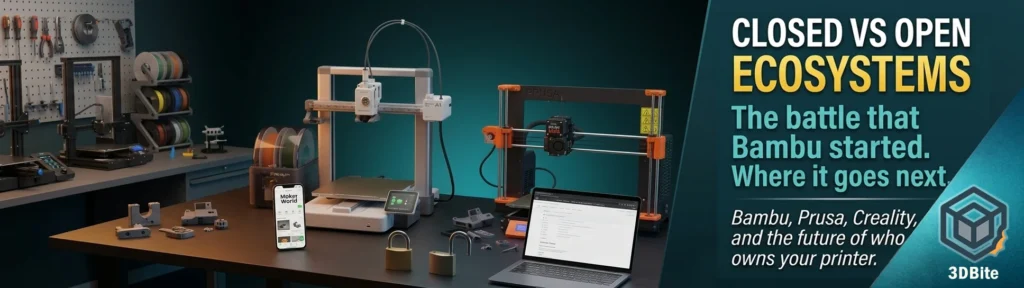
The Bambu Lab controversy did not create the open versus closed ecosystem debate in 3D printing. It just made it impossible to ignore. Before the OrcaSlicer cease-and-desist, before the AGPLv3 investigation, before the Software Freedom Conservancy launched the baltobu project — all of which are documented in exhaustive detail across this site’s earlier posts — the debate was running at low intensity. Practitioners who cared about open source were watching. Most hobbyists were not. The events of late 2025 and early 2026 turned a philosophical undercurrent into the loudest conversation in the community, and the community’s response has been clarifying enough that it is worth stepping back from the specific Bambu situation to examine the broader question: what does the industry’s trajectory between closed and open actually look like, who are the principal players in each camp, and where does this go from here?
The spectrum, not the binary
The framing of closed versus open is a useful shorthand but it obscures a more complex reality. No consumer 3D printer manufacturer in 2026 is entirely closed or entirely open. What differs is where each company sits on a spectrum, which components of the stack they have chosen to lock down or liberate, and how aggressively they enforce their position. Understanding the debate properly requires being precise about which layer of the stack is in question: hardware, firmware, slicer, cloud infrastructure, filament, accessories, content. A company can be fully open on firmware while running a proprietary filament authentication system. A company can open-source its slicer while keeping the cloud platform closed. These are separate decisions and each one has different implications for the user.
The broadest map of the spectrum looks roughly like this. Voron Design sits at the fully open end — a community project with no manufacturer, no proprietary components, and hardware that consists entirely of off-the-shelf parts and printed components. Prusa Research sits at the open-source institutional end — a company with proprietary hardware but fully open firmware, fully open slicer source code, full repair documentation, and an actively maintained community contribution pipeline. Creality occupies the interesting middle ground — historically proprietary but strategically adopting open-source Klipper firmware across its newest high-speed lineup as a deliberate competitive move. Bambu Lab sits toward the closed end — hardware partially open, slicer source visible but not genuinely open, cloud infrastructure fully proprietary, filament authentication locked to RFID, and as of 2025, active legal enforcement against open-source developers who built around the proprietary networking layer. Flashforge sits in a similar position to Bambu but with less community engagement and less drama. Anycubic sits between Creality and Bambu — ostensibly open to third-party slicers but with a proprietary slicer that has functional gaps that are becoming increasingly visible as users try to replace it.
Bambu: the walled garden with the best garden
The Apple comparison gets made for Bambu Lab constantly, and it is accurate in the specific way that matters. Bambu has built a vertically integrated experience — hardware, firmware, slicer, cloud platform, content library, app, filament — where every layer is designed to work with every other layer, and the friction of that integration has been eliminated specifically because Bambu controls all of it. The AMS RFID system reads a spool, applies its profile, and the print begins. The camera spots spaghetti, alerts the Handy app, pauses the job. MakerWorld hosts models pre-configured for Bambu hardware with one-tap printing. The whole experience is cohesive in a way that no competitor has matched because no competitor has chosen to design the whole stack as a single system.
The cost of that cohesion, as the events of 2025 made concrete, is dependency. By January 2025, Bambu’s Authorization Control System made the extent of that dependency explicit. Users who updated their firmware found that their third-party slicer direct connections were severed and routed through Bambu Connect — a proprietary middleware layer that Bambu controls, can modify, and can eventually deprecate. Users who did not update lost future firmware improvements. The choice was: deeper into Bambu’s ecosystem, or frozen in time. Neither option was the one the community had been sold when it bought into the platform.
The AGPLv3 investigation confirmed what the authorization controversy implied: Bambu had been building its business on open-source foundations while selectively refusing to honour the licence obligations those foundations carried. The SFC identified two confirmed violations — the proprietary libbambu_networking library bundled with AGPLv3-licenced Bambu Studio, and the legal threats against Jarczak that violated the AGPLv3’s anti-restriction clause — and launched the baltobu project specifically to build infrastructure that routes around the closed networking layer. The detail is covered in the SFC investigation post. The summary is this: Bambu took the community’s open-source tools, improved on them, and then attempted to close the door behind it. The community noticed and responded with one of the most coordinated open-source enforcement actions the 3D printing industry has seen.
What makes Bambu’s position interesting rather than simply condemned is that the garden genuinely is very good. Despite being the market’s most aggressive ecosystem closer, Bambu captured 37% of the global entry-level 3D printer market in 2025 — overtaking Creality, which had led for years — on the strength of that integrated experience. MakerWorld reached 10 million monthly active users by the end of 2025, with an 83% user retention rate that most consumer tech platforms would regard as extraordinary. The community built on Bambu hardware is enormous, engaged, and producing content at a rate that gives the platform network effects that are genuinely difficult to displace. The ecosystem strategy is working commercially even as it alienates the philosophical core of the maker community.
The filament RFID lock-in deserves specific attention because it is the most commercially interesting component of Bambu’s ecosystem strategy. Bambu’s own filament profiles load automatically. Third-party filament requires generic profiles or manual configuration. PLA Pure, as covered in the PLA Pure post, extends this with ingredient-level food-contact certification attached specifically to Bambu’s own product. The RFID ecosystem creates a soft lock-in that does not prevent third-party filament but makes it marginally less convenient and positions Bambu’s own products as the path of least resistance. This is a well-established consumer electronics strategy — make your own accessories slightly easier to use than competitors’ and capture the upgrade purchases over time. It is not the same as a hard lock-in that physically prevents third-party filament, but it is directionally consistent with the rest of the ecosystem approach.
Prusa: the open-source institutional benchmark
Prusa Research represents the clearest counterpoint to Bambu’s ecosystem philosophy, and the comparison is unusually direct because Prusa actively positions itself as the alternative for users who value openness. Where Bambu locks down firmware, Prusa publishes it. Where Bambu routes third-party slicers through proprietary middleware, Prusa maintains PrusaSlicer as fully open-source and encourages the OrcaSlicer and Bambu-derivative community that built on it. Where Bambu’s legal team threatened a developer for building a network workaround, Prusa’s firmware ships with hooks specifically designed to make third-party slicer integration easier.
The practical implications for long-term ownership are significant. MK3 printers from 2018 are still running production operations in 2026. The hardware designs are documented well enough that third-party manufacturers produce compatible parts, and the community that has been improving Prusa machines since the RepRap era — the same RepRap that started this site’s own journey, as covered in the RepRap origin post — continues to produce firmware improvements, hardware mods, and community knowledge that extends the machine’s useful life well beyond what any manufacturer-controlled support cycle would. A Bambu A1 whose cloud infrastructure becomes inaccessible in 2031 has an uncertain future. A Prusa MK4S in 2031 will still have a community actively developing for it, because the community owns the tools.
The commercial problem Prusa faces is that openness has a cost in user experience that the mainstream market has consistently shown it is not willing to pay in the Bambu era. Prusa’s speed disadvantage relative to Bambu narrowed with the CORE One’s CoreXY architecture, but the out-of-box print quality difference and the calibration burden difference remain real for new users. The market share that Prusa built during the MK3’s decade of dominance has been eroded by Bambu’s combination of speed, automation, and price, and the users who left Prusa for Bambu are largely not coming back.
What Prusa retains is the philosophical community — the portion of the maker world that values understanding their tools, modifying them, repairing them independently, and contributing to a commons rather than a corporate ecosystem. That community is real, it is vocal, and it has been growing in visibility precisely because Bambu’s ecosystem decisions have made the contrast so stark. GamersNexus publicly buying Prusa hardware in response to the OrcaSlicer situation is the cultural signal of this moment: for a meaningful segment of the technically engaged community, Prusa’s openness is not a feature to be weighed against speed and price. It is the product.
Creality: the pragmatic open-source convert
Creality’s trajectory is the most strategically interesting in the market right now, because it represents a manufacturer choosing openness not out of ideological commitment but out of commercial necessity. Historically a proprietary-firmware, budget-hardware company focused on the tinkerer market, Creality has made a deliberate strategic pivot toward Klipper-based open firmware across its K-series lineup. The K2 Plus uses Klipper. The K1 series has Klipper available. This is not a RepRap-philosophy decision — Creality has never been in the business of open-source advocacy. It is a competitive positioning decision: in a market where Bambu’s closed ecosystem has become a reputational liability, Creality is differentiating on openness as a feature.
The implications are significant. Klipper is genuinely powerful, genuinely community-supported, and genuinely extensible. A Creality machine running Klipper can accept configuration improvements from the community without waiting for a manufacturer firmware update. The input shaping calibration, resonance compensation, and motion system tuning that Bambu does in a proprietary black box is fully visible and adjustable on Klipper. For technically inclined users who want Bambu-class speed without Bambu-class ecosystem constraints, the Creality K-series on Klipper is a more credible option in 2026 than it was two years ago.
The challenge Creality faces is execution consistency. Their manufacturing quality has been variable enough that the community distinguishes between “good Creality” and “bad Creality” in ways that a Bambu owner does not have to. The slicer ecosystem around Creality hardware is less polished than Bambu Studio, though OrcaSlicer’s expanding printer support — including the Kobra X addition covered in the OrcaSlicer 2.4.0 post — is building the third-party slicer coverage that makes Klipper-based machines genuinely accessible. Creality’s strategy is to win the users that Bambu’s ecosystem decisions have alienated, and it is the right strategy — whether the execution quality is there to capitalise on the opportunity is the open question.
Flashforge: the quiet proprietary incumbent
Flashforge occupies an interesting position as one of the few manufacturers with a longer commercial history than Bambu but a fraction of the community profile. Their Creator and Adventurer series have been workhorses in education and prosumer markets for years, and their ecosystem approach has historically been quietly proprietary — proprietary slicers, limited third-party slicer support, no open firmware — without the aggressive enforcement actions that turned Bambu’s equivalent approach into a community crisis.
The lack of community crisis is partly a function of market position. Flashforge’s ecosystem has not attracted the kind of developer attention that produced OrcaSlicer on Bambu hardware — there is no equivalent third-party network workaround to threaten, because fewer developers were building into Flashforge’s stack. The quieter proprietary approach is less contentious than Bambu’s because it has less to be contentious about. InfiMech, the InfiMech MX Pro manufacturer covered in the InfiMech post, is a Flying Bear subsidiary — Flying Bear being another Chinese manufacturer in a similar position to Flashforge: commercially established, firmware proprietary, community impact modest relative to the Bambu-Prusa-Creality triangle. The InfiMech MX Pro’s Kickstarter positioning suggests the brand is aware of the community’s open-source values — their TX machine is Klipper-based — but whether the MX Pro follows the same path will be one of the telling data points about how new entrants read the current ecosystem landscape.
The accessory lock-in layer
Hardware and firmware are the most discussed lock-in vectors, but accessories are the commercial engine that makes proprietary ecosystems financially durable. The model is familiar from consumer electronics: the margins on the printer itself are modest; the recurring revenue comes from the consumable and accessory ecosystem around it.
Bambu’s AMS unit, build plates, nozzles, and filament represent a coherent accessory ecosystem where each component is designed to work with the others and priced to capture the value of that integration. The E3D ObXidian hotend — as covered in the nozzle guide — exists as an officially approved third-party accessory specifically because Bambu has opened the A1 and A2L hotend interface to the third-party market under a licensing arrangement where Bambu receives a royalty and donates a portion to the Sanjay Mortimer Foundation. This is a more sophisticated approach to accessory ecosystem management than a hard lock-in: approve specific third parties under controlled terms, capture a percentage of their revenue, and maintain quality control over what can be officially sold for the platform. The user benefits from genuine third-party options. Bambu benefits from ecosystem revenue without requiring proprietary monopoly on every component.
Prusa’s accessory approach is the open-source version of the same model: many of the replacement parts for Prusa machines are 3D-printable files that Prusa publishes openly. The community manufactures and shares compatible components. Third-party part suppliers produce Prusa-compatible hardware without licensing arrangements. This creates a more competitive accessory market — which benefits the user in cost terms — but reduces the manufacturer’s recurring revenue capture. Prusa compensates with direct parts sales from its own store, community goodwill that drives new printer purchases, and the brand positioning that “open ecosystem” provides. Whether this is economically sustainable at Bambu’s market scale is the question the industry has not had to answer yet because Prusa has not reached Bambu’s market scale.
The filament ecosystem: the most commercially significant battleground
Filament is the recurring consumable that underpins every 3D printing business model, and the competition for that revenue stream is intensifying as the market matures. The filament ecosystem debate has three distinct levels: authentication, profile availability, and material-specific optimisation.
Authentication is the sharpest tool. Bambu’s RFID-based filament authentication does not prevent third-party filament — any spool without an RFID tag loads as a generic profile, and the machine prints with it. But the friction differential is real: Bambu filament auto-loads its profile, third-party filament requires manual selection and potentially manual calibration. For a user who values the Bambu “just works” experience, the path of least resistance is Bambu’s own filament. Multiply this across the 10 million monthly active MakerWorld users and the commercial implications are substantial. This is not a hypothetical: it is the same strategy that makes Apple’s first-party accessories the default choice for iPhone users even in the presence of cheaper third-party alternatives.
Profile availability is the second level, and it operates differently from authentication. The filament profiles in a slicer determine how well any given material is calibrated for a specific machine. As documented in the filament profiles post, Bambu Studio has named third-party profiles for some brands but not others — eSun does not have a native named profile despite being one of the most widely used filament brands in the hobbyist market. AnycubicSlicerNext, as documented across the Kobra X posts, has virtually no named third-party profiles at all. OrcaSlicer’s Orca Cloud, introduced in the 2.4.0 release covered in the OrcaSlicer post, is specifically designed to be the community answer to this gap — a centralised repository for community-calibrated profiles that any OrcaSlicer user can download rather than building from scratch. If Orca Cloud achieves the community adoption its architecture supports, it becomes the first genuinely cross-manufacturer filament profile ecosystem, benefiting users of any machine that OrcaSlicer supports rather than being restricted to a single brand’s platform.
Material-specific optimisation is the third level, and it is where the proprietary ecosystem can genuinely deliver value that open alternatives struggle to match. Bambu’s own PLA Basic is engineered specifically for Bambu hardware — the speed profiles, pressure advance values, and temperature ranges are developed alongside the printer rather than independently. The combination of a Bambu machine running Bambu filament on a Bambu profile is, for that specific material, genuinely better calibrated than any generic alternative. This is not ecosystem cynicism. It is the real benefit of vertical integration. Whether that benefit justifies the cost premium and the dependency it creates is a personal value calculation, but the benefit is real.
The content ecosystem: MakerWorld, Printables, and the platform battle
The most underappreciated component of the closed versus open ecosystem debate is the content library — where people find the models they print. The content platform, more than any hardware or filament decision, determines how sticky a user’s relationship with a particular ecosystem becomes.
Bambu’s MakerWorld is the fastest-growing model library in the market. Its one-tap printing integration — find a model in MakerWorld, tap print, and the file is sent directly to your Bambu printer with the correct settings applied — is the kind of friction elimination that produces the retention rates that MakerWorld’s 83% figure represents. The content strategy is not separate from the hardware strategy. It is the capstone of it. A user whose model library lives in MakerWorld, whose printer is configured for MakerWorld’s pre-sliced files, and whose printing habits are built around one-tap convenience from the app has a switching cost that extends well beyond the price of a new printer. They would need to rebuild their model workflow, their slicer familiarity, and their content discovery habits simultaneously. That is a significant barrier that the hardware and firmware decisions alone would not create.
Printables — Prusa’s content platform — is the direct open-source equivalent. Well-curated, community-moderated, and genuinely one of the higher-quality model libraries available. Its integration with Prusa hardware is less seamless than MakerWorld’s Bambu integration but it is less deliberately proprietary — models on Printables are formatted for any printer, not optimised specifically for Prusa hardware. Thingiverse, the original community model library, has suffered years of reliability issues and quality decline that have pushed its community toward both MakerWorld and Printables. The content platform battle is currently two-way between MakerWorld and Printables, with MakerWorld’s growth advantage reflecting Bambu’s hardware market share growth.
The right to repair argument
The right to repair has been one of the policy movements of the early 2020s — legislative pressure in the EU and US requiring manufacturers to provide spare parts and repair documentation for electronic products, and to stop voiding warranties as a result of user repair. The SFC’s formation of a 3D printer right-to-repair committee in June 2026, as covered in the SFC investigation post, places the 3D printing industry explicitly within this broader movement rather than treating it as a purely community issue.
The right to repair argument connects firmware openness to hardware longevity. A printer whose firmware is open can be maintained, improved, and supported by the community long after the manufacturer’s support window closes. The X1 Carbon — as covered in the X1C EOL post — has firmware support through May 2027 and spare parts through 2031. After that, the machine’s future depends entirely on whether Bambu continues to exist as a company and chooses to continue supporting it. A Prusa MK3S from 2018 running in 2026 does not carry the same dependency, because the community can maintain the firmware and produce compatible parts regardless of what Prusa Research the company decides to do.
The warranty voiding claim around custom firmware — specifically the X1Plus ecosystem covered in the jailbreaking post — sits directly within the right-to-repair framework. EU and UK consumer law provides statutory warranty protections that cannot be waived by manufacturer terms, which means Bambu’s warranty void claim for X1Plus installation is legally contestable in these jurisdictions regardless of what the terms say. As right-to-repair legislation strengthens across Bambu’s key markets, the legal basis for using warranty void claims to discourage open firmware becomes weaker, not stronger. Bambu’s decision to create a rootable firmware pathway specifically for X1Plus — while simultaneously announcing it would apply new security measures to future firmware that prevent rooting — suggests the company is aware of this tension and responding to it, however imperfectly.
Where this goes next
Predicting the direction of this debate requires distinguishing between what is commercially likely and what the community wants, because these are not always the same thing.
The commercial trajectory favours continued ecosystem closure among market leaders. Bambu’s market share has grown during and after the controversy, not despite it. The community that protests ecosystem lock-in loudly on Reddit and in forum threads is not the same population as the mainstream hobbyist market that represents the majority of Bambu’s 37% market share. Most people buying their first 3D printer in 2026 are not aware of the AGPLv3 dispute. They find a Bambu machine at an accessible price, see that it produces good results out of the box, and buy it. The controversy has not significantly dented Bambu’s commercial momentum, which sends a clear signal to the rest of the industry about the elasticity of the market’s response to ecosystem closure. Creality’s strategic Klipper adoption is a bet that there is a meaningful market segment that will pay attention and choose differently. Whether that bet is right depends on whether the controversy translates into sustained purchasing behaviour change among the mainstream market or remains concentrated in the vocal but commercially marginal technical community.
The community trajectory, however, points in a genuinely interesting direction. The baltobu project is funded and staffed to build open-source infrastructure that routes around Bambu’s proprietary networking layer. OrcaSlicer’s Orca Cloud is building community profile infrastructure that benefits any printer, not just Bambu machines. The SFC’s right-to-repair committee is institutionalising the advocacy that the controversy mobilised. These are not marginal developments. They represent a serious, well-funded effort to build the open ecosystem alternative to Bambu’s closed one — not by competing on hardware, but by making the software and network layer that Bambu is trying to control less relevant. If the baltobu project succeeds in reverse-engineering libbambu_networking and OrcaSlicer develops to the point where it matches Bambu Studio’s polish for Bambu hardware — which OrcaSlicer 2.4.0’s trajectory suggests is plausible within 18 months — the primary advantage of Bambu’s closed ecosystem narrows to MakerWorld’s one-tap integration and filament profile convenience. Both of those are replicable advantages given sufficient community investment.
The most likely 2–3 year scenario is not a clean victory for either camp. Bambu continues growing market share while the SFC’s enforcement action reaches some form of resolution — probably a negotiated source code release for libbambu_networking, a more formal third-party slicer API policy, and enough face-saving for both sides that the immediate legal situation concludes without litigation. OrcaSlicer Orca Cloud builds a profile library that makes third-party slicer access to Bambu hardware genuinely comparable to Bambu Studio for most common use cases. Right-to-repair legislation in the EU creates hard requirements around spare parts and firmware access that Bambu’s 2031 support commitment partially addresses but does not fully satisfy. Prusa continues producing well-regarded hardware for the community that values openness, at a premium that the mainstream market largely does not pay. Creality captures some of the market segment that the controversy has made receptive to alternatives. And the 3D printing industry, as a whole, arrives at a situation that looks somewhat like the smartphone market: a polished, dominant closed ecosystem that the majority uses; an open-source alternative with a committed community; and ongoing regulatory and advocacy pressure that slowly raises the floor on what proprietary ecosystem behaviour is permissible.
The question of which camp wins is probably the wrong frame. The more useful question is what the two camps’ competition produces for the user. Every proprietary feature that the open ecosystem replicates becomes a feature that both camps must now offer, narrowing the advantage that was originally proprietary. Every right-to-repair requirement that legislation imposes raises the floor for proprietary manufacturers. The open community benefits from the proprietary manufacturer’s investment in UX and capability; the proprietary manufacturer benefits from the competitive pressure the open community creates. The tension is productive even when it is uncomfortable, and the Bambu Lab controversy — for all the frustration it generated, and for all the legitimate legal and ethical concerns it raised — has made this industry’s most important debate impossible to avoid. That is probably worth something, even if it has not been pleasant to sit through.
Where I sit: I use Bambu hardware, I find the closed ecosystem frustrating where it meets the open-source principles I understand intellectually even when I do not feel their absence in daily use, and I think the SFC’s investigation is right on the law even while I continue printing on the machine at the centre of it. The A1 and A2L sit on the desk. OrcaSlicer is installed alongside Bambu Studio. The baltobu project has my good wishes even though I have not contributed to its fundraiser. This is an uncomfortable position that I suspect reflects where a significant proportion of the Bambu user community actually sits, even if it does not reflect the volume of the loudest voices on either side.