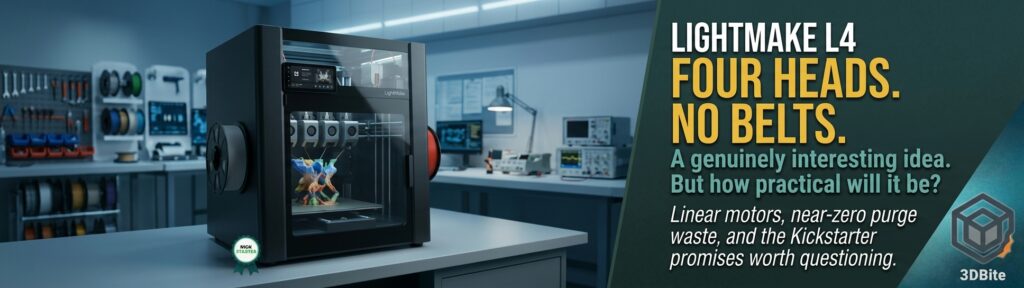
Every few months a Kickstarter lands promising to solve the multi-colour waste problem once and for all, and this site has covered a genuine stack of them this year — the Sovol M1D’s IDEX-toolchanger hybrid, the InfiMech MX Pro’s eight-toolhead pricing controversy, Bambu’s own Vortek system on the H2C. The LightMake L4 is the newest entry, and it takes a genuinely different architectural approach from all three: rather than swapping between toolheads, it gives every colour its own permanently mounted, permanently powered print head, and moves the whole gantry on linear motors instead of belts. It launched on Kickstarter on September 1, 2026, with pricing starting at $1,299 for the earliest backers. It is an interesting idea. Whether it is a genuinely practical machine is a different question, and — as with every printer in this category — the answer depends enormously on something the marketing page barely mentions: the slicer and the ecosystem sitting underneath the hardware.
The core architecture: four heads, not one head that swaps
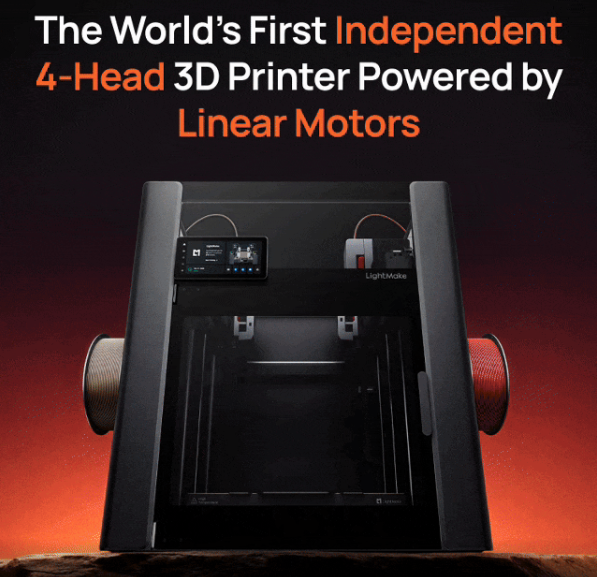
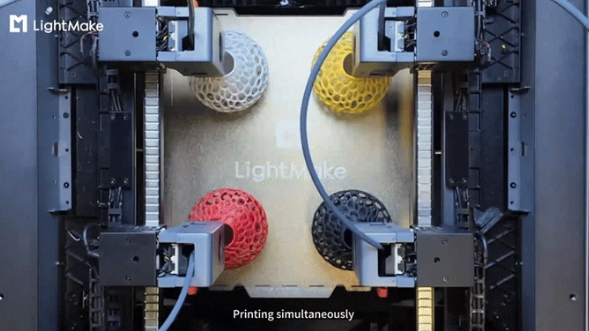
This is the detail that genuinely separates the L4 from every toolchanger this site has covered so far. The Vortek system, the InfiMech MX Pro, and the Sovol M1D’s toolchanging side all work by picking up and putting down a single active hotend from a rack of parked ones — one nozzle prints at any given moment, and the swap is what has been engineered to be as fast as possible. The L4 does not swap anything. It mounts four completely independent print heads on the gantry simultaneously, each permanently loaded with its own material, and — according to LightMake’s own marketing copy — pre-heated and ready throughout the print. Yanko Design’s coverage frames this correctly as the machine’s defining characteristic: four separate print heads operating simultaneously within a single build volume, either printing four identical objects in parallel or all four contributing colours and materials to one complex object without the purge cycle that a shared single nozzle requires.
The “1-second toolhead change” figure that appears throughout LightMake’s marketing is a genuinely different claim from what it sounds like at first glance, and it is worth being precise about what it actually measures. It is not describing the time to physically swap a nozzle the way the Vortek or InfiMech systems do — there is no toolhead being picked up or put down at all in the L4’s core multi-colour mode. LightMake’s own footnote on the product page clarifies this directly: the 1-second figure refers to the mechanical switch time from when one toolhead stops printing to when the next takes over — which, on a machine where all four heads are already loaded, heated, and simply taking turns being the active depositor, is a considerably easier engineering problem to solve than genuinely picking up and reseating a cold hotend from a rack.
Linear motors: the other headline mechanical claim
The second pillar of the L4’s pitch is replacing the toothed belts that drive almost every consumer FDM printer’s gantry with linear motors — direct electromagnetic drive with no belt, no pulley, and, according to LightMake, no mechanical wear from tensioned rubber stretching or slipping over time. Notebookcheck’s independent coverage confirms the basic mechanism accurately: this allows the toolhead to move with zero transmission loss, and LightMake’s own specification sheet claims ±1μm closed-loop motion precision, a 500mm/s maximum print speed (1,000mm/s in pure travel moves), and a motor lifespan rated beyond 50,000 hours.
The genuinely interesting and honest detail buried in LightMake’s own footnotes is worth reading properly rather than skimming past: the linear motor’s true physical limit is vastly higher than the 500mm/s and 20m/s² acceleration the company has actually configured the machine to run at, and LightMake states plainly that they deliberately tuned it down to those figures specifically to ensure stable, high-quality output rather than chasing the highest number the hardware could theoretically produce. That is a refreshingly candid admission for a crowdfunding page to make, and it suggests either genuine engineering discipline or a company that has already discovered the practical print-quality ceiling the hardware runs into at higher speeds — quite possibly both at once.
The purge waste numbers: genuinely impressive, if accurate
This connects directly to the hidden workflow cost discussion this site has covered on single-nozzle AMS systems, and Notebookcheck’s coverage flags something worth being precise about: LightMake’s marketing headline claims “zero purge waste,” but the actual comparison chart on their own site tells a more accurate and still genuinely impressive story — under one gram of purge waste for the L4 against a comparison figure of over 219 grams for what the chart labels as a single-toolhead printer completing an equivalent job. Zero is marketing language. Under one gram, with each colour running through its own permanently dedicated nozzle rather than a shared melt zone, is the more honest and still remarkable number, and it is structurally consistent with how the four-head architecture actually works — there is genuinely very little reason for one colour’s nozzle to be depositing waste material that belongs to a colour it has never touched.
Pricing and what is actually confirmed
The Kickstarter launched September 1, 2026, with the L4 available from $1,299 at the Super Early Bird tier, rising toward a stated MSRP that the pre-launch reservation page describes as up to $1,300 higher for anyone who misses the early pricing windows. A companion single-head machine, the L1, launches alongside it at $1,099. LightMake’s PR Newswire release states an expected initial shipment window of Q4 2026 — a notably tight and specific timeline for a campaign that had, at time of writing, only just opened. The build volume is 354 × 370 × 386mm (LightMake’s own product page and its PR release differ very slightly on the exact middle dimension, 370mm versus 350mm — worth confirming directly with LightMake before backing if that number affects your specific plans), on a 395 × 395mm PEI plate, with the full machine footprint at 610 × 620mm — a genuinely large physical presence for a desktop machine, which is the direct trade-off for fitting four complete, independent print heads and their associated hardware onto one gantry.
Notebookcheck’s coverage adds a detail on the company background worth knowing: LightMake’s founder, Vic Wang, previously held senior positions at Anker and Huawei — genuinely substantial consumer electronics manufacturing experience, and a meaningfully different founder profile from a first-time hardware startup with no track record. That does not guarantee the campaign delivers on schedule, but it is a more reassuring signal than the founder profile behind a lot of crowdfunded printer campaigns this site has covered.
The features that go well beyond print mechanics
This is where the L4’s marketing starts reaching toward genuinely ambitious territory, and it is worth taking each claim on its own terms rather than as a single undifferentiated feature list. Cluster Management promises dispatching print jobs to over 1,000 networked machines from a single interface — squarely aimed at print farm operators rather than hobbyists. L4 AutoQueue is described as an AI system that reads a delivery deadline and automatically allocates however many machines in a fleet are needed to hit it. OpenClaw Integration lets a user send a WhatsApp message that the system interprets and turns directly into a finished print job. Conversational AI Slicing claims to translate natural-language instructions into slicing parameters without manual setup.
Every one of these is a software claim rather than a hardware one, and this is precisely the point worth dwelling on given my own scepticism going into this piece. A four-head, linear-motor gantry is a genuinely ambitious and verifiable piece of mechanical engineering — you can measure whether it holds ±1μm precision, whether the motors actually last 50,000 hours, whether the purge waste genuinely comes in under a gram. Natural-language conversational slicing that reliably produces correct, print-ready parameters from an arbitrary spoken instruction, and a WhatsApp-triggered pipeline that goes from a text message to a finished physical object with no human intervention, are considerably harder claims to verify from a product page and video, and they are exactly the kind of feature that tends to work beautifully in a curated demo and considerably less reliably once real users with real, messy, ambiguous requests start relying on it daily.
Where my scepticism actually sits
The four-head, linear-motor concept is genuinely interesting, and I do not think it is a gimmick — the physics of eliminating a shared single-nozzle melt zone entirely, rather than making the swap between materials faster, is a structurally different and in some ways more elegant solution to the multi-colour waste problem than anything the toolchanger machines this site has covered can offer. Four dedicated nozzles simply do not have the contamination and purge problem that a single nozzle switching between materials will always have to some degree, however fast the switch becomes.
What I remain genuinely unconvinced about, and what every machine in this exact category has stumbled on before, is the software. A four-head system managing simultaneous batch production, mirrored prints, multi-material single-object jobs, fleet-wide AutoQueue scheduling, and conversational AI slicing all at once is asking an enormous amount of a proprietary slicer built by a company entering the 3D printing market for the first time. This site’s coverage of the Sovol M1D and the InfiMech MX Pro both flagged the same underlying concern from different angles: hardware ambition is verifiable and often genuinely delivered; software ambition on a brand-new platform, built by a team without years of iterative slicer development behind them, is where these projects have historically fallen shortest of their launch-day promises. Bambu Studio’s polish, covered repeatedly across this site, is the product of years of continuous iteration on top of an already-mature open-source slicing foundation. A proprietary slicer built from scratch alongside four other genuinely novel hardware subsystems, on a company’s first flagship product, is a lot to get right simultaneously in time for a stated Q4 2026 shipping window that is only a few months away from the campaign’s launch date.
The practical questions I would want answered by independent, hands-on testing before backing this rather than just watching the campaign: does the four-head system genuinely avoid the physical collision and clearance problems that multi-head gantries have historically struggled with when heads need to work close together on a single object? Does the promised 30μm optical alignment between heads hold up consistently across a long, complex multi-colour print, or does it drift the way un-recalibrated multi-nozzle offsets tend to on cheaper hardware? And, the question that matters most for anyone actually planning to use rather than admire this machine: is the slicer genuinely capable of managing four simultaneous heads intelligently, or does the “conversational AI slicing” headline turn out to be doing considerably less real work than a well-configured OrcaSlicer profile already does today.
The honest position
This is worth watching rather than backing on day one purely on the strength of a well-produced product page. The hardware idea is genuinely novel and, on the physics alone, addresses the purge-waste problem more completely than any toolchanger this site has covered. The pricing is aggressive relative to the Bambu H2C and the Sovol M1D’s Advanced tier. The founder background is more reassuring than the average crowdfunded printer campaign. But every one of the specific concerns that has actually determined whether a printer in this exact ambitious multi-head category succeeds or disappoints — reliable calibration across genuinely independent heads, and a slicer mature enough to manage that complexity without falling over — sits entirely in the “we will find out once real units ship and real reviewers get hands-on time” category. For anyone tempted by the early-bird pricing: the same advice that applied to the Sovol M1D applies here. Wait for the actual campaign to demonstrate working units on video rather than pre-rendered marketing footage, read the comments section rather than just the pitch, and treat a Kickstarter deposit as exactly what it is regardless of how polished the product photography looks.