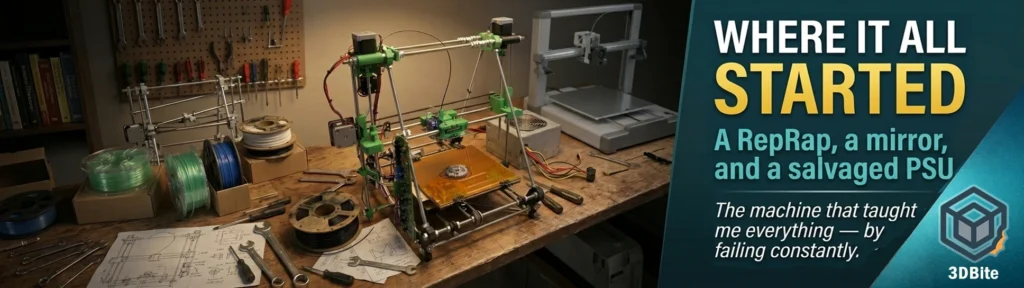
Everything on this site — the A1, the Kobra X, the 40-plus spools, the Grinch accumulating parts on the print bed, the posts about purge waste and filament dryers and build plates — starts from a box of threaded rods and a bag of nuts and bolts. My first 3D printer was a RepRap. I built it myself, from a kit, at a time when building it yourself was the only way to have one at a sensible price. It barely worked. It taught me everything.
This is the first in what will be an occasional series looking back at the machines I have owned before arriving at the current setup. I have had approximately six printers between that first RepRap and the A1 currently on the desk, and each one taught me something different. But the RepRap was where the education started, and the context for what made it remarkable requires a bit of history first.
What RepRap was and why it mattered
The RepRap project — Replicating Rapid Prototyper — was conceived by Dr Adrian Bowyer, a British engineer and lecturer at the University of Bath. Before RepRap, 3D printing technology existed but was prohibitively expensive, with commercial machines costing around €30,000. Moreover, these machines couldn’t replicate themselves. The vision Bowyer was pursuing was not just cheaper 3D printing — it was a machine that could print most of its own structural parts. A 3D printer that could, in principle, help make copies of itself.
On February 2, 2004, Adrian Bowyer published the concept of a self-replicating 3D printing machine. The RepRap project aimed to create a 3D printer capable of producing most of its own components, paving the way for the mass replication of such devices. It was a revolutionary idea that aligned with the open-source movement and sought to democratise 3D printing technology. Bowyer started a research blog in March 2005 and the project gathered momentum from there. Summer 2005: funding for initial development at the University of Bath of £20,000 was obtained from the UK’s Engineering and Physical Sciences Research Council. September 2006: the RepRap 0.2 prototype successfully prints the first part of itself. February 2008: RepRap 1.0 “Darwin” successfully makes at least one instance of over half its total rapid-prototyped parts.
The name Darwin — after Charles Darwin, The Origin of Species — was deliberate. During that year I had decided to make everything about the project open-source. My first reason for that was that I thought a general-purpose self-replicating manufacturing machine was a potential industrial disruptor, and that — in order to prevent its leading to an increase in wealth inequality — I ought to give it to everyone. Bowyer’s decision to release everything under open-source licensing was both principled and pragmatic, and it was the decision that made RepRap what it became. Every subsequent FDM printer that a hobbyist has built, bought, or tweaked traces its lineage back to that open-source release. MakerBot, LulzBot, Prusa, and more — all got their starts with the RepRap project.
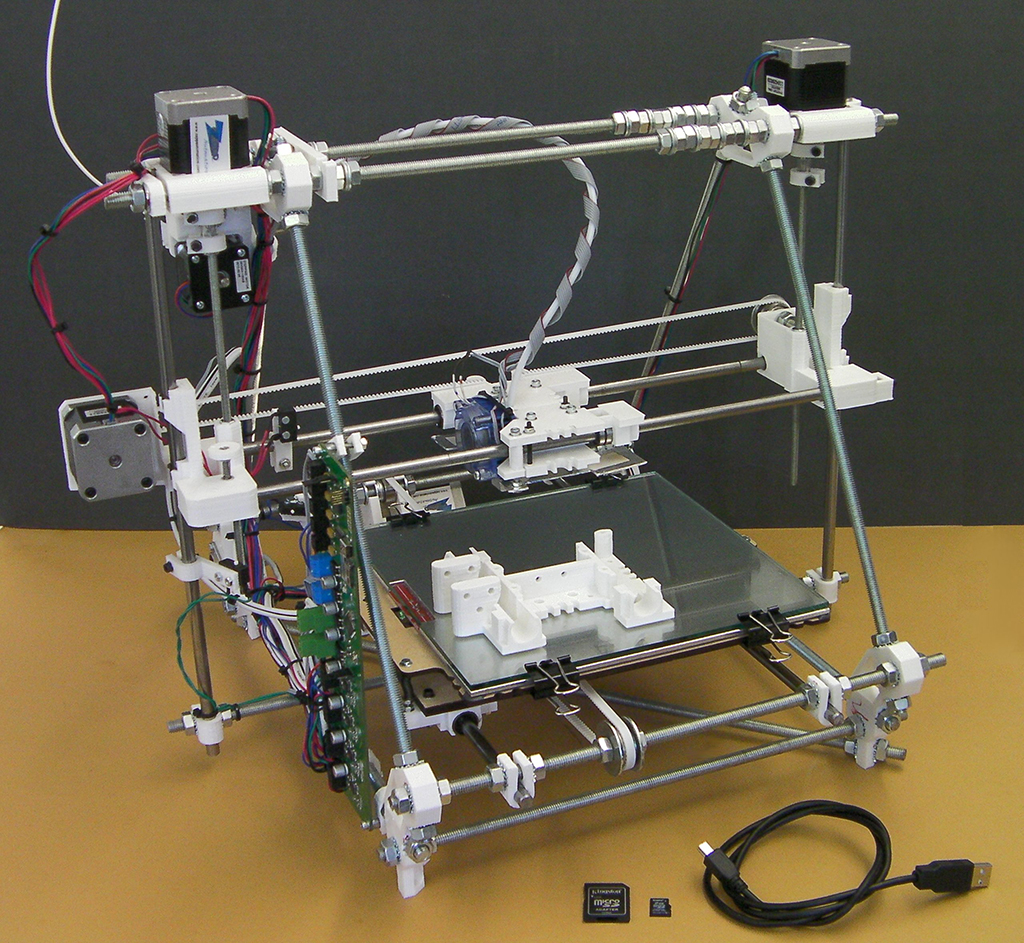
The machine I built was a Prusa i3 variant — the third generation of RepRap designs, named after Josef Průša, a Czech maker who contributed significantly to RepRap’s development and later founded Prusa Research. The i3 was the design that brought RepRap from the domain of technically advanced enthusiasts into the reach of anyone with patience, basic engineering skills, and the willingness to spend a weekend with an Allen key.
What building it actually involved
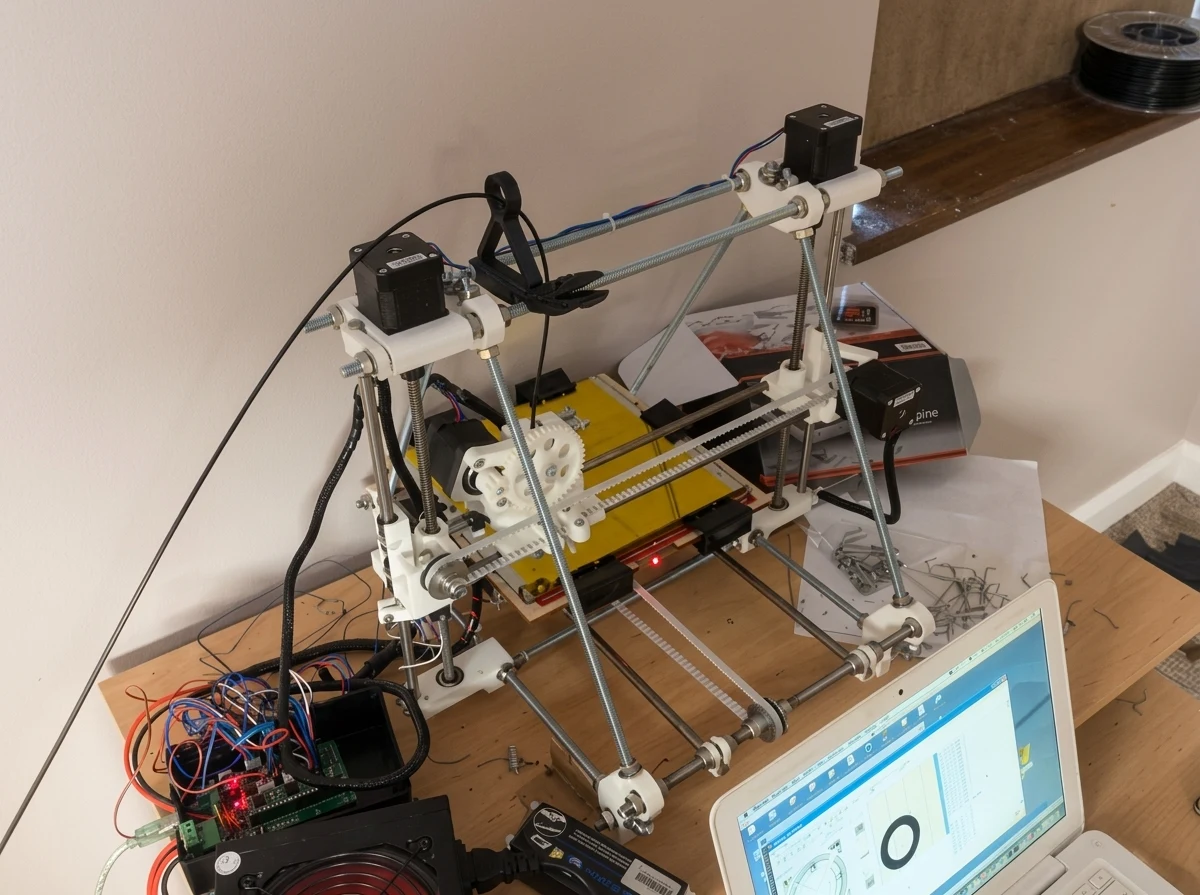
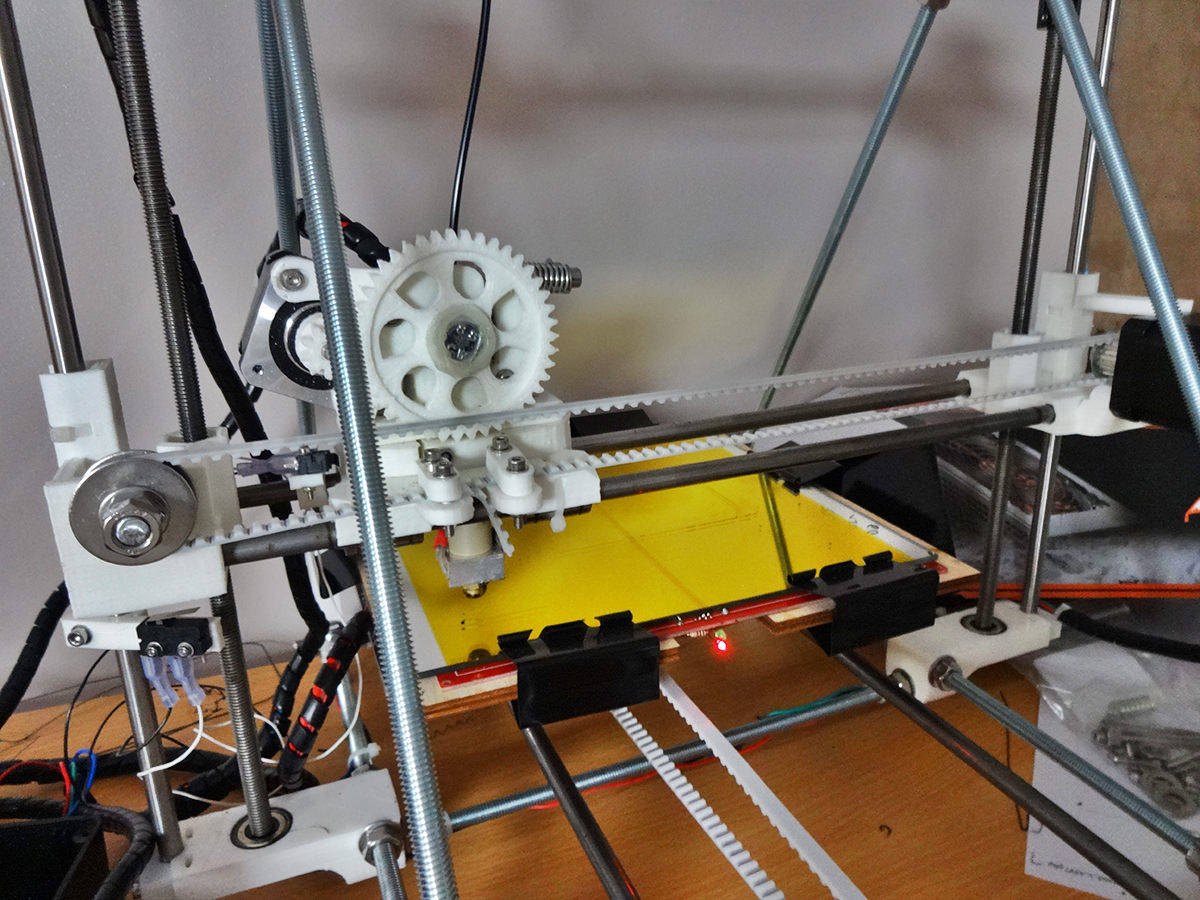
The kit arrived as a collection of components that bore no resemblance to a finished printer. The frame was threaded rod — lengths of M8 stainless steel studding, the kind you find in any hardware shop — held together with nuts, bolts, and printed plastic brackets. The motors were off-the-shelf NEMA 17 stepper motors, the same type used in CNC machines and robotics applications. The controller board was a RAMPS 1.4 running Marlin firmware. The power supply was salvaged from an old desktop PC — the kind of 400-watt ATX unit that would otherwise have gone to the recycling centre.
The plastic printed parts — the brackets, the motor mounts, the belt tensioners, the extruder body — were printed by another RepRap or by someone with access to a printer. This was the self-replicating philosophy made literal: you could not build a RepRap without printed parts, and those printed parts had to come from somewhere. The kit suppliers printed them. The community had them available. And once your machine was working, your first real obligation was to print a set of parts for someone else.
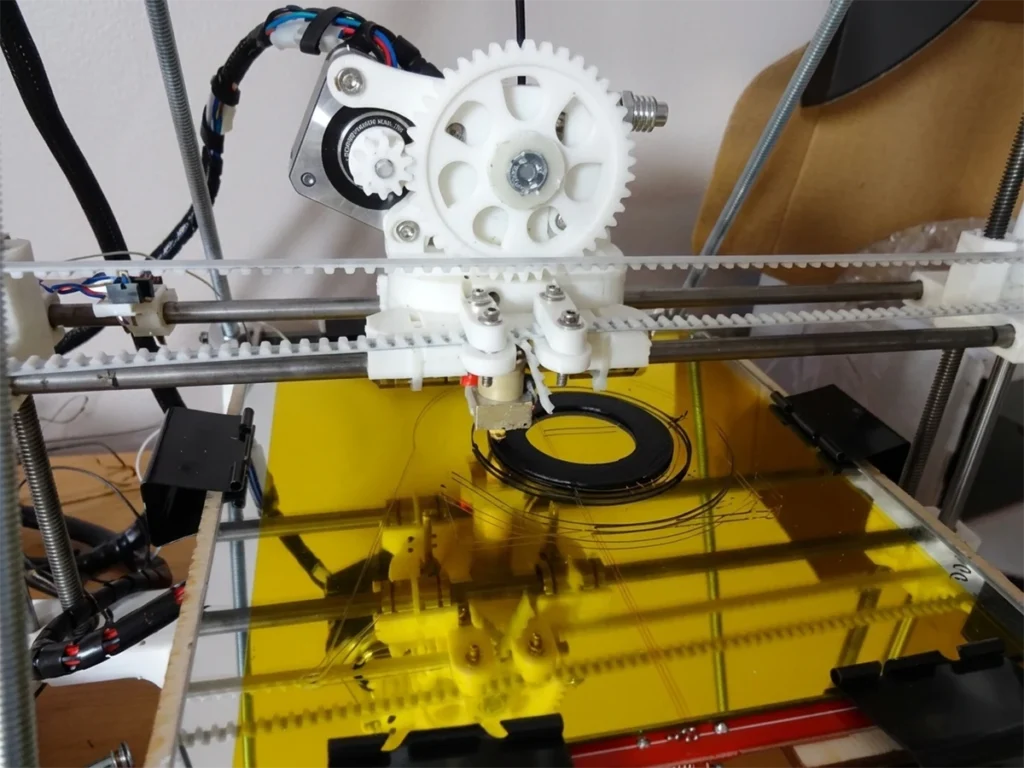
The bed was a mirror tile — the flat glass surface provided a level, smooth printing surface — covered in Kapton tape. Kapton is a high-temperature polyimide film used in electronics manufacturing that provides just enough adhesion for ABS when hot and releases the print when cool. Getting it flat, wrinkle-free, and staying that way required more time than I care to admit. A fresh sheet of Kapton was one of the most satisfying things in the early days of the hobby. A bubbled or peeling sheet was one of the most frustrating.
The experience of printing ABS on a machine that barely worked
I printed only ABS in those early days. This was, in retrospect, the hardest possible material choice for a machine in the category of “barely functional open-frame machine with a salvaged power supply and a Kapton-covered mirror for a bed.” ABS is the material that warps without an enclosure, requires a bed at 100°C, needs a nozzle at 240°C, and will punish any inconsistency in the setup with lifted corners, delaminated layers, or prints that simply peel off the bed mid-job and produce a nest of tangled filament.
The reason I was printing ABS rather than PLA was partly the era — PLA was less mainstream then, and ABS was considered the serious printing material — and partly that the machine ran hot enough to need it. The heated bed on a RepRap of this vintage was not optional for ABS. It was essential. And a heated bed running at 100°C in a room with no enclosure, no active cooling beyond the ambient temperature, and draughts from the window was a recipe for warping.
The failure rate was high. More often than not, the print would fail. A corner would lift. The first layer would not adhere uniformly. The extruder would jam partway through. The belt would slip. The z-axis would bind. Something would go wrong, and diagnosing which of the many possible wrong things had caused the specific failure in front of you was the primary activity of early RepRap ownership. Not printing. Diagnosing.
When it worked — when the stars aligned, the bed was level, the Kapton was fresh, the temperature was right, and the filament fed cleanly — the result was a rough, striated, slightly warped object in ABS that was genuinely remarkable. Not because it looked good. It usually did not. But because it had come from a machine that I had assembled from components, that was running firmware I could inspect and modify, and that had deposited plastic in three dimensions based on a file I had created or downloaded. That was remarkable in a way that is difficult to convey now that the same outcome happens reliably on a machine that costs £260 and sets itself up.
What the RepRap taught me
Building a RepRap before there were YouTube tutorials, accessible documentation, and active forums on every platform meant learning by doing and by failing. The education this produced was irreplaceable and is directly relevant to how I approach printing today.
I learned bed levelling not as a setting in a menu but as a physical reality — the relationship between the nozzle height and the first layer, adjusted manually by turning four thumb screws while dragging a sheet of paper under the nozzle at the four corners and the centre. I learned temperature as a variable with consequences rather than a number to set from a profile. I learned that the quality of a print is a product of the entire system — filament, temperature, speed, cooling, mechanical calibration — and that a problem with any one of these produces symptoms that can look like a problem with something else entirely.
That systems-thinking approach to 3D printing is what the RepRap instilled and what makes a significant difference in diagnosing problems on modern machines. When the Kobra X had slicer crashes in week one, I was not confused about whether it was a hardware or software problem — the RepRap had trained me to think through the system rather than blame the nearest component. When the Sunlu red shifted toward orange on the first layers, I knew immediately it was a temperature problem before I had read a single guide about pigment behaviour at elevated temperatures. The RepRap taught me the physics of the process, not the steps in a workflow.
The RepRap’s legacy: then and now
The machine I built is still in my possession. It does not print. It has not printed in a long time. But I have not been able to part with it, partly for sentimental reasons and partly because it represents something worth keeping: the period when 3D printing was genuinely difficult, when every successful print was an achievement, and when the community that had built itself around the RepRap project was one of the most collaborative and generous technical communities I had encountered.
The irony that the Bambu Lab vs OrcaSlicer controversy we have been covering on this site — a story about a manufacturer closing off the open-source ecosystem it was built on — maps almost exactly onto the RepRap’s founding philosophy is not lost on me. Adrian Bowyer made the RepRap open-source specifically to prevent a powerful technology from being captured and monopolised. He is still an advocate for open 3D printing, and his input on open-source licensing continues to be sought by manufacturers including Prusa Research. The values he built into the foundation of desktop FDM printing are the same values that the SFC is now defending in the Bambu Lab investigation. The circle from RepRap to the current ecosystem drama is complete and not coincidental.
The contrast between the RepRap and the A1 is the story of fifteen years of development compressed into a single comparison. A weekend’s build time versus a fifteen-minute setup. A success rate that required luck versus a success rate that requires neglect to fail. A machine that you fought to understand versus a machine that presents itself as an appliance. The progression is real and the access it has created is genuine — the A1’s reliability is why I can send a print from my phone while away from the workshop and trust that it will complete.
But the RepRap taught me things the A1 cannot, because the A1 is designed not to require you to know them. The knowledge that makes me a better user of the A1 came from the machine that made everything visible, forced every decision to be made explicitly, and provided no safety net when those decisions were wrong. That machine was a box of threaded rods and a bag of bolts. I am glad I built it. I am also very glad I do not have to print on it any more.
What comes next in this series
Between the RepRap and the current setup I have owned approximately six printers. Each one represented a stage in the technology’s development and each one taught something different. Some were good. Some were frustrating. One I sold within a month. The series will cover them all in time — as much as personal history as printer review, and hopefully useful context for anyone trying to understand how we got from threaded rods and Kapton tape to a machine that sets itself up in fifteen minutes and sends you a notification when your print is done.
Photos of the RepRap will follow when I can locate it properly in storage. It is there. I know it is there. Somewhere behind approximately forty spools of PLA+ and several pieces of a large Grinch.