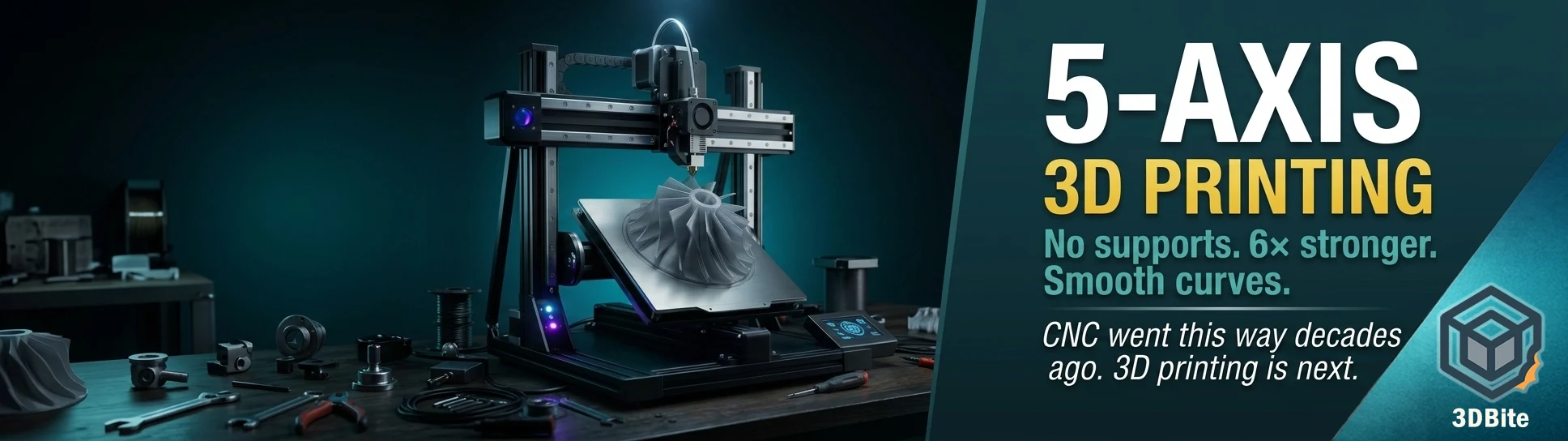
CAD/CAM machines went 5-axis decades ago. The manufacturing industry understood the advantages — better surface finish, stronger parts, elimination of support structures, the ability to machine from angles that a 3-axis machine simply cannot reach — and invested in the technology despite the significant cost and complexity premium. Desktop CNC routers and milling machines have been 5-axis capable for years. 3D printers, which are in many ways the additive inverse of a CNC mill, are only now beginning the same transition. The interesting question is not whether 5-axis FDM printing will become mainstream. It is how long the journey takes and who makes the first products that bring it to the accessible hobbyist price point.
There are machines attempting to answer that question right now — on Kickstarter, in academic research labs, and in small-batch production. This post covers what 5-axis 3D printing actually means, the specific problems it solves that 3-axis printing cannot, the machines currently pursuing it, and the honest challenges that are keeping this technology from your desk today.
First: what does “5-axis” actually mean for a 3D printer?
A standard FDM printer moves in three axes: X (left-right), Y (front-back), and Z (up-down). Every layer is flat and horizontal. The machine builds from bottom to top, stacking flat slices. This is why standard FDM is sometimes described not as 3D printing but as “2.5D printing” — you are printing flat layers stacked along a single direction, not truly depositing material in three-dimensional paths. It is the simplest and most reliable approach to additive manufacturing and it produces excellent results for the vast majority of geometries. But it has fundamental limitations that flatness imposes.
Five-axis printing adds two rotational degrees of freedom to the three linear ones. In CNC machining the convention is to call these A and B (or B and C depending on configuration) — rotations around the X and Y axes respectively. In 3D printing terms, these extra axes allow the nozzle and the build surface to be tilted relative to each other. Instead of the nozzle always pointing straight down at a horizontal surface, the surface (or the nozzle, depending on the implementation) can be angled. Layers can be deposited at an angle to gravity. The print can be reoriented mid-job so that what would be an overhang is no longer an overhang at the moment of deposition.
The two additional axes can be implemented in different ways. Some designs tilt the nozzle or print head — a nozzle-rotating system where the head itself has rotational freedom. Others tilt the build platform — a three-point suspension system where independent actuators on each support point can tilt the bed to any angle within the mechanical range. Some use a delta-style base with a rotating platform mounted on top. The TOP.E R1 uses the tilting bed approach with a three-point bearing. Generative Machine’s system uses a tilting build platform too. Each implementation has different tradeoffs in rigidity, travel range, and the complexity of the mechanical design.
What 5-axis printing solves that 3-axis printing cannot
1. Elimination of support structures
This is the headline benefit and the most immediately understandable. Five axes of motion have long been desired by 3D printer operators for a simple reason: you don’t normally need any support structures. That’s because the ongoing print can be reoriented in a way that you aren’t printing overhangs. They defy gravity, in a way.
When the build platform tilts, a feature that was previously an overhang becomes a slope or even an underside that is being deposited onto a surface that has been rotated to face upward. The nozzle deposits filament onto solid material below it — because “below it” has been redefined by the tilt. Support structures are an artefact of the constraint that you can only deposit material onto a flat horizontal surface from above. Remove that constraint and the need for supports largely disappears.
5-axis 3D printing allows support-less extrusion of overhanging geometries. This has several benefits: it reduces the waste of materials caused by extruding the support materials, reduces the print time significantly, removes the oftentimes fiddly and time-consuming need to remove any support material, and results in cleaner surface finishes for the overhanging areas.
For anyone who has spent time picking support material off a complex overhang, or watched a print fail when support adhesion gave way mid-job, or accepted that the underside of every supported surface will be rough regardless of settings — this is not a minor improvement. It is a structural change in what the printing process produces and how much post-processing is required.
2. Dramatically stronger parts
This is the benefit that receives less attention than support elimination but is arguably more significant for engineering applications. Standard FDM printing has a fundamental mechanical weakness: layer boundaries. The bond between two adjacent layers is always weaker than the filament material itself, because the interface between layers is where delamination happens under stress. A part printed in standard flat-layer FDM is strong in X and Y but significantly weaker in Z — the direction where the layer boundaries are perpendicular to the applied force.
Multi-axis printing breaks this constraint. A team of international scientists developed a new computational framework for multi-axis, non-planar 3D printing of polymer parts. The FFF-based technique works by aligning filaments along the direction in which they experience the greatest stress, alleviating weak points and increasing the overall strength of the part. The work yielded up to 6.35x increases in part strengths when compared to conventional planar FFF printing. 6.35 times stronger from the same machine and the same material, purely by changing the layer orientation.
The principle is the same one that makes plywood stronger than a single-grain board: when the structural material runs in the direction of the stress, rather than perpendicular to it, the part resists failure at the layer boundary. A bracket printed with its layers aligned along the load direction will not delaminate under the same force that splits a conventionally printed bracket at its layer lines. This is the FDM equivalent of fibre-aligned composite manufacturing — and it has been inaccessible to desktop printers because flat layers cannot be aligned to arbitrary stress directions.
3. Surface finish on curved geometry
The staircase effect on curved surfaces is one of FDM printing’s most recognisable limitations. Each horizontal layer approximates the curve with a flat step. The finer the layer height, the smaller the steps and the less visible the staircase — but they never disappear completely, and reducing layer height extends print time dramatically. Non-planar slicing dramatically enhances surface quality by eliminating the staircase effect. Curved layers follow the model’s contours, depositing filament along natural slopes rather than approximating them with flat steps. A dome printed with curved layers emerges smooth and glossy, free of the visible ridges that mar planar prints, especially on low-angle surfaces.
When the print head can be angled to follow the contour of the model surface, the deposited filament conforms to the curve rather than approximating it. The resulting surface is genuinely smooth — not smooth-after-sanding, not smooth-if-you-squint, but actually smooth off the machine. For organic shapes, aerodynamic surfaces, medical devices, ergonomic handles, and anything with compound curves, this is a transformative improvement.
4. Printing on existing surfaces and objects
A 5-axis system that can scan the surface of an existing object and then deposit material conformally onto that surface opens up an entirely new category of applications: printing onto non-flat substrates, repairing existing parts, adding functional features to manufactured objects, and integrating printed elements with other manufacturing processes. The team is working on closed-loop control for the machine and a photogrammetry capture module that can 3D scan objects for closed-loop control or to print on existing parts.
This is where 5-axis FDM begins to intersect with hybrid manufacturing — machines that can both add material and, with a different toolhead, remove it. CNC machining went this way with hybrid centres that combine subtractive and additive processes. The same convergence is now happening in desktop manufacturing.
The machines worth knowing about
TOP.E R1 — the desktop 5-axis candidate
The Top.E R1 aims to bring about nothing less than a paradigm shift. Instead of stubbornly building up the component layer by layer along a fixed Z-axis, this printer brings movement into play. The printing plate can not only be adjusted in height, but also tilted by up to 30 degrees. This is not a gimmick, but the core of the concept.
The R1 uses a three-point bearing suspension for the build platform — three independent actuators at three contact points that can raise or lower each point independently, creating a controlled tilt in any direction up to 30°. The 30° limit is not arbitrary: beyond that angle the build platform risks colliding with the toolhead structure, and the toolpath planning complexity increases significantly. 30° is enough to address the most common overhang angles in practical models — the typical FDM rule of thumb that overhangs above 45° need supports means 30° of tilt adds meaningful coverage of the problematic overhang range.
The R1 has additional features that sit independently of the 5-axis headline: an AI model generator powered by Tencent and Tripo, voice control, and a cloud-based slicer. The cloud-based slicer is a double-edged sword — no software to install, everything runs in a browser, convenient. But it creates a dependency on the company’s servers. For a community that has been watching Bambu Lab’s ecosystem control behaviour closely, a cloud-dependent slicer is a concern worth factoring in. Price and launch date remain undisclosed. A Kickstarter campaign is imminent.
Generative Machine — the British open-source contender
Generative Machine is a British startup bringing to market 5-axis desktop material extrusion systems with help from software toolchain firm Ai Build. The printer is powered by Duet3D and the team is working on closed-loop control for the machine and a photogrammetry capture module that can 3D scan objects for closed-loop control or to print on existing parts. The five-axis functionality, which includes a tilting build platform, allows for more complex geometries and tougher parts. The printer is open source.
The Ai Build partnership is significant. Ai Build is a serious commercial software toolchain used in industrial robotic 3D printing applications — the kind of toolpath planning that multi-axis printing requires is orders of magnitude more complex than planar slicing, and having an established software partner addresses the hardest part of the problem. The open-source hardware approach echoes the RepRap philosophy and means the community can build on and modify the design rather than being locked to a single manufacturer’s decisions.
The Joris Peels assessment at 3DPrint.com is honest about the commercial challenges: a lot of people will look at this and conclude that it will be way too expensive to be seriously commercially viable. Powder bed part pricing is coming down, and perhaps some parts could be substituted with different technologies. Something like this Generative Machine printer would really be valuable to prosthetists, hospitals, and in sporting protective gear. The application areas where the strength and geometry benefits most justify the cost premium are specialist rather than general consumer.
The Archer — community built, five-axis, multi-toolhead
In the community builder tradition that the RepRap established, the Archer from developer multipoleguy represents what happens when an experienced maker decides to tackle the 5-axis problem from scratch. The Archer five-axis printer features automatic four-hotend toolchanging, a CoreXY motion system, and print results as good-looking as any Voron. The print bed rests on three ball joints, two on one side and one in the centre of the opposite side. Each joint can be raised and lowered on an independent rail, allowing the bed to be tilted on two axes.
The Archer is not a product you can buy. It is documented on Hackaday and the maker’s GitHub as an open-source build that demonstrates the hardware concept is achievable with accessible components. The four-hotend multi-colour capability alongside the five-axis motion is the most ambitious specification in this category — it suggests that the convergence of 5-axis movement and multi-material printing is both desirable and technically achievable at the community build level. What the community has built, commercial manufacturers will follow.
5axisworks / 5axismaker — the earlier pioneer
The 5axisworks project from the mid-2010s was one of the first attempts to bring 5-axis capability to the maker community at an accessible price. The 5axismaker aimed to create a machine capable of working with a variety of interchangeable toolheads, including a 3D printer extruder, a CNC mill, a water jet, a touch probe, and a wire cutter. The project’s creators pointed out that such equipment, at prices upwards of $10k, was typically reserved for larger manufacturers and machine shops. By using off-the-shelf components, the startup managed to bring down the cost to about $5k. Earlier Kickstarter 5-axis projects had failed to reach their funding goals — the market was not yet ready for this technology at that price. The 5axisworks project moved the needle but the software toolchain challenge remained unsolved, and the project did not achieve mass market adoption.
The difference between then and now is software maturity. The toolpath planning software that 5-axis printing requires — the equivalent of what Bambu Studio does for 3-axis printing, but for a nozzle that can approach the model from multiple angles — is significantly more complex than planar slicing. In 2014, no accessible slicer could generate 5-axis toolpaths. In 2026, academic groups have published open-source frameworks, companies like Ai Build have commercial solutions, and the Klipper ecosystem is mature enough to accept 5-axis motion commands. The software gap that stopped earlier projects is closing.
The genuine challenges: why 5-axis is not on your desk today
Toolpath planning complexity
Planar slicing is a relatively simple computational problem. Take the model, intersect it with horizontal planes, generate the extrusion path for each intersection, stack the results. A computer does this in seconds. Non-planar toolpath planning for a 5-axis machine is an entirely different level of computational complexity. The slicer must determine not just where to extrude but at what angle to the print surface, how to avoid collision between the nozzle and already-printed geometry when approaching from an angle, and how to transition between regions that require different tilt configurations. Toolpathing is usually a nightmare with these systems. Slicing will also be complex, and learning to design for this system could require some real new thinking.
This is the software challenge that has prevented 5-axis printing from being accessible to non-specialist users, and it is the challenge that current projects are actively working to solve. Ai Build’s software partnership with Generative Machine is specifically aimed at making this accessible. The TOP.E R1’s cloud-based slicer is presumably doing the heavy computation in the cloud rather than on the user’s machine. Neither solution is yet as simple as clicking “slice” in Bambu Studio.
The tilt angle constraint
The tilting bed approach that most accessible 5-axis designs use has a mechanical limit on tilt angle — typically 30° for the TOP.E R1 and similar machines. This covers a significant range of the overhang angles that cause support requirements, but it does not cover all of them. Vertical walls, true 90° overhangs, and complex undercut geometries may still require supports even with 30° of tilt. A full 5-axis machine with the nozzle approaching the model from any angle — as industrial 5-axis machines do — addresses this comprehensively, but the mechanical complexity of a nozzle that can tilt arbitrarily is significantly higher than a tilting bed.
Calibration and precision
Multi-axis motion amplifies small mechanical errors. In a 3-axis printer, a slight misalignment in the Z-axis affects layer height uniformly. In a 5-axis system, a small error in the rotational axes is multiplied by the distance from the axis of rotation — the lever effect. Precise calibration and compensation of 5-axis systems is an active research area, and the approaches being developed use automatic self-calibration with touch probes and kinematic modelling to compensate for mechanical imprecision. These solutions exist. They are not yet packaged in a consumer-friendly automatic calibration routine comparable to Bambu’s LeviQ or the A1’s automatic bed levelling.
The CNC parallel: why this transition feels familiar
The trajectory of 5-axis technology in CNC machining maps almost exactly onto where 5-axis 3D printing is now. In the 1990s, 5-axis CNC was exclusively industrial — enormous machines costing six figures, operated by specialists, programmed with CAM software that required significant expertise. By the 2000s, capable desktop 5-axis mills existed but remained expensive and complex. By the 2010s, Kickstarter projects were attempting to bring 5-axis milling to the maker community at £5,000–£10,000. By the 2020s, prosumer 5-axis mills were available at prices serious hobbyists could consider.
3D printing is following the same arc, approximately fifteen years behind. Industrial 5-axis FDM exists and has existed for years — companies like Stratasys and EOS have always offered multi-axis systems at industrial pricing. The desktop 5-axis Kickstarters of the 2010s failed because software was not ready. The current generation — TOP.E R1, Generative Machine, Archer — is arriving as the software challenge becomes tractable. The price point that will bring 5-axis to the mainstream hobbyist is probably £1,000–£2,000 within three to five years, if the current trajectory continues. That is the same kind of price compression that brought high-speed CoreXY printing from industrial-only to the Bambu A1’s accessible price point in roughly a decade.
What you could do with a 5-axis that you cannot do with a 3-axis
- Print complex organic geometry support-free — turbine blades, propeller hubs, organic sculpture, anything with compound overhangs and undercuts that currently needs extensive support scaffolding
- Functional parts with direction-specific strength — a bracket that is six times stronger along its load axis than a conventionally printed equivalent, from the same filament and the same machine
- Smooth curved surfaces directly off the machine — prosthetics, sporting equipment, aerodynamic components, ergonomic handles — without sanding or chemical smoothing
- Print onto existing objects — add features, text, or functional elements to existing manufactured parts rather than designing around them
- Conformal printing on non-flat surfaces — electronics conformally deposited on a curved housing, strain gauges printed directly onto a curved structural component
- True 3D internal structures — lattice infill oriented along stress paths rather than on a fixed horizontal grid, producing lighter parts with better strength-to-weight ratios
My honest take
I am not about to back any of the current Kickstarter projects, and not because the concept is wrong — the concept is clearly right. The support elimination case alone is compelling enough to make 5-axis FDM worthwhile. The strength improvement data from academic research is genuinely remarkable. The surface finish benefits for organic geometry are real and documented.
The hesitation is the software and the maturity of the implementations. The Snapmaker U1, which I considered before having the Kobra X experience, taught me that Kickstarter 3D printers need mature firmware and slicer software to be genuinely useful. A 5-axis printer at this stage of development is even more dependent on software maturity than a standard FDM machine, because the toolpath planning is so much more complex. The machine that works well is the machine with both the hardware and the software dialled in — and for 5-axis desktop printing that combination does not yet exist in a form I would be comfortable recommending to anyone without a high tolerance for being an early adopter.
Watch this space over the next two to three years. The CAD/CAM industry made this transition decades ago. The desktop manufacturing community is making it now. When the first 5-axis FDM printer arrives with Bambu-class software maturity and a sub-£1,500 price point, the conversation about whether to buy one will be a much shorter one than it currently is.