This post is built from All3DP’s report of Antinsky’s announcement, Bambu Lab’s own data sheet and documentation, independent H3C reviews and published research on soft printed lattices. I could find no product page, data sheet or independent test for the filament itself, and I say so wherever that matters. The arithmetic is mine.
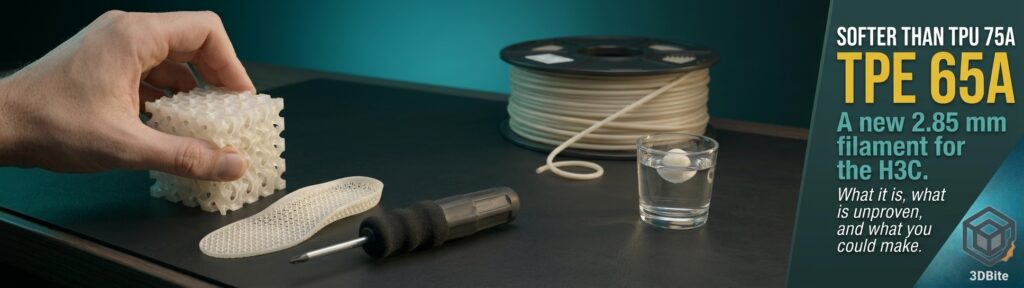
Ten days ago Bambu Lab launched the H3C with a 2.85 mm tool and a 75A TPU, and I wrote that the interesting part was the engineering choice: a thicker filament so that very soft material stops buckling on its way to the nozzle. I also said other makers would follow. The first one has. Antinsky, a Xiamen company better known for resin and release films, has announced a 2.85 mm TPE at Shore 65A, aimed squarely at H3C owners and priced at about $20.
Two things make it worth a post. It is ten points softer than Bambu’s own filament, which is a bigger step than it sounds. And it is a TPE, not a TPU, which changes what it is good at and what it is bad at. Softness at this level opens up projects that 95A TPU was never suited to, so most of this post is about what you could make. First, though, what has been claimed and how much of it anyone has checked.
What Antinsky has announced
All of the following comes from All3DP’s write-up, published on 12 November. It reads like a launch announcement and directs readers to Antinsky’s stand at Formnext, which runs in Frankfurt from 17 to 20 November. I could not load the full page, so these are the figures visible in excerpts of it.
| Property | Antinsky’s claim |
|---|---|
| Hardness | Shore 65A |
| Diameter | 2.85 mm |
| Density | 0.95 g/cm³ |
| Elongation at break | Over 500% |
| Tensile strength | 7.1 MPa |
| Tear strength | 48 kN/m |
| Rebound resilience | Over 50% |
| Flex life | Over 200,000 bending cycles |
| Working temperature | Stays elastic from -40 °C to 50 °C |
| Moisture | Low absorption; continuous drying mostly unnecessary |
| Other claims | Raw material meets food-contact requirements, skin-friendly, UV and weather resistant, recyclable, suits random lattice printing |
| Price | About $20 |
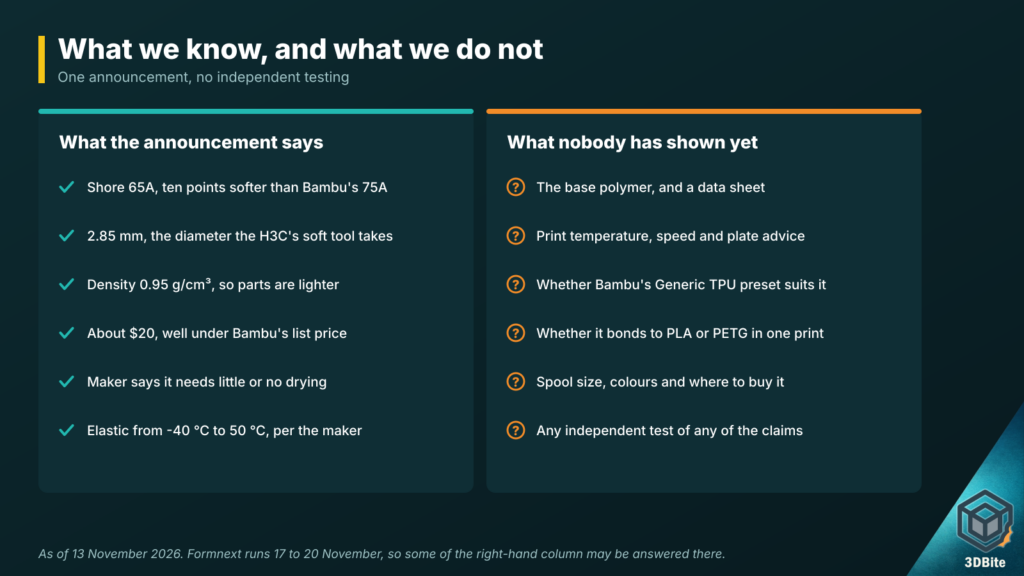
What I did not see: the base polymer, a nozzle temperature, a print speed, a recommended build plate, the spool weight, the colours, or a shop that has it in stock. Antinsky’s own websites list PLA, PETG, ABS and TPU but not this. Until a data sheet appears, treat every number above as a manufacturer’s claim.
How soft is 65A?
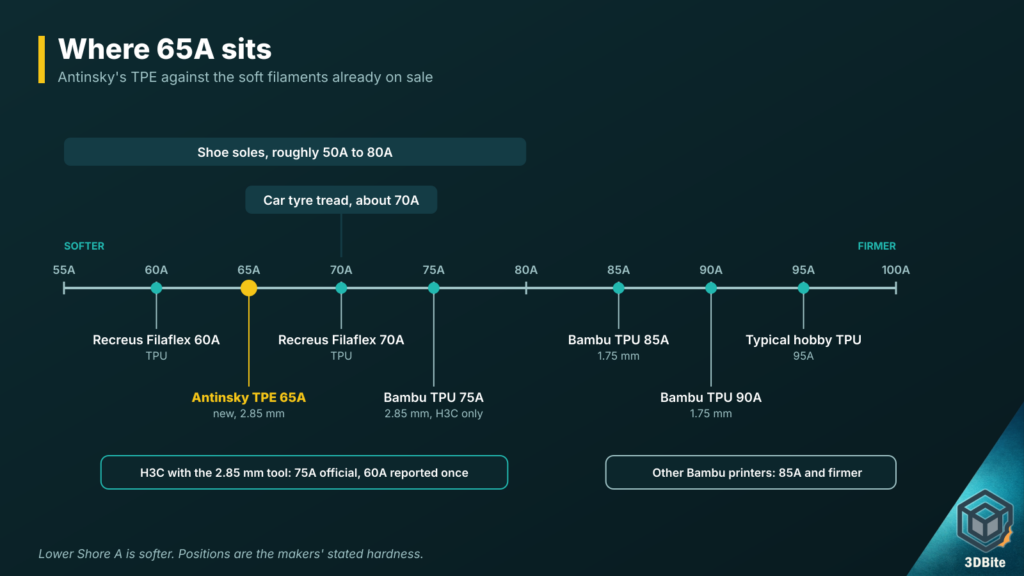
My TPU grades guide started at 85A because, until this month, that was the soft end of what most people could print. For reference points: a car tyre tread is about 70A, shoe soles run from roughly 50A to 80A, and the TPU most of us own is 95A. Bambu’s new filament is sold as 75A and measures 76 on its own data sheet. So 65A is softer than a tyre and inside the range of a cushioned sole.
It is not the softest filament on sale. Recreus has sold Filaflex at 70A and 60A for years, and CNC Kitchen printed the 60A on an H3C, describing the raw filament as feeling like “seriously overcooked spaghetti”. Those are TPUs, though, and expensive ones: All3DP’s flexible filament guide puts the Filaflex range at $66 to $91 a kilo. A 65A material at $20 is a different proposition, if the price holds and the spool is a full kilo.
There is a small irony here. Antinsky’s own flexible filament guide, published last month, lists material around 60A as “hard to print” and tells beginners to start much firmer. Both things are true. Soft filament is hard to print at 1.75 mm. The 2.85 mm diameter is what changes that.
This is a TPE, and the density gives it away
As I covered in What Is TPE, and How Is It Different From TPU?, TPE is the family and TPU is one member of it. When a spool says “TPE”, it usually means one of the non-urethane types. Antinsky has not said which, but the density is a strong hint. TPU filaments sit around 1.2 g/cm³: Bambu’s 75A is 1.17 and its TPU for AMS is 1.26. A flexible material at 0.95 is not a urethane. That figure is typical of styrenic TPEs, the SEBS-based kind used for soft-touch grips. This is my inference, not Antinsky’s statement.
One more clue: a parts seller called Creality3dParts lists a “TPR 65A” 2.85 mm filament with the same hardness, the same 0.95 density and the same elongation figure. TPR, thermoplastic rubber, is another trade name for this kind of material. I cannot confirm the two are related, but the match is close.
Here is how the Antinsky numbers compare with Bambu’s data sheet for TPU 75A.
| Property | Antinsky TPE 65A | Bambu TPU 75A |
|---|---|---|
| Hardness | 65A | 76 ± 1A |
| Density | 0.95 g/cm³ | 1.17 g/cm³ |
| Tensile strength | 7.1 MPa | 11.5 MPa |
| Elongation at break | Over 500% | Over 800% |
| Rebound resilience | Over 50% | 50% |
| Moisture | Low absorption claimed | 0.70% saturated absorption; dry at 70 °C for 8 hours |
| Price | About $20 | $47.99, or $28.79 in the current sale |
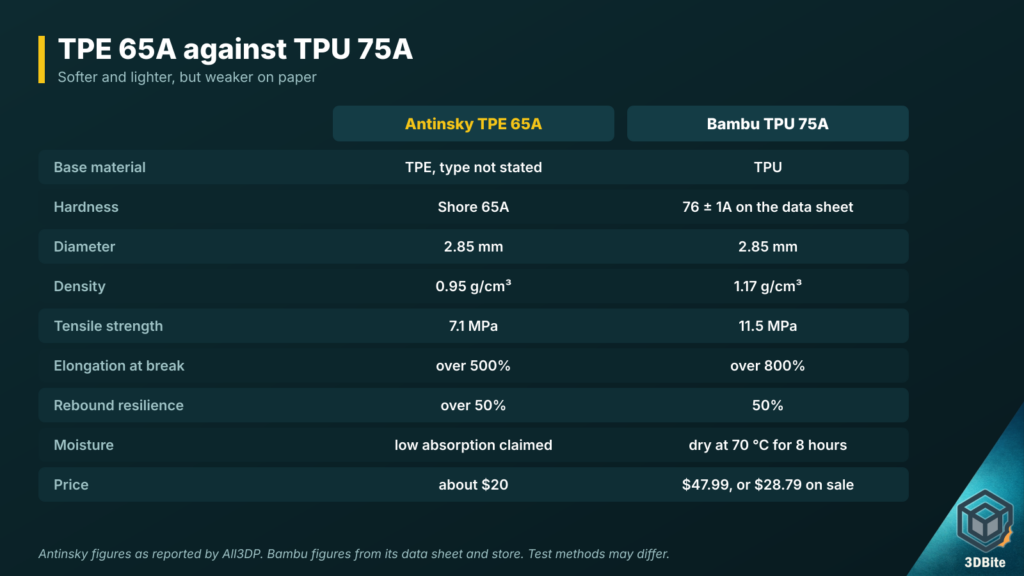
Three things follow from that table.
It is lighter. Antinsky says parts weigh 20 to 30% less than TPU. Against Bambu’s 75A the difference works out at about 19%; against a 1.26 TPU it is about 25%. The other side of that sum is that a kilo goes further: roughly 1,053 cm³ of material against 855 cm³, or 23% more volume per kilo. If the $20 is for a kilo, that is about $1.90 per 100 cm³, against $3.37 for Bambu’s 75A at its sale price and $5.61 at list.
It is weaker on paper. Tensile strength is about 38% lower than Bambu’s figure and it stretches less before breaking. I would not put much weight on the tear strength comparison, because Bambu’s number is measured across printed layers and Antinsky has not said how its figure was taken. Different test methods make all of these comparisons rough.
It will wear differently. The general rule from material guides is consistent: TPU beats non-urethane TPE on abrasion and on resistance to oils, greases and solvents. TPE wins on soft feel and, for SEBS types, on UV stability. So expect something that feels nicer in the hand than TPU and wears out sooner on the ground.
Why it needs an H3C
Soft filament behaves like a rope when you push it. Between the drive gears and the nozzle it bends and folds instead of moving forward, which is why Bambu’s general TPU guide says its other printers do not support anything softer than 85A. A 2.85 mm strand has about 2.65 times the cross-section of a 1.75 mm one and, by my earlier sum, about seven times the bending stiffness. It resists buckling far better.
The H3C is the only current Bambu printer that takes it. One of the nine tools in the Combo is a 2.85 mm tool, the filament is fed by hand through a bypass port and not through the AMS feeder, and Bambu says that tool is for flexible filaments only. The launch post and the TPU 75A post have the detail. For this post the point is simple: no H3C, no 2.85 mm, and so no Antinsky TPE 65A.
Will it actually print? The open questions
“Compatible with the H3C” in the announcement means the diameter fits. Whether it prints well is a separate matter, and there are five things I would want answered.
The preset. Bambu Studio has two 2.85 mm presets, one for its own TPU 75A and one called Generic TPU. There is no TPE preset that I know of. Generic TPU is the obvious starting point, with the temperature and flow adjusted. The encouraging evidence is CNC Kitchen’s Recreus 60A print at 10 mm³/s, but that was a TPU, so it proves the extruder can push something that soft and nothing about how this material melts.
The temperature. I saw none in the announcement. The look-alike TPR 65A listing gives 200 to 230 °C at the nozzle, a bed between 25 and 60 °C, the fan on, and 10 to 80 mm/s. I would use that as a place to begin a temperature tower, not as a setting.
Drying. This could be the material’s best feature. Bambu’s 75A must be dried at 70 °C for eight hours and kept dry, and Bambu warns that the spool can deform in the process. Antinsky says its TPE absorbs little moisture and mostly does not need continuous drying. If that is right, it removes the most tedious part of printing soft filament. My TPE post said these materials are somewhat less moisture-sensitive than TPU but still worth drying, and I would keep to that until someone tests it. I would not put it in the AMS 3H’s dryer slots at high heat without a stated safe temperature: a material that stops behaving at 50 °C is not one to guess with.
Bed adhesion. Styrenic TPEs are low-surface-energy materials, which is the same property that makes polypropylene awkward on a build plate. The look-alike listing names PEI among its surfaces. I would test on a small part before committing a long print, and my bed adhesion guide covers the options.
Bonding to rigid plastic. This is the one that matters most for the H3C, because printing soft and hard together is the machine’s party trick. TPU sticks to PLA and PETG well enough that reviewers printed shoes, watches and wheels that way. SEBS-type TPEs are different. Injection-moulding guides say they bond readily to polypropylene and to ABS, inconsistently to polycarbonate, and need help on polyester-type plastics. That is moulding, not printing, and nobody has published a test of this filament against PLA or PETG. Until someone does, design any soft-on-rigid part with a mechanical lock: holes the soft material flows through, undercuts, or a dovetail.
What you could make with it
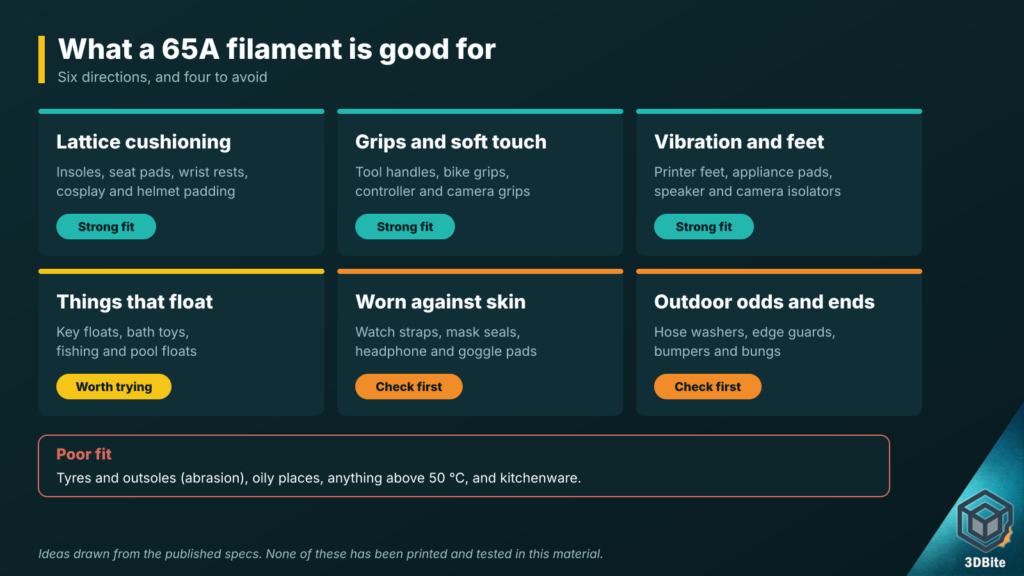
Now the enjoyable part. None of what follows has been printed in this material by me or by anyone I could find. These are ideas that follow from the published properties: very soft, light, rebounds well, said to shrug off moisture and sunlight, and not good with abrasion, oil or heat.
Lattices and cushioning
Antinsky singles out lattice printing, and it is the best fit. A lattice lets you set softness twice: once with the material and again with how much of it you use. Researchers have been doing this with firmer filaments for years. A 2026 study in iScience on printed footwear chose gyroid infill at 30 to 50% for midsoles after compression testing. Insole studies have shown that changing infill pattern and density between 14% and 20% measurably shifts pressure under the foot. One soft-robotics team got parts softer than their 95A filament simply by dropping infill and flow.
Start with a 65A material and that whole scale moves down. Things that were merely flexible become properly squashy: insoles and heel cups, seat and kneeling pads, wrist rests, padding for helmets and cosplay armour, camera-case inserts cut to the shape of the kit. Gyroid is the usual choice because it compresses evenly in every direction. Being about a fifth lighter than TPU helps most in exactly these bulky parts.
Grips and soft-touch surfaces
This is what styrenic TPE is used for in industry: the rubbery part of a toothbrush or a screwdriver handle. Printed sleeves for tool handles, bike grips, pen and stylus grips, controller grips, tripod leg wraps and camera grips are all natural uses. A sleeve that stretches over a rigid core avoids the bonding question entirely.
Feet, pads and vibration
Soft feet for printers, washing machines and speakers, isolation pads under a turntable or a noisy pump, grommets around cables. A rebound figure of about 50% means it gives back half the energy put into it and absorbs the rest, which is a reasonable middle for damping. I would keep it away from anything warm, such as feet directly under a heated enclosure.
Things that float
This is my own inference from the data. At 0.95 g/cm³ the material is less dense than fresh water, so even a solid part should float, where a TPU part at 1.17 sinks unless it traps air. That suggests key floats for boats and paddleboards, fishing floats, bath toys and pool bits. Print one and drop it in a sink before trusting it with your keys.
Worn against skin
Watch straps, mask and goggle seals, headphone pads and earhooks are where softness is felt most, and Antinsky calls the material skin-friendly. Bambu makes a similar claim for its 75A and, as I said in that post, has not published the standard behind it. Neither has Antinsky. I would print these for myself and see how they wear. I would not sell them as skin-safe on the strength of a press line.
Outdoors
Antinsky claims UV and weather resistance and elasticity down to -40 °C, which fits what SEBS-type materials are known for. Hose washers, edge guards, bumpers for garden furniture, bungs and caps are sensible things to try. The 50 °C ceiling is the catch: a dark part in direct summer sun or behind a car windscreen can get hotter than that.
Soft and rigid in one print
The H3C can carry a rigid filament and a 2.85 mm soft one in the same job, and can run different nozzle sizes while it does. A PETG handle with a soft over-grip, a rigid box with a printed-in gasket, articulated models with soft joints, buttons with a soft cap. All of it depends on the bonding question above, so lock the parts together mechanically until someone shows the two materials fuse.
Grippers, bellows and squishy toys
Compliant grippers, bellows, suction-cup shapes and fidget toys all get better as the material gets softer, and a claimed 200,000 bend cycles suggests it tolerates repeated flexing. For anything a child or a pet will chew, I would wait for real safety documentation.
Where I would not use it
- Tyres, wheels, shoe outsoles and anything that scuffs. TPU is the better material for wear.
- Seals or pads that sit in oil, grease or fuel.
- Anything hot: dishwashers, engine bays, parts near a heated bed or chamber.
- Parts that carry load. At 7.1 MPa this is a cushioning material, not a structural one.
The claims I would treat carefully
Food contact. The wording is that the raw material complies with food-contact requirements. That is a statement about the pellets, not about a printed part. Printing adds a nozzle, layer lines that hold residue, and any colourant in the filament. The material also loses its properties above 50 °C, which rules out hot drinks and dishwashers. I would not make kitchenware from it.
No drying needed. Plausible for this class of material and unproven for this product. A spool that has sat open for a month will tell you more than the announcement does.
“Optimised for the H3C.” From what I can see, this means it is made in 2.85 mm. I found no Bambu Studio profile, no tested settings and no statement from Bambu.
Recyclable. Any thermoplastic can be remelted in principle. Whether anyone near you collects printed TPE is another question.
If you plan to sell anything made from it, my guide to selling prints is worth reading before you repeat a manufacturer’s safety wording to a customer.
If you do not own an H3C
That is my position with an A1 and an A2L, and it is most people’s. The announcement I read mentions only 2.85 mm, so there is nothing here for a 1.75 mm printer. There are still two ways to get softer parts.
The first is the lattice trick in reverse. Print 85A or 90A TPU from the external spool holder with few walls and low gyroid infill, and the part will feel a good deal softer than the filament’s rating. The second is a 1.75 mm ultra-soft TPU such as Filaflex 70A, printed slowly on a direct-drive extruder. Bambu says its other printers do not support anything below 85A, so that route is at your own risk, and Recreus itself warns against all-metal hotends for its softest grades. My retraction guide and drying guide apply to both.
It is also worth watching whether a P3C or anyone else’s tool changer picks up 2.85 mm. A second filament maker committing to the diameter makes that a little more likely.
The other two products in the announcement
Antinsky launched two other things alongside it. PBST is a modified co-polyester filament at $9, said to print at PLA speeds, feed through a Bambu AMS, contain over 60% bio-based material and break down under industrial composting. The third is a filament tangle cutter, about which I could read nothing beyond the name. Neither is why this announcement is interesting, and the composting claim deserves its own scrutiny another day.
Who should care
| If you… | My view |
|---|---|
| Own an H3C and print cushioning, grips or wearables | Worth a spool once it is on sale and someone has published settings. It is softer and, if the price is per kilo, much cheaper than Bambu’s 75A |
| Own an H3C and print wheels, soles or wear parts | Stay with TPU. Abrasion resistance is TPU’s strength |
| Want soft and rigid fused in one print | Wait for a bonding test with PLA and PETG |
| Own any other Bambu printer | You cannot use it. Use low-infill 85A or 90A TPU for softer parts |
| Are choosing a printer | One third-party spool is not a reason to buy a $2,499 machine, but it is a sign that 2.85 mm soft filament will have more than one supplier |
My own read: the material matters less than what it signals. A second company making 2.85 mm soft filament within a fortnight of the H3C suggests the diameter is coming back for flexibles, and a TPE at 65A gives H3C owners something Bambu’s range does not. Whether this particular spool is any good is a question nobody outside Antinsky can answer yet.
Where the evidence is thin
- Every figure for the filament comes from one announcement, which I could only read in excerpts. There is no data sheet and no independent test.
- The base polymer is not stated. “Styrenic TPE” is my inference from the density and from a similar product listing.
- I do not know the spool weight, so the price-per-volume sums assume a kilo.
- Print settings are unpublished. The temperatures I quote are from a different seller’s look-alike product.
- The bonding guidance comes from injection moulding, not from FDM printing.
- The ideas section is reasoning from properties. Nothing in it has been printed and tested in this material.
- Antinsky’s and Bambu’s mechanical figures may use different test methods and print directions.
Formnext starts on 17 November. If a data sheet, settings or a first hands-on report appears there, I will update this post.
Sources and further reading
- All3DP: Antinsky launches TPE 65A, PBST and a filament tangle cutter
- Bambu Lab: TPU 75A technical data sheet
- Bambu Lab US store: TPU 75A (2.85 mm)
- All3DP: Bambu Lab’s TPU 75A and the return of 2.85 mm
- Bambu Lab wiki: TPU printing guide
- CNC Kitchen: Bambu Lab H3C review
- Antinsky: flexible filament guide
- Creality3dParts: TPR 65A 2.85 mm listing
- Recreus: Filaflex 70A
- All3DP: flexible filament brands and prices
- iScience (2026): gyroid lattice density in printed footwear
- Infill pattern and density of 3D-printed insoles
- A legged soft robot platform (softness from infill and flow)
- Komaspec: overmoulding material compatibility
- Farr Polychem: TPE grades for overmoulding
- Xometry: TPE vs TPU
- Formnext 2026: dates and opening hours