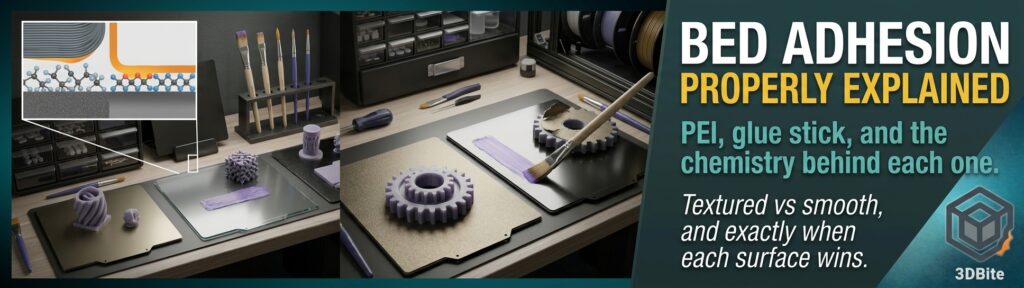
Bed adhesion advice online is a genuine mess of folk wisdom — “use hairspray,” “use glue stick,” “textured is always better” — repeated without anyone explaining the actual chemistry that makes each one work or fail. This is the properly explained version: what textured and smooth PEI are actually doing differently at a molecular level, why glue stick is not what most people think it is, and the specific surface-and-additive combination that wins for each material, matching the depth of the support settings and retraction settings posts in this series.
Textured PEI and smooth PEI are not the same surface with different looks
This is the single most important thing to understand before anything else in this post, because the two PEI finishes bond to plastic through genuinely different mechanisms rather than being cosmetic variants of the same thing. Smooth PEI is a glossy film that makes direct molecular contact with the melted filament across its full surface area, producing what one detailed comparison describes as “aggressive suction-like grip” through that contact — the plastic and the PEI film essentially interlock at a chemical level across a continuous area.
Textured PEI, by contrast, presents roughly 40% less direct molecular contact area than the smooth film. It compensates for that reduced chemical contact with physical friction and mechanical geometric locking instead — the microscopic texture gives the cooling plastic something to physically key into, rather than relying purely on surface chemistry. This is precisely why textured PEI grips PLA and PETG confidently while still releasing cleanly once the bed cools, where smooth PEI’s purely chemical bond, particularly with certain materials, can become a genuine problem rather than a feature.
Why PETG specifically turns “excellent adhesion” into a liability
This is worth explaining at the chemistry level because it explains a genuinely common frustration covered in the PETG materials post — PETG’s plate adhesion is not just “strong,” it is a specific chemical reaction. PETG contains glycol-modified PET, and when it is extruded at 230-250°C onto a smooth PEI sheet heated to 70-80°C, the polymer chains at the interface between the two materials actually interdiffuse and fuse together — not a surface bond that can be prised apart cleanly, but genuine molecular mixing at the boundary. The resulting bond can exceed the cohesive strength of the PEI coating itself, meaning the print tears the surface coating away from the plate rather than separating cleanly from it. This is precisely the mechanism behind the plate-adhesion warning already covered in the PETG materials post, explained at the level of what is actually happening rather than just the symptom.
Glue stick is not what most people think it is
This is the single most widely misunderstood piece of bed-prep advice in the whole hobby, and it is worth correcting directly. Glue stick is contrary to popular belief primarily a release agent, not an adhesion promoter. The PVA in a standard glue stick activates at printing temperature and creates a thin, slightly tacky sacrificial interface — a layer that bonds to both the plate and the printed part, but bonds to each only loosely enough that the whole assembly separates cleanly once cool, rather than the part and the plate ever actually touching and fusing directly.
This distinction genuinely changes what glue stick is doing depending on the material. With ABS, glue stick does function closer to a conventional adhesion promoter, helping a material that otherwise struggles to grip cold plate edges during warping stress. With PETG specifically, its job is the opposite: a sacrificial release layer standing between PETG’s aggressive chemical bonding tendency and the plate surface, preventing the direct interdiffusion described above from ever happening in the first place. Apply it to smooth PEI while the bed is cold, in a thin, even layer — a thick or uneven application does not improve adhesion, it just adds an inconsistent layer the print has to squish through on its first pass.
The glue stick and hairspray mistake specific to PLA
This is a genuinely counterintuitive finding worth flagging directly, because the instinct to “add more grip” is entirely reasonable and entirely wrong here. PLA sticks to a clean textured or smooth PEI sheet at 55-60°C reliably with zero additives — this connects directly to the first layer troubleshooting post‘s point that PLA’s adhesion failures are almost always a contamination or Z-offset problem rather than a surface-grip problem. Adding hairspray or glue stick to PLA on PEI specifically reduces adhesion compared to the bare clean surface, because the PVA or hairspray polymer fills in the microscopic texture that PLA was relying on to physically grip in the first place. If PLA is not sticking, the fix is cleaning the plate properly — covered in the first layer troubleshooting post — not adding a layer of glue stick on top of the problem.
The full comparison table
| Material | Best surface | Bed temperature | Release agent? | Why |
|---|---|---|---|---|
| PLA | Textured or smooth PEI, clean | 55-60°C | None — actively counterproductive | Mechanical grip on texture (or chemical grip on smooth) is already sufficient; additives fill the texture and reduce grip |
| PETG | Textured PEI (gold standard); smooth PEI only with glue stick | 70-85°C | Mandatory on smooth PEI; not needed on textured | Textured PEI’s reduced contact area avoids the molecular interdiffusion that occurs on smooth PEI; glue stick on smooth prevents that same fusion |
| PETG on bare glass | Avoid without glue stick | 80-85°C | Mandatory | PETG bonds to the silicates in glass directly; the bond can chip or crack the glass on removal without a release layer |
| ABS / ASA | Textured PEI, enclosed | 95-110°C | Optional (ABS slurry helps on large parts) | Thermal grip at high bed temperature is the main mechanism; enclosure prevents warping regardless of surface choice |
| TPU | Textured PEI or Garolite | 40-50°C | None on textured; avoid smooth without caution | TPU can bond very aggressively to smooth surfaces in the same way PETG does; textured’s reduced contact area avoids the same over-adhesion risk |
Garolite: the underrated option worth knowing about
This surface came up repeatedly across sources as a genuinely underappreciated option specifically for PETG — G10/Garolite offers good adhesion at 70°C and self-releases cleanly once cool, without any of the over-adhesion risk smooth PEI carries. This is the same material already named as the gold-standard surface for nylon in the nylon materials post, and its appearance here as a solid PETG option too is worth remembering — a single Garolite plate genuinely covers both of these otherwise-fussy materials.
When smooth PEI genuinely wins despite the PETG risk
This is worth stating plainly rather than treating smooth PEI as a surface to avoid outright. For display pieces, logo plates, lithophane frames — anything where the bottom face of the print is a visible, presentation-facing surface — smooth PEI delivers a mirror finish that a textured plate’s micro-geometry simply cannot produce. The catch, covered throughout this post, is specifically PETG; for PLA, smooth PEI is an excellent, zero-compromise choice for exactly this reason, and switching to it deliberately for a PLA piece where the underside will be seen is a genuinely sensible, low-risk swap. For PETG on the same surface, the glue stick release-layer step is simply non-negotiable rather than optional.
The maintenance side: when a textured plate stops working
This connects directly to the maintenance guide‘s discussion of build plates as a genuine consumable rather than a permanent fixture. A textured PEI plate’s micro-texture wears smooth with repeated use, with one source citing roughly 500 print-hours as the point where adhesion reliably starts dropping off — the physical geometry that provided the mechanical grip described earlier in this post has simply worn away. A plate that used to hold prints reliably and has started producing adhesion failures with no change in settings, cleaning routine, or filament is very likely at or past this wear point, and replacing it rather than endlessly chasing a settings fix is the correct response.
The practical summary
Default to textured PEI for everyday PLA and PETG printing — it is the one surface that handles both materials competently with zero additive fuss, which is exactly why it ships as the factory default on most modern machines including the A1 and A2L. Reach for smooth PEI deliberately when a mirror-finish underside genuinely matters for a specific PLA display piece, and never run PETG on smooth PEI without a thin glue stick release layer underneath it. Treat glue stick as a release agent for PETG and TPU specifically, not a general-purpose adhesion fix — adding it to PLA on a clean plate makes things worse, not better. And replace a textured plate once its adhesion has genuinely degraded rather than assuming every adhesion problem is a settings issue; sometimes the plate itself has simply worn out.