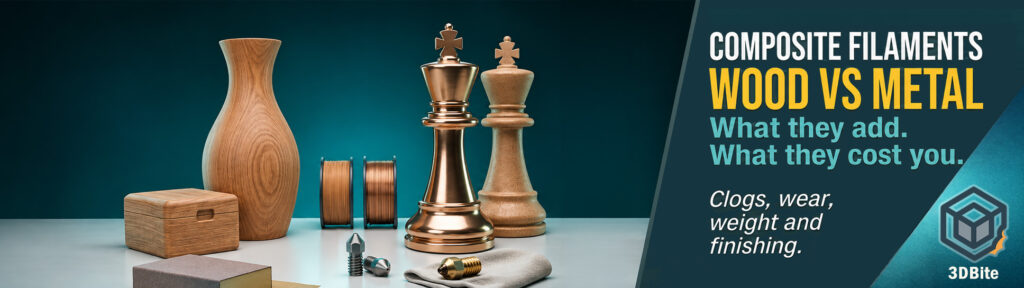
Carbon fibre gets most of the attention in composite filaments, and I have covered that side in my abrasive filaments guide. But two other composites keep turning up on shop shelves and in display cabinets: wood-fill and metal-fill. They are sold on how they look and feel, not on strength, and their trade-offs are quite different from each other. Here is what each one genuinely adds, and what you pay for it.
The short version
| Wood-fill | Metal-fill | |
|---|---|---|
| What it is | PLA (sometimes PLA/PHA) blended with wood fibre or flour | PLA blended with fine metal powder: bronze, copper, brass, stainless steel or iron |
| What it adds | Matte, grainy, wood-like look and feel, a woody smell, sandable and stainable surface, heat-dependent shading | Real weight, a cold metal feel, and a surface you can polish or patinate to look cast |
| Main cost | Clogging, so a larger nozzle; brittle filament; weaker parts; moisture sensitivity | Heavy abrasion, brittleness, poor bridging, much higher price, mandatory post-processing |
| Nozzle | 0.6 mm is the common advice, never 0.2 mm. Hardened steel is debated | Hardened steel or ruby nozzle. 0.5 to 0.6 mm often easier |
| Strength | Worse than plain PLA | Stiffer but weaker, and brittle |
| Worth it for | Decorative pieces, props, prototypes that should look like timber | Display pieces, trophies, props and jewellery blanks where weight and finish matter |
Prusa’s knowledge base sums up both in one sentence: wood- and metal-filled filaments are used mostly for aesthetic purposes, and have much worse mechanical resistance and layer adhesion than unmodified filaments. That is the frame I would keep in mind for everything below.
Wood-fill: what it adds
- The look and feel. Bambu describes its PLA Wood as slightly grainy with a matte finish that conceals layer lines. Reviewers and guides agree the surface is the point. It sands and stains much like real wood, and parts can be glued with wood glue.
- Shade control by temperature. Several guides say wood filament prints lighter at lower nozzle temperatures and darker at higher ones, and Xometry’s guide quotes up to 240 °C for a darker finish. Others suggest varying the temperature a few degrees between layers to mimic grain. This works with some brands and not others, and running hot raises the risk of burnt, clogged fibre.
- Low warping. Clever Creations notes warp and layer splitting are minimal, so no enclosure is needed. That is the PLA base showing through.
- The smell. colorFabb and Bambu both mention a mild woody scent while printing. Bambu says it is non-irritating, which is its claim.
Wood-fill: what it costs you
- Clogs. The fibres are the issue. Prusa recommends at least a 0.6 mm nozzle and 0.2 mm layer height for wood-filled and other large-particle composites. Fillamentum’s Timberfill guide recommends 0.5 or 0.6 mm for 1.75 mm filament, and says to clean the nozzle with a maintenance filament after several prints. Bambu’s wiki lists wood, rock and metal-filled PLA as unavailable on a 0.2 mm nozzle, and its PLA Wood page repeats that.
- Is a hardened nozzle needed? Sources disagree. Simplify3D says wood is much less abrasive than metal-filled and carbon-fibre filaments because the particles are softer, and a Prusa support reply in Czech says a hardened nozzle is not necessary for woodfill. Bambu’s PLA Wood page, by contrast, recommends hardened steel at 0.4, 0.6 or 0.8 mm, or a 0.4 mm stainless steel nozzle. A few guides call it “somewhat abrasive”. My reading is that wear is slow, and the practical reason to use hardened is to stop swapping nozzles, not because wood is nasty.
- Fibre content is inconsistent. Brands quote roughly 10 to 40% wood. colorFabb’s woodFill is described by retailers as about 30%, while budget brands list 20% or less. There is no standard, so the same settings will not suit every spool.
- Weaker parts. colorFabb’s data sheet lists tensile strength of about 36.9 MPa with only 1.7% strain at break, which is stiff and brittle. Xometry’s comparison table gives a wood-filled PLA flexural strength of 14.47 MPa against 91.6 MPa for standard PLA, though that is one sample set and test methods vary. Treat these as directional.
- Moisture. Bambu says to dry PLA Wood before use. One forum user said it was fine when freshly dried but problems started within a day, so they re-bagged it with fresh desiccant. That is anecdotal.
- Brittleness in feeders. Bambu’s wiki warns that some brands of PLA Wood are too brittle and can break in the AMS or AMS Lite channel. Its filament guide also says PLA Wood can be compatible with the AMS but may not be with the AMS Lite. Retailers quoting Bambu’s own PLA Wood page list it as AMS and AMS Lite compatible, so check your brand, and consider an external spool on an A1.
- Clean-out discipline. Fibre left in a hot nozzle can burn. Guides say to push leftover wood filament out and, if you stop, pull it from the hotend. FormFutura and Fillamentum both say to flush with plain filament afterwards.
Typical wood-fill settings
| Setting | What the sources give |
|---|---|
| Nozzle temperature | colorFabb woodFill 190 to 220 °C (advised 195 to 220 °C). Bambu and Prusa’s guides give 190 to 240 °C for the category |
| Bed | 50 to 60 °C; smooth PEI suggested by Prusa for composites, with a glue stick if adhesion is poor |
| Speed | Guides suggest 30 to 60 mm/s; colorFabb advises 40 to 100 mm/s for woodFill |
| Layer height | 0.2 mm or thicker (Prusa) |
| Retraction | Guides differ: some say reduce it to avoid grinding, others say increase it for stringing. Tune on your own spool |
Metal-fill: what it adds
- Weight. This is the headline. FormFutura’s MetalFil Ancient Bronze is quoted at 80% bronze by weight with a density of 3.5 g/cm³, roughly three times PLA. colorFabb’s bronzeFill is listed at 3.9 g/cm³. Proto-pasta’s stainless steel PLA is 60% steel by weight and about three times the weight of PLA, and its magnetic iron is about 1.5 times, with real ferromagnetic behaviour.
- A finish that can pass for cast metal. Straight off the printer it is matte and dull. After sanding and polishing, colorFabb and others show results close to real bronze or copper. FormFutura says a rotary tumbler can make a part “indistinguishable” from cast metal, which is a marketing claim, but the tumbled results I have seen from other makers support the general point.
- Patina and rust effects. You can patinate bronze or copper, and Proto-pasta’s iron filament is designed to be rusted deliberately.
- Low shrinkage. Prima’s data sheet notes very low shrinkage from the metal powder.
Metal-fill: what it costs you
- Nozzle wear. Every manufacturer I read says so. colorFabb’s tutorials say to use a hardened steel or ruby nozzle, FormFutura says the powders accelerate brass nozzle wear much faster than unfilled filament, and Prusa calls metal-filled materials highly abrasive and requires a hardened nozzle. CNC Kitchen’s nozzle-wear testing also notes metal filaments wear nozzles. Bambu’s wiki says hardened steel is required for metal-filled PLA, and that stainless steel or brass nozzles are not hard enough. That matters for an A1, whose standard hotend uses a stainless steel nozzle (check your own).
- Brittleness. Prusa does not recommend printing these with its MMU because the filament is brittle, and Simplify3D says both the printed parts and the raw filament are brittle, advising a strong guide tube with limited bend. That is a warning for AMS Lite users too. Bambu’s wiki rates metal-filled PLA as AMS compatible except for filament that is too brittle, rough or soft.
- Bridging and overhangs. Simplify3D explains that the weight makes molten metal-filled plastic droop, so large bridges and steep overhangs do poorly. It suggests thinner layers, 0.1 to 0.15 mm, to reduce the overhang problem.
- Retraction and flow. Simplify3D says retraction can be hard because metal powder makes the nozzle struggle to hold suction. MatterHackers and some retailers say these filaments often need more flow than ordinary PLA. See my flow rate calibration guide.
- Weak parts. A 2017 study in the journal Materials compared PLA with Bronzefill and magnetic iron filament and concluded that such blends cannot be used where mechanical strength is needed. NASA researchers found metal-filled PLA stiffer but weaker than unfilled, with strength and toughness falling as metal content rose and porosity increasing.
- Heat. The base is still PLA. A retailer’s listing for bronzeFill gives a glass transition temperature of 55 °C. Proto-pasta’s HTPLA-based metals can be heat treated to improve temperature resistance, which is a separate step.
- Price. See below.
Finishing metal-fill (it is not optional)
Unfinished metal-fill does not look like metal. A tutorial on metal composites says plainly that post-processing is a necessity, and Prusa says polishing gives a metal look but not metal properties. A common sequence, from colorFabb’s guidance via a retailer: sand from around 120 to 180 grit until the printed lines fade, then 240 to 320, then 600, wipe with a clean cloth, and polish. Prusa suggests wet sanding from 600 up to 1500 grit or finer. For a deeper shine, tumble the part in a rock tumbler with a polishing medium. Print slowly and cleanly, because a layer shift or blob has to be sanded out.
What it costs in money
| Filament | Price I found | Per kilogram |
|---|---|---|
| Bambu PLA Basic (reference) | $17.99 with spool (US) | $17.99 |
| Bambu PLA Wood | $24.99 per 1 kg (US reseller). €27.90 including VAT in Germany | About $25 |
| Polymaker PolyWood (wood look, no wood) | $43.28 for 600 g, excluding VAT (3DJake US) | About $72 |
| colorFabb bronzeFill | $56.61 for 750 g, excluding VAT (3DJake US). £50.50 including VAT in the UK | $75.48 excluding VAT. £67.33 including VAT |
| colorFabb copperFill | $48.72 for 750 g, excluding VAT (3DJake US) | $64.96 |
| Proto-pasta steel-filled PLA | $55.93 for 500 g, excluding VAT (3DJake US) | $111.86 |
| Proto-pasta magnetic iron PLA | $42.24 for 500 g, excluding VAT (3DJake US) | $84.48 |
These are snapshots from different retailers and dates, so check current prices. There is a second cost that does not show on the label. Because metal-fill is so dense, a spool contains far less filament by length. My arithmetic, using 1.75 mm filament (cross-section about 2.405 mm²) and a typical PLA density of about 1.24 g/cm³: 750 g of PLA is roughly 250 m, and 750 g of bronzeFill at 3.9 g/cm³ is roughly 80 m. That is about a third of the length. Combining the two effects, the cost per cubic centimetre of printed volume works out at roughly 13 times that of PLA using US prices ($75.48 × 3.9 against $17.99 × 1.24). The printed part is also heavy, which is partly the point, but it means a metal-fill model costs far more than the same model in PLA.
Wood-fill is much kinder: Bambu’s own PLA Wood is about 40% dearer per kilo than PLA Basic on these prices, though a speciality brand can cost around four times as much.
Printer and nozzle checklist
| Check | Wood-fill | Metal-fill |
|---|---|---|
| Nozzle size | 0.6 mm preferred, 0.4 mm workable on short prints, never 0.2 mm | 0.5 to 0.6 mm often easier, though some brands say 0.4 mm works (FormFutura) |
| Nozzle material | Hardened steel if you print it regularly. Sources disagree on whether it is essential | Hardened steel or ruby. Bambu says stainless or brass is not hard enough |
| Hotend | Standard PLA-capable hotend | All-metal hotend advised by several guides |
| Feeding | Check AMS and AMS Lite compatibility for your brand, or use an external spool | Brittle, so external spool and a gentle feed path are safer |
| Build plate | Smooth or textured PEI, glue stick if needed | Smooth PEI suggested by Prusa, glue stick suggested by colorFabb |
| Enclosure | Not needed | Not needed. Part cooling fan on |
| Before and after | Dry first, flush with plain filament afterwards | Flush with plain filament afterwards |
One naming trap: not everything that looks metallic is metal-filled. Bambu’s wiki puts its own “PLA Metal”, along with Silk and Matte, in the regular PLA group, meaning it does not contain the hard, large-particle fillers. By contrast it groups Sparkle, Marble and carbon or glass-fibre PLA as abrasive. Always check the data sheet and the filler, not the marketing name. For the nozzle side, see my nozzle types guide.
Alternatives worth knowing
- Foamed wood-look PLA. Polymaker’s PolyWood contains no wood powder at all. It uses a foaming process that gives wood-like density, listed at about 0.8 g/cm³, and Polymaker says this removes the clog risk. It is more expensive than ordinary wood-fill on the prices above, but it is the lowest-risk way to get a timber look.
- Paint, stain or a finishing technique. A matte or silk PLA with a decent paint job can give the look of metal or wood without the wear, and with the strength of PLA.
- Carbon-fibre PLA. It is a structural composite with its own abrasion rules, covered in the abrasive guide, and not an aesthetic one.
My take: when is it worth it?
| If you want… | My view |
|---|---|
| A timber look for a prop, plaque or display piece | Wood-fill is a fair choice. Use a 0.6 mm nozzle, dry the spool, and expect to sand and stain |
| A wood look with the least hassle | Try a foamed wood-look PLA or a painted finish before committing to fibre-filled |
| Real weight and a polishable metal finish on a showpiece | Metal-fill does something nothing else does. Budget for a hardened nozzle, a lot of sanding, and a high price per print |
| A part that has to carry load or take heat | Neither. Use PETG, nylon or a CF-reinforced engineering filament, and see my enclosed printer and chamber guides |
| To print through an AMS Lite | Check the brand first, and expect to feed brittle filaments from an external spool |
My honest read is that both materials are worth trying once, for the right project, and neither should become your default. The wood-fill penalty is mostly annoyance, with clogs and feeding trouble, while the metal-fill penalty is abrasion, weight in your wallet and a lot of finishing. If a finished part looks like timber or bronze and sits on a shelf, they earn their keep. If it has to do any work, they do not.
Personally, I have printed a few dozen spools of wood-fill filament from Eryone and Elegoo on my A1. All with the same nozzle and I’ve noticed no issue with nozzle wear on the original stainless steel 0.4mm nozzle that shipped with my A1. I know others have reported wear on both nozzle and AMS with wood-fill, but this has not been my experience with them.
What I have had, particularly with the Eryone, is filament that’s brittle and breaks quite easily. One has to be carful when loading and feeding in to the AMS as breaks can be an issue. Once loaded it’s typically ok for me.
Sources and further reading
- Prusa Help: composite materials (metal or wood particles)
- Bambu Lab wiki: filament guide material table
- Bambu Lab wiki: compatibility and parameter settings of filaments
- Simplify3D: metal-filled materials guide
- Simplify3D: wood-filled materials guide
- Fillamentum: Timberfill 3D printing guide
- colorFabb: how to print with bronzeFill
- colorFabb: how to print with steelFill
- colorFabb: how to print with woodFill
- FormFutura: MetalFil Ancient Bronze
- Proto-pasta: stainless steel metal composite PLA
- Proto-pasta: magnetic iron PLA
- Polymaker: PolyWood technical data sheet
- MatterHackers: how to succeed with metal PLA
- All3DP: the best 3D printer metal filaments
- CNC Kitchen: how much abrasive filaments damage your nozzle
- Materials (MDPI): mechanical properties of metal-polymer blends printed by FDM
- NASA NTRS: metal composite PLA mechanical testing
- Xometry: wood 3D printing filament
- 3DJake: colorFabb bronzeFill pricing
- 3DJake: Polymaker PolyWood pricing
- Bambu Lab PLA Wood (reseller listing quoting Bambu’s page)