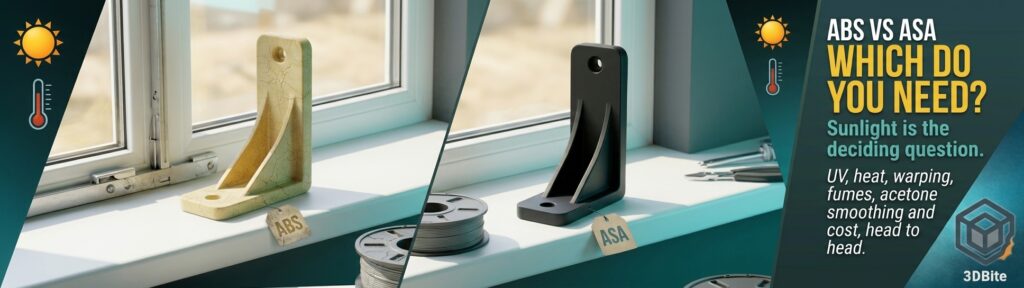
This site already has a standalone explainer for each of these materials, the ABS post and the ASA post, so this is not another “what is it” article. It is the one comparison you actually need when you are standing between two spools: they look almost identical, print almost identically, and cost almost the same, so which one do you pick? The short answer is that for most people the decision comes down to a single question, whether the part will live in sunlight, with a handful of smaller factors deciding the cases where it will not. The longer answer is worth having, partly because the published advice contradicts itself in several places, and I would rather show you where than pretend the sources agree.
The short version
| If your part… | Pick | Why |
|---|---|---|
| Will sit outdoors or in sunlight, including behind a window | ASA | UV resistance is the one clear, large difference |
| Lives indoors and needs to be cheap | ABS | It is generally slightly cheaper |
| Needs to be glued with acetone or vapour smoothed | ABS | The acetone workflow is established for ABS, and reports for ASA are mixed |
| Is large and prone to warping on your machine | ASA, if anything | Several sources report slightly lower warping, though others say they behave alike |
| Has to survive heat but never sunlight | Either | The heat figures overlap and the sources disagree about who wins |
| Will be printed on an open-frame printer | Neither | Both need an enclosure. Use PETG, or change printer |
Why they behave so alike, and the one thing that is different
ABS and ASA are close relatives. Both are styrene-acrylonitrile plastics toughened with a rubber phase. The difference is the rubber: ABS uses butadiene rubber, ASA replaces it with acrylic rubber. That substitution is the whole story. The butadiene rubber contains double bonds that sunlight attacks, while the acrylic rubber does not, which is why ASA is credited with roughly ten times the weathering and UV resistance of ABS, along with somewhat better long-term heat and chemical resistance. Everything else, the temperatures, the warping behaviour, the need for an enclosure, follows from the shared styrene backbone. One guide sums up the printing experience as nearly identical, same settings, same warping, same fume profile.
UV and weather: the decisive difference
Every source I read agrees on this one, and it is the reason the choice exists at all. In sunlight, ABS yellows and becomes brittle, with guides variously describing the damage setting in over weeks or months depending on conditions, and ASA keeps its colour and strength for years. The polymer science literature, as one materials supplier points out, consistently shows ASA’s advantage, though the size of the gap varies with the test method. For practical purposes the rule is simple: if sunlight will reach the part, use ASA. That includes the less obvious cases, such as a bracket on a windowsill or a mount inside a car, because glass does not block all of the UV that does the damage. One guide’s blunt advice is not to choose ABS for outdoor parts merely because it is cheaper, since UV exposure is a genuine weakness.
Heat resistance: the numbers will not settle
Both materials sit well above PLA and PETG for heat, with heat deflection temperatures around the mid-90s to 100 degrees Celsius. Beyond that, the sources part company, and it is instructive to see how.
| Source | What it says about heat |
|---|---|
| A materials guide (PrintPal) | Both around 95 to 100°C, essentially equal |
| A head-to-head test write-up | ABS slightly ahead, about 100°C against about 95°C for ASA |
| An industrial supplier (BigRep) | ASA about 86 to 94°C depending on load, ABS about 75 to 90°C, so ASA ahead |
| A filament guide (Wevolver) | ASA about 85 to 96°C, and more resistant to temperature fluctuation |
| A retailer guide | Both about 98°C |
| A European blog | Both about 95 to 105°C, comparable |
The honest reading is that the numbers overlap so heavily that the winner depends on the specific filament, the test load and the source. Heat deflection temperature also varies a lot between brands and is not the same as a safe working temperature, so a part that must survive a hot environment should be tested rather than trusted to a headline figure. If heat is the only concern, treat the two as equal and decide on other grounds. The one fair generalisation is the wider point from the ASA literature, that its long-term heat performance and stability under temperature cycling tend to hold up well.
Warping and the enclosure
Both materials shrink as they cool and both want a warm, still environment, so both need an enclosure, a point every guide I read makes without exception. Whether ASA warps less is where the advice splits. Several sources say yes: one says ASA has lower warping, another that it has better dimensional stability, especially on large prints, and another suggests an open frame gives moderate warping with ASA against severe warping on ABS over about 50mm. Others disagree and describe the two as behaving the same, with one guide rating ASA as moderate to high against ABS high. Wikipedia notes ASA has low moulding shrinkage, which supports the idea that it behaves a little better, but that is an industrial moulding figure rather than a printing result.
My practical reading is that ASA is at best a little more forgiving. The suggested chamber temperatures reflect that: one test write-up suggests 40 to 50°C for ABS and 35 to 45°C being sufficient for ASA, while a materials guide suggests 40 to 55°C for both. Either way, you still need a chamber, a hot bed, low part cooling and no drafts. Everything in the warping guide applies equally to both, and if you have a part that lifts in ABS, switching to ASA will not rescue it on its own.
Fumes and safety
Both are styrene-based, and both need ventilation, which is another point of unanimity. Where sources differ is degree. Some say ASA gives off noticeably fewer volatile compounds than ABS, one describing significantly fewer, and another saying lower emissions but with ventilation still recommended. Others put the two at the same level. Even the more optimistic ones stop short of calling either safe to breathe, and one is explicit that ASA is “safe for home printing in well-ventilated rooms” while still not recommended to inhale directly. The sensible takeaway is that ASA may be a little gentler, but you should treat both identically: print in a ventilated space or with proper extraction, and do not rely on an enclosure or a built-in carbon filter to remove the need for fresh air. The fumes and ventilation post covers the practical side, and the enclosed printers editorial explains why a closed box is not the same thing as a ventilation system.
Post-processing: the acetone question
This is ABS’s best argument. ABS dissolves in acetone, which means two useful tricks: vapour smoothing, which can produce a glossy, injection-moulded-looking surface, and solvent welding, where acetone fuses two ABS parts together into a near-seamless joint. These are well documented and widely used. For ASA the picture is muddier, and the sources do not agree. Some say ASA does not respond and recommend sanding, painting or a clear coat instead. One test write-up says acetone smoothing is limited. Another guide’s comparison table says vapour smoothing works well for both. The reasonable conclusion is that if the acetone finish is central to your project, ABS is the safe choice, and if you are curious whether a particular ASA responds, test a scrap piece first, because behaviour appears to vary between filaments. What is clearer is that ASA sands and paints well, and the UV stability helps painted parts outdoors.
Strength, cost and settings
Mechanically the two are close, with most guides calling impact resistance high for both, and a couple suggesting ABS is marginally tougher or ASA slightly lower in impact. For a printed part, the difference is unlikely to matter next to layer adhesion and orientation. On cost, ABS is generally described as slightly cheaper, and ASA as usually costing a little more, though the gap is small and varies by brand and region. Settings are close enough that the same profile family works, with ASA typically wanting a few degrees more.
| Setting | ABS (typical) | ASA (typical) |
|---|---|---|
| Nozzle temperature | About 220 to 255°C | About 230 to 260°C |
| Bed temperature | About 90 to 110°C | About 90 to 110°C |
| Chamber | About 40 to 55°C | About 35 to 55°C |
| Part cooling fan | Off to very low | Off to very low |
| Speed | Moderate, often 40 to 60mm/s in guides | Moderate, similar |
These ranges are compiled from several guides and overlap a lot, so treat them as a starting point and use the temperature on the spool, plus the process in the temperature tower post, to find the right value for your filament. Designing for shrinkage is also advised: one guide suggests making parts around half to one percent larger than the target dimensions.
Where the sources disagree, and what to do about it
| Question | What the sources say | What I would do |
|---|---|---|
| Which has higher heat deflection? | ABS, ASA or equal, depending on the source | Treat as equal, read the spool datasheet, and test hot parts |
| Does ASA warp less? | Several say yes, others say the same | Assume a small advantage at best, and still use a chamber |
| Does ASA smooth with acetone? | No, limited, or works well | Test a scrap piece of your exact filament |
| Are ASA fumes lower? | Some say noticeably, others say the same | Ventilate both properly |
| Is ASA easier to print? | Some say moderately, some say slightly | Expect similar difficulty, with ASA marginally friendlier |
What this means if you own an A1 or an A2L
I own both, so this is personal. Neither is a good fit for either material. Both are open-frame bed slingers, Bambu lists the A2L for PLA, PETG, TPU and PVA only, and the A1 is in the same family. ABS and ASA need a warm, still enclosed chamber to avoid warping and layer splitting, which an open frame cannot provide, and the A1 enclosure post explains why bolting a box onto one is not something Bambu recommends. Fumes are a second reason, since an open printer in a living space would be pumping styrene into the room.
What do you do if you need heat or outdoor performance on an open machine? Two options. If your need is moderate, PETG is the practical step up from PLA, and one guide rates its UV resistance as moderate and dependent on the formulation, which may well be enough for a sheltered outdoor part. The PETG, PCTG and PETG-CF comparison covers the family. If you genuinely need ASA’s UV resistance or the extra heat headroom, the honest answer is an enclosed printer designed for it, such as the P2S with its Active Airflow flap, which lets ABS and ASA print with the door closed, or the X2D with its heated chamber. That is a purchase rather than a tweak, and it is worth making only if you will use it.
Do you need either one at all?
It is worth asking, because most hobby parts do not need ABS or ASA. The honest ladder looks like this.
| Material | Good for | Needs an enclosure? |
|---|---|---|
| PLA and PLA+ | Everyday prints, anything that stays cool and indoors | No, and it can suffer heat creep in a warm one |
| PETG | Tougher, slightly more heat tolerant, sheltered outdoor use | No |
| ABS | Indoor parts needing heat resistance, glued or smoothed with acetone | Yes |
| ASA | Anything in sunlight or weather, with ABS-like heat resistance | Yes |
| PC and nylon | Hard engineering demands, higher heat or strength | Yes, and often a hotter chamber |
If your part would be fine in PETG, use PETG. ABS and ASA are the right answer when you need roughly 90 to 100 degrees of heat resistance, or when sunlight and weather matter. They are poor choices when they are merely the tougher-sounding option.
Common mistakes
- Choosing ABS for a part that will sit in sunlight because it is a little cheaper, and watching it yellow and crack.
- Assuming ASA fixes warping, when the enclosure and the bed matter far more.
- Printing either on an open-frame machine and blaming the filament for the warping.
- Trusting a headline heat deflection figure without testing the actual part.
- Expecting acetone smoothing to work on any ASA without testing a scrap piece first.
- Relying on an enclosure or carbon filter instead of ventilating the room.
- Reaching for either material when PETG would do the job.
The verdict
Strip away the contradictory detail and the decision is simpler than the volume of advice suggests. ASA is ABS with the sunlight weakness fixed, at a small price premium and with a slightly friendlier printing and fume profile that the sources do not entirely agree on. ABS keeps one genuine edge, the acetone workflow, along with a slightly lower cost. So choose ASA if the part will see sunlight or weather, choose ABS if it is indoors and you want to smooth or glue it with acetone, and otherwise treat the two as interchangeable and pick on price. Whichever you choose, you need an enclosure and proper ventilation, and if you do not have those, neither is the right material for you yet. Check the spool’s own datasheet, test the awkward cases on scrap, and remember that for a large share of everyday parts, PETG gets you most of the way there with far less fuss.