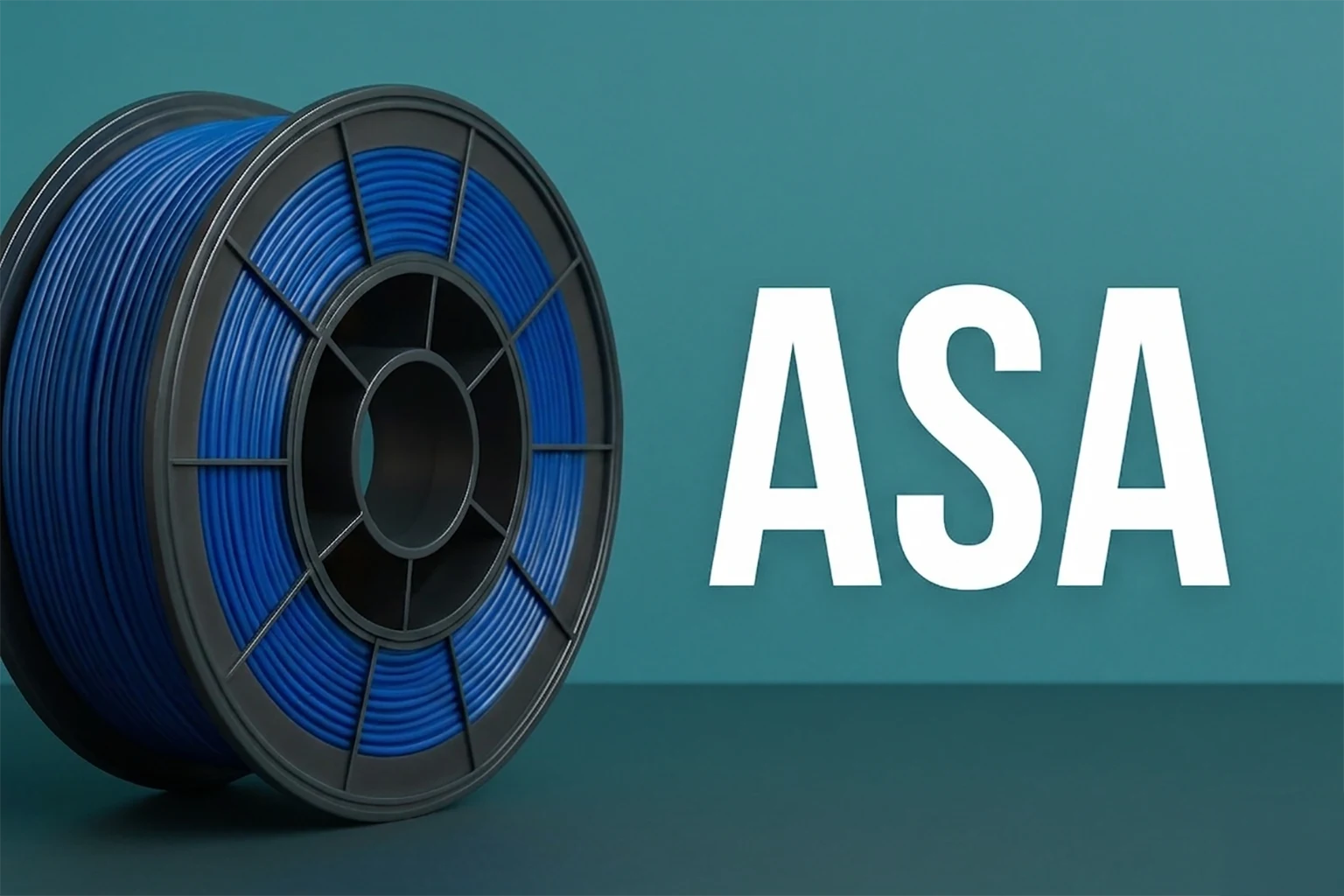
Most 3D printing filament decisions are driven by convenience. PLA because it is easy. PETG because it is slightly more capable and not much harder. These are sensible defaults for most use cases — but they both have a hard limit that you will hit the moment a print steps outside. Sunlight destroys PLA. It yellows, warps, and becomes brittle within months. PETG fares better but still degrades under sustained UV exposure over time. If you are printing anything that lives outdoors — brackets, enclosures, mounts, garden tools, automotive parts — neither material is the right answer. ASA is.
ASA — Acrylonitrile Styrene Acrylate — was developed specifically as an outdoor-capable engineering plastic. It is not a novelty material or a niche upgrade. It is the go-to choice for outdoor use across a range of industries, and it is increasingly accessible to FDM printers, including the Bambu A1, P1S, and X2D. This post covers what it is, why it behaves the way it does, how to print it, and what it is genuinely worth using for.
What ASA actually is
ASA is a thermoplastic polymer — the same fundamental class of material as ABS, PETG, and PLA. The full name, Acrylonitrile Styrene Acrylate, describes the three monomers that make up its structure: acrylonitrile, styrene, and an acrylic ester (acrylate). If you are familiar with ABS — Acrylonitrile Butadiene Styrene — you will notice the only difference is the third component. ABS uses butadiene rubber to give it toughness and impact resistance. ASA replaces that butadiene with an acrylic ester.
That substitution is the entire reason ASA exists. Butadiene, while excellent for impact toughness, contains double bonds in its molecular structure that are vulnerable to UV radiation. UV breaks those bonds, causing the material to oxidise, yellow, become brittle, and eventually crack. Acrylate does not have this weakness. The acrylic ester component in ASA is chemically stable under UV exposure — it does not absorb UV in the same way, so the degradation mechanism that kills ABS outdoors simply does not operate. The result is a material with mechanical properties comparable to ABS but with dramatically superior resistance to sunlight, weather, and long-term outdoor exposure.
ASA is not a new material in manufacturing. It has been used in the automotive industry for decades — exterior mirror housings, grilles, trim pieces, roof rails — exactly the applications where you need something that looks acceptable after years in the sun. The transition to FDM filament brought those properties to desktop printing.
Key properties
| Property | ASA | PLA (for comparison) | PETG (for comparison) | ABS (for comparison) |
|---|---|---|---|---|
| UV resistance | Excellent | Poor — yellows and becomes brittle | Moderate — degrades with sustained exposure | Poor — butadiene bonds degrade rapidly |
| Heat resistance (HDT) | ~95–100°C | ~55–60°C | ~80–85°C | ~95–100°C |
| Vicat softening point | ~106°C | ~60°C | ~85°C | ~103°C |
| Impact resistance | Good | Low — brittle under impact | Good | Good |
| Tensile strength | ~44–50 MPa | ~50–65 MPa | ~50 MPa | ~40–50 MPa |
| Water / moisture resistance | Good | Poor — absorbs moisture and degrades | Good | Moderate |
| Chemical resistance | Good — resists acids, alkalis, oils | Poor | Good | Moderate |
| Warping tendency | Moderate | Very low | Low | High |
| Enclosure required | Strongly recommended | No | No | Yes |
| Surface finish | Matte, smooth | Slightly glossy | Glossy | Matte |
| Acetone smoothing | No | No | No | Yes |
| Fumes during printing | Moderate — ventilate | Low | Low | High |
UV resistance: what it means in practice
UV resistance is ASA’s headline property and it is worth understanding concretely rather than treating it as a marketing claim. UV radiation breaks the molecular bonds in polymers. In ABS, this process is visible within months of outdoor exposure — the surface yellows, the material becomes noticeably more brittle, and parts that were once flexible enough to flex without cracking will snap. PLA goes through a similar process and is additionally vulnerable to moisture, which causes it to absorb water into the layer structure and degrade mechanically.
ASA’s acrylate component does not contain the same UV-reactive bonds. Long-term outdoor testing — both accelerated lab testing and real-world exposure — consistently shows that ASA parts retain their mechanical properties and colour stability after years of direct sunlight. One documented case from real-world testing involved ASA automotive parts printed and left in direct Texas summer sun. After months of sustained exposure at high ambient temperatures, the parts showed no visible degradation, no colour fading, and no warping. That is the practical gap between ASA and the standard alternatives.
For hobbyist context: if you print a cable management bracket in PLA and mount it on a south-facing wall, expect to replace it within six to twelve months in a UK climate, sooner anywhere hotter. The same bracket printed in ASA should outlast the cable it is managing.
Heat resistance
ASA’s heat deflection temperature sits at approximately 95–100°C, with a Vicat softening point around 106°C. In practical terms this means ASA parts will not deform in a hot car — a scenario that kills PLA, which softens around 55–60°C, reliably and quickly. A PLA phone mount in a car left in summer sun is a known failure mode. PETG is better, softening at around 80–85°C, but that margin disappears on a hot day in a car with the windows up. ASA sits comfortably above the temperatures encountered in everyday vehicle interiors and outdoor environments in most climates.
It is not the most heat-resistant material available in FDM. Nylon, polycarbonate, and ASA’s own carbon-fibre composite variants all offer higher thermal resistance for applications near heat sources or motors. But for the specific combination of UV resistance and heat resistance at a reasonable printing difficulty level, ASA is the practical optimum.
Mechanical properties
ASA’s mechanical profile is close to ABS. Tensile strength in the range of 44–50 MPa, good impact resistance, moderate flexibility, and enough rigidity to hold structural dimensions under load. It is not as stiff as PLA — parts that need to be rigid and non-deflecting under force are sometimes better served by PLA or carbon fibre composites — but it handles the kinds of mechanical loads encountered in real-world outdoor parts without issue.
Impact resistance is meaningful for outdoor parts specifically because they experience stress beyond static load. Wind vibration, thermal cycling (heating and cooling repeatedly over seasons), and physical contact from maintenance or handling all apply fatigue stress to printed parts over time. ASA handles this class of loading well. Parts printed in PLA, which is relatively brittle, will develop micro-cracks and eventually fail under repeated impact or vibration loading far sooner than the same geometry in ASA.
Chemical resistance is a practical advantage for garden and automotive applications specifically. ASA resists oils, greases, mild acids, and alkalis. A part that will encounter fertiliser, fuel, or cleaning products in normal use is well served by ASA’s chemical profile.
Printing ASA: what you actually need to know
ASA is more demanding to print than PLA or PETG but less demanding than most people expect, particularly on an enclosed machine like the Bambu P1S or X2D. The core requirements are straightforward: high bed temperature, low part cooling fan, enclosure to prevent warping, and ventilation because the material does produce fumes.
The enclosure requirement
ASA shrinks as it cools. If it cools too quickly — either from a draft, an open environment, or an active cooling fan running at full speed — the outer layers contract while the inner layers are still warm. The resulting differential stress warps the part, lifts corners off the bed, and on larger prints can cause layer delamination. An enclosed printer traps ambient heat, keeps the air around the print warm, and eliminates drafts. This is the single most important hardware requirement for ASA.
On the Bambu A1, which is open-frame, ASA is printable with care but the success rate on larger parts is lower. The A1 does not have an enclosure, so you are relying on ambient room temperature and the absence of draughts rather than an actively controlled environment. Smaller ASA parts — under roughly 100 × 100 mm — are more forgiving. Larger flat parts with significant surface area are where warping becomes a real risk on an open machine. The P1S, X2D, and X1C, all of which are enclosed, are the right platforms for serious ASA work.
Recommended settings on Bambu printers
| Setting | Recommended range | Notes |
|---|---|---|
| Nozzle temperature | 240–260°C | Start at 250°C. Drop to 245°C if stringing is visible |
| Bed temperature | 90–110°C | 100°C is a reliable starting point on smooth or textured PEI |
| Part cooling fan | 0–30% | Zero for most of the print. Low fan (20–30%) only on overhangs or bridging sections where needed |
| First layer fan | 0% | Non-negotiable. A cooling fan on the first layer will cause it to lift |
| Print speed | 50–100 mm/s outer walls | Do not push to maximum speed — thermal stress from fast moves in a warm chamber can cause layer splitting |
| Layer height | 0.15–0.2 mm | Standard height works well. Thinner layers improve adhesion on overhangs |
| Enclosure | Required for reliable results on large parts | Keep the door closed throughout the print |
| Bed surface | Smooth PEI or textured PEI + glue stick | Glue stick adds significant insurance against corner lifting |
| Drying | 80°C for 8 hours before printing | ASA is moisture-sensitive. Wet filament produces bubbles, rough surfaces, and weak layer bonds |
Bed adhesion
Bed adhesion is the most common failure point for new ASA prints. The material does not stick as readily to PEI as PLA does, and on a heated bed at 100°C the first layer needs to bond properly or the print will lift, usually at the corners. A glue stick applied to the bed surface before printing makes a significant practical difference — it is not optional for larger parts. Allow the bed to fully reach temperature before the print starts and do not attempt to remove the finished part while the bed is still hot. Let it cool to near room temperature, at which point ASA releases cleanly.
Fumes and ventilation
ASA produces styrene-based fumes during printing, in the same family as ABS but generally considered less pungent. The fumes are not immediately overwhelming in a large room, but sustained exposure is not advisable. Print in a ventilated space or use the 3-stage filtration on the Bambu enclosed machines (the X2D and P1S both include HEPA and activated carbon filters). If you are running long jobs, opening a window in the print room is sensible practice. This is the one legitimate drawback of ASA compared to PLA or PETG — it does require attention to your print environment rather than just setting it and forgetting it.
Moisture sensitivity
ASA absorbs moisture from the air over time, and damp filament produces notably worse results — surface bubbling, rough texture, inconsistent extrusion, and weakened layer adhesion. Dry your ASA at 80°C for 8 hours before printing if the spool has been exposed to ambient air for more than a few days. Store it sealed with desiccant between uses. This is standard practice for any engineering-grade material and ASA is no different. A filament dryer running continuously while you print is the ideal setup for longer jobs.
Post-processing
ASA’s matte surface finish is one of its more useful aesthetic properties — the slight texture hides layer lines more effectively than glossy PETG does, so prints often look better straight off the plate without any post-processing. For display pieces or anything where surface quality matters, light sanding works well on ASA and it takes paint without difficulty.
One thing to note: ASA does not smooth with acetone. ABS does — acetone vapour dissolves the surface and produces a glossy, layer-line-free finish. ASA’s acrylate component makes it resistant to acetone in the same way. If you need a smooth, post-processed finish on engineering plastic, ABS is the material to use. If you need outdoor durability with a good-enough surface finish from the plate, ASA is the answer. They are complementary choices rather than direct substitutes for every application.
ASA can be bonded with cyanoacrylate (superglue) or plastic-specific adhesives. It machines reasonably well — drilling and cutting clean holes in printed ASA parts is straightforward compared to brittle materials like PLA. For multi-part outdoor assemblies, this makes ASA a practical material for the full fabrication workflow, not just the printing stage.
Real-world use cases
Automotive exterior parts
This is the application ASA was developed for in manufacturing and it is where it delivers most clearly. Custom brackets, mirror housing repairs, trim clips, cable management in engine bays, antenna mounts, and roof rack adaptors all benefit from ASA’s combination of UV stability, heat resistance, and structural rigidity. A PETG car phone mount left on a dashboard in summer sun will deform — the same mount in ASA will not. For anything on the exterior or interior of a vehicle that sees direct sun, ASA is the correct material.
Garden and outdoor fixtures
Plant labels, hose fittings, tool handles, cable clips for outdoor wiring, shed organisation components, compost bin repairs, irrigation line brackets — anything in the garden that needs to survive British weather year-round. The specific challenge in a garden environment is not just UV but the combination of UV, moisture, temperature swings, and occasional physical contact. ASA handles all of these. PLA in the garden is usually a six-month consumable before it degrades visibly.
Outdoor electronics enclosures
Weather station housings, sensor mounts, solar panel monitoring enclosures, Pi-based outdoor projects — any electronics project that lives outside needs a material that will not degrade around the components. ASA provides the UV and moisture resistance to keep the enclosure structurally sound over multi-year deployment. The material’s chemical resistance also means it handles rain and humidity without absorbing moisture into the walls of the enclosure, which is a real failure mode for PLA in damp environments.
RC and drone parts
RC vehicles and drones experience a specific combination of mechanical stress: impact resistance, vibration fatigue, and UV exposure from outdoor use. ASA covers all three well. Drone frames, motor mounts, landing gear, and body panels printed in ASA hold up to crash impacts better than PLA (which is brittle under sudden impact) and do not degrade in sun the way ABS does. For anyone building or maintaining RC hardware, ASA is the default material for any component that sees outdoor operation.
Outdoor signage and display
Printed signs, house numbers, garden markers, and directional labels. The challenge with outdoor signage is colour — most materials that start with a strong printed colour will fade under sustained UV. ASA’s colour stability means a printed sign in red or black ASA looks the same after two years of outdoor exposure as it did on day one. For any labelling or signage application that needs to remain readable without repainting, ASA is the right choice.
Marine and waterfront applications
Boat hardware, kayak fittings, buoy markers, dock equipment, and anything exposed to salt spray or submersion. ASA’s combination of water resistance, UV stability, and chemical resistance (including mild salts) makes it one of the few FDM materials genuinely suitable for marine environments. It will not absorb water like PLA does and will not degrade under the particularly aggressive UV load found on open water.
Functional outdoor prints — practical quick list
- Solar light mounts and cable clips
- Roof bracket adaptors and antenna mounts
- Garden hose fittings and irrigation line clips
- Outdoor sensor and Pi enclosures with gasket channels
- Bicycle mount hardware and rack fittings
- Van conversion external fittings
- Letterbox reinforcements and external door hardware
- Shed wall organisers and tool clips
- Plant pot labels and garden markers
- Drone frame components and motor guards
- RC car body panels and bumpers
- Car interior trim clips and exterior badge repairs
ASA vs the alternatives: when to use what
Choosing between ASA, PETG, and ABS for outdoor and functional printing comes down to a small number of practical questions rather than a comprehensive spec comparison. Here is how to think about it.
If the part will live outdoors in direct sunlight for more than a few months, use ASA. PETG is a reasonable compromise for parts that see occasional or indirect sun — it is significantly easier to print, does not require an enclosure, and its UV resistance is acceptable for moderate exposure. But for sustained outdoor use, it will eventually fade and weaken. ABS is not the answer for outdoor applications. Its UV vulnerability is the reason ASA was developed to replace it.
If the part is indoors but needs heat resistance — motor mounts, electronics enclosures near heat sources, automotive interior components — ABS is a perfectly valid choice and has the advantage of acetone smoothing for surface finish work. ASA is not better than ABS indoors; it is only meaningfully better outdoors.
If you do not have an enclosed printer, PETG remains the more practical choice for most functional printing. ASA on an open-frame machine is possible for small parts but inconsistent for larger ones. The enclosure requirement is real.
| Scenario | Best choice | Why |
|---|---|---|
| Outdoor, direct sunlight, long-term | ASA | UV and weather resistance no other common FDM material matches |
| Outdoor, indirect sun, short-to-medium term | PETG | Easier to print, adequate UV resistance for moderate exposure |
| Indoor, heat resistant, post-processing needed | ABS | Same mechanical properties as ASA, acetone smoothing available |
| Indoor, decorative, no stress | PLA | Easiest material, best surface detail, no functional disadvantage indoors |
| Marine or salt exposure | ASA | Chemical resistance plus UV stability |
| High mechanical stress, max strength | PA-CF or PC | Engineering composites outperform all standard materials under load |
| No enclosure available, outdoors needed | PETG + UV-resistant coating | Compromise — print with PETG and apply UV-stable spray paint as protection |
Which ASA to buy
Bambu Lab’s own ASA is the most reliable starting point on any Bambu printer. The RFID tag means settings load automatically through the AMS, the material is formulated specifically for the enclosed Bambu environment, and Bambu publish their testing behind it. The cost per spool is higher than third-party options, and for high-volume outdoor printing that matters. For occasional projects or single outdoor parts, it is the path of least resistance.
Polymaker is the standout third-party option. Their ASA has a strong community reputation for consistent quality, low warping tendency compared to generic ASA, and reliable colour stability. Overture produces a solid budget-tier ASA with decent real-world reviews. eSun’s ASA is available and works on their standard PLA+ print profile with temperature adjustments — if you are already running eSun PLA+ as your daily material, eSun ASA is a natural extension to the same brand without introducing new unknowns.
For the Bambu A1 specifically, where the lack of enclosure makes ASA more challenging: stick to smaller parts, run the print in a draught-free room, and consider a simple DIY enclosure (a cardboard box over the printer is a well-established community solution for exactly this scenario). On enclosed Bambu machines, third-party ASA with a tuned custom profile is entirely viable and costs significantly less per kilogram than Bambu’s own material for high-volume use.
Summary
ASA is the correct material for any 3D printed part that will live outdoors. Its UV resistance is genuine and durable — not a coating or a marketing claim, but a fundamental property of its molecular structure. It resists heat up to around 100°C, handles moisture, oils, and mild chemicals, and maintains mechanical strength and colour stability under years of outdoor exposure. Printing it requires an enclosure, a hot bed, minimal cooling, and a ventilated space. On an enclosed Bambu machine, none of that is difficult — it is a profile selection and a couple of settings adjustments away from the same workflow as PETG.
If you have been printing outdoor parts in PLA and replacing them every season, switch to ASA. It is the single most impactful material upgrade for anyone who prints functional objects that step outside.