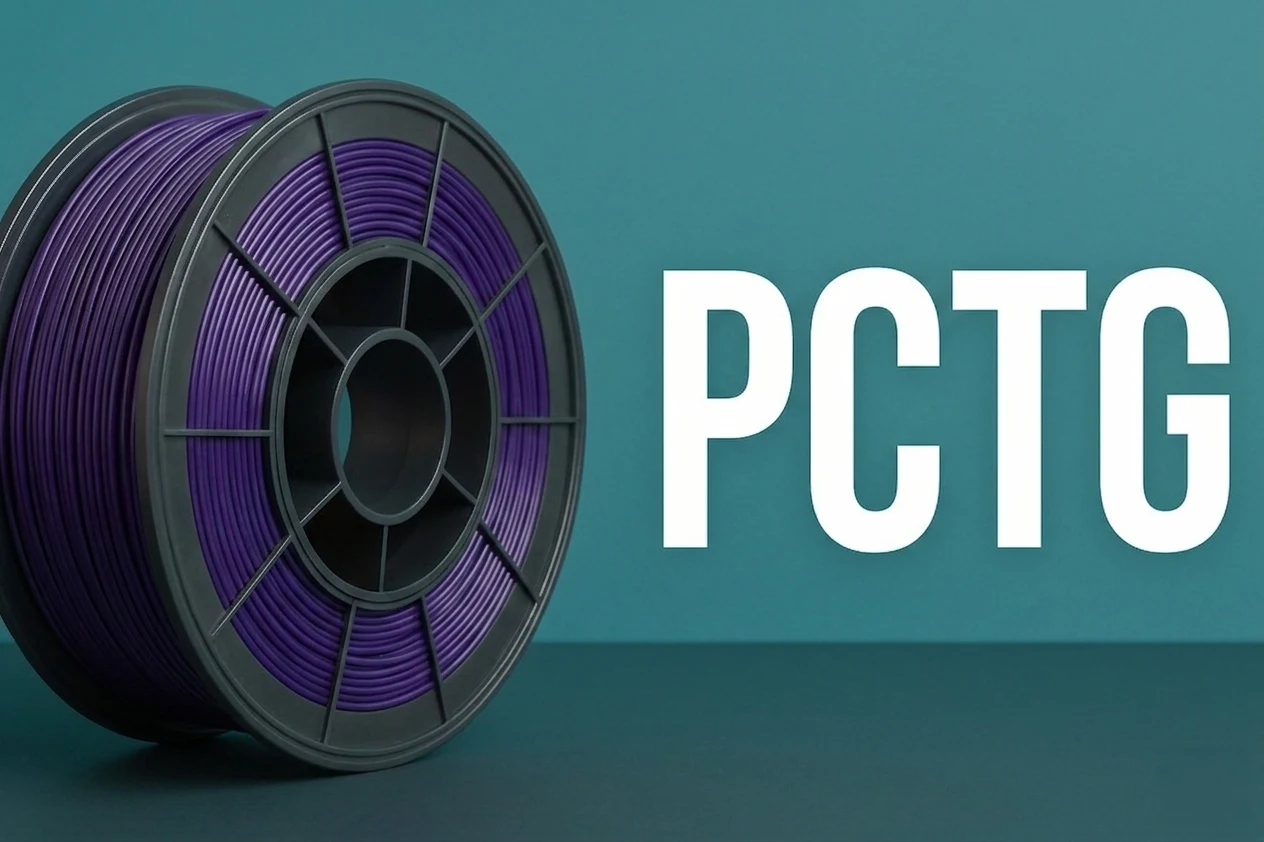
PETG has been the default step-up material for most FDM hobbyists for years — the answer to “I need something tougher than PLA but I do not want to deal with ABS.” It is a reasonable position and PETG is a capable material. But there is a version of PETG that is, in almost every measurable way, better: tougher, more chemically resistant, less hygroscopic, with better layer adhesion and a more refined surface finish, at roughly the same printing temperature and with the same enclosure-free workflow. It is called PCTG, it has been available for a few years, and it has been quietly gaining a community following that is now starting to attract broader attention.
The reason PCTG has not already replaced PETG as the default workhorse material is simple: cost and availability. Only a small number of manufacturers produce it, which limits competition, keeps prices high, and restricts the colour range to a fraction of what PETG offers. Those are real limitations. This post covers what PCTG is, why it is genuinely better than PETG on the technical merits, where it earns its place, and why the cost and availability constraints mean it is not necessarily the right choice for everyone right now — even if the material itself is excellent.
What PCTG actually is
PCTG stands for PolyCyclohexylene Dimethylene Terephthalate Glycol-modified. The name is long, but the chemistry behind it explains directly why it performs the way it does. PCTG is a glycol-modified copolyester in the same material family as PETG, but made from a different base polymer: Eastman Tritan copolyester rather than the standard PET resin PETG uses.
Both PETG and PCTG are glycol-modified copolyesters — the same family of polymers. The key difference is in which glycol modifier is used. PETG uses ethylene glycol (EG) to interrupt the polymer chain and improve printability over standard PET. PCTG uses cyclohexane dimethanol (CHDM) — a bulkier, ring-shaped molecule — in higher concentrations. PCTG contains cyclohexane dimethanol, which gives it increased flexibility and toughness compared to PETG’s ethylene glycol structure. PCTG contains a higher concentration of CHDM — often over 40% — significantly increasing the material’s impact resistance, ductility, and chemical resistance.
The larger CHDM molecule disrupts the polymer chain differently than ethylene glycol does, producing a material that is less crystalline and more amorphous in structure. This amorphous character is what gives PCTG its exceptional optical clarity in transparent form — the same underlying chemistry behind Eastman Tritan, the material used for BPA-free water bottles and food-contact containers. It also contributes to the improved toughness and reduced moisture sensitivity that distinguish PCTG from PETG.
Key properties
| Property | PCTG | PETG (for comparison) | PLA+ (for reference) |
|---|---|---|---|
| Tensile strength | ~45–50 MPa | ~45–50 MPa | ~50–65 MPa |
| Impact resistance (Izod) | ~24 kJ/m² (CNC Kitchen test) / 8 kJ/m² (Izod) | Lower — notably less tough under sudden impact | Low — brittle fracture |
| Glass transition temperature (Tg) | ~85°C | ~80°C | ~60°C |
| Heat deflection temperature (HDT) | ~74–76°C | ~70°C | ~55°C |
| Layer adhesion | Excellent — significantly better than PETG | Good | Moderate |
| Surface finish | Glossy, smooth, refined — better than PETG | Glossy but can show layer lines prominently | Slightly glossy |
| Chemical resistance | Excellent — resists IPA, oils, solvents | Good but lower than PCTG | Poor |
| Moisture absorption (hygroscopic) | Lower than PETG — more forgiving of storage | Moderate — requires drying if stored open | Moderate |
| Optical clarity (natural) | Exceptional — water-clear transparent | Good but slightly hazy | Limited clarity |
| Warping tendency | Very low — similar to PETG | Very low | Very low |
| Enclosure required | No | No | No |
| Nozzle requirement | Standard brass fine for base PCTG | Standard brass | Standard brass |
| Food safety | Yes — CHDM base is BPA-free and food-contact approved | Generally considered food-safe with caution | Variable |
Impact resistance: the headline difference
The single most significant mechanical advantage PCTG has over PETG is impact resistance — the ability to absorb sudden force without fracturing. This is the property that determines whether a part survives being dropped, hit, or subjected to a sudden mechanical load rather than a gradual one.
In independent testing by CNC Kitchen, PCTG achieved around 24 kJ/m² impact strength, placing it far above both PLA and PETG and roughly on par with ABS, but without the enclosure requirement, styrene fumes, or warping behaviour that ABS demands. Reaching ABS-level impact resistance without needing an enclosure is the combination that makes PCTG genuinely interesting. ABS is the material the community has traditionally reached for when impact resistance is the requirement — but ABS needs an enclosure, produces fumes, and warps aggressively on open-frame machines. PCTG delivers comparable impact performance on an open-frame A1 with no enclosure and no fumes.
The mechanism behind this is the CHDM molecular structure. PCTG is more ductile, allowing it to absorb and dissipate energy during impact without cracking or shattering. PCTG has better inter-layer bonding when 3D printed, reducing weak points in the structure where impact forces might cause failure. PCTG parts are less likely to crack, chip, or break when dropped, making it ideal for high-impact applications like enclosures or wearable devices. PCTG can endure repeated bending or sudden forces better than PETG, making it more suitable for hinges, clips, and flexible parts.
Chemical resistance: better than PETG
PETG already has better chemical resistance than PLA or ABS for most common substances. PCTG takes this further. PETG is already favoured for its superior chemical resistance compared to ABS, but PCTG takes it a step further, able to withstand exposure to certain solvents and cleaning agents, including isopropyl alcohol, without deterioration. The resistance to IPA specifically is relevant to 3D printing workflows — IPA is the standard cleaning agent for build plates, and parts that will be cleaned regularly or stored in environments where IPA exposure is common benefit directly from PCTG’s resistance.
The practical applications are clear: medical device enclosures, laboratory equipment, workshop tools, anything that will be cleaned regularly with standard sanitising agents, and food-contact items where chemical resistance to acids and oils in food is a requirement. Pro PCTG is a glycol-modified copolyester engineered to deliver improved toughness, dimensional stability, chemical resistance, and lower moisture sensitivity compared to standard PET and PETG. It is intended for application and production parts such as housings, load-bearing prototypes, and components exposed to mechanical stress or chemically demanding environments.
Moisture sensitivity: less demanding than PETG
PETG’s hygroscopic nature — its tendency to absorb moisture from the air — is a known practical issue. A PETG spool stored open for a few days in a humid environment will produce stringing, surface bubbling, and reduced mechanical properties. The filament dryer is almost a requirement for serious PETG use in anything other than a climate-controlled workshop.
PCTG’s CHDM structure reduces the number of sites available for moisture interaction in the polymer chain. PCTG requires less frequent drying, making it easier to handle in environments with higher humidity. It is also more forgiving if printed without drying. Both materials benefit from being stored in airtight containers with desiccant, but PCTG will be less prone to degradation if exposed to moisture for extended periods. This is a practical advantage in any workshop that is not climate-controlled — the UK’s ambient humidity levels make moisture management a genuine daily concern, and a material that is more tolerant of realistic storage conditions is a real benefit.
Printing PCTG: how it compares to the PETG workflow
This is where PCTG’s appeal becomes most obvious: it prints at essentially the same settings as PETG, on the same hardware, with no additional requirements. No enclosure. No chamber heating. Standard brass nozzle. Standard PEI bed. The learning curve for switching from PETG to PCTG is minimal.
| Setting | PCTG | Notes |
|---|---|---|
| Nozzle temperature | 230–260°C | Similar to PETG. Start at 240°C and adjust from there |
| Bed temperature | 70–85°C | Standard PETG bed range. Textured PEI is the recommended surface |
| Bed surface | Textured PEI | Works well. Glue stick recommended as a release agent to prevent over-adhesion — same advice as PETG |
| Enclosure | Not required | Open frame machines including A1 are suitable |
| Cooling fan | 20–50% | Reduced cooling compared to PLA. More cooling than ABS. Similar to PETG |
| Print speed | 40–80 mm/s outer walls | Similar to PETG — not as fast as PLA at equivalent quality |
| Nozzle requirement | Standard brass 0.4mm | Fine for base PCTG. Hardened steel required for PCTG-CF and PCTG-GF variants |
| Drying | 65°C for 4–6 hours if open-stored | Less critical than PETG but still beneficial. Dry before long jobs |
| Retraction | Similar to PETG | Stringing is less pronounced than PETG in community reports |
One community observation worth highlighting: PCTG is PETG with better impact resistance and toughness, chemical resistance, improved print surfaces and clarity, much lower moisture absorption, identical print difficulty and basically the same thermal characteristics. It prints much easier than a lot of PETG. Seems in 2026 more filament manufacturers are getting onboard with it so the prices should come down. The “easier than PETG” observation is consistent across multiple community reports and reflects a real characteristic — PCTG strings less, adheres more consistently, and produces a more refined surface without the surface quality variability that PETG can exhibit between spools and brands.
Optical clarity: the best transparent filament in its category
PCTG in natural (unfilled, unpigmented) form is genuinely water-clear in a way that PETG in the same configuration is not. PETG natural has a slight haze that is apparent when the material is used in thin-walled sections or light-transmitting applications. PCTG’s CHDM structure prevents the crystallisation that causes haze in PETG, producing a material that transmits light with much higher clarity.
For parts where optical clarity is part of the design — light diffusers, lens covers, instrument windows, decorative transparent elements — PCTG natural is the best option available in the standard FDM material set at this price tier. It sits below polycarbonate in pure optical performance but beats PETG comfortably and does not require the demanding print conditions that PC demands.
PCTG variants: CF and GF composites
PCTG follows the same reinforced composite path as PLA-CF and PETG-CF. PCTG-CF (carbon fibre reinforced) adds chopped carbon fibre to the PCTG base, significantly increasing stiffness while maintaining the base material’s toughness advantage over PETG. 3D-Fuel produces a PCTG-CF10 and a PCTG-GF (glass fibre reinforced) variant. These require hardened steel nozzles — the same requirement as any CF or GF composite. The PCTG base’s superior toughness combines with carbon fibre’s stiffness to produce a composite that is both stiffer and tougher than PLA-CF — a combination that PLA-CF’s brittleness under impact cannot match.
Real-world use cases
Functional enclosures and housings
Anything that needs to survive being handled, dropped, or bumped and is currently being printed in PETG or ABS is a candidate for PCTG. Electronics project boxes, tool handles, equipment housings, Pi cases, sensor mounts — PCTG’s combination of impact resistance, chemical resistance, and no-enclosure printing makes it the correct upgrade over PETG for parts where mechanical survival matters.
Medical and food-contact applications
PCTG’s BPA-free credentials and food-contact approval from the Eastman Tritan base material make it the most credible option for printed food-contact items — utensils, containers, measuring tools. Combined with a stainless steel nozzle (the food-safe nozzle choice covered in the nozzle guide), PCTG is the most defensible material choice for food-adjacent printing. Standard brass nozzles introduce a lead contamination risk that stainless steel avoids, and PETG on brass occupies an uncertain position on food safety. PCTG on stainless is on much firmer ground.
Workshop tools and jigs
Parts that will be cleaned with IPA or contact lubricants and oils. Jigs, fixtures, guides, and handles that need to survive a workshop environment without being ABS-demanding. PCTG’s chemical resistance and impact toughness serve this category well and the open-frame printing is a practical advantage over ABS in a shared or home workshop space.
Hinges, clips, and snap-fits
Repeated mechanical cycling — a snap-fit lid opened and closed daily, a hinge that flexes regularly, a clip that is fitted and removed — produces fatigue in materials that are less ductile. PLA and standard PETG can develop micro-cracks under repeated flexing. PCTG’s higher ductility and energy absorption make it more suitable for parts that cycle mechanically throughout their service life. For snap-fit designs specifically, PCTG’s combination of stiffness and flexibility before fracture produces more reliable results than PETG.
Transparent and light-transmitting elements
Instrument covers, LED diffusers, decorative transparent elements, and any application where optical clarity is part of the part’s function. Natural PCTG is the best available option in this category at standard FDM hardware requirements.
The principal limitations: cost and availability
This is the honest section, and the reason PCTG has not already displaced PETG as the default workhorse material despite being genuinely better on almost every technical metric.
The number of manufacturers currently producing PCTG is small. 3D-Fuel, Spectrum, Prusament, 3DXTECH, nobufil, and a handful of others. The contrast with PETG — where every filament manufacturer produces it in dozens of colours — is stark. Limited competition means limited price pressure. A kilogram of quality eSun PETG costs £12–£15. A kilogram of PCTG from the available manufacturers costs £20–£35 depending on brand and where you source it. For light use or specific functional applications, that premium is entirely acceptable. For a daily workhorse material used across dozens of prints a month, the cost difference adds up to a meaningful annual expense.
The colour range is the other significant practical limitation. PETG is available in essentially every colour across a dozen manufacturers, with silks, mattes, speciality finishes, and a wide palette of shades. PCTG currently comes in a limited set — typically naturals, blacks, whites, a small number of standard colours, and transparent variants. Seems in 2026 more filament manufacturers are getting onboard with it so the prices should come down. This is the direction of travel — more manufacturers entering the market should bring both more colour options and lower prices. But that future state is not the current state, and a printer owner whose work requires specific colour accuracy across a wide palette is constrained by PCTG’s limited colour availability in ways that PETG’s range does not create.
For Bambu Lab users specifically: there is no Bambu Lab branded PCTG with RFID tags at the time of writing. This means no automatic profile loading via the AMS RFID system — you are on a custom or generic profile from day one. Given that PCTG’s print profile is close to PETG’s, starting from a PETG profile and adjusting for the specific brand’s temperature recommendations is a workable starting point. But it is one more piece of setup that Bambu’s native filament ecosystem removes for their own materials.
PCTG vs PETG vs ABS: when to use which
| Scenario | Best choice | Why |
|---|---|---|
| General functional indoor parts, budget priority | PETG | Lower cost, wide availability, adequate for most standard functional use |
| Impact-critical functional parts, no enclosure available | PCTG | ABS-level impact resistance without enclosure requirement |
| Chemical exposure — oils, IPA, cleaning agents | PCTG | Superior chemical resistance over PETG |
| Food contact or medical applications | PCTG with stainless steel nozzle | BPA-free Tritan base, best food-contact credibility in FDM |
| Indoor, heat resistant, acetone smoothing wanted | ABS | Only material with acetone smoothing capability. Requires enclosure |
| Transparent, light-transmitting parts | PCTG natural | Water-clear in natural form — better clarity than PETG |
| Hinges, snap-fits, repeated cycling | PCTG | Ductility and toughness under repeated mechanical stress |
| Outdoor, UV exposed | ASA | PCTG has limited UV resistance data — ASA is the established outdoor choice |
| Wide colour range required | PETG | PCTG colour availability is currently limited |
Which PCTG to buy
The market is small but growing. At the time of writing, the recommended options with strong community track records are:
- 3D-Fuel Pro PCTG — the most documented option with the most independent testing data, including a formal 3D Printing Industry technical review. Available in natural and a range of standard colours. CF and GF variants available. US-based but ships internationally
- Spectrum PCTG — European manufacturer with good availability from 3DJake and similar EU resellers. Community reports are positive and it is competitively priced relative to 3D-Fuel
- Prusament PCTG — Prusa’s own branded PCTG with the quality control and consistency that the Prusament brand carries. Available in a limited colour set. Most accessible for European buyers
- 3DXTECH PCTG — engineering-focused US manufacturer with documented technical data. Higher price tier but strong reputation for consistency
If you are primarily interested in PCTG for transparent or food-contact applications, natural PCTG from any of the above manufacturers is the starting point. If you want standard opaque colours for functional parts, check current availability — the colour range shifts as manufacturers add new options, and what is available now will be broader by next year as more manufacturers enter the market.
Summary
PCTG is genuinely better than PETG on the technical merits across almost every dimension that matters for functional printing: impact resistance comparable to ABS, superior chemical resistance, better layer adhesion, improved optical clarity, lower moisture sensitivity, and the same no-enclosure, open-frame printing workflow. It is very much like comparing ASA to ABS, where ASA provides similar ease of printing but excels in weatherability and UV resistance, making it better suited for demanding applications. PCTG offers comparable ease of printing to PETG but excels in mechanical performance and chemical resistance.
The reason it has not replaced PETG in most hobbyist workflows is the practical reality of limited manufacturer adoption: fewer spools available, higher prices, and a colour range that does not yet approach PETG’s breadth. Both of these will improve as the market matures and more manufacturers bring PCTG to scale. The community observation that 2026 is seeing more manufacturers getting on board is accurate — and if the trajectory continues, PCTG’s cost and availability gap will narrow meaningfully over the next one to two years.
For now: if you print functional parts that need to survive real-world mechanical use, chemical exposure, or repeated handling, and you are currently using PETG or considering ABS, PCTG is worth the cost premium. If budget is the primary constraint and colour range matters, PETG remains the pragmatic choice. The gap between them is real — PCTG is the better material — but it is a gap that currently comes with a price attached.