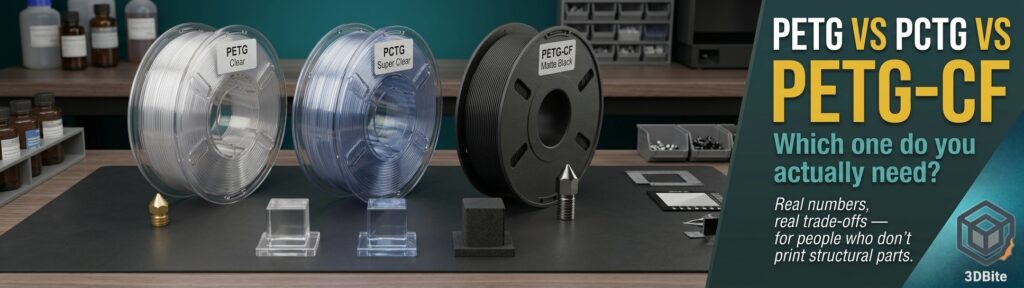
PETG has been the daily-driver material for functional printing throughout the PETG materials post, and lately two related materials keep showing up in filament ranges and comparison content: PCTG, often marketed as “the bigger brother of PETG,” and PETG-CF, the carbon-fibre-reinforced version. None of what gets printed on this desk is genuinely structural — no drone frames, no load-bearing brackets holding real weight — which changes the actual question here considerably. This is not “which one is strongest.” It is “does either of these actually do anything for me, given that I don’t need the strength they are built for.” Having gone through the chemistry and the real numbers properly, the honest answer is more interesting than a straightforward upgrade path.
The chemistry, briefly
All three materials share the same polyester family root covered in the PETG post — PET, the same polymer used in water bottles, modified to stop it crystallising into a brittle, difficult-to-print state. PETG achieves that by adding glycol to the base PET chain. PCTG (polycyclohexylenedimethylene terephthalate glycol) takes a different route to a similar destination: rather than modifying standard PET resin, it is built from Eastman Tritan copolyester, with cyclohexane dimethanol (CHDM) content exceeding 50% of the modifying component. That higher CHDM concentration is what fundamentally shifts PCTG’s properties toward better clarity, chemical resistance, and toughness relative to PETG — it is a genuinely different base chemistry aimed at a similar printing experience, not just a rebranded PETG. PETG-CF is a third, distinct thing again: standard PETG with 10-20% short chopped carbon fibre, typically 100-300 microns in length, blended into the base polymer specifically to increase stiffness and dimensional stability rather than to change the base chemistry at all.
Key properties compared
| Property | PETG | PCTG | PETG-CF |
|---|---|---|---|
| Impact resistance | Good — 3-4x PLA | Excellent — ~24 kJ/m² in CNC Kitchen testing, roughly on par with ABS | Reduced versus standard PETG — stiffer but more brittle, cracks rather than flexes |
| Stiffness / flexural modulus | Baseline | Higher than PETG, more rigid | Substantially higher — one documented test found a 203% increase in flexural modulus (2,500 MPa) over standard PETG |
| Clarity / optical quality | Good — clear but with less gloss | Superior — genuinely better transparency and a glossier finish than PETG | None — opaque, matte, fibre-textured finish |
| Surface finish | Glossy, shows fine stringing or blobs if under-tuned | Glossy, refined, hides minor print imperfections better than PETG | Matte, frosted, hides layer lines effectively — described as looking “almost injection-moulded” |
| Heat deflection temperature | ~70°C | ~76°C — close to PETG, not a dramatic jump | Higher than standard PETG, retains stiffness at elevated temperature better |
| Moisture absorption | Higher — needs more frequent drying | Substantially lower (some tested at under 0.1%) — more forgiving of imperfect storage | Similar to standard PETG — inherits base polymer’s moisture behaviour |
| Warping / dimensional stability | Low warp, generally reliable | Low warp, comparable to PETG | Reduced warping versus standard PETG — the fibre content limits thermal expansion during cooling |
| Nozzle requirement | Standard brass | Standard brass | Hardened steel mandatory — genuinely abrasive, can damage a brass nozzle within tens of grams |
| Print temperature | 230-260°C | Same range as PETG | Similar to PETG, some formulations run slightly hotter |
| Colour range availability | Very wide | Narrower — fewer manufacturers, still catching up | Growing but still limited — primarily solid, darker tones suited to the matte finish |
| Typical price | Baseline | Moderate premium over PETG | Moderate premium over PETG, similar to PCTG |
PCTG: the genuine upgrade, if you actually need what it offers
This is the material most directly described across every source researched as “PETG done better,” and the claim largely holds up under scrutiny — with one important correction worth making plainly. PCTG’s toughness advantage is real and substantial: CNC Kitchen’s testing found roughly 24 kJ/m² impact strength, putting it well above both PLA and PETG and close to ABS territory, without any of ABS’s warping or enclosure requirements. Layer adhesion is described consistently as dramatically better than PETG, and one detailed comparison notes PCTG has better inter-layer bonding, reducing the weak points where impact forces typically cause a print to fail — directly relevant to the anisotropic weakness covered in the orientation for strength post.
Where the marketing overreaches slightly: PCTG’s heat deflection temperature sits around 76°C against PETG’s roughly 70°C — a real but genuinely modest difference, not the dramatic high-temperature upgrade some framing implies. One detailed comparison states this precisely: “their heat performance is often closer than their names suggest, so PCTG should not be treated as an automatic high-temperature upgrade.” If heat resistance specifically is the goal, PCTG is not meaningfully better than PETG for that purpose alone.
For non-structural, decorative printing specifically, PCTG’s genuinely compelling advantages are the ones that have nothing to do with strength at all. Clarity is superior to PETG — better transparency and a glossier finish, which connects directly to the transparent printing guide‘s territory. And moisture resistance is dramatically better, with some tested formulations under 0.1% absorption against PETG’s considerably higher uptake — meaning PCTG is genuinely more forgiving of the casual storage habits that PETG punishes, without needing the disciplined drying routine covered in the filament drying post. For anyone whose actual frustration with PETG has been stringing or bubbling from imperfect drying discipline rather than any strength concern, PCTG genuinely solves that specific problem.
PETG-CF: the honest case for non-structural printing is purely aesthetic
This is where the research gets genuinely useful for the specific question at hand, because every source is consistent and blunt about PETG-CF’s real trade-off. The stiffness gain is real and substantial — that 203% flexural modulus increase is not exaggerated — but it comes specifically at the cost of impact resistance. One source states this precisely: “PETG-CF parts crack where regular PETG parts would bend.” The material is stiffer, not tougher, and for anything that gets dropped or knocked rather than loaded statically, that is a genuine downgrade rather than an upgrade.
The part that is genuinely relevant to non-structural printing is the surface finish. PETG-CF’s matte, frosted, fibre-textured surface hides layer lines effectively and is described repeatedly as giving finished parts a “professional,” “almost injection-moulded” look straight off the plate, with no post-processing required. One source is admirably direct about where this does and does not belong: “it looks right on brackets, enclosures, and mechanical parts. It looks wrong on anything meant to be decorative.” That is a genuinely useful piece of aesthetic guidance rather than a strength-based one — the matte CF look reads as intentionally technical and engineered, which suits a project going for that specific aesthetic and looks out of place on something meant to look soft, organic, or traditionally finished.
The genuine cost-benefit question for anyone in exactly this position — no structural need, purely curious about the finish — is whether a hardened nozzle is worth buying purely for a cosmetic effect. The abrasive wear mechanism covered in the abrasive filaments guide applies at full force here: PETG-CF’s carbon fibre content will damage a standard brass nozzle within tens of grams of printed material, meaning a hardened nozzle is not optional, it is mandatory from the very first print. If a matte, technical-looking finish is genuinely appealing for a specific project — a display piece deliberately going for an “engineered” look rather than a soft or traditional one — that is a legitimate reason to buy the nozzle. If the interest is more casual curiosity than a specific aesthetic goal, the hardware cost is a real consideration against a benefit that standard fuzzy skin or a matte filament additive, covered in the silk PLA post‘s discussion of finish effects, can approximate without the abrasive-wear commitment.
The honest recommendation for non-structural printing
Given that nothing printed here needs to survive genuine mechanical load, the decision tree is genuinely simpler than the marketing around either upgrade suggests. Standard PETG remains the correct default for the overwhelming majority of what actually gets printed — it is cheaper, has the widest colour range by a considerable margin, and every slicer profile and community troubleshooting resource already assumes it. There is no compelling reason to move away from it purely because PCTG or PETG-CF exist.
PCTG is worth trying specifically for two situations: a project where genuine optical clarity matters more than PETG can deliver, or a period where filament storage discipline has been genuinely inconsistent and the drying hassle covered in the drying post has been a recurring annoyance rather than an occasional one. Neither of those is a strength argument — they are convenience and aesthetic arguments, which is exactly the right frame for someone not printing structural parts.
PETG-CF is the one genuinely worth skipping unless a specific project calls for its particular matte, technical look deliberately. The stiffness it offers solves a problem that does not exist here, the impact resistance trade-off is a genuine downside rather than a neutral one, and the mandatory hardened nozzle is real hardware cost for a purely cosmetic benefit that other, cheaper routes can approximate. If a specific build genuinely wants that engineered, injection-moulded aesthetic, it earns its place. Reached for casually because the description sounds impressive, it is solving the wrong problem for the price.