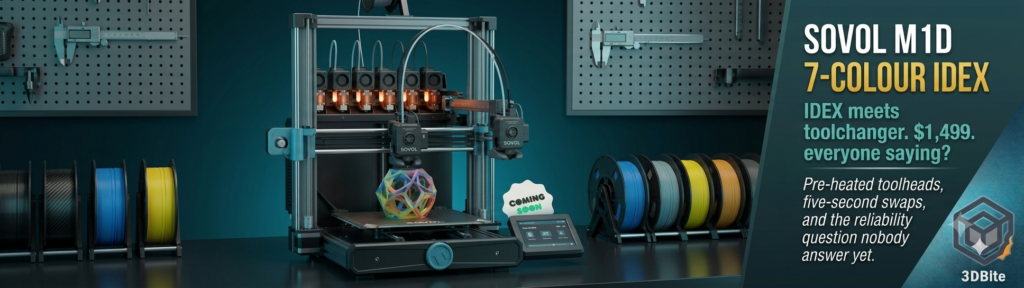
A new printer has generated a genuinely unusual amount of buzz for something that has not shipped yet, is not on retail shelves, and is currently sitting in a pre-order deposit scheme ahead of an eventual Kickstarter launch. The Sovol M1D combines two architectures that have historically been separate categories — independent dual extrusion (IDEX) and a swappable toolhead changer — into one machine, promising up to seven colours or materials in a single print with, according to Sovol, virtually no purge waste. At $1,499 for early backers rising to $1,799 at full list price, it lands directly in the price bracket this site has been watching closely since the Vortek H2C post and the tool changer economics post. This is worth a proper look at what it actually does, and what the coverage so far is saying about whether it delivers.
What DualX actually is
The architecture at the centre of the M1D is Sovol’s branded system called DualX, and understanding it requires separating two ideas that have historically lived in different machines. IDEX means two independent toolheads that can both move and extrude simultaneously and independently — this is what lets an IDEX printer run copy mode (two identical parts printed side by side at once) or mirror mode (a left and right version of the same asymmetric part printed together). A toolchanger, separately, means a single toolhead that physically detaches and swaps for a different one, addressing more materials than a fixed dual-nozzle system but only ever running one nozzle at a time.
The M1D combines both. One extruder is fixed in place and handles continuous printing without ever needing to swap. The second extruder is the flexible one — it can detach from its current toolhead and pick up any of six others stored at the back of the build chamber, using what Sovol describes as a patented metal gripper mechanism, in around five seconds per swap. Fixed extruder plus six swappable heads gives a maximum of seven addressable materials or colours in a single job. According to Fabbaloo’s coverage, Sovol claims this is the first IDEX printer to also incorporate a toolchanger — a genuinely novel combination of two established approaches rather than either one alone.
The detail that has people paying attention: pre-heated toolheads
This is the specific feature that distinguishes the M1D from other toolchanger approaches, including the Vortek system covered on this site. On most toolchanger machines, a parked toolhead sits cold in its dock until it is picked up, at which point it needs to heat from ambient to printing temperature — the Vortek H2C’s induction heating gets this down to roughly eight seconds, which is already fast by historical standards. Sovol’s approach is different: the stowed toolheads on the M1D remain active and heated even while parked, meaning that when the toolchanging extruder picks one up, it is already at temperature rather than needing to heat from cold. Fabbaloo’s coverage draws the direct comparison to Prusa’s INDX system, noting that Prusa emphasises how quickly its toolheads can heat — the implicit contrast being that the M1D is trying to remove that heating step from the equation entirely by keeping the heads warm continuously.
Whether keeping six toolheads permanently heated is a net efficiency win depends on print duration and how often colour changes actually happen — continuously heating six idle nozzles has its own power draw, and for a short print with few colour changes that overhead may not be worth it. For long, complex multi-colour jobs with frequent swaps, removing the heat-up delay from every single swap compounds meaningfully across a print. AMPulse’s industry analysis frames this as addressing “a real usability gap” compared to competing systems where idle toolheads require reheating and add seconds per swap.
The important limitation: this is not simultaneous multi-material on one part
This is the detail that several outlets have been careful to flag clearly, and it is worth being equally clear about here. The M1D’s two extruders can both be active and both be printing at the same time — but not on the same object simultaneously. IDEX mode on the M1D supports Copy mode (two identical parts printed in parallel, useful for small-batch production) and Mirror mode (left and right versions of an asymmetric part printed together), both genuinely useful for volume and symmetric-part workflows. What it does not do is have both nozzles contributing to a single object at the same time the way a true simultaneous dual-material system would for something like soluble supports printed alongside a model material in one continuous pass.
AMPulse’s analysis states this plainly: the IDEX architecture “enables dual-object printing, though not simultaneous dual-material use on a single part, which limits its appeal for complex multimaterial engineering prototypes.” For anyone hoping this machine replicates the H2D’s genuinely simultaneous dual-nozzle capability — printing rigid and flexible sections of the same part concurrently, or soluble support alongside model material without switching — the M1D’s Multi mode (which does combine colours, materials, and support filaments in one job by switching between the toolchanger heads) is closer to a fast sequential swap system than a true simultaneous dual-material printer for a single part.
Specs at a glance
| Spec | Detail |
|---|---|
| Build volume | 300 × 300 × 350mm |
| Max speed | 600mm/s (manufacturer claim) |
| Toolhead swap time | ~5 seconds via patented gripper mechanism |
| Maximum materials/colours | 7 (1 fixed + 6 toolchanger) |
| Modes | Multi, Mirror, Copy, Single |
| Monitoring | Camera-based spaghetti/foreign-object detection, eddy current sensing, vision-based auto calibration, real-time Z offset adjustment, clog/tangle detection |
| Platform | Open-source (per Sovol’s own description) |
| Launch pricing | $1,499 super early bird / $1,799 standard list, via Kickstarter |
Where it sits against the competition
The pricing places the M1D directly against the Bambu H2C — covered in detail in the Vortek post — which launched at $2,399. The M1D undercuts that meaningfully at its early-bird price, though the full $1,799 list price narrows the gap considerably. It also sits below Prusa’s INDX-equipped machines. AMPulse’s analysis makes an observation worth taking seriously: the M1D undercuts Prusa on price and roughly matches Bambu’s pricing tier, “but Sovol lacks the ecosystem lock-in (proprietary slicers, cloud services, filament ecosystems) that those competitors use to retain users.” This is framed as a competitive weakness in that analysis, but it can just as easily be read as an advantage depending on where you sit on the closed-versus-open spectrum discussed at length in the ecosystem post. A genuinely open platform without the walled-garden dynamics that Bambu has been under scrutiny for is exactly the kind of positioning that a segment of the community has been actively looking for since the AGPLv3 investigation covered in that post.
The M1D’s monitoring feature set — camera-based failure detection, eddy current sensing, vision-based calibration, real-time Z offset adjustment — reads as a checklist response to what Bambu has established as the baseline expectation for a serious prosumer machine, rather than a differentiator in its own right. This is broadly the same pattern observed with other manufacturers responding to Bambu’s market position, discussed in the ecosystem post — features that Bambu introduced as genuinely new have become table stakes that any credible new entrant now needs simply to be taken seriously.
What still needs to be proven
Every piece of coverage found for this post makes the same point in some form, and it is the correct point to make: the M1D has not shipped. It is in a pre-order deposit scheme ahead of a Kickstarter campaign with no confirmed launch date at the time of writing. The specifications, the five-second swap claim, the 600mm/s top speed, and the waste-reduction promise are all manufacturer statements rather than independently verified results. AMPulse’s analysis is blunt about the real risk: “the M1D is a credible option if Sovol delivers on the pre-heated toolhead speed advantage and maintains reliable calibration across six tool changes per layer.” That second clause is the one worth sitting with — six tool changes potentially happening within a single layer on a complex multi-colour print is a considerably higher-frequency mechanical operation than most toolchangers are asked to perform, and reliability at that swap frequency, sustained across a long print, is exactly the kind of claim that only real-world testing across many hours will confirm or undermine.
Kickstarter-funded hardware also carries the generic risks that any crowdfunded product carries regardless of how credible the specifications look on paper: delivery timeline slippage, the gap between prototype units shown in marketing material and what actually ships to backers, and the manufacturer’s capacity to support the product post-launch if the campaign underperforms. None of this means the M1D will not deliver — Sovol is an established manufacturer with existing retail products rather than a first-time startup — but it does mean that “what everyone is saying” right now is necessarily speculation and specification analysis rather than hands-on verdicts.
My take
The engineering idea is genuinely interesting and, as far as the available coverage indicates, novel in combining IDEX with a toolchanger rather than choosing one architecture over the other. The pre-heated parked toolhead approach is a sensible response to the specific latency problem that toolchangers have always had, and if it works reliably at sustained speed, it addresses something the Vortek system’s fast induction heating only partially solves. The pricing is competitive enough to matter, and the absence of Bambu-style ecosystem lock-in is a real point in its favour for anyone who has been uneasy about the direction Bambu’s platform decisions have taken.
The honest caution: this is a Kickstarter-stage product with manufacturer claims that have not yet been independently tested, competing in a category — reliable high-frequency toolhead swapping — where the mechanical demands are genuinely difficult to get right at scale. Worth watching closely, worth being interested in, not yet worth treating as a settled recommendation. If it delivers on the reliability claim across real-world hours of complex multi-colour printing, it is a serious and differentiated entry into the waste-free multi-material space at a price that undercuts the established players. That “if” is doing real work in that sentence, and the Kickstarter delivery process over the coming months is where the answer will actually come from.