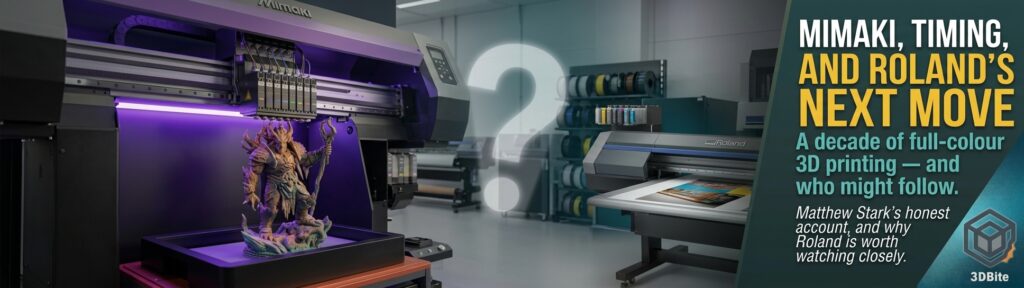
TCT Magazine’s Sam Davies published a genuinely interesting interview on September 8, 2026 with Matthew Stark, Mimaki USA’s 3D Segment Manager — Mimaki’s Matthew Stark: ‘In full-colour 3D printing, timing is a huge thing’ — reflecting on nearly a decade of Mimaki’s full-colour material jetting business. Full credit to Sam Davies and TCT for the piece, most of which sits behind their subscriber paywall, but the free opening section is substantial enough, combined with what is publicly documented about Mimaki’s actual hardware and the broader large-format print industry, to make a proper post out of it. I have used and worked with Mimaki’s large-format print-and-cut machines and their UV flatbed printers in a previous professional life, well before this site existed, and reading Stark’s reflections landed differently as a result — this is a company whose print-and-cut and UV hardware I know reasonably well, now talking candidly about why the 3D side of the business took nearly a decade to find its footing. It also raises a question I have been turning over since reading it: if Mimaki has stayed the course in 3D printing for this long, does that make it more or less likely that Roland — Mimaki’s direct rival in the exact same large-format solvent and UV print space — finally takes 3D printing seriously too?
What Mimaki’s full-colour printers actually are
This is worth explaining properly for anyone whose printing experience, like most readers of this site, is entirely FDM. Mimaki’s 3DUJ line — the original 3DUJ-553 launched in 2017, and the more compact, more accessible 3DUJ-2207 that followed — uses UV-curable inkjet material jetting, sometimes called PolyJet-style printing. Rather than melting and extruding a solid filament through a nozzle, the machine jets tiny droplets of liquid photopolymer resin directly onto the build platform in layers as thin as 20 microns, curing each layer instantly with UV light as it goes. Colour and clear inks — CMYK plus white and clear — are jetted in combination at each pass, which means the object’s colour is built in during printing rather than painted on afterward. Mimaki’s own literature claims over 10 million producible colours and describes the colour gamut as covering roughly 84% of the Fogra 39L standard and 90% of SWOP — industry colour-accuracy benchmarks borrowed directly from Mimaki’s decades of experience in 2D commercial print, which is precisely the crossover expertise that makes Mimaki’s entry into 3D distinctive compared with a company starting from FDM or resin printing roots.
The 3DUJ-553 sits at the high end — a 508 × 508 × 305mm build volume, objects up to 70kg, and a price around $200,000 according to VoxelMatters’ coverage. The 3DUJ-2207 is the deliberately scaled-down, office-friendly version — a genuinely compact 203 × 203 × 76mm build volume, quiet enough and small enough to fit through a standard office doorway without disassembly, priced at $42,078 plus a mandatory $7,000 installation and training package according to MatterHackers’ listing. That gap between the two machines — industrial workhorse versus compact office unit — is itself a reflection of the lesson Stark describes in the interview: Mimaki’s original ambition was considerably grander than what the market could actually support.
The honest admission at the centre of the interview
What makes this interview worth reading beyond the technical spec sheet is Stark’s candour about how wrong Mimaki’s original plan turned out to be. The company’s founding vision for the 3DUJ line was full-colour 3D signage — Stark specifically references the giant mechanical signs on a street in Osaka, the enormous crab and running-man displays, and Mimaki’s dream of producing a photorealistic human figure that size at the touch of a button. What actually happened, in Stark’s own words, is that the weight and cost of an object at that scale turned out to be “way more than we were expecting” — printing a 20-kilogram object that is effectively 100% cured ink is not remotely cheap, and that basic economic reality reshaped the entire commercial strategy around the technology.
The pivot that followed is the genuinely interesting part. Rather than large decorative signage, Mimaki’s real commercial traction has come from applications where the cost of a resin-heavy print is justified by what it replaces or enables. Stark names the medical industry directly — there is, in his words, “almost no price for a medical model” — and cites the speed advantage over the traditional prototyping workflow of printing a part, shipping it to a factory in China for hand-painting, and waiting a month for it to come back, as something that has “changed a lot of workflows” for companies willing to pay for that speed. He also describes a genuinely delightful detail about how Funko uses these machines: not just producing full-colour Pop figure prototypes, but printing test pieces in the exact same plastic colour as their actual injection-moulded production run, specifically so the paint job can be tested and refined against a sample that behaves like the real manufactured product — and then taking those prototypes to toy trade shows without disclosing they are 3D printed at all, simply to preview upcoming releases.
Where this sits relative to what this site actually covers
This is genuinely a different category of machine from everything covered on this desk. The A1 and A2L are extrusion-based, single or limited-material FDM printers built for a hobbyist and small-business price point. Mimaki’s material jetting hardware is industrial, priced at $42,000 to $200,000, and solving a fundamentally different problem — colour accuracy and photorealism direct from a 3D file, without any painting step at all. It is a useful reminder of how wide the actual 3D printing landscape is beyond the Bambu-and-competitors segment this site lives in day to day. But it connects to something genuinely relevant here too: the AI tools post covered Meshy, Tripo, and the broader category of AI 3D model generation, and VoxelMatters’ own coverage of Mimaki’s technology explicitly demonstrates the exact pipeline this site flagged as a plausible future direction — taking an AI-generated full-colour 3D model and printing it directly on a Mimaki 3DUJ-2207 with no manual colour-separation step required at all, since the machine prints the colour data embedded in the file directly rather than needing it translated into filament swaps or layer height, the way HueForge and the AMS both do on FDM hardware.
The Roland question, and why it is worth asking seriously
This is where my own background outside this site’s usual FDM territory is genuinely relevant. I have used Mimaki’s large-format print-and-cut machines and UV flatbed printers directly, and Roland DG has been Mimaki’s closest direct competitor in exactly that space — large-format solvent and eco-solvent print-and-cut, and UV flatbed printing — for decades. Anyone who has worked in signage, vehicle wrap, or promotional print production has almost certainly used hardware from one company or the other, often both. So the natural question, watching Mimaki commit to a genuine decade-long 3D printing strategy with real commercial traction to show for it, is whether Roland is going to do the same thing, or whether Roland has already tried and the answer is more complicated than a simple yes or no.
The answer, once you actually dig into Roland’s own history, is that Roland has already been in additive and digital fabrication for considerably longer than casual observers might assume — just not always successfully, and not always loudly. Roland’s MDX series of benchtop CNC milling machines dates back years, aimed at exactly the same rapid-prototyping and small-business market that FDM printers now dominate, and the company spun its entire 3D and digital fabrication business off into a dedicated subsidiary, DGSHAPE Corporation, specifically to give that side of the business room to develop its own identity. DGSHAPE’s product range today genuinely does include a proper 3D printer line — most notably a dedicated dental 3D printer with purpose-built Quick Denta 3D software, a directly analogous move to Mimaki’s own medical-market pivot that Stark describes in the TCT interview. Roland’s desktop CNC router push, in other words, is not really a failed side project sitting in isolation — it evolved into a distinct, still-operating digital fabrication business under its own brand, even if it has never achieved anything like FDM’s mainstream hobbyist visibility.
What genuinely sharpens the question is a Roland DG press release from May 2026 — considerably more recent than most of the material this post draws on, and worth treating as the most current signal available. Roland has explicitly previewed a new portfolio of industrial digital printing technology aimed at the “global industrial decoration market,” including an industrial UV flatbed inkjet printer (the VersaObject IO-300) and a cylindrical UV printing series, alongside a new “Hard UV Ink” formulated specifically for durability in demanding industrial applications. This is not a 3D printer announcement in the sense this site would normally cover — it is squarely in Roland’s existing flatbed and cylindrical UV decoration territory, the same general technology family as UV printing but applied to decorating existing objects rather than building new ones from scratch, similar in spirit to the UV printer story covered separately in the Bambu Lab UV printer post. But it confirms something genuinely important for the question at hand: as of mid-2026, Roland is actively and visibly expanding its industrial UV and inkjet capability, at the same moment Bambu Lab is independently reported to be building out its own UV printing division, and at the same moment Mimaki’s 3D segment manager is giving candid interviews about a decade of hard-won commercial lessons. The underlying inkjet and UV-curing technology stack that would be needed for a genuine desktop full-colour 3D printer is exactly the technology Roland is investing in right now, even if the current announcement is aimed at flat and cylindrical objects rather than genuine 3D geometry.
Why this could be a genuine shake-up if it happens properly
This is the part of my own thinking worth spelling out plainly, because it connects directly to the strategic pattern this site has traced through Bambu Lab’s own expansion into laser cutting and now, reportedly, UV printing, covered across the R1 laser post and the UV printer post. Bambu’s playbook, and arguably Mimaki’s own eventual playbook once it found its actual market fit, is not about inventing an entirely new manufacturing category. It is about taking an established, professional-grade process and repackaging it at a price and complexity level the professional-grade original never offered. Bambu did this to consumer FDM printing. If Roland — a company that already has decades of inkjet colour science, an existing UV ink chemistry portfolio, an established international dealer and service network, and an already-operating digital fabrication subsidiary in DGSHAPE — decided to seriously commit to a genuinely accessible, desktop-priced full-colour 3D printer rather than a $42,000 office unit, that is a fundamentally different kind of competitive entrant than a Kickstarter startup like the Sovol M1D or the LightMake L4 covered elsewhere on this site.
Roland already has the ink chemistry. It already has UV-curing hardware experience directly comparable to Mimaki’s. It has an existing global service and distribution network built for exactly the kind of professional and semi-professional customer who would actually consider a full-colour desktop 3D printer at a genuinely competitive price. What it has lacked, historically, is either the specific technical decision to point that infrastructure at full-colour 3D material jetting rather than flat and cylindrical UV decoration, or the confidence that the market is finally ready — which circles back precisely to the title of Stark’s own interview. Timing genuinely is a huge thing in this specific corner of the industry, and if Mimaki’s own decade of trial, error, and eventual market-fit discovery has taught the wider industry anything transferable, it may be that the market for full-colour 3D printing at genuinely accessible pricing is closer to viable now than it has ever been — precisely the moment a well-resourced competitor with adjacent technology already in hand might choose to move.
Where this leaves me
I do not think Roland’s May 2026 industrial UV announcement is a precursor to an imminent desktop 3D printer launch — the technology described is squarely aimed at flat and cylindrical decoration, not additive manufacturing. But having used both companies’ large-format hardware directly, and having now read Stark’s genuinely honest account of how long and how much trial and error it actually took Mimaki to find a real, sustainable niche in full-colour 3D printing, I am watching Roland’s next few announcements with more genuine curiosity than I would have a year ago. The underlying capability is closer to being in place at Roland than most observers probably realise, given how quietly DGSHAPE has been operating. Whether the company decides this is the moment to point that capability at 3D printing specifically, rather than continuing to focus on flat and cylindrical UV decoration, is the open question — and if a company with Roland’s chemistry, manufacturing scale, and distribution network genuinely did enter this space properly, it would be a considerably bigger deal for the industry than another Kickstarter campaign, however clever the specific hardware.
The full TCT interview, for anyone with a subscription, is worth reading in full at the link above — Stark goes on to discuss AI, data management, and where he sees the sub-sector maturing, none of which I could access behind the paywall but all of which sounds like exactly the kind of grounded, decade-earned perspective this industry could use more of.