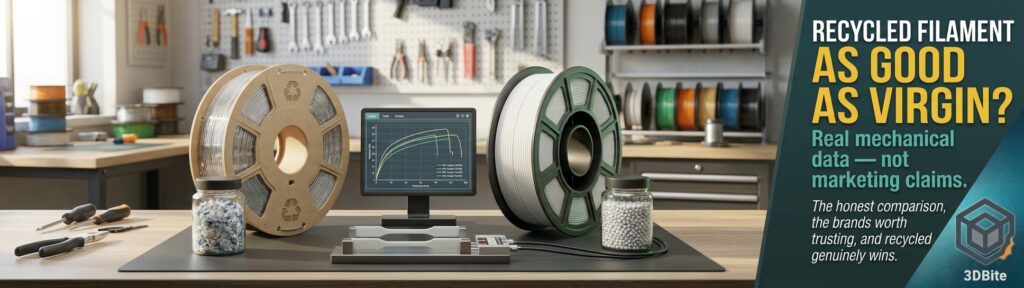
Recycled filament has moved from a niche, slightly suspect corner of the market to something most major filament brands now offer as a genuine product line rather than a token gesture. The honest answer to whether it matches virgin material is more nuanced than either the marketing (“95% of virgin performance!”) or the scepticism (“recycled plastic is always worse”) suggests — the research itself is genuinely mixed, and understanding why it is mixed is more useful than picking a single headline number and repeating it.
What “recycled filament” actually means
This term covers two genuinely different source materials, and the distinction matters for quality more than most marketing copy lets on. Post-industrial recycled content comes from production waste — offcuts, failed batches, and excess material generated during the manufacture of filament or other plastic products, collected and reprocessed before it ever reached a consumer. This is the cleaner, more consistent feedstock, since its composition and purity are already reasonably well known. Post-consumer recycled content comes from material that has already been used and discarded by an end user — plastic bottles, packaging, or other consumer waste — which introduces considerably more variability in composition, contamination, and degree of prior wear on the polymer chains before it even reaches the recycling process.
The mechanical data, honestly presented
This is worth being direct about rather than picking the single most flattering or most damning number and presenting it as the whole story, because the research genuinely disagrees depending on the source material, the recycling process, and how rigorously the test was conducted.
At the optimistic end, one peer-reviewed study comparing virgin and recycled PLA blends found both 100% virgin and 100% recycled PLA outperformed a commercial reference filament by 48-50% in tensile strength, with fully recycled PLA actually showing higher stiffness than virgin, attributed to enhanced crystallisation and shorter polymer chains from the reprocessing itself. Industry-facing guidance converges on a broadly similar figure, describing quality recycled PLA as landing within 90-95% of virgin mechanical performance — close enough, in that framing, that supplier quality control matters considerably more than whether the material is labelled recycled at all.
At the more cautious end, a separate controlled comparison found fully recycled PLA prints with tensile and flexural strength more than 15% below a virgin reference under that specific study’s conditions. And the gap widens considerably for recycled PET specifically rather than PLA — one rigorous academic comparison found rPET averaging 17.68 MPa tensile strength against 34.20 MPa for standard PETG under matched printing conditions, a roughly 93% difference, with rPET’s flexural strength, hardness, and impact strength all measurably lower across the same test set. A separate study reached the opposite conclusion for a specifically optimised rPET formulation, finding its tensile strength actually matched or exceeded virgin PET, ABS, and PLA at properly tuned settings — which reinforces the point that the specific formulation and processing matters enormously, and a single “recycled is X% as good” figure cannot responsibly cover every product calling itself recycled.
The honest synthesis: recycled PLA, handled well by a competent manufacturer, genuinely can match or come close to virgin PLA’s mechanical performance. Recycled PET-based materials (rPET, rPETG) show a wider and more inconsistent gap across the research, and the specific brand and formulation matters more here than for PLA. Neither material category should be assumed equivalent to virgin on faith alone — the manufacturer’s own track record and quality control process are what actually determine the answer for any specific spool.
Where the real-world consistency problems actually live
This is arguably more important for day-to-day printing than the raw mechanical numbers, and it connects directly to the diameter tolerance discussion in the filament brands post. Diameter consistency with recycled filament depends on manufacturer quality control considerably more than it does with virgin material from an established brand, where tight tolerance is often simply a given. A well-run recycled filament operation measures diameter with lasers during extrusion and can genuinely hit ±0.03-0.05mm, comparable to ordinary mid-range virgin filament — but this is a manufacturer-dependent outcome rather than something inherent to recycled material, and an unknown or less rigorous producer can and does drift further from that.
Colour consistency is the other genuine practical limitation worth knowing about before buying for a specific project. Recycled feedstock, particularly post-consumer material, often cannot be pigmented to a precise, repeatable shade the way virgin resin can, since the base material itself may carry some inherent colour variation batch to batch. For colour-critical work — matching a specific brand colour, or the kind of multi-spool consistency the multi-part printing and seasonal build projects on this site depend on — this is a genuine reason to stick with virgin, precisely pigmented material rather than a recycled product whose exact shade may shift subtly between batches. Impurities in recycled feedstock — traces of incompatible plastic or residual colorant — can also measurably affect flow and layer adhesion in a way a filtered, controlled virgin resin simply does not encounter.
Brittleness and moisture: the PLA-specific trade-off worth knowing
One detailed comparison names this directly as recycled PLA’s specific weak point relative to virgin: rPLA is somewhat more brittle and more hygroscopic than virgin PLA. This connects to the drying discipline covered in the filament drying post — recycled PLA may need slightly more attentive moisture management than a virgin spool of the same nominal material would, and for anything genuinely load-bearing or impact-prone, the brittleness difference is worth factoring into material choice the same way the orientation and material decisions in the orientation for strength post are weighed for any other material.
The genuine environmental case, with real numbers
This is worth stating clearly because it is the part of the case that is genuinely solid rather than contested. Life cycle assessment research puts the emissions reduction from recycling PLA at roughly 50-60%, driven mainly by energy savings in raw material production and polymerisation that recycled feedstock simply skips. Comparing virgin and recycled material carbon footprints directly, one study found PET’s footprint drop from 2.23 to 0.91 (a 59% reduction) when recycled, a broadly similar pattern to other common plastics. Whatever uncertainty exists around mechanical performance matching virgin material exactly, the environmental case for recycled content is genuinely well-supported rather than marketing spin — it is the mechanical performance question, not the sustainability claim, where the real nuance actually lives.
Brands worth trusting, and the one cautionary note
Filamentive is the name that comes up repeatedly and specifically for UK buyers — a UK-based brand offering recycled PLA (averaging around 50% recycled content) and 100% recycled PETG made from post-industrial waste, with ISO-verified recycled content specifically, which the brand itself notes distinguishes it from competitors making recycled claims without third-party validation. For anyone in the UK specifically wanting a traceable, verifiable recycled option rather than taking a brand’s word for it, this verification is a genuinely meaningful differentiator.
Prusament rPLA and BigRep’s rPETG and rPLA (made from 100% post-industrial waste) both lean on the kind of manufacturing rigour already covered in the filament brands post’s discussion of Prusament’s tight tolerance and per-spool documentation — a genuinely reassuring pedigree for recycled material specifically, where quality control matters more than with virgin stock. FormFutura’s ReForm rPLA and colorFabb’s rPLA round out the established European options, both built from post-consumer and post-industrial PLA waste with a specific sustainability-line identity rather than being a side product.
The cautionary note worth including honestly: Refil, once described as the world’s first fully recycled high-quality 3D printing filament brand, globally available and genuinely well-regarded, stopped production in February 2020. Supply of recycled filament has historically been patchy, and while the landscape has genuinely improved since then with more established brands now offering recycled lines as a permanent part of their catalogue rather than an experimental side project, it is worth choosing a brand with a genuine, ongoing commercial track record rather than a smaller operation whose long-term supply continuity is less certain.
The decision table
| Use case | Recycled worth it? | Why |
|---|---|---|
| Prototyping, draft parts, test prints | Yes | Mechanical performance differences rarely matter at this stage, and the environmental case is genuinely solid |
| Household organisers, non-critical functional parts | Yes, from an established brand | Quality recycled PLA genuinely competes here; choose a brand with real QC rather than an unknown source |
| Colour-critical decorative or gift work | No — stick with virgin | Batch-to-batch colour consistency is recycled material’s weakest practical point |
| Genuine structural or load-bearing parts | Caution — verify the specific product’s tested mechanical data | The research genuinely disagrees by brand and formulation; do not assume parity without checking |
| Anything needing rPETG-level toughness or chemical resistance | Choose a reputable brand specifically (Filamentive, BigRep) rather than generic rPET | The gap between virgin PETG and generic rPET in academic testing is considerably larger than for PLA |
The honest summary
Recycled filament is not a single, uniform category that can be judged as universally “as good as” or “worse than” virgin material — the honest answer depends heavily on which material (PLA genuinely closes the gap more readily than PET-based materials), which specific brand and formulation, and what the part actually needs to do. For the overwhelming majority of what gets printed in a home workshop — prototypes, organisers, decorative pieces where colour consistency is not the single defining requirement — a recycled filament from a brand with genuine, verified quality control is a sensible, environmentally meaningful choice with little practical downside. For colour-critical gift work or genuinely structural parts, the research supports being more selective, checking the specific product’s own tested data rather than assuming the recycled label alone guarantees parity with virgin material.