Updated 1 November 2026, two days before Bambu’s H3C reveal on Tuesday 3 November at 2 PM UK time.
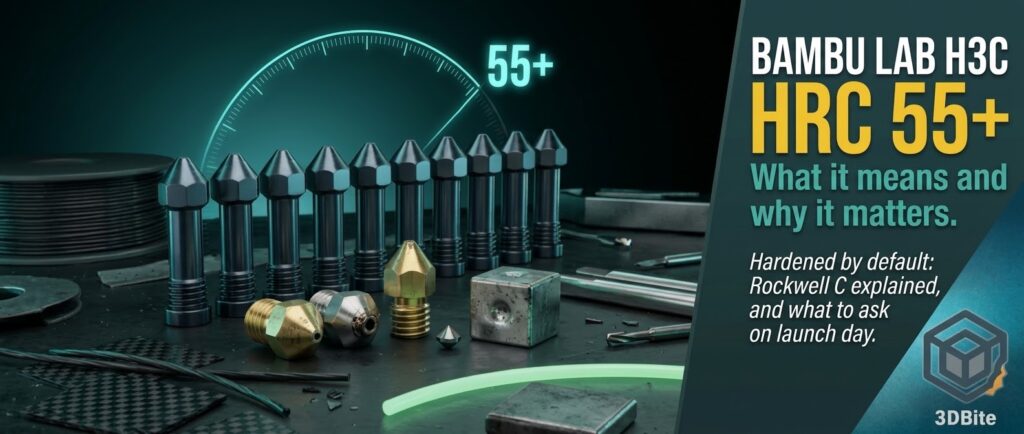
On 30 October Bambu Lab posted a third teaser for the H3C, and this one is not a video. It is a headline on the community forum reading “HRC 55+. All of them”, with the tagline “Durable by design. Hardened by default.” That is a very Bambu way to announce a spec: a number, a cryptic suffix and no explanation. If you are wondering what HRC even means, why 55 matters and why a company would build a teaser around it, this post is for you. I will explain the rating, put it in context against the nozzles you already use, work out why it matters more on a tool changer than it would on any other printer, and be clear about what Bambu has not told us yet.
What HRC means
HRC stands for Rockwell hardness, C scale. The Rockwell test presses a diamond cone into the surface of a metal, first with a light load and then with a heavy one, and measures how deep the dent ends up. A harder metal gives a shallower dent, so a higher number means a harder material. The C scale uses a 150 kgf load and is the standard way of rating hardened steel and tool steel, which is why it is the scale you see on knives, files and cutting tools. A higher HRC number means more resistance to being scratched, ground down or deformed.
“HRC 55+” therefore reads as “at least 55 on the Rockwell C scale”, which is a hardness in the range of good cutting tools. The plus sign is the hedge: the spec is a minimum, not a precise figure. Hardness numbers are not linear, and a steel at 55 is dramatically harder than one at 30, though the difference between 55 and 60 is smaller in practice than it sounds.
Why a nozzle needs to be hard
Plain PLA, PETG and ABS are soft on a metal scale, and a brass or stainless nozzle will print them for a very long time. The problem is filaments with hard particles in them. Carbon fibre, glass fibre, glow-in-the-dark pigments, metal powders and some stone and marble effects act like fine sandpaper as they are forced through a tiny orifice at 250 degrees or more. The hole slowly grows, the flow becomes inconsistent and the print quality drops. Bambu’s own wiki shows a stainless nozzle after ten hours of PETG-CF printing with a visibly enlarged hole, which is a vivid way of making the point. I covered the full picture, including extruder gear wear, in the abrasive filaments guide and the nozzle types explainer.
How 55+ compares with other nozzles
| Nozzle material | How hardness is rated | What it means in practice |
|---|---|---|
| Brass | Far softer than hardened steel. It is normally rated on a softer scale such as Rockwell B or Vickers, not C | Excellent heat transfer and cheap, but wears quickly on abrasive filaments |
| Stainless steel | Harder than brass, below hardened steel | Fine for standard filaments. It still wears on carbon and glass fibre, just more slowly than brass |
| Hardened steel | Bambu’s store quotes about HRA 74 for its current hardened steel. Third-party pages often claim HRC 60 or more, which I would not rely on | The usual answer for carbon fibre, glass fibre and glow filaments |
| Tungsten carbide | Bambu quotes HRA 90, a scale designed for very hard materials such as cemented carbide | Bambu says it gives roughly 50% more life than hardened steel on abrasive fibre-reinforced filaments |
| H3C, per the teaser | HRC 55 or more, “all of them” | Hardened by default, with no stated material, and no stated price |
A word of caution on that table, because it hides a trap. Different Rockwell scales cannot be compared by eye. HRA and HRC use the same diamond cone at different loads, so a number on one does not map onto the other directly. Using the standard ASTM E140 conversion chart for steel, 55 HRC works out at roughly 78.5 HRA, while Bambu’s quoted HRA 74 for its current hardened steel works out at only about 47 HRC. That is my own conversion, not Bambu’s, and the chart is only valid for non-austenitic steels, so treat it as a rough indication. If it holds, it would mean the H3C’s nozzles are harder than the hardened steel nozzles Bambu sells today. It could equally mean Bambu’s existing figure was measured differently, or that the two numbers are not describing the same thing. I would not read too much into it until Bambu publishes the full spec.
Why it matters more on a tool changer
This is the real reason the teaser exists, and it is a good one. With the nine-tool design, as covered in the H3C and P3C roundup, there are nine nozzles to worry about instead of one. Think through what that does to the usual advice.
- Every tool can print everything. On a single-nozzle printer you either swap to a hardened nozzle before a carbon fibre job or you do not. On a tool changer, if only some tools were hardened, you would have to remember which tool holds which filament, and the slicer would have to keep abrasive materials off the soft ones. “Hardened by default” removes that whole juggling act.
- Mixed-material prints become practical. A part with a carbon-fibre structural section, a glow-in-the-dark accent and plain PLA surfaces needs several tools to take abrasive filament. If all nine are hardened, the slicer is free to assign them however it likes.
- Wear is multiplied, and so is replacement cost. Nine nozzles that can wear out is a bigger consumable bill than one. Making all of them hard at the factory is a way of protecting that cost. One forum commenter grumbled that anyone wanting into these machines now needs a new nozzle standard and noted the growing number of Bambu hotend formats, so cost and compatibility will be questions on launch day.
- It simplifies the pitch. A printer that is “abrasive-ready out of the box” is easier to sell to the engineering-minded users who are the natural buyers of a multi-tool machine.
What hardened does not give you
- It is not wear-proof. Hard is slower wear, not no wear. Tungsten carbide exists for a reason.
- It can conduct heat less well than brass. One nozzle guide notes that standard hardened steel conducts heat worse than brass, which on a fast printer can show up as mild under-extrusion at high flow rates. Bambu has not said how the H3C’s heating works, and whether it carries over the induction heating from the H2C, which Bambu says reaches PLA temperature in about 8 seconds, is still unconfirmed.
- It does not protect the rest of the filament path. The P1 series example is instructive: the extruder gears can wear as well, as I covered in the gear wear guide. We have no information on what the H3C’s feed path is made of.
- It does not make tiny nozzles suitable. Bambu advises against running carbon and glass fibre filaments through a 0.2mm nozzle, and nothing about hardness changes the physics of fibres in a very small hole.
A confusing label: “Required nozzle HRC” in the slicer
If you have ever opened a filament profile in Bambu Studio, you may have noticed a field called something like “required nozzle HRC”. Be careful with it. According to a long-running user discussion on the Bambu forum, it is a small category number rather than a true Rockwell reading, roughly a ladder from “standard nozzle is fine” up to “hardened steel needed”. That is the user community’s explanation, not an official definition, so I would not lean on the details. The point for today is simply not to confuse that slicer value with the “HRC 55+” figure on the teaser. They share a name and measure different things.
What Bambu has not said
| Question | Status |
|---|---|
| Does “all of them” mean all nine nozzles, or the whole tool? | The text of the forum post does not say. I could not read the teaser image, so I cannot rule out more detail there |
| What material is it? | Not stated. Hardened tool steel, martensitic stainless and a coated alloy would all be plausible, and none is confirmed |
| Is 55 the measured figure or a minimum? | The plus sign says minimum. Where on the nozzle it is measured is unknown |
| Is tungsten carbide still an option? | Unknown |
| What does a replacement cost? | No price announced for any H3C part |
| Do the P3C’s tools get the same treatment? | No information on that printer at all |
| Are the nozzles compatible with the H2C’s Vortek hotends? | Forum users who compared the teaser image said the nozzle looks similar to the Vortek nozzles but with a different heat sink and a flat side. That is a reading of a photo, not an announcement |
What it means for you
| You are… | What 55+ changes |
|---|---|
| Printing mostly PLA, PETG and ABS, like me with PLA+ on the A1 and A2L | Nothing. Standard filaments do not need it |
| Using carbon or glass fibre filaments regularly | A real convenience: no nozzle swapping, and every tool can take them |
| Running glow, metal-filled or stone-effect filaments | These are the materials that kill soft nozzles, so a hardened default is a quiet relief |
| Printing engineering parts with mixed materials | Potentially the biggest winner, since any tool can carry any filament |
| Budget-conscious | Watch the price of spare nozzles on launch day, because nine of them is a long shopping list |
| An H2C owner | Ask whether H3C nozzles are interchangeable with yours. Nobody knows yet |
My take
I think “HRC 55+” is more than a marketing flourish. It is Bambu answering a question every tool-changer buyer will ask: what happens to nine nozzles when I print the filaments I bought a multi-tool printer to use? By making the answer “they are all hard, all the time”, Bambu removes one of the awkward edges of the design, and the fact that it is willing to teaser a hardness number tells me engineering-grade materials are central to the pitch. What I cannot tell you is how hard these nozzles really are, what they are made of, how they print standard filaments compared with brass, or what they cost to replace. Those are exactly the questions I will be looking for in the launch details on 3 November at 2 PM UK time. I will update this post then.
Sources and further reading
- Bambu Lab Community Forum: [Bambu Lab H3C] HRC 55+. All of them
- Bambu Lab store: tungsten carbide nozzle (HRA 90 versus hardened steel at 74)
- Bambu Lab wiki: P1S extruder and hardened steel upgrade
- Bambu Lab Community Forum: what is the HRC setting for?
- Wikipedia: Rockwell hardness test
- Noramark: steel hardness conversion chart (ASTM E140)
- Angl3d: Bambu Lab nozzle guide
- Plate and Spool: how long a nozzle lasts