The nozzle is the last thing that touches your filament before it becomes a print. It is also one of the most ignored components in a desktop FDM printer — most people use whatever came in the box, print thousands of hours through it, and only think about it when something goes wrong. That approach works fine until you start printing materials that the stock nozzle was never designed for, or until the nozzle quietly degrades and you start chasing print quality problems that turn out to have nothing to do with your slicer settings.
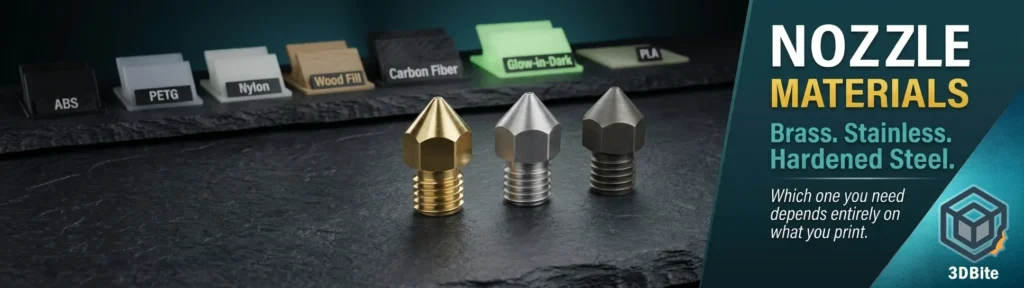
This post covers the three main nozzle materials you will encounter on a Bambu machine or any other modern FDM printer — brass, stainless steel, and hardened steel — what each one does well, where each one fails, and when you should be reaching for each type. There are also a couple of specific scenarios worth knowing about that rarely get mentioned: why printing with magnetic filament and a hardened steel nozzle is a combination to avoid, and why some filaments that seem harmless will quietly destroy a brass nozzle before you notice anything is wrong.
Why nozzle material matters
A nozzle does two things: it transfers heat from the heater block into the filament, and it shapes the extruded line at the orifice. Both of those functions are affected by the material the nozzle is made from.
Thermal conductivity determines how quickly and evenly the nozzle heats up and how consistently it maintains temperature during printing. A nozzle with high thermal conductivity responds quickly to temperature changes, maintains a stable melt zone, and allows faster extrusion without under-melting the filament. A nozzle with poor thermal conductivity requires more time to stabilise, may struggle at high volumetric flow rates, and often needs higher set temperatures to achieve the same actual melt behaviour.
Wear resistance determines how long the nozzle orifice holds its original shape. The orifice is a precisely sized hole — 0.4mm for the standard nozzle on a Bambu A1 — and its size directly affects extrusion width, line consistency, and print quality. As a nozzle wears, the orifice enlarges. Extrusion becomes slightly over-width. Lines lose their precise edges. Surface finish degrades. The degradation is gradual and invisible at first, which is what makes wear the insidious failure mode: you start chasing settings problems that are actually hardware problems.
These two properties — thermal conductivity and wear resistance — are in tension with each other. The materials that conduct heat best are soft and wear quickly. The materials that resist wear best are harder and conduct heat less efficiently. Every nozzle material is a point on that trade-off curve.
Brass: the default for good reason
Brass is the standard nozzle material on virtually every consumer FDM printer. The Bambu A1 ships with a stainless steel nozzle rather than brass — an unusual and sensible default choice that we will come back to — but across the broader market, brass is what you will find in the box.
The reason brass dominates is its thermal conductivity. Brass nozzles are preferred for their high thermal conductivity of around 110 W/(mK), which allows them to heat up quickly and maintain a stable temperature, crucial for smooth filament flow and consistent extrusion. That number — 110 W/(mK) — is roughly three times higher than stainless steel. The practical consequence is that a brass nozzle reaches temperature quickly, responds immediately to temperature adjustments, and holds a consistent melt zone even at high print speeds. For standard filaments — PLA, PETG, ABS, TPU — brass produces the cleanest, most consistent extrusion of any nozzle material.
Brass is also inexpensive. A good quality brass nozzle costs less than £2. Buying a set of ten for rotation and replacement is cheaper than a single hardened steel nozzle.
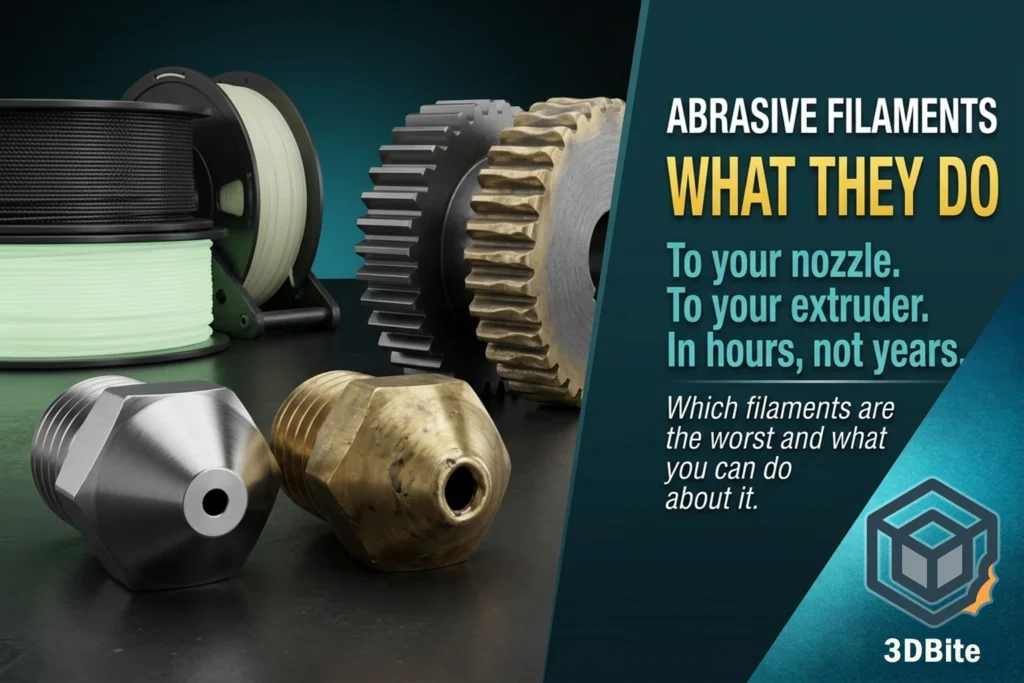
The limitation is hardness. Brass is a soft metal, and abrasive filaments — anything with hard particles in the polymer matrix — wear the orifice progressively. A single spool of carbon fibre or glow-in-the-dark filament can ruin a brass nozzle. That is not hyperbole. Carbon fibre particles are significantly harder than brass. As they pass through the orifice under pressure, they abrade the inner surface and the lip of the orifice itself. The hole enlarges, the edges round, and print quality drops in a way that is difficult to attribute to the nozzle until you compare the orifice diameter against a new nozzle.
| Property | Brass |
|---|---|
| Thermal conductivity | Excellent — ~110 W/(mK). Heats fastest, holds temperature best |
| Wear resistance | Poor — soft metal, wears rapidly with any abrasive content |
| Max temperature | ~300°C — adequate for all standard filaments |
| Food safe | No — brass contains lead in some formulations |
| Cost | Very low — cheapest nozzle material available |
| Best for | PLA, PLA+, PETG, ABS, ASA, TPU, Nylon (non-CF) |
| Avoid with | Any CF, GF, metal-fill, glow-in-the-dark, abrasive composites |
Stainless steel: the overlooked middle ground
Stainless steel nozzles sit between brass and hardened steel on both the wear resistance and thermal conductivity scales, and they occupy a useful position in the nozzle selection decision that often gets overlooked in the brass-versus-hardened-steel framing.
Stainless steel has relatively poor thermal conductivity, around one third that of brass. That gap is real and measurable in print behaviour — stainless steel nozzles take longer to reach temperature, respond more slowly to temperature adjustments, and can struggle to maintain consistent melt at the highest volumetric flow rates. In practice, for most standard printing on a Bambu machine at normal speeds, the difference is not dramatic. You may need to add 5°C to your nozzle temperature compared to a brass nozzle and accept slightly reduced maximum flow rate. Neither is a dealbreaker.
The wear resistance advantage over brass is meaningful for occasional abrasive work. The level of abrasion resistance that you get from stainless steel is far higher than brass, but it is still vulnerable to highly abrasive filaments like carbon fibre. A stainless steel nozzle will handle a spool or two of wood-fill, glow-in-the-dark, or mildly reinforced composite without significant degradation where a brass nozzle would show visible wear within that same volume. It is not the right nozzle for regular CF or GF use, but it handles the occasional abrasive job without paying the full price premium of hardened steel.
Stainless steel has one unique advantage that neither brass nor hardened steel can match: food safety. Stainless steel nozzles are lead-free, making them safe enough to print with medical-grade parts and food containers. They are the only food and medical-safe nozzles. If you are printing anything intended for food contact — cups, plates, utensils, cookie cutters, anything that will touch what someone eats — stainless steel is the correct nozzle material regardless of any other consideration. Brass contains lead and should not be used for food-contact prints. Hardened steel may contain treatment coatings that introduce contamination risk.
This is also why the Bambu A1 ships with a stainless steel nozzle rather than brass as its standard. Bambu made a deliberate choice to default to the more durable, food-safe, lead-free option rather than the cheapest one. The A1 printer comes pre-installed with a stainless steel nozzle with a diameter of 0.4mm. For the majority of PLA and PETG printing that most A1 owners do, the stainless steel nozzle is an excellent default — it lasts longer than brass, handles the occasional non-standard filament without immediate degradation, and avoids the food-safety concern entirely.
| Property | Stainless Steel |
|---|---|
| Thermal conductivity | Moderate — approximately one third of brass. Slower heating, slightly reduced max flow rate |
| Wear resistance | Moderate — significantly better than brass, not adequate for regular CF or GF use |
| Max temperature | >300°C — suitable for high-temperature materials |
| Food safe | Yes — lead-free, the only food-safe nozzle option |
| Cost | Low to moderate |
| Best for | PLA, PETG, ABS, occasional wood-fill, glow-in-the-dark, food-contact prints |
| Avoid with | Regular or heavy CF/GF composite use — will wear faster than hardened steel |
Hardened steel: when abrasion resistance is the priority
Hardened steel nozzles are standard steel that has been heat-treated to dramatically increase surface hardness — typically exceeding 60 HRC on the Rockwell scale, which is the hardness range of quality cutting tools. That treatment produces a nozzle that resists abrasion from composite filaments at a level neither brass nor stainless steel can approach.
Hardened steel can be up to ten times more wear-resistant than other nozzle materials. These nozzles can last for an incredibly long time given proper maintenance. Community users have reported running multiple kilogram spools of nylon carbon fibre through a hardened steel nozzle with no measurable orifice enlargement — a volume of abrasive material that would have destroyed a brass nozzle within the first spool and degraded a stainless steel nozzle significantly across the run.
The thermal conductivity trade-off is real. In terms of thermal conductivity, hardened steel sits somewhere mid-way between brass and stainless steel. The practical implication for Bambu users is an increase of 5–10°C on nozzle temperature compared to the stainless steel default, and a slightly reduced maximum volumetric flow rate. Hardened steel nozzles require fine tuning your filament temps, print speeds, and retraction. The poor thermal dynamics mean you will likely need to print hotter and slower. For most use cases this adjustment is straightforward — update your filament profile for the hardened steel nozzle, save it, and apply consistently. It is a one-time calibration, not an ongoing burden.
One important maintenance note: hardened steel may rust if not properly maintained. Store hardened steel nozzles in a dry environment and clean after use to extend lifespan. Stainless steel nozzles do not have this concern. If you store a hardened steel nozzle for a period between uses, keep it in a sealed container or a desiccant bag.
| Property | Hardened Steel |
|---|---|
| Thermal conductivity | Lower than brass and stainless — requires 5–10°C temperature increase in profiles |
| Wear resistance | Excellent — up to 10× more wear-resistant than brass. The correct choice for regular CF/GF use |
| Max temperature | >300°C — handles all engineering and composite materials |
| Food safe | No — treatment coatings may introduce contamination risk |
| Rust resistance | Lower than stainless — store dry, clean after use |
| Cost | Moderate to high — significantly more than brass, but lasts far longer with abrasives |
| Best for | PLA-CF, PETG-CF, PA-CF, PA-GF, metal-fill, glow-in-the-dark, any abrasive composite |
| Avoid with | Food-contact prints. Magnetic filaments (see below) |
The abrasive filaments that catch people out
The filaments that destroy brass nozzles fastest are not always the ones that look dangerous. Carbon fibre composites are well understood — the “use hardened steel” warning is prominent enough that most people know it before they buy PLA-CF. But there are several filament types that are less obviously abrasive and that quietly wear out nozzles without the user connecting the print quality degradation to the nozzle material.
Glow-in-the-dark
Glow-in-the-dark filament is one of the most commonly underestimated abrasive filaments. The photoluminescent powder that gives it its glow property — typically strontium aluminate — is extremely hard, harder than most metals. Brass nozzles cannot be used to print glow-in-the-dark filaments as the abrasive particles will wear the nozzle rapidly. A single spool of glow filament through a brass nozzle can enlarge the orifice enough to degrade print quality perceptibly. Use a hardened steel nozzle for glow-in-the-dark filament without exception.
White filaments
This one surprises people. Some white filaments — not all, but a meaningful proportion — use titanium dioxide as a pigment. Titanium dioxide is significantly harder than brass and will cause progressive wear over time. Some white filaments are abrasive due to their titanium dioxide content. The wear rate is lower than for carbon fibre, but it is real over a long printing run. For occasional white printing on a brass nozzle, the wear is not significant. For anyone who prints large volumes of white filament regularly, stainless or hardened steel is the sensible choice.
Wood-fill and metal-fill
Wood-fill filaments are mildly abrasive — the wood particles are softer than metal but still cause gradual wear over time, particularly at the orifice lip. A stainless steel nozzle handles wood-fill comfortably for extended use. Brass will wear faster. Metal-fill filaments — brass, copper, bronze, and iron powder suspended in PLA or PETG — are more aggressively abrasive than wood-fill. The metal particles are hard enough to wear brass relatively quickly. Stainless steel is a reasonable choice for moderate metal-fill use. Hardened steel is the correct choice for heavy or regular use.
Carbon fibre and glass fibre composites
These are the most abrasive filament categories available for desktop FDM and the ones where the hardened steel requirement is most critical. PLA-CF, PETG-CF, PA-CF, PA-GF, ASA-CF — any filament with CF or GF in its name contains hard particles that will wear a brass nozzle within a single spool and a stainless steel nozzle within a few spools. Hardened steel is the only practical nozzle material for regular use of these filaments. As covered in the PLA-CF guide, Bambu specifically states the A1’s stainless steel nozzle should not be used with CF or GF filaments and recommends replacement with hardened steel before printing these materials.
The magnetic filament exception: why hardened steel is the wrong choice here
Here is the scenario that rarely gets covered but is directly relevant to anyone printing models that incorporate embedded magnets or magnetic inserts: iron-filled filament, sometimes called magnetic or magnetisable PLA.
Iron-filled PLA contains iron powder in the polymer matrix. Iron powder is abrasive enough that a brass nozzle will wear — stainless steel is the minimum, hardened steel is preferable for the abrasion resistance. So far, standard advice. But the specific consideration with iron-filled filament and magnetic applications is the nozzle’s own magnetic properties. Hardened steel is ferromagnetic — it is attracted to magnets and can become magnetised itself. If you are printing a model designed to hold embedded magnets, printing with a nozzle material that is attracted to those same magnets introduces the possibility of the nozzle geometry being subtly affected by the magnetic field of any embedded magnets already in the print during subsequent layers, and more practically, a hardened steel nozzle cleaning process near neodymium magnets risks attracting debris to the nozzle tip.
More importantly: if you are printing with iron-fill specifically to create a magnetisable surface, using a hardened steel nozzle means the particles of iron in the filament are being processed through a ferromagnetic nozzle, which can cause slight particle clustering and uneven distribution in the melt zone near any strong magnetic field. For most hobbyist applications this is a minor concern. For anyone printing precision magnetic applications — sensor-facing surfaces, speaker components, magnetic closure mechanisms — it is worth knowing that stainless steel (grades 304 and 316 are non-ferromagnetic) is the cleaner choice for iron-fill and magnetic filament work. 316L stainless steel provides the best wear resistance in the stainless range and is non-magnetic — the right combination for this specific use case.
Specialty nozzles: ruby, tungsten carbide, and copper
Beyond the three main categories, a small number of specialty nozzles are worth knowing about even if most hobbyists will never need them.
Ruby-tipped nozzles
Ruby-tipped nozzles use a brass body for thermal conductivity and a synthetic ruby insert at the tip for wear resistance. Ruby is third only to diamond and cubic boron nitride in hardness, and even compared to hardened steel the wear resistance of the ruby tip is magnitudes higher. The result is the thermal performance of brass with abrasion resistance far beyond hardened steel. The trade-off is fragility — the ruby tip is extremely hard but brittle. If you accidentally crash the nozzle into the build plate or drop it on a concrete floor, the tip can shatter or dislodge. Ruby-tipped nozzles are expensive and require careful handling. For extremely abrasive filament at high volume — PA-CF, PC-CF, metal-fill on long production runs — they make sense. For typical hobbyist use, hardened steel at a fraction of the price is adequate.
Tungsten carbide
Tungsten carbide matches the thermal performance of brass while offering industrial-grade wear resistance for even the most abrasive materials. The downside is the initial cost, but it will likely last the life of your printer. Tungsten carbide nozzles are the premium option for anyone who wants both excellent thermal conductivity and maximum abrasion resistance without the fragility of ruby. They are uncommon in the hobbyist market due to cost, but they represent the engineering ideal for composite printing.
Copper and nickel-plated copper
Copper nozzles offer higher thermal conductivity than brass — useful for ultra-high-speed printing where maximum volumetric flow rate is the priority. They are almost always plated with nickel to improve wear resistance and reduce plastic adhesion, but they are not suitable for abrasive filaments. A niche choice for high-flow, high-speed printing with standard materials on a high-performance machine. Not a typical hobbyist purchase.
Nozzle geometry: Bambu-specific notes
Nozzles are not universal. Different printer families use different thread standards, body lengths, and hotend geometries. You must identify if your machine uses a standard geometry like V6 or MK8, or a proprietary system like Bambu Lab or Revo. Bambu machines use a proprietary nozzle standard that is not directly compatible with V6 or MK8 nozzles from the broader market without an adapter.
Bambu sells their own range of nozzles directly — brass (now less commonly available as the stainless steel default has largely replaced it), stainless steel (the A1 default), and hardened steel in 0.2mm, 0.4mm, 0.6mm, and 0.8mm diameters. Third-party Bambu-compatible nozzles are available from several suppliers, but verify compatibility specifically before purchasing — the Bambu nozzle design has specific hotend geometry requirements that not all third-party options meet correctly.
Changing nozzles on the A1 and P1 series is a hot-swap procedure — the nozzle must be at printing temperature to remove and install correctly. Always follow Bambu’s documented nozzle replacement procedure. Attempting to remove a cold nozzle risks damaging the heatblock threads and the heater assembly.
Quick reference: which nozzle for which filament
| Filament | Brass | Stainless Steel | Hardened Steel |
|---|---|---|---|
| PLA / PLA+ | ✓ Best choice | ✓ Good | ✓ Works — slight thermal compromise |
| PETG / PETG+ | ✓ Best choice | ✓ Good | ✓ Works |
| ABS / ASA | ✓ Good | ✓ Good | ✓ Works |
| TPU / TPE | ✓ Best choice | ✓ Good | ⚠ Works but slightly rough interior may cause inconsistency |
| Nylon (non-CF) | ✓ Adequate | ✓ Better — longer lasting | ✓ Best for long runs |
| Glow-in-the-dark | ✗ Avoid — rapid wear | ⚠ Short-term only | ✓ Required |
| White (TiO₂ pigment) | ⚠ Moderate wear over volume | ✓ Good | ✓ Best |
| Wood-fill | ⚠ Wear over time | ✓ Good | ✓ Best |
| Metal-fill (brass, copper, iron) | ✗ Avoid | ⚠ Short-term only | ✓ Required |
| PLA-CF / PETG-CF | ✗ Avoid — very rapid wear | ✗ Avoid — will wear | ✓ Required |
| PA-CF / PA-GF | ✗ Avoid | ✗ Avoid | ✓ Required |
| Iron-fill / magnetic filament | ✗ Avoid — wear | ✓ Best — non-ferromagnetic 316L | ⚠ Ferromagnetic — see notes |
| Food-contact prints | ✗ Contains lead | ✓ Only food-safe option | ✗ Not food-safe |
How to tell when a nozzle needs replacing
Nozzle wear is gradual and the symptoms arrive slowly. The warning signs to watch for are extrusion inconsistency that appears without any settings change, visible roughening of line edges on the top surface, under-extrusion that does not respond to flow rate adjustment, and a general softening of fine detail on models that previously printed crisply. None of these symptoms are conclusive on their own — they can all have other causes. But if you have been printing abrasive filament through a brass or stainless steel nozzle for extended periods and start seeing these issues, the nozzle should be the first thing you check before adjusting settings.
Visual inspection of a worn nozzle requires either a jeweller’s loupe or a macro lens. A worn orifice will appear slightly enlarged and rounded at the edges compared to a new nozzle of the same size. If you have a calibrated test print — a single extrusion wall at a specific width — you can compare the actual extrusion width against the expected value to detect whether the orifice has enlarged. A measurable deviation suggests the nozzle needs replacement.
On brass nozzles with non-abrasive filaments, replacement on a schedule rather than waiting for symptoms is a reasonable approach. A brass nozzle is cheap enough that replacing it every few hundred hours of PLA printing as preventative maintenance is worthwhile insurance against gradually degrading print quality. On hardened steel nozzles with standard filaments, scheduled replacement is not necessary — the wear rate is slow enough that symptoms will appear well before the nozzle is critically degraded.
Summary
For standard PLA, PETG, and ABS printing, the stainless steel nozzle that ships with the Bambu A1 is a good default — better longevity than brass, adequate thermal performance, food-safe if you need it. If you want maximum print quality and extrusion consistency for non-abrasive filaments and print speed is a priority, a brass nozzle gives you marginally better thermal performance. If you print PLA-CF, PETG-CF, PA-CF, metal-fill, or glow-in-the-dark filament in any meaningful volume, hardened steel is not optional — it is the only sensible choice. And if you are printing with iron-fill or magnetic filament and care about the magnetic properties of the finished part, reach for 316L stainless steel rather than hardened steel and avoid the ferromagnetic complications entirely.
The nozzle is not the most exciting component in your printer. But it is the one that is in direct contact with every line of every print you make. Getting the material right for your filament choice costs very little and removes a class of print quality problems that can otherwise be extremely difficult to diagnose.