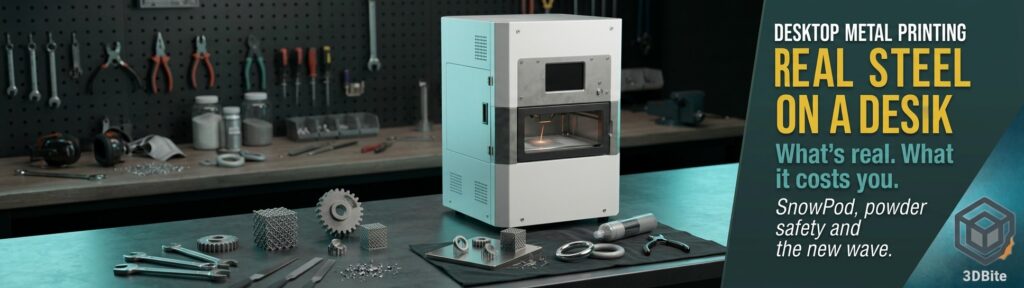
For as long as I’ve been printing, “metal 3D printing at home” has meant one of two things. One is filament with metal powder in it, which still gives you a plastic part. The other is sending a file to a bureau with an industrial machine that costs as much as a house. That’s starting to change. A handful of small laser powder bed fusion printers have appeared this year at prices that would have sounded silly two years ago, and the one getting the most attention is the SnowPod from SnowX, which is due on Kickstarter from $5,299.
This post covers what the SnowPod is and how it works, what’s been shown and what hasn’t, and where it sits among the other “desktop” metal printers coming to market. It also covers the cheaper routes to real metal parts that most hobbyists should probably try first.
Who SnowX are
SnowX is based in Suzhou, China. It says it was founded in 2023 and has more than 200 staff. Makers101 reports that it is tied to Suzhou-based Rongspeed Technology and that it raised close to RMB 100 million in a Series A+ round. That comes from one secondary source, so treat it as unconfirmed. Despite the name, it has nothing to do with Desktop Metal Inc.
The founder and CEO, Fangda Xu, told 3Dnatives a story I found more convincing than the marketing. In 2024 the team built a desktop metal printer that fed wire into a laser (directed energy deposition). It worked, but the parts needed so much machining afterwards that his own engineers rarely bothered with it. He asked why they wouldn’t just send the CAD files to a machine shop, set the machine aside and moved to laser powder bed fusion. The SnowPod is the result. It’s SnowX’s first product.
How the SnowPod works
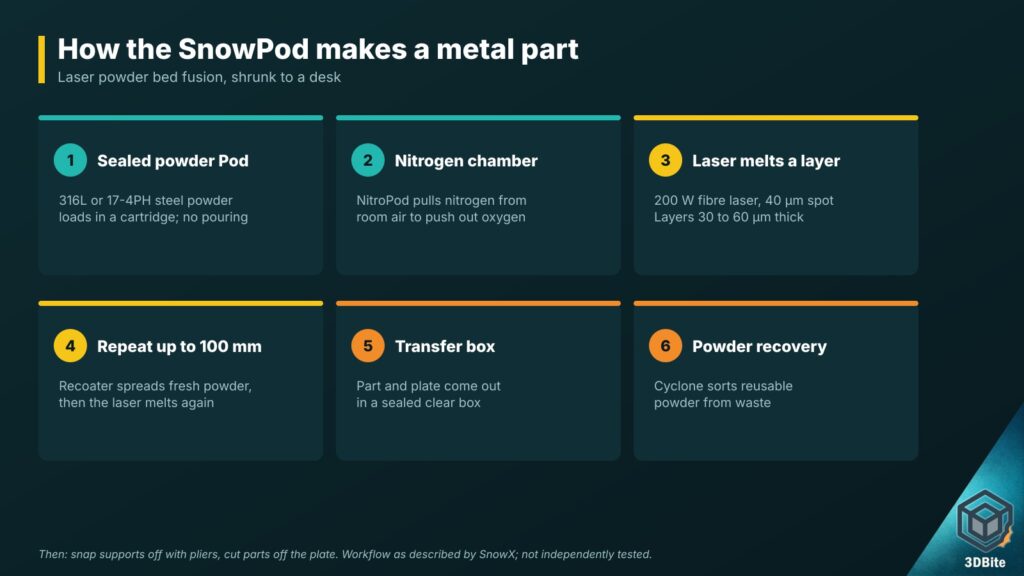
The SnowPod uses selective laser melting (SLM), the same basic process as industrial metal printers. A recoater spreads a thin layer of fine steel powder over the build plate, and a 200 W fibre laser melts the outline of that layer into solid metal. The plate drops slightly, more powder goes down, and the laser melts the next layer. Each layer is 30 to 60 µm thick. All of this happens in nitrogen, so the hot metal doesn’t oxidise.
The part SnowX has clearly worked hardest on is everything around that process. Powder arrives in sealed cartridges that SnowX calls Pods, so you never pour loose powder yourself. The finished part and its plate come out in a sealed clear transfer box. A cyclone separator sorts the leftover powder into reusable and waste, and SnowX claims around 90% of unused powder can be recovered, depending on the part’s shape. Nitrogen comes from either a gas supply or SnowX’s own NitroPod, a generator that pulls nitrogen out of room air.
Supports are the other part SnowX has rethought. On industrial machines, getting metal supports off usually means a saw, a grinder or wire EDM. The SnowPod’s slicer, SnowPath, generates thin “origami-style” supports that SnowX says break away in stages, like opening a zip. 3DWithUs tried it at the booth and could snap supports off with pliers by pushing sideways. Parts printed straight onto the plate still have to be cut off.
The specifications
| Item | SnowX’s figure |
|---|---|
| Process | Selective laser melting (laser powder bed fusion) |
| Laser | One 200 W fibre laser, about 40 µm spot |
| Build volume | 80 × 80 × 100 mm |
| Layer thickness | 30 to 60 µm |
| Materials | 316L and 17-4PH stainless steel |
| Accuracy / density | ±0.05 mm on a 12 mm test cube; 99.75% relative density (both SnowX’s own tests) |
| Smallest features | 0.1 mm walls, 0.6 mm pins; 35° overhangs without supports |
| Atmosphere | Nitrogen; NitroPod generator 99.9% purity at 3 L/min |
| Filtration | Internal H13 and external H14 HEPA, PM2.5 sensor with interlock |
| Power | 100 to 240 V, 700 W |
| Size / weight | 360 × 360 × 660 mm; 40 kg |
| Software | SnowPath slicer (free), Windows and macOS; camera with AI defect detection |
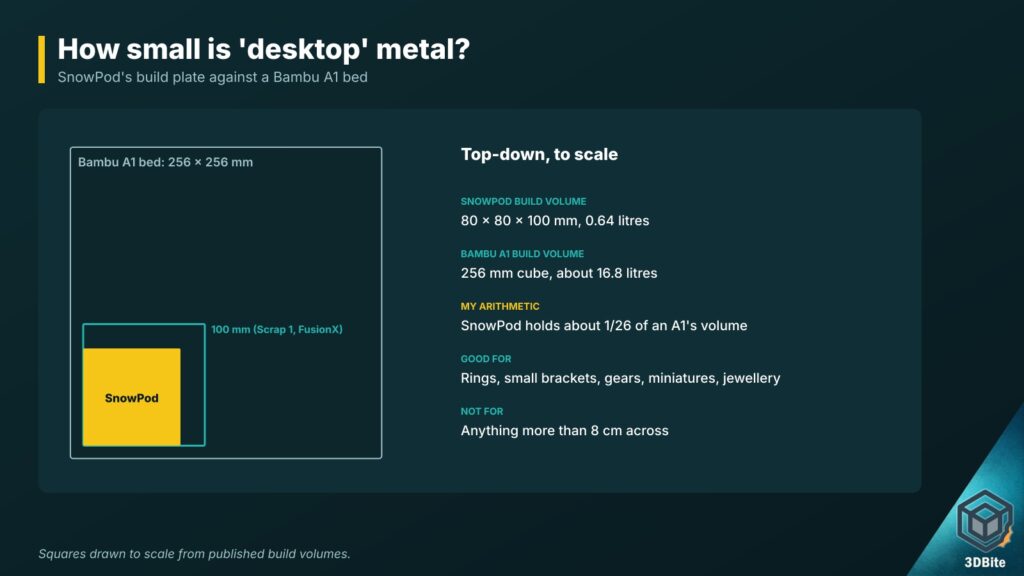
The 40 µm laser spot is the specification that stands out. 3Dnatives says that’s about half the 80 to 120 µm typical of industrial machines, which is why SnowX pitches the SnowPod at jewellery, miniatures and fine detail rather than chunky brackets. The build volume is the one to be honest about, though. By my arithmetic, 80 × 80 × 100 mm is about 0.64 litres, roughly a twenty-sixth of the build volume of my Bambu A1. If a part won’t fit in your palm, it won’t fit in a SnowPod.
Price and Kickstarter
| Package | VIP reservation | Kickstarter launch price | Planned MSRP |
|---|---|---|---|
| SnowPod Printer Kit | $4,999 | $5,299 | $9,299 |
| SnowPod + NitroPod Kit | $5,599 | $5,899 | $9,999 |
According to 3DWithUs, the VIP prices go to people who paid a refundable $50 deposit before launch. SnowX has said Q4 2026 for the campaign from the start. When I checked Kickstarter on 20 November it still showed “Launching soon”. It was on show at Formnext in Frankfurt this week, so a launch date shouldn’t be far off.
For UK buyers, prices are in dollars only so far. If it ships from China, as you’d expect, add 20% import VAT on top. On the $5,299 kit that’s about another $1,060 by my arithmetic, before shipping and any duty. Nothing has been said about a UK warranty, UK support or a delivery date.
What the one hands-on report found
The only proper hands-on so far is from 3DWithUs, who saw the SnowPod at TCT Shenzhen in October and spent about an hour with Fangda Xu. The machine really was printing at the stand. He handled sample parts (threads, gears, thin walls, lattices, jewellery and print-in-place parts, some polished to a mirror finish), removed supports himself, and looked at the powder Pods and transfer box.
He was just as clear about what he didn’t see. The slicer wasn’t connected to a printer, the powder-recovery step wasn’t demonstrated, and SnowX still owed him data on accuracy in XY against Z, the powder’s nickel content, oxygen sensing and the price of replacement filters. His article doesn’t say whether his trip was paid for. He came away keen, and would pick the NitroPod bundle to avoid buying gas separately, but he made clear he was looking at a prototype whose specifications and price could change.
Safety, and whether “desktop” means home
SnowX markets the SnowPod as fitting “beside your monitor” with “no dedicated room required”. Its own FAQ is more careful: it still recommends personal protective equipment during routine use, requires it for maintenance, and says SnowX is working towards third-party certification for powder safety. 3DWithUs adds that a nitrogen leak could displace oxygen locally. SnowX says the system monitors oxygen and pressure and stops if something’s wrong, but hasn’t said where the sensors are. 316L also contains nickel, which matters if you ever handle the powder.
Carolyn Schwaar’s All3DP round-up makes the point I’d make: sealed cartridges and filters reduce the risk from metal powder, but they don’t remove it, especially when you’re cleaning, servicing or dealing with a spill. She also noted that some SnowX marketing images look AI-generated and seem to suggest home use, which she questioned. A garage or workshop with good ventilation seems the realistic setting. A spare bedroom doesn’t.
The costs nobody has priced yet
The machine price is the easy part. SnowX hasn’t published prices for any of these:
- Powder Pods, which are proprietary cartridges, so you can’t simply buy cheaper powder elsewhere
- Build plates, which 3DWithUs says are normally replaced every print, or reused after surface grinding
- The internal filter housing, replaced as a unit every few months
- Nitrogen, if you don’t buy the $600 NitroPod upgrade
- Any heat treatment after printing. SnowX hasn’t mentioned it, though larger industrial parts are often stress-relieved
Until those are known, nobody can tell you what a SnowPod part really costs. All3DP’s summary covers this whole category: the real cost includes labour, consumables, failed builds, maintenance and post-processing, and a machine that can print metal isn’t the same as one that can reliably make metal parts.
The wider picture: why desktop metal is suddenly cheaper
The SnowPod isn’t alone. All3DP counted around ten small metal machines announced or launched this year. The main reason they’re cheaper is size. A smaller chamber needs less powder, a smaller laser system and less gas, and Chinese suppliers have brought the cost of lasers and galvo scanners down a lot. Xu told 3Dnatives that SnowX’s own galvo controller costs about as much as a bare circuit board, against $3,000 for the cheapest controller it had used before.
| Machine | Process | Build volume | Price | Status (November 2026) |
|---|---|---|---|---|
| Studio 3e8 Mesa 1 | Cartridge-fed, built-in sintering furnace | Not published | From $3,500 (kit) | Planned Kickstarter |
| Global Laser Box DP-C1 | Laser powder bed fusion | Conflicting specs | From $4,888 | Unclear; All3DP questions its specs and safety information |
| SnowX SnowPod | Laser powder bed fusion, 200 W | 80 × 80 × 100 mm | $5,299 (Kickstarter) | Kickstarter “launching soon” |
| Metal-Base Metal 1.0 (Netherlands) | Laser powder bed fusion, 60 W blue diode | Not published | From about €8,500 to €9,000, part-assembled | Kickstarter funded; five beta machines out |
| Scrap Labs Scrap 1 (US) | Laser powder bed fusion | 100 mm cube | $14,200 kit; $17,990 assembled | Shipments early 2027; production June 2027 |
| Lasefinity FusionX (UK) | Laser powder bed fusion, 500 W | 100 × 100 × 80 mm | £24,999 | Orderable since June; no installs reported |
| Mastrex MX100 | Laser powder bed fusion | Not published | About $39,000 | On sale |
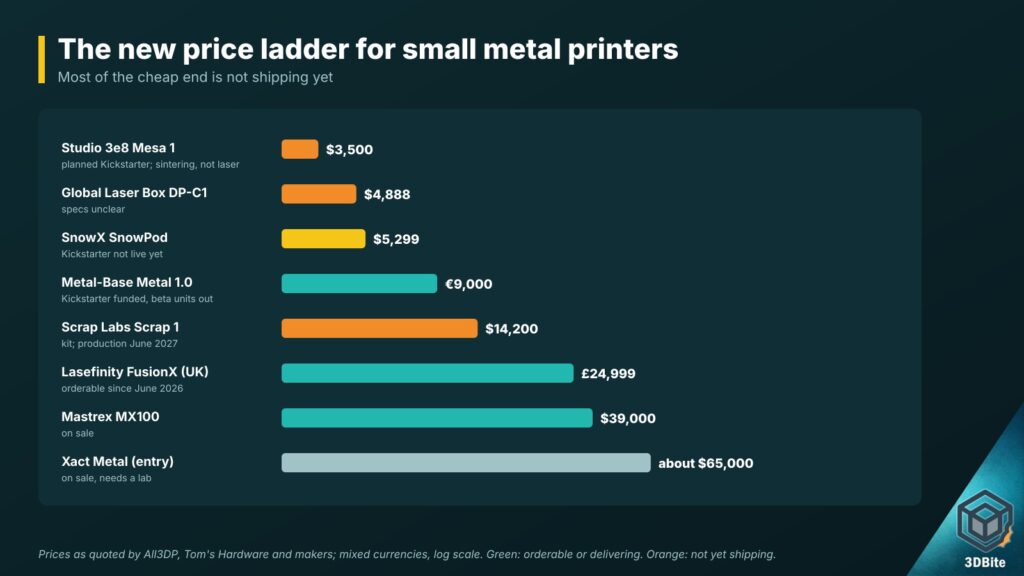
A few things stand out. The cheapest machines are the least proven: Mesa 1 and DP-C1 are, for now, mostly promises. Metal-Base has the best evidence of the cheaper ones, with beta machines in real use and tensile tests carried out by an outside lab. Lasefinity is a UK company, which matters for support and VAT if you’re buying for a business here. And “desktop” is a stretchy word. All3DP points out that Kings 3D’s dental machine weighs 140 kg and needs three-phase power, and that 2onelab’s “mobile” 2Create Desktop weighs 200 kg.
All3DP’s view of who these machines are for is dental labs, universities, jewellers, engineering departments and small machine shops. Hobbyists aren’t on that list yet.
The routes to metal most of us can use today
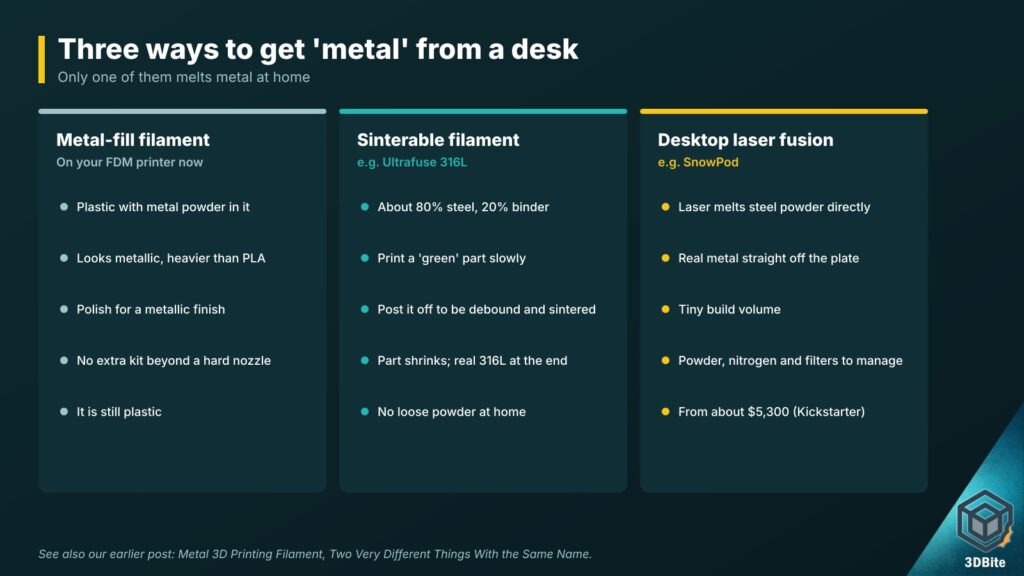
Before spending £5,000 or more, it’s worth knowing the cheaper options, because they get you most of the way for most hobby uses.
Metal-fill filament is plastic with metal powder mixed in. It prints on any FDM machine with a hardened nozzle, can be polished to a convincing shine, and feels heavier than PLA. But it’s still plastic. We covered what it’s good for, and what it does to nozzles, in Wood-Fill and Metal-Fill Composites.
Sinterable filament gives you real metal. Forward AM’s Ultrafuse 316L is about 80% stainless steel and 20% polymer binder, and prints slowly on an ordinary open-material printer. You then send the “green” part to a partner who removes the binder and sinters it in a furnace. In Europe that partner is Elnik Systems. The part shrinks, but it comes back as 316L stainless steel, and you never handle loose powder. MatterHackers lists a 1 kg spool at around $190, plus a processing ticket. Our explainer Metal 3D Printing Filament: Two Very Different Things With the Same Name covers how the two kinds of filament differ.
And for a one-off part, an online printing bureau with an industrial machine is still hard to beat. You get a bigger build volume, materials like titanium and aluminium, and no powder in your house.
Where the evidence is thin
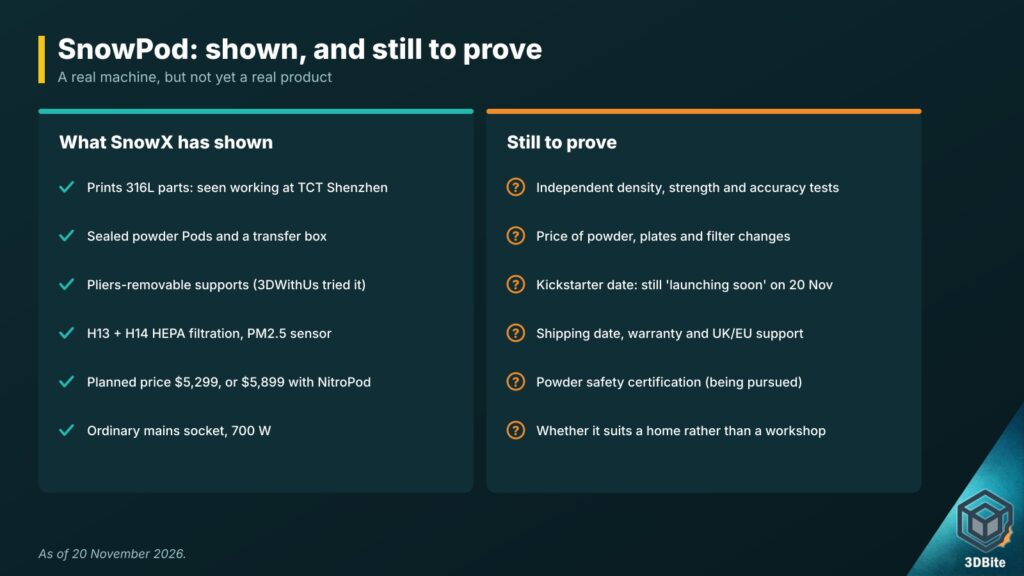
- Every SnowPod performance figure, including accuracy, density and powder recovery, comes from SnowX’s own tests.
- No independent strength, density or accuracy tests of SnowPod parts have been published.
- There are no prices for consumables: powder, plates, filters or nitrogen.
- The Kickstarter isn’t live, and there’s no shipping date, warranty or UK support plan.
- Powder safety certification is “being pursued”, not granted.
- Some early coverage was sponsored and written by SnowX, and the funding background rests on one source.
- Across the wider market, most of the cheapest machines have no record of deliveries.
My take
I’m more interested in the SnowPod than I expected to be. Most “cheap metal printer” pitches shrink an industrial machine and leave the hard parts to the buyer. SnowX has gone after the parts that put people off: loose powder, supports that need a saw, and a workflow that needs a materials scientist. The founder’s story, scrapping a working machine because nobody wanted to use it, suggests a company that has thought about the user.
But it’s a prototype from a first-time hardware company, with no consumable prices, no independent tests and no campaign yet. And it builds parts the size of a ring box. If you make jewellery, small precision parts or one-off metal bits for a business, it’s worth following closely and comparing against Metal-Base and the UK-made FusionX. If you’re a hobbyist curious about metal, try a spool of sinterable filament first. In either case, wait for the first independent teardown before putting £5,000 on Kickstarter. Our Co Print Quadro preview has a checklist for backing hardware on Kickstarter that applies here too.
Sources and further reading
- SnowX: SnowPod product page, specifications and FAQ
- 3DWithUs: SnowX SnowPod hands-on at TCT Shenzhen
- 3Dnatives: SnowPod, one founder’s attempt to put metal LPBF on the desk
- Makers101: SnowPod desktop metal 3D printer
- 3D Printing Industry: SnowX opens Kickstarter pre-launch page
- All3DP: SnowX sponsored article (September 2026)
- All3DP: Why desktop-size metal 3D printers are suddenly everywhere (Carolyn Schwaar)
- Tom’s Hardware: Scrap Labs Scrap 1
- 3D Printing Industry: Metal-Base Metal 1.0
- Forward AM: Ultrafuse 316L
- 3DBite: Metal 3D Printing Filament, Two Very Different Things With the Same Name
- 3DBite: Wood-Fill and Metal-Fill Composites