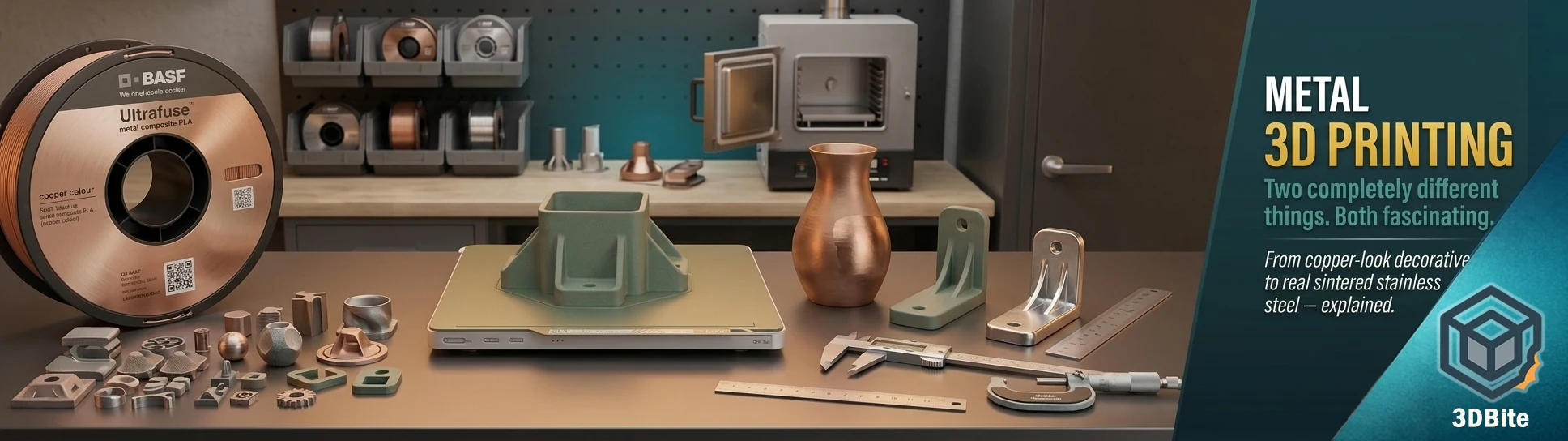
I went into researching this post knowing roughly two things: that there is filament with metal in it, and that there is some kind of process involving an oven that turns a print into actual metal. Both of those things turn out to be true, but they are completely different materials with completely different processes, completely different costs, and completely different outcomes. The name “metal filament” covers both, which is unhelpful. This post separates them properly.
Category one: metal composite filaments
The first type is metal-filled decorative filament. It is PLA, PETG, or a similar polymer with fine metal powder particles mixed into it during manufacturing. The metal content runs from around 40% to 60% by weight. The result is still fundamentally a plastic part — the metal particles are suspended in a polymer matrix and they stay there — but the finished print has a noticeably different weight and surface character from a standard PLA print, and with post-processing it can look convincingly like cast metal.
The range of metals available in this form is wider than you might expect. Copper-fill and bronze-fill are the most commonly seen, and they produce warm-toned prints with a genuine metallic density that surprised me in the documentation. Iron-fill is its own specific category with an unusual application: expose an iron-fill print to a saltwater or vinegar-salt solution and the iron particles in the surface layer will rust. Authentically. In hours. This is deliberately used to create aged, weathered-looking prop pieces and display models where convincing rusted metal is the design goal. Stainless steel fill, brass fill, and silver fill round out the range, and there are various exotic blends from specialist suppliers.
What you get in the box is a polymer filament that is noticeably denser and stiffer than standard PLA. What the finished print looks like fresh off the plate is a grey or brown or orange part that is heavier than a standard PLA print at equivalent size. What the finished print looks like after tumbling or sanding and polishing is a convincing metal-surfaced object — the post-processing exposes and smooths the metal particles at the surface, removing the polymer surface layer and revealing the metal underneath. Done well, the result would not obviously read as plastic to someone who had not been told what it was.
The nozzle problem with metal-fill
This is where the abrasive filament warning from the abrasive filaments guide is most directly relevant. Metal particles are harder than brass. Forcing metal-fill filament through a brass nozzle does the same thing as running carbon fibre through one — the nozzle bore is progressively worn and enlarged by the abrasive particles until the extrusion diameter is no longer controlled precisely. A hardened steel nozzle is not optional for metal composite filaments; it is the starting point before the spool goes anywhere near the machine. The abrasive filaments post goes into this in detail, including the specific mechanism and the nozzle options that address it.
What metal composite filament is actually good for
Decorative pieces where a metal aesthetic is the point. Cosplay props, scale model details, figurine bases, display items, and anything where you want visual and tactile weight without needing actual structural metal properties. The polymer matrix is still the structural element — you are not printing functional load-bearing metal parts. The metal particles provide mass, colour, surface texture after processing, and the specific feature of rust and patina in the iron-fill variants. At £25-45 per kilogram these are significantly more expensive than standard PLA, and the post-processing adds time, but they open aesthetic possibilities that no amount of paint convincingly replicates.
The iron-fill category earns a specific mention for one niche application that is genuinely interesting: investment casting masters. A printed iron-fill form can be used to create a mould, which is then used to cast actual metal through traditional foundry methods. The printed part does not become the metal part — it is the pattern from which the metal part is made. This is outside most hobbyist workflows but it illustrates that the decorative metal filaments have a functional use beyond pure aesthetics when combined with traditional metalworking techniques.
Category two: sinterable metal filaments
This is the oven category. And it is significantly more remarkable than I expected going into the research.
Sinterable metal filaments — the two main brands being BASF’s Ultrafuse range and The Virtual Foundry’s Filamet range — contain 80% to 90% metal by weight in a thermoplastic binder. The key word is binder. The binder’s job is purely to carry the metal powder through the extrusion process. It has no role in the finished part’s properties because the finished part does not contain any binder. The finished part is metal.
The process has three steps. Print the part on a standard FDM machine. Remove the binder in a debinding step. Sinter the part in a furnace at high temperature to fuse the metal particles into a near-solid metal object. What comes out of the furnace after sintering is, to all practical purposes, a metal part — not a plastic part that looks like metal, not a composite with metal particles in a polymer matrix. Peer-reviewed research from 2025 finds sintered parts from these filaments reaching 96 to 99% of theoretical metal density, with mechanical properties approaching wrought or cast equivalents. Those parts can be machined, welded, drilled, and polished using standard metalworking tools. Threads can be tapped. Surfaces can be ground. Any standard metal process can be performed on the result.
The debinding step: two routes
BASF’s Ultrafuse filaments use catalytic debinding — a chemical process where the printed part is exposed to a gaseous acid environment that dissolves the primary binder while leaving the secondary binder and metal structure intact. This requires specialist equipment and is why BASF offers a debinding and sintering service through an industrial partner called ELNIK: you print your parts at home, ship them to the service, pay per the weight and volume of the parts, and receive sintered metal parts back. The service exists specifically because catalytic debinding is not something that happens in a home workshop.
The Virtual Foundry’s Filamet materials use thermal debinding — the binder is burned out in the furnace itself during the early heating stages of the sintering cycle. This is simpler in concept and potentially achievable with a suitable furnace, though the furnace temperatures involved in sintering — around 1,000 to 1,400°C depending on the specific metal — are industrial equipment territory rather than a domestic oven. The “fire it in an oven” description is technically accurate but the oven in question is a specialised sintering furnace, not a kitchen one.
The materials range: wider than expected
BASF offers Ultrafuse 316L (austenitic stainless steel with excellent corrosion resistance) and Ultrafuse 17-4 PH (precipitation hardening stainless steel with higher strength after heat treatment). Both are practical engineering materials with well-understood properties and a long industrial track record. The Virtual Foundry’s Filamet range is considerably wider: stainless steel 316L, bronze, copper, aluminium 6061, high carbon steel, and then a set of genuinely exotic options that stopped me mid-read — tungsten, Inconel 718, and titanium. A desktop FDM printer printing a filament that is 80% titanium by weight, which then goes through sintering to produce a near-fully-dense titanium part, is a sentence that I did not expect to be writing when I started this research. The industrial metal additive manufacturing machines that traditionally produce titanium parts cost upwards of £500,000. The Bambu A1 cost £260.
The shrinkage problem
Sintering is not a dimensionally neutral process. As the binder is removed and the metal particles fuse together, the part shrinks — typically 15 to 20% in all three axes. A part that measures 100mm when it comes off the print bed measures approximately 80 to 85mm after sintering. This is predictable and consistent for a given material and sintering profile, which means it can be compensated for in the design by scaling up before printing. BASF’s documentation describes the accuracy achievable: 0.4mm dimensional accuracy after the first sintering iteration, reducing to 0.1 to 0.25mm after calibration of the scaling factor for a specific part geometry. Features requiring tight tolerances — threads, precision bores, mating surfaces — are tapped, drilled, or machined to final dimension after sintering rather than printed to final dimension. This is why the manufacturers describe the process as “near-net-shape” rather than exact-net-shape.
Printer requirements for sinterable filament
The machine requirements for sinterable metal filaments are more demanding than for metal composite decorative filaments, and layer quality during printing matters more than in any other FDM application. If layers are poorly bonded or have gaps during printing, they will not fuse correctly during sintering. A delaminated printed part going into the furnace produces a delaminated sintered part — and there is no recovery from delamination at the sintering stage because the binder that held the structure together is gone. Enclosures are strongly recommended for this reason: the thermal stability of an enclosed build environment produces better layer bonding and reduces the risk of the structural failures during sintering that printing defects cause.
High infill is mandatory. For functional sintered metal parts, 100% infill is standard — hollow sections and low-infill prints will not sinter into the solid metal parts that the process is designed to produce. The hardened steel nozzle requirement from the decorative metal filaments applies even more stringently here: 80-90% metal content versus 40-60% means more abrasive particles per unit length of filament, and a brass nozzle would not survive a meaningful print run. Print speeds need to come down from the Bambu A1’s full capability — these materials are denser, the binder’s melt behaviour is different from standard polymers, and the stakes for print quality are higher when a poor print goes straight to a scrap part rather than a re-slice and re-run.
The cost reality
Sinterable metal filaments are expensive. The pricing range is £95 to £450 per kilogram depending on the material, compared to £12 to £15 per kilogram for eSUN PLA+. BASF Ultrafuse 316L lands at approximately £100-£130 per kilogram. The Virtual Foundry’s Filamet materials start around £120 and reach considerably higher for the exotic alloys. Then the debinding and sintering service cost goes on top: BASF’s ELNIK service charges by the part volume and weight, and while it makes small batch production accessible it is not free. A realistic cost for a small functional stainless steel part — say a bracket or a custom fitting — including material and service might run to £30-80 for the part depending on its mass and complexity.
In context, that is expensive compared to a PLA print but competitive with having the same part made by a machine shop or cast through a traditional process in small quantities. The value proposition is specifically for one-off and small-batch functional metal parts where the design flexibility of 3D printing matters and where the quantity is too small to justify injection moulding or traditional casting tooling costs. It is not a hobbyist everyday printing material. It is a serious engineering material that happens to be accessible from a desktop printer for the first time.
The comparison table
| Category | Metal composite (decorative) | Sinterable (functional) |
|---|---|---|
| What the finished part is | Plastic with metal particles | Actual metal (96-99% density) |
| Metal content by weight | 40–60% | 80–90%+ |
| Price per kg | £25–45 | £95–450 |
| Materials available | Copper, bronze, iron, stainless, brass, silver | 316L SS, 17-4 PH, bronze, copper, aluminium, titanium, tungsten, Inconel |
| Post-processing | Sanding, tumbling, polishing | Debinding (chemical or thermal) + sintering in furnace (1,000–1,400°C) |
| Nozzle requirement | Hardened steel (mandatory) | Hardened steel (mandatory) |
| Can it be welded, machined? | No — it is plastic | Yes — standard metal processes |
| Part shrinks during post-processing? | No | Yes — 15–20% in all axes |
| Good for | Decorative, props, display, investment casting masters, rusted iron aesthetic | Functional engineering parts, prototyping, small-batch metal components |
| Printer requirements | Hardened nozzle, standard settings | Hardened nozzle, enclosure recommended, 100% infill, careful layer bonding |
Where this leaves the Bambu A1 and A2L specifically
For metal composite decorative filaments: a hardened steel nozzle upgrade and the usual abrasive filament discipline covered in the abrasive guide, and both machines can print metal-fill materials without modification. The surface quality achievable on the A1 and A2L at moderate speeds with good layer calibration should produce a good base for the post-processing that reveals the metallic surface.
For sinterable filaments: the A1 and A2L can physically print BASF Ultrafuse and Filamet. Both machines support the printing temperature range, both can use the required hardened nozzle, and both can run the slow speeds and high infill that sinterable metal filaments require. The A1 is open-frame, which is less than ideal for the thermal stability that good layer bonding in sinterable metal requires — an enclosure or a print tent is the practical mitigation. The A2L is in the same position. Neither machine is the ideal platform for this type of printing — an enclosed machine like the P1S or H-series would be preferable — but neither is categorically unsuitable.
The sintering step is handled by a service. BASF’s ELNIK sintering service takes the printed parts and returns metal. You never need a furnace. The combination of an A1 with a hardened nozzle, a spool of Ultrafuse 316L, careful print settings, and a BASF sintering service voucher can genuinely produce stainless steel parts. That is a more remarkable statement than it appeared to be before I understood what was actually happening in that process. Printing titanium parts on a Bambu A1 and sending them to a sintering service is not science fiction. It is a purchasing decision and a careful print profile.