Today is June 1st. The A2L has been announced. I am underwhelmed. That is not the reaction I wanted to have — I have been watching this announcement build for days, wrote a whole post about what I hoped it would be, and was genuinely excited going into 4 PM CEST. The larger build volume is exactly what I asked for. Everything else about this machine is either what I did not ask for or absent when I specifically wanted it there. Let me explain.
What the A2L actually is
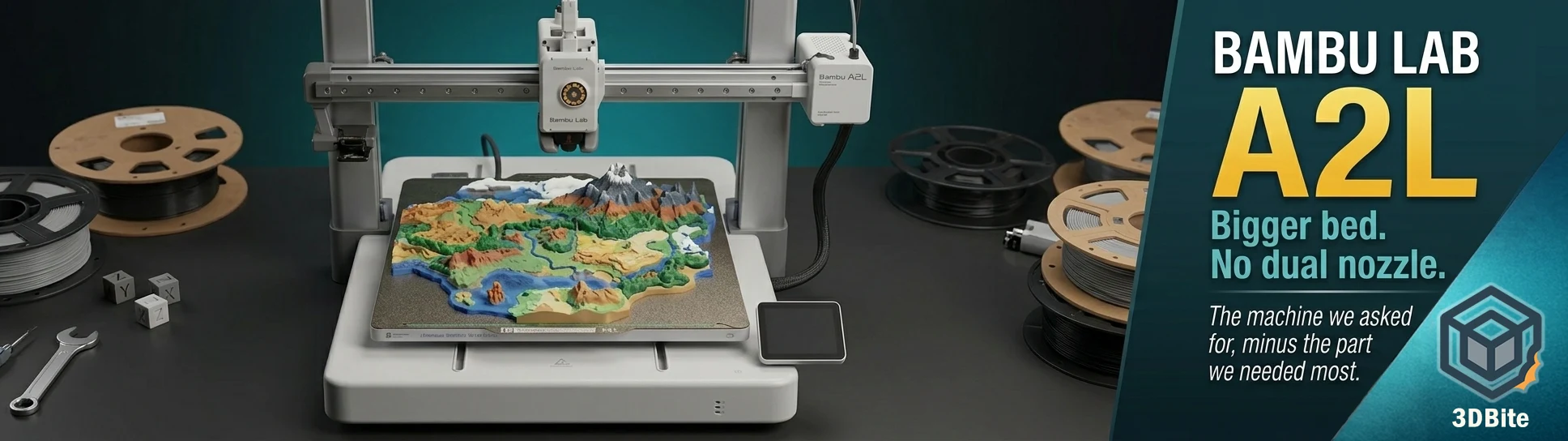
The Bambu Lab A2L is a large-format open-frame bed slinger — the direct large-format sibling to the A1 that the community has been requesting since the A1 launched in 2023. The L in A2L does stand for Large, confirming the prediction that was broadly shared across the community. The build volume is significantly larger than the A1’s 256 × 256 × 256mm, stepping up toward the H2-series territory that the community has been asking Bambu to make accessible at A-series pricing. That part of the brief is delivered.
The A2L retains the open-frame bed slinger architecture — no enclosure, no heated chamber, the same category of machine as the A1 designed for PLA, PETG, and TPU. It is AMS-compatible, supporting multi-colour printing with the AMS Lite in the same configuration as the A1. The PMSM closed-loop servo extruder that the Bambu chatbot accidentally revealed in the pre-launch forum thread appears to be confirmed — the same motor technology used on the X2D, providing torque monitoring for jam detection and more consistent high-speed extrusion. This is a meaningful hardware upgrade over the A1’s extruder and one that was correctly predicted from the chatbot leak.
The pricing is good. Bambu has kept this in A-series pricing territory rather than pushing it toward H-series cost. For the build volume on offer, the price-per-cubic-millimetre is compelling, and for anyone whose primary need is simply more build plate without engineering material requirements, the A2L is a reasonable proposition on paper.
The vinyl cutter: a feature I did not ask for and do not need
Here is the thing that Bambu chose to lead with as a differentiating capability: a vinyl cutter attachment. The A2L can be equipped with a cutting blade for vinyl and paper cutting — Cricut-style craft work, stickers, heat transfer vinyl, paper templates. The “Creative Playground” tagline now makes complete sense. This is not a 3D printing upgrade. It is a crafting machine that also 3D prints.
I have no use for this whatsoever. I do not cut vinyl. I do not make stickers. I do not work with heat transfer media. None of the use cases for a vinyl cutter intersect with anything I make or intend to make. The feature is not offensive — it will find an audience among crafters who want a single machine that bridges 3D printing and vinyl cutting, and that audience is real. But it is not me, it is not most of the people who were watching this announcement specifically hoping for dual extrusion and a larger print volume, and the community reaction on social media is reflecting exactly this mismatch.
The pre-announcement speculation correctly identified that a cutting blade was possible on an open-frame bed slinger — Tom’s Hardware noted that a laser would be out of the question for safety reasons on an unenclosed machine, but a cutting blade was realistic. What the speculation did not predict was that this would be the headline feature rather than a minor addition. Bambu has positioned the vinyl cutter as central to the A2L’s identity. That is a deliberate product decision. It is also a decision that tells you something about who Bambu thinks their A-series audience is — and it is a different audience from the technically-minded functional printer users who were hoping for dual extrusion.
The community forum thread, which has been running since the teaser dropped days ago and is now responding to the actual announcement, reflects this. Only upside for this is allowing whatever people new to Bambu the ability to cut paper easily. No new customer would even need a build volume that large. The people that do however need this large of a print volume (such as cosplayers and maybe print farmers) may benefit if the price is low enough. That summary from a forum member captures the core tension: the people who want the large build volume are not the people who want the vinyl cutter, and vice versa.
The dual nozzle that did not come
No dual nozzle. This is the single biggest omission relative to the wishlist post published days ago and relative to what the majority of engaged A-series users were hoping for. The March 2025 patent showing a fixed dual-nozzle configuration on an A1-style body exists and is documented — it just did not make it into the A2L. The community speculation that Bambu would not want to cannibalize the X2D’s value case by putting dual extrusion in an A-series machine at A-series pricing proved to be the correct read. The A2L is a single-nozzle machine. AMS-based multi-colour printing is the same architecture as the A1, with the same purge waste implications and the same colour change time.
This is genuinely disappointing. The combination of larger build volume and dual extrusion — the ability to run support interface material cleanly in the second nozzle across a larger bed — was the machine I described wanting. That machine still does not exist in the Bambu lineup at an accessible price point. The X2D delivers dual extrusion in the 256mm build volume. The H2C delivers dual extrusion in the H-series build volume. The space between — large format bed slinger with dual extrusion at A-series pricing — remains empty.
No camera upgrade
The A1’s camera has been a consistent minor frustration — 720p resolution produces timelapse footage and monitoring images that are noticeably lower quality than the 1080p cameras on the P2S and X2D. The P2S’s camera upgrade was one of the meaningful practical improvements in that transition. The A2L appears to have not received the same treatment. For a machine with a larger build plate where timelapse footage of large, impressive prints would be particularly appealing, this feels like a missed opportunity.
What the A2L is actually good for
Setting aside the disappointment about what it is not, there is a specific and genuine use case where the A2L makes sense.
Large single-colour prints. The Grinch at full scale without aggressive part splits. Seasonal display pieces that currently exceed the A1’s 256mm limit. Large functional parts that need to be printed in one piece rather than assembled. The ENIQUE3D builds that we have been running on the A1 at scaled-down or split geometry — all of those could print at full designed size on the A2L’s larger bed. For cosplayers, set builders, prop makers, and anyone whose primary frustration with the A1 is the build volume ceiling rather than the multi-colour architecture, the A2L addresses the actual problem directly.
The price — which Bambu has kept competitive — makes this a reasonable choice for anyone in that category. If your primary printing workflow is large-format single-colour work on PLA and PETG, the A2L is an A1 upgrade that costs a sensible amount and gains you the build volume you need. It is not the machine I wanted. It is a useful machine for a specific and real user profile.
How the community is reacting
The social media reaction is consistent with my own. Disappointment is the dominant tone among the technically engaged audience that had been hoping for dual extrusion. The vinyl cutter is being received with a mix of bemusement and resignation — it is not a bad feature, it is just not the feature this audience wanted as the headline innovation. The larger build volume is universally welcomed. The single-nozzle architecture is universally noted as a missed opportunity by the people who wanted more.
There is also a strand of commentary in the forum thread that is worth acknowledging: the A2L fills a genuine gap for people coming to Bambu from outside the existing ecosystem rather than upgrading from an A1. A crafter who wants a single machine for 3D printing and vinyl cutting is a real customer, and Bambu is explicitly targeting them. For that customer, the A2L makes a lot of sense. For the existing A1 owner who has been waiting two and a half years for the A-series to get something genuinely new — it is a machine for someone else.
My position: tempted but not convinced
I am considering ordering an A2L. Not because it is the machine I wanted, but because the larger build volume is genuinely useful for the large seasonal and display prints that have been hitting the A1’s ceiling. The Grinch at full scale, with no part splits, is a print I want to make. ENIQUE3D’s full-size seasonal builds designed for the H-series plate size become accessible at A2L build volume. These are real projects that the larger bed enables.
If I order it, the use case is specifically single-colour large prints and non-AMS projects where the build volume matters more than multi-material efficiency. The vinyl cutter will stay in the box. The AMS Lite will stay on the A1. The A2L would be a complementary machine for a specific category of work rather than a replacement or upgrade. Given the price, that is a defensible purchase. It is just not the machine I was hoping for.
The dual-nozzle A-series machine, if the patent is any guide, is still coming. The dual nozzle patent was real. It just did not appear in this generation. The A2L without dual extrusion is either a product generation ahead of the dual-nozzle A2 variant, or Bambu has decided that the A-series and X-series serve different audiences and the dual nozzle stays in the X tier. Which of those it is will become clearer as the product line develops over the next 12 months. For now: the A2L exists, it has a bigger bed, it cuts vinyl, and it is not what most of us were expecting when the “Extra Large” teaser dropped five days ago.
The A2L is available now at uk.store.bambulab.com. This post will be updated with a full hands-on review if an order goes in.
What is your reaction to the A2L? Were you hoping for dual extrusion? Does the vinyl cutter change the picture for you? Or does the build volume alone make it worth a look? Drop a comment — I suspect the range of reactions is wide and I am interested in whether the people who are excited are coming from a different use-case starting point than the people who are underwhelmed.