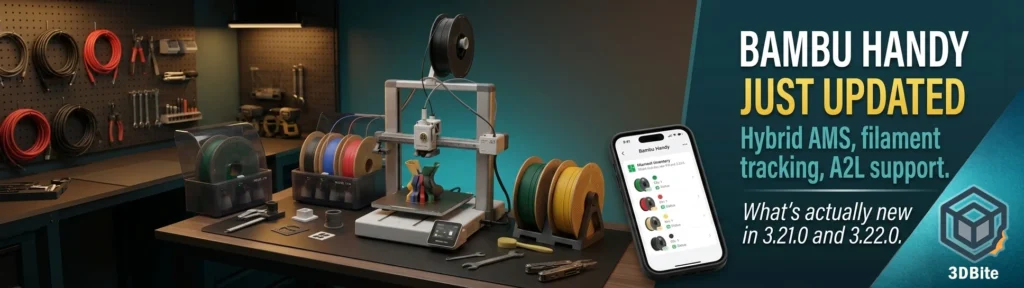
Bambu Handy has had two updates in the space of a week — version 3.21.0 landed on June 1st alongside the A2L announcement, and version 3.22.0 followed on June 9th. Together they represent one of the more substantial feature pushes the app has seen in a while, and given how much of my daily workflow runs through Handy — checking on prints remotely, browsing MakerWorld, managing AMS assignments — it is worth a proper look at what has actually changed.
The short version: A2L support, a genuinely new approach to multi-colour printing that combines AMS with an external spool, an automatic filament inventory system, and a refreshed interface. Some of these are immediately useful. One of them — the external filament hybrid printing — is more interesting than the changelog entry makes it sound, and is worth its own section.
A2L support arrives on day one
Version 3.21.0 added A2L support on June 1st — the same day the printer was announced. This is worth noting because it reflects something Bambu has generally done well: new hardware launches with app and slicer support already in place, rather than buyers having to wait for compatibility to catch up. Given the underwhelmed reaction to the A2L’s headline features covered in the announcement post and the full specs analysis, the launch-day software support is one area where the A2L has not disappointed.
For A2L owners, Handy now exposes the full feature set documented in the A2L’s own firmware release history — control over the PMSM extruder’s flow dynamics calibration, the 2nd-Gen AMS hybrid connectivity covered below, and the new monitoring systems that the A2L’s sensor array feeds into. None of this is groundbreaking for existing A1 or P-series owners, but it confirms that the A2L is being treated as a first-class citizen in the app from launch rather than an afterthought.
The headline feature: hybrid AMS and external spool multi-colour printing
This is the feature in 3.21.0 that deserves more attention than the changelog wording gives it. Bambu Handy now supports printing in multiple colours using a combination of the AMS and an external spool holder simultaneously — not AMS-only, not external-spool-only, but both feeding the same print job. The A2L’s firmware documentation describes this as Hybrid AMS and External Spool Support, enabling multi-colour printing using a combination of the AMS and the external spool holder.
Why this matters: the AMS Lite caps out at four colours on the A1, and the AMS 2 Pro chains up to a maximum determined by how many units you connect. Until now, if you wanted a fifth colour, you needed a fifth AMS slot — another unit, more cost, more desk space. The hybrid approach effectively adds one more colour channel for free, using the external spool holder that every Bambu printer already has built into its frame. For anyone running a four-colour AMS setup who occasionally needs just one more colour for a specific model — a contrasting trim colour, a logo accent, a support material — this removes the binary choice between “buy another AMS unit” and “don’t use that fifth colour.”
The firmware notes also mention a manual filament change assistance tool that ensures smoother colour transitions without an AMS — which suggests this hybrid mode is built on top of improved manual filament change handling generally, not just a special case for the hybrid scenario. If manual filament changes have been made smoother and more guided through Handy, that is a genuine quality-of-life improvement for anyone doing occasional manual colour changes on machines without an AMS — which, as covered in the Kobra X posts, is a workflow I have been thinking about more since adding a second printer to the desk.
The 2nd-Gen AMS connectivity story, and what it means for the A1
The A2L’s AMS compatibility — covered in the full specs post — supports up to four AMS 2 Pro units plus one AMS Lite simultaneously, enabling up to 19 colours. AMS Lite and the 2nd-Gen AMS share the same embedded buffer system, so you can stack and mix them: four spools, eight spools, sixteen spools, whatever your project asks for, fed cleanly through one queue.
The reason this is relevant beyond A2L owners is the upgrade path question raised in the full specs post: an A1 owner’s existing AMS Lite is not made redundant by adding AMS 2 Pro units. Handy’s interface updates around AMS management in this release reflect that mixed-unit reality — the app needs to present a sensible interface for a printer that might have an AMS Lite, an AMS 2 Pro, or both connected simultaneously, each potentially holding different materials. Whether the A1 itself gains the same hybrid mixing capability that the A2L has at launch is not yet clear from the documentation — the A1’s connection guide still references the dedicated A1 AMS Hub for multi-unit setups, and it is worth checking the Bambu wiki for A1-specific confirmation before assuming full feature parity with the A2L’s launch specification.
3.22.0: the filament management system
The newer of the two updates, 3.22.0, introduces an automatic filament management system that compares filament used with an inventory, making it easier for users to keep track of existing materials. This is the feature I am most interested in trying, because it addresses a problem that everyone with more than a handful of spools eventually runs into: knowing what you actually have, how much of it is left, and whether you need to reorder before starting a long job.
At 40-plus spools, my own filament inventory is currently tracked the old-fashioned way — by looking at the spool rack and estimating remaining weight by feel. An automatic system that tracks consumption against an inventory and flags when a specific colour is running low would be a genuine improvement, particularly for planning multi-colour jobs where running out of one colour partway through a long print is one of the more frustrating failure modes. The obvious limitation, and one that is not yet clear from the early coverage, is how this interacts with non-RFID third-party filament. Bambu’s own spools report consumption automatically via RFID. eSun, Polymaker, and other third-party spools loaded without RFID tags would presumably need manual entry or estimation — and the value of an inventory system depends heavily on how much friction there is in keeping it accurate for the filament that most hobbyists actually use day to day.
The wording from the 3Druck.com coverage is appropriately cautious here: the practical effects of the revised interface in everyday use cannot yet be assessed on the basis of the information published so far. This is a feature that needs hands-on testing before a verdict, and I plan to spend some time with it over the coming weeks specifically to see how well it copes with a mixed Bambu and eSun inventory.
Print-then-print from internal storage, and other smaller changes
Version 3.20.0, which preceded both of the headline updates, introduced access to models stored in the printer’s internal memory directly from Handy — prints can now be started directly on the device from files already on the printer’s storage, rather than needing to push a file from Studio first. This is a small but genuinely useful change for anyone who keeps a library of frequently-printed calibration models, Benchys, or favourite figures on the printer’s internal storage and wants to queue them up from their phone without going through a computer.
The 3.21.0 and 3.22.0 releases bundle in a handful of smaller refinements: revised slicing logic and switching for timelapse recordings (hopefully addressing some of the timelapse reliability complaints that have appeared in the Bambu Handy bug reporting threads over the past year), the ability to follow specific topics in the community section of the app, and a fix for an icon display bug. None of these are individually significant, but they reflect the kind of continuous small-scale iteration that — as discussed in the review units vs real ownership post — is exactly the sort of post-launch software development that distinguishes a maturing ecosystem from one that has stalled.
The pattern: incremental, but consistent
Looking at the Bambu Handy version history over the past year — roughly monthly releases, each adding a mix of new hardware support, workflow refinements, and bug fixes — the pattern is one of consistent incremental development rather than dramatic overhauls. Dark mode arrived as its own release. AMS tray multi-colour support and virtual slots were added as a batch. Chamber fan control for the P series came in a dedicated update. This release cadence is the software-side equivalent of what makes the Bambu hardware ecosystem feel mature: not because any single update is transformative, but because the cumulative effect of two years of monthly updates is an app that has steadily closed gaps and added capability.
This is worth holding in mind against the AnycubicSlicerNext comparison covered extensively in the Kobra X posts. AnycubicSlicerNext’s instability and thin third-party profile coverage are not necessarily permanent characteristics — they are characteristics of where that software is now, at an early point in its development. Bambu Handy’s current polish is the result of dozens of releases like 3.21.0 and 3.22.0, each individually modest, compounding over two-plus years. Whether AnycubicSlicerNext follows a similar trajectory depends on whether Anycubic commits to the same kind of release cadence. The hybrid AMS feature in this release is a good example of what that compounding looks like in practice — a feature that would have been hard to imagine in Handy’s early versions, arriving as a natural extension of infrastructure that has been built up release by release.
What I’m trying first
The hybrid AMS and external spool feature is the one I am most keen to test directly. The most obvious application for my own setup: running the standard four-colour AMS Lite configuration for a figure’s main colours, with a fifth spool on the external holder providing a contrast colour for a specific detail — eyes, a logo, an accent — without needing to swap any of the four AMS slots mid-print or invest in a second AMS unit. If this works as described, it is the kind of small capability expansion that quietly removes a constraint that has been there since the AMS Lite launched.
The filament inventory system is the second thing on the list, mainly to see how it copes with a collection that is mostly eSun rather than Bambu-branded filament. If it can track non-RFID spools with reasonable accuracy through manual updates, it solves a genuine organisational problem. If it only works well for RFID-tagged Bambu filament, it will be a feature that exists in the app but does not meaningfully change how I manage the spool rack.
Both updates are available now via the standard app store update channels — Bambu Handy 3.22.0 on Android and iOS. If you have tried either of these features already, particularly the hybrid AMS and external spool mode, I would be genuinely interested to hear how it has gone in the comments.