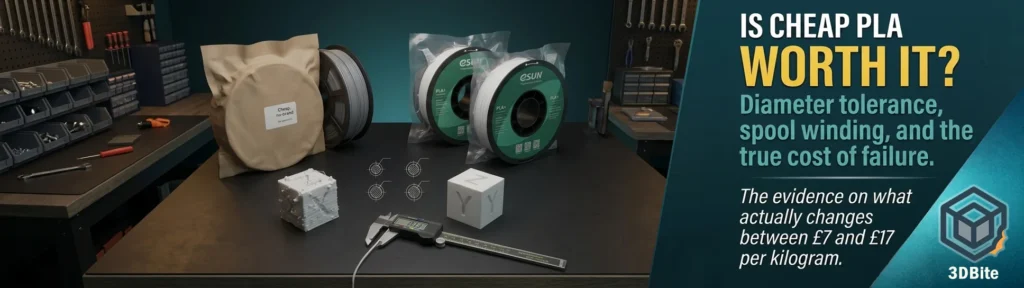
The temptation is real. You are browsing Amazon for filament, the eSUN spool you usually buy is £13.99, and right below it is a brand you have never heard of offering a four-pack at £7 per kilogram with four-star reviews and a description that says “premium PLA” in bold. The question of whether to click that instead of the familiar option gets more complicated the more you understand about what actually varies between filament brands and price points — and what does not. After two years of printing, a 40-plus spool collection, and one memorable Yuaneang silk disaster covered in the worst filament post, the honest answer is: it depends, but not on what most guides focus on.
First: what does “cheap” actually mean?
The filament market in 2026 has fairly distinct price tiers, and knowing where the real cliffs are in the quality-versus-price curve matters more than the absolute price point. In UK terms, converted from current USD pricing:
Below £8 per kilogram is the genuinely risky zone. This is no-brand AliExpress filament, house brands from generic sellers, and the bottom of the Amazon marketplace. Not all of it is bad, but quality control at this price point is genuinely variable — and “variable” is the worst characteristic a filament can have, because a tangle or a diameter spike you cannot predict is more damaging to a print workflow than a filament that is consistently mediocre.
£8 to £13 per kilogram is the budget tier — brands like SUNLU, Overture, and the cheaper eSUN standard PLA. These are real manufacturers with real quality control processes. The filament is generally usable and widely used. The tolerance is typically ±0.05mm, which means the actual diameter might be anywhere from 1.70mm to 1.80mm at any given point. That range was broadly fine on the slower printers that dominated the hobby three years ago. It is more of a conversation on a Bambu A1 running at 300mm/s.
£13 to £20 per kilogram is where the majority of experienced hobbyists settle. eSUN PLA+ at £12-15, Polymaker PolyLite at around £17-19, Hatchbox at similar pricing. These brands have tighter tolerances in the ±0.03mm range, better spool winding, and significantly longer track records in the community. The difference between a £10 and a £15 spool is not enormous in absolute terms. The difference in failure rates over fifty prints is measurable.
Above £20 per kilogram is the premium tier — Prusament at around £24-28, Bambu Lab’s own PLA Basic at similar pricing, Polymaker’s higher-spec lines. Here the tolerance tightens to ±0.02mm or better. Prusament goes further: every spool has a QR code linking to its actual measured production data, diameter graph included, so you can see the specific variance for the exact spool you are holding. That level of documentation is industrial quality control applied to consumer filament, and it matters for specific applications more than others.
The one variable that actually matters: diameter tolerance
Almost every quality difference between filament price points comes back to one specification: diameter tolerance. How closely does the actual filament diameter match the advertised 1.75mm along the entire length of the spool?
This matters because the extruder does not measure how much filament is going in — it measures how far the gear turns. If the slicer says “extrude 2.47mm of filament” and the extruder turns the appropriate amount, the actual volume of plastic deposited depends entirely on the cross-sectional area of the filament that passed through the gear. A section of filament at 1.78mm diameter has significantly more volume than a section at 1.72mm at the same length. The result is alternating over-extrusion (blobs, rough surface, potential clogs) and under-extrusion (gaps, weak layer adhesion, visible voids) that tracks the filament’s own inconsistency along the spool.
At low print speeds, this variation is partly absorbed by the natural pressure dynamics of the melt zone. At 300mm/s — the speeds the A1 and A2L are capable of running — there is far less time for the system to absorb or compensate. A thick spot hits the nozzle, pressure spikes, a blob appears. A thin spot arrives, flow drops, a gap forms. Independent testing of eight budget PLA brands under £15/kg found that three had diameter variation above 0.03mm; those three produced two to three times more failed first layers and occasional clogs compared to the five with tighter tolerances. That two-to-three times failure rate multiplier from a £3-per-kilo saving is not a good trade.
Reputable manufacturers achieve tight tolerances using dual-axis laser micrometers during production — a continuous real-time measurement of the filament diameter as it is extruded, feeding back to control the puller speed and maintain the target diameter. This equipment and the process control around it is not cheap. It is the single largest manufacturing cost difference between a properly made spool and a no-brand one. When you pay more for a good filament, this is substantially what you are paying for.
The second variable that ruins long prints: spool winding
Diameter consistency is the in-print failure. Poor spool winding is the one that kills prints hours in, when nothing else has gone wrong and you cannot figure out why the extruder suddenly started skipping. A cross-wound spool — where filament has laid over itself during winding — will run fine for eight hundred grams and then lock up completely when it reaches the crossed section, because the filament below cannot unwind freely. The extruder pulls, the spool resists, the gear grinds the filament, and the print produces nothing while the nozzle keeps moving.
One reviewer who tested Prusament across multiple spools over six weeks described having zero tangles across the entire test. Their experience with mid-tier filament averaged one minor cross-over per spool requiring attention. With cheaper imports they had experienced spools that locked up 800 grams in. That experience pattern is consistent with what shows up in community reports and the 3D printing subreddits when people post about mysterious long-print failures.
The AMS adds an extra wrinkle to this specific problem. On a direct-drive machine, a tangling spool will typically pause the print as the extruder stalls — frustrating but recoverable. On an AMS-fed machine, the feeding path is longer and the system has less tolerance for resistance. A spool that tangles in the AMS during a six-hour multi-colour job may do so silently, allowing the print to continue with no filament being deposited for a significant number of layers before it becomes obvious. The winding quality of filament matters more in an AMS workflow than in a direct-drive one, and this is worth factoring into the buying decision for any Bambu machine user running multi-colour or unattended prints.
Moisture packaging: the condition it arrives in
PLA absorbs moisture from the air, and a spool that arrives already partially wet — because it was poorly packaged or sat in a humid warehouse — starts with a handicap. Vacuum sealing with a desiccant pack in the bag is the basic minimum for any filament worth buying. A spool shipped in a plain plastic bag with no vacuum seal and no desiccant has been absorbing ambient humidity for its entire transport journey, which could easily be weeks.
The symptoms of wet filament are covered in the filament dryers guide and connect directly to the fumes post — popping and crackling from the hotend, bubbling on the surface, increased stringing, and rough top layers are all moisture symptoms that can be mistaken for settings problems. If a cheap spool arrives wet, you have to dry it before any diagnostic is meaningful. If you dry it and it still behaves poorly, then the filament quality itself is the issue. The better brands seal their spools properly. The cheaper ones often do not, and that moisture starts degrading the filament before it ever enters the printer.
Batch-to-batch colour consistency
This matters less if you are printing functional parts where the colour is irrelevant. It matters considerably for multi-spool projects. If you start a large seasonal build with spool one and need a second spool of the same colour to finish it, whether those two spools actually match is a function of the manufacturer’s batch control processes. The premium tier brands track this with lot numbers and, in the case of some brands, hex-coded colour references on the spool. Cheap filament from brands with limited colour management may have visible hue differences between spools of ostensibly the same colour. For a Grinch or a Rudolph printed across three spools of the same green, that batch drift is the difference between a cohesive finished piece and one that noticeably changes shade partway up.
What the community says, summarised honestly
The consensus from the Bambu subreddit, Reddit’s 3D printing communities, and comparison guides in 2026 is broadly consistent. Hatchbox is described repeatedly as the Honda Civic of PLA — reliable, predictable, not exciting, rarely causes problems. eSUN PLA+ sits just below Hatchbox on surface finish but has a longer manufacturing history and a slightly better toughness profile from the PLA+ formulation, which is the reason it is the primary filament here. Polymaker PolyLite earns consistent top-three finishes in independent testing for the combination of price and tight real-world tolerances. These three names come up in the “just works” category across the most experienced community voices, and they are all in the £13-20/kg range.
SUNLU is polarising in the community. Some users report consistent, no-problem printing across years of use. Others report diameter variations visible to the naked eye and winding-related tangles. The specific quote from one 2026 filament comparison: “inconsistent quality control means you might love one spool and hate the next.” That unpredictability — not the average quality, but the variance — is what makes SUNLU a harder recommendation than eSUN or Hatchbox despite similar average pricing. You can build a workflow around predictably average. You cannot build one around unpredictably varying.
Amazon Basics, generic no-brand filament, and anything under £8/kg consistently draws the same warnings: higher moisture content out of the box, more clogs, more diameter variation, and more failed prints than the savings justify. The 3DFilamentPrice testing of eight budget brands under £15/kg found three in this worst tier producing two to three times the first-layer failures of the five better-winding brands in the same price range. The bad ones at £7/kg end up being the most expensive filament in the collection once wasted material and failed print time are factored in.
The high-speed printing factor
There is a real reason why the filament conversation has shifted since Bambu machines became mainstream. The same ±0.05mm budget filament tolerance that was “fine” on an Ender 3 at 50mm/s is a meaningfully different proposition on an A1 at 300mm/s. At high speeds, the printer has less time to absorb diameter variation through natural pressure compensation. Thick spots and thin spots in the filament create visible artefacts at 300mm/s that the same filament would have produced acceptably at 60mm/s. Cheap filament printed on an Ender 3 and cheap filament printed on an A1 at speed are not the same test.
This is why filament advice that worked two or three years ago sometimes needs updating. “eSUN is fine” is correct for most purposes. “No-brand £7 filament is fine” was marginal advice before high-speed printing was consumer-accessible and is more marginal now that the machines can expose the variation that slow printers absorbed invisibly. The printer’s capability is increasingly ahead of the filament’s consistency at the budget end, and that gap shows in finished print quality in ways it previously did not.
When cheap is actually fine
None of this means every print requires £20/kg filament. The calculation is use-case dependent. Calibration prints, test geometry, prototypes where you are checking fit rather than surface finish, or any print where the material is going in the bin after the information it provides is extracted — all of these are exactly the right application for budget filament. Spending £15 on a kilogram of eSUN to print forty calibration cubes and temperature towers is not the right economic decision when £8 filament prints the same calibration cube perfectly adequately.
Functional parts where the surface is hidden inside an assembly and the print will be used once or twice before being replaced: budget is reasonable. Short prints where a tangle cannot do much damage because the print is done in forty minutes. Colour experiments where you want to try a shade before committing to a full spool of better filament at that colour. All valid applications for the budget tier.
Where budget genuinely costs more in practice: long unattended prints, AMS-fed multi-colour jobs, display pieces where surface finish is part of the point, dimensional accuracy matters (functional assemblies, print-in-place mechanisms), and any print you are planning to give to someone. These are the cases where the lower price of cheap filament predictably produces a more expensive outcome in terms of failed material and wasted time.
The actual recommendation
The sweet spot for most hobbyist FDM printing in 2026 is the £13-17/kg range. eSUN PLA+ at the lower end of that, Hatchbox or Polymaker PolyLite in the middle. These filaments have the diameter consistency to perform well on fast machines, the spool winding to survive long prints and AMS feeding, the moisture packaging to arrive in printable condition, and enough community history that the settings for them are documented, tested, and reliable. None of them are exciting to buy. They are exciting to print with, in the sense that they mostly just work.
Premium tier filament at £24-28/kg earns its place for colour-critical work, production printing where waste is a real cost, high-detail models where surface consistency across the whole print matters, and anyone who wants the certainty of documented spool-by-spool quality data. For a hobbyist running a varied print queue of seasonal builds, functional parts, and occasional display pieces, the daily-driver case for premium over mid-range is harder to make — the quality difference is real but the practical impact is incremental.
The under-£10/kg filament that lands on the desk without vacuum sealing and from a brand with no community track record: the answer there is that the short-term saving is reliably false economy. One failed ten-hour print wastes more material than the price difference across five spools. Cheap filament is not worth it at that end. The more interesting question — and the one this post has tried to answer — is where “cheap” becomes “budget” becomes “good enough,” and the answer is that the mid-range brands have been pushing that threshold steadily downward for years.