The PTFE tube is one of the quietest, least glamorous components in the entire filament path, and it is also one of the few genuine consumables in this hobby that most people never think about until it fails mid-print. Bambu’s own official guidance is more aggressive about replacement than almost anyone actually follows — and my own A1 is a good example of exactly that gap. Well over two years of daily use, not a heavy diet of abrasive filament, and I have never yet needed to replace a single PTFE tube. That is worth explaining properly, because the honest answer is not that the guidance is wrong, but that it is calibrated for a use case that does not automatically apply to everyone.
What the PTFE tube actually does, and why it wears at all
PTFE is chosen specifically for its very low coefficient of friction — the whole point of the tube is letting filament slide through the AMS and toolhead feed path with as little resistance as possible. But “low friction” is not “no friction,” and filament passing through the same tube thousands of times over its working life slowly abrades the inner wall regardless of how slick the material starts out. The internal diameter widens gradually, the once-smooth bore surface roughens, and the friction profile the tube presents to the filament changes as a direct result. Filament that used to slide through cleanly starts to drag slightly. The feed motor compensates for that added resistance without necessarily throwing an obvious error, and the first symptom most people actually notice is a gradual drift in print quality rather than a sudden, dramatic failure.
The official guidance, stated plainly
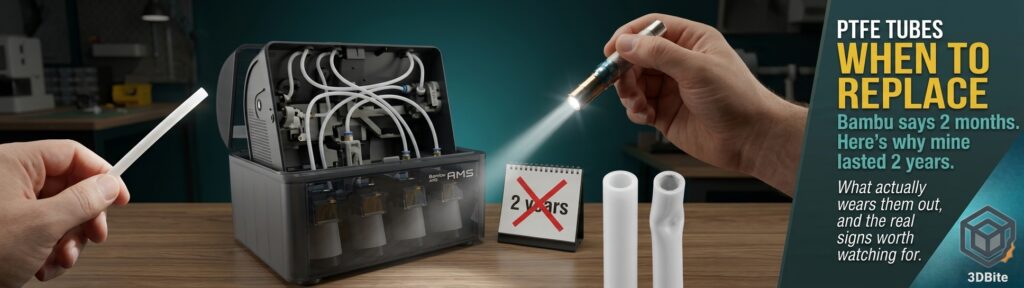
Bambu’s own wiki is consistent and specific across the AMS, AMS Lite, and P1-series documentation: under normal usage conditions, PTFE tubes should be replaced every two months to ensure unobstructed material movement. When printing abrasive materials specifically — carbon fibre, glass fibre, glow-in-the-dark, metal-fill — that interval drops to monthly, or whenever noticeable wear appears first. The P1 series documentation frames the same guidance slightly differently, in terms of material volume rather than calendar time: check after roughly 5 rolls of abrasive material, or after roughly 10 rolls of regular filament. The printer itself has an automated maintenance reminder that prompts a PTFE check every two months as part of its standard HMS routine, exactly the kind of prompt covered in the maintenance guide.
The honest community observation, worth including because it matches real experience rather than the official line: most owners skip this interval entirely, and their printers keep working fine regardless. That gap between official guidance and actual practice is not evidence that the guidance is wrong — it reflects the fact that the two-month figure is a conservative, one-size-fits-all recommendation designed to cover the heaviest plausible usage pattern, including genuine daily commercial print farm volume, rather than a hard failure threshold that every printer will actually hit on that exact schedule.
The three things that actually accelerate wear
This is the part that directly explains why some printers genuinely need replacement on schedule and others, like this A1, go years without it. Wear is driven by three specific factors, and none of them scale purely with calendar time — they scale with what is actually being printed and how.
Abrasive filaments are the most aggressive factor by a wide margin, for exactly the reasons covered in the abrasive filaments guide — carbon fibre and glass-fibre composites contain hard particles that erode nozzles quickly, and the same particles erode the PTFE bore they travel through on the way there. For anyone printing CF or GF regularly, the monthly interval genuinely reflects real, fast-accumulating wear rather than being an overcautious default.
Aggressive retraction cycles during multi-material AMS swaps are the second and more subtle factor. Every colour change on a single-nozzle AMS system involves retracting the outgoing filament back through the tube and feeding the new colour forward — and that repeated backward-and-forward motion concentrates wear specifically at the points in the tube where retraction repeatedly reverses direction, rather than distributing it evenly along the tube’s length. This is precisely why a heavy multi-colour AMS workflow — running the four-colour figurine and seasonal builds covered extensively across this site’s project posts — puts genuinely more cumulative stress on a PTFE tube per kilogram of filament printed than an equivalent volume of single-colour printing ever would, because the retraction cycling itself is the wear mechanism, not just the raw distance filament travels.
Heat is the third factor, and it applies specifically to the toolhead-side section of tube sitting closest to the hotend, where sustained proximity to a heat source accelerates the material’s degradation over time in a way the AMS-side sections of the same tube run do not experience nearly as much.
Why this A1 has genuinely gone two years without needing one
Putting those three factors against my own actual printing habits explains the result reasonably well. Abrasive filament use here has been genuinely occasional rather than regular — a spool now and then rather than a steady diet of CF or GF prints, which removes the single most aggressive wear factor almost entirely. And while the AMS Lite does get regular multi-colour use for the figurine and seasonal builds covered throughout this site, that is still a meaningfully lower total volume of retraction cycling than a genuine daily production environment would rack up — the two-month official interval is explicitly calibrated to cover heavy commercial and daily-use scenarios, and a hobbyist workshop running a handful of prints a week, even with regular colour changes, is accumulating wear at a considerably slower rate than that baseline assumes.
None of this means the tubes are indestructible or that this printer is somehow exempt from the underlying wear mechanism — it means the specific combination of moderate volume, occasional rather than constant abrasive filament use, and a print schedule well below genuine commercial throughput has simply not yet accumulated enough of the actual wear-driving activity to produce a functional problem, even though two calendar years have technically passed. The two-month figure is a time-based proxy for a volume and material-based reality, and calendar time alone is a fairly poor predictor of actual wear when the underlying usage pattern is well below what that interval assumes.
The symptoms that actually mean it needs replacing
Rather than replacing tubes on a fixed calendar schedule regardless of actual condition, watching for the genuine functional signs is the more sensible approach for anyone whose usage pattern, like this one, sits below Bambu’s conservative baseline. Feed failures and filament jams within the AMS are the headline symptom Bambu’s own documentation names directly — a filament that fails to load or unload cleanly, particularly on a spool and printer combination that has worked reliably before, is worth investigating at the tube level rather than assuming a spool or firmware problem first. Print quality drift that has no other obvious cause — inconsistent extrusion, a gradual change in surface finish across successive prints with no settings changes — is the subtler signal, since increased internal friction shows up as a compensation problem for the feed motor before it produces an outright jam.
The direct physical inspection method: pull a section of tube out during routine maintenance and look for visible inner-wall scoring, ideally by shining a torch through the tube’s length to check the internal surface for roughness rather than relying on the outer appearance alone, which tells you very little about internal wear. A second useful test is bending the tube gently — if it holds a permanent kink at the bend point rather than springing back to a smooth curve, the material itself has degraded and lost the flexibility it had when new, which is a reasonable indicator that its internal surface has degraded similarly even where that is not directly visible. Worth noting: internal wear tends to be a late-stage sign by the time it is visible to the eye or produces a kink you can feel, since the abrasion happening inside the bore during normal operation is not something you would notice through casual handling until it has progressed considerably.
The replacement process, briefly
Replacement itself is a genuinely quick job once you have the correct parts — Bambu’s own wiki documents it as a straightforward procedure, and the AMS enclosure on most models opens with just two screws for access. Always power the printer off completely before doing any of this work, for the same reasons covered throughout the maintenance guide — working on toolhead wiring or electronics with the machine powered risks a short circuit and genuine electrical damage. Use the correct replacement tube specifically rather than a generic substitute: Bambu specifies a 2.5mm internal diameter and 4mm external diameter for their tubing, and using a different size is explicitly discouraged, since a narrower internal diameter increases friction unnecessarily and a wider one introduces its own feeding inconsistency. When routing the new tube, avoid tight bends — smooth curves only, since sharp bends concentrate wear at the bend point in exactly the way that produces the permanent-kink symptom described above sooner than a properly routed tube ever would.
The practical takeaway
Bambu’s two-month interval is a genuinely sensible default for anyone printing at real commercial volume, running abrasive filaments regularly, or managing a multi-printer farm where consistent, predictable maintenance schedules matter more than optimising for any individual machine’s actual wear rate. For a hobbyist workshop with moderate volume and occasional rather than constant abrasive use — the pattern this A1 has actually followed for two years — the calendar interval is considerably more conservative than the real wear rate justifies, and watching for the genuine functional symptoms covered above is a perfectly reasonable alternative to blind, fixed-schedule replacement. The tube is a consumable either way. It is just a consumable whose actual lifespan depends far more on what you print and how than on how many months have passed since you last opened the AMS up.