
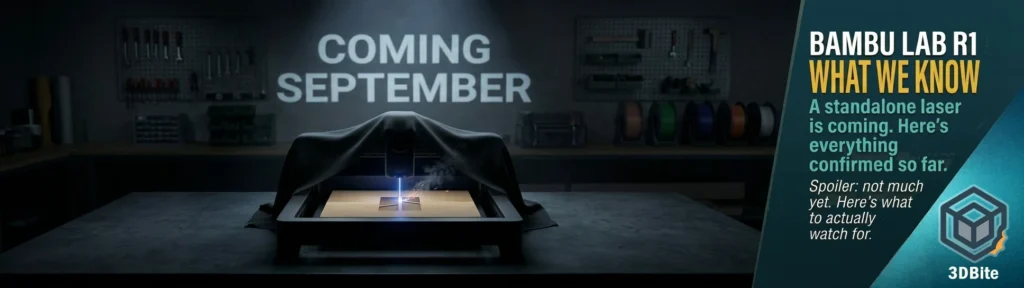
Bambu Lab has announced a new product category for the first time since the H-series brought a laser module to the printer lineup, and this one is genuinely different in kind rather than another printer variant. The R1 is a standalone laser engraver and cutter — not a module bolted onto a 3D printer, but a dedicated machine in its own right, the first of its kind from a company that has, until now, only ever offered laser capability as an add-on to the H2D and H2S. The teaser landed on August 13, 2026, and the honest answer to “what do we know” is: not very much yet, and it is worth being precise about exactly how little rather than filling the gap with speculation. Given the H2D laser module post already covers what Bambu’s existing laser hardware can do, this is worth reading as the companion piece — the question here is what a standalone version of that same capability might look like, and what is and is not actually confirmed at time of writing.
What was actually announced
The teaser went live simultaneously across Bambu’s channels — the dedicated landing page at bambulab.com/r1, a Reddit post, and the Bambu community forum — on August 13, 2026. The visible copy is genuinely thin: “Bambu Lab R1,” the tagline “A new Ray of making,” and “Coming September.” The Reddit post adds one further line: “ONE MORE TOOL. More power. Made simple. Something new is warming up in the Lab.” The page’s underlying metadata is slightly more informative than the visible text, describing the R1 as “the first laser engraver and cutter from Bambu Lab that helps you create with more materials,” and positioning it explicitly alongside rather than inside the printer range: “From 3D printing to laser, we’re building your personal manufacturing hub.”
The accompanying render shows a single laser beam cutting the four-square Bambu Lab logo cleanly through a light wood board — a clean-cut demonstration image rather than a product photograph, and one that tells you essentially nothing about the actual hardware beyond confirming that cutting, not just engraving, is part of the intended capability. All3DP’s Carolyn Schwaar’s framing captures the moment accurately: lasers are already a part of Bambu’s multi-function machines, but the beam has now earned its own apartment.
What is genuinely not known yet
This deserves its own section rather than being buried as a caveat, because the gap between what has been reported and what has actually been confirmed is unusually wide even by the standards of a pre-launch teaser. No laser type has been confirmed — not diode, not the more expensive fiber or CO2 alternatives that some standalone laser cutters use for cutting metal. No power rating. No work area or bed size. No price. No preorder date beyond “September.” No safety certification details. No confirmation of whether it uses the same Bambu Suite software that already drives the H2D’s laser functionality, though given that Bambu has already built that entire software and workflow stack, it would be a genuine surprise if the R1 did not build on it rather than starting from scratch.
Several outlets tracking this closely — Makers101’s ongoing coverage in particular — are explicit that anything specific circulating about wattage or specifications before Bambu’s own release should be treated as unverified speculation rather than fact, and that the strongest official confirmation currently available sits in the page’s metadata rather than in the visible marketing copy itself. That is about as bare a teaser as a company of Bambu’s size and marketing sophistication tends to put out, which is itself worth noting — it suggests either a genuinely early announcement to build anticipation ahead of a fuller reveal, or a product still being finalised close enough to launch that specifics are not yet locked down for public release.
The one reference point that actually exists: the H2D laser module
While nothing about the R1 itself is confirmed, Bambu’s existing laser hardware gives a genuine, useful baseline for what the company is capable of building, and it is the most concrete evidence available for what direction the R1 might take. As covered in the H2D laser post, the H2D currently offers two module tiers: a 10W blue diode laser at 455nm capable of cutting through roughly 6mm of basswood, and a 40W version capable of 15mm in a single pass, with engraving speeds of 400mm/s and 1,000mm/s respectively. Pricing for the H2D with these modules currently sits at $2,149 (10W) and $2,699 (40W) in the US, or an upgrade kit from $698 for existing H2D owners without a laser fitted. Whether the R1 uses the same laser hardware, a scaled-up version, or something built specifically for a standalone form factor is genuinely unknown — but the 455nm blue diode laser technology itself is proven, working hardware that Bambu already manufactures and sells at volume, which is a reasonable starting assumption for what a first-generation standalone product would build from rather than reinventing.
Why a standalone laser is a genuinely different proposition
This is worth thinking through properly rather than assuming the R1 is simply the H2D’s laser module repackaged into its own box. The H2D laser post covered the real limitations of the current combined approach: noise loud enough that reviewers recommend a garage workspace or ear protection during 40W operation, a $599.99 optional Smoke Purifier accessory that adds meaningfully to the total cost, and a machine whose primary identity is still a dual-nozzle 3D printer with laser capability layered on top rather than a purpose-built laser machine from the ground up.
A genuinely standalone laser product gives Bambu room to solve several of those problems properly rather than as compromises within a printer chassis. A dedicated enclosure can be engineered specifically around laser fume extraction and noise dampening rather than adapted from a chassis designed primarily for FDM printing. The work area is not constrained by needing to also accommodate a print bed and dual nozzle gantry. And critically, it opens the laser category to anyone who has no interest in 3D printing at all — someone who wants to engrave and cut wood, leather, and acrylic specifically, without paying for or housing a printer they will never use. That is a meaningfully larger addressable market than “existing H2D owners who also want a laser,” and it is consistent with the “personal manufacturing hub” framing in the R1’s own page metadata — Bambu building out a family of purpose-specific tools around a shared software and ecosystem identity, rather than cramming every capability into a single machine indefinitely.
The competitive context: this is not a category Bambu is creating
Standalone consumer laser engravers are an established and reasonably mature market already, and Bambu is entering rather than inventing it. xTool, Glowforge, and Creality’s own Falcon range (a 10W diode unit selling around $474-519 even several years ago) have been building the desktop laser category for a while, with established software, community profiles, and price expectations already set. Makers101’s analysis frames the real strategic question sharply: the fight here is as much about software and ecosystem as it is about raw laser hardware, and xTool in particular already owns a strong position in the consumer laser space with a mature, well-regarded software stack of its own.
What Bambu brings to that fight that a first-time entrant would not have is the same thing that made the A1 and P-series successful against Prusa, Creality, and the rest of the established 3D printing field: a genuinely polished software experience, a large and engaged existing user base already comfortable with Bambu’s ecosystem and MakerWorld, and manufacturing scale that lets them compete aggressively on price. Whether that translates directly into laser cutting — a category with its own established players, its own safety certification requirements, and its own community conventions — is the open question a bare teaser cannot answer. The ecosystem post covers the broader pattern of Bambu using ecosystem lock-in and software polish as competitive advantages rather than pure hardware specification; if the R1 follows that same playbook into the laser category, the specific hardware numbers may matter less to Bambu’s competitive position than how well it ties into Bambu Suite, MakerWorld, and the existing installed base of Bambu Studio users.
What to actually watch for
Full specifications are reportedly due in late August 2026, with preorders opening in September — though as with the teaser itself, treat “late August” as an estimate rather than a confirmed date until Bambu’s own channels post it directly. When the real specification sheet lands, the numbers worth checking first: laser type and wavelength (diode is near-certain given Bambu’s existing H2D hardware, but power rating is genuinely unknown), maximum material thickness for a single-pass cut, work area dimensions, whether it uses the same Bambu Suite software as the H2D laser modules, what ventilation and fume extraction is built in versus sold separately, and — the number that will determine whether this is genuinely competitive or a premium-priced entry into an already crowded market — the actual price.
Given how directly this connects to the earlier laser coverage on this site, this is a story worth revisiting properly once Bambu actually publishes something concrete rather than a wood-cutting render and a September date. For now, the honest position is exactly what OC3D’s coverage lands on: it is clear the R1 is a laser cutter and engraver, and it is clear Bambu intends it to follow the same “less fiddling, more making” philosophy that has defined its printer range. Everything else — the numbers that would actually let anyone decide whether to buy one — is still, genuinely, unknown.
Thanks for keeping this to what is actually confirmed — a wood-cut render and a September date is not a spec sheet. From a shop that already prints jigs and fixtures, a standalone laser is interesting mainly as a second process next to FDM: hold-downs, alignment fences, and honeycomb-bed risers are usually the first parts I print once a work area is known. Until bed size and single-pass thickness land, those STLs have to stay generic. I keep a few printable fixture files at https://luphra.com for that hybrid workflow and would happily iterate once Bambu posts real numbers.