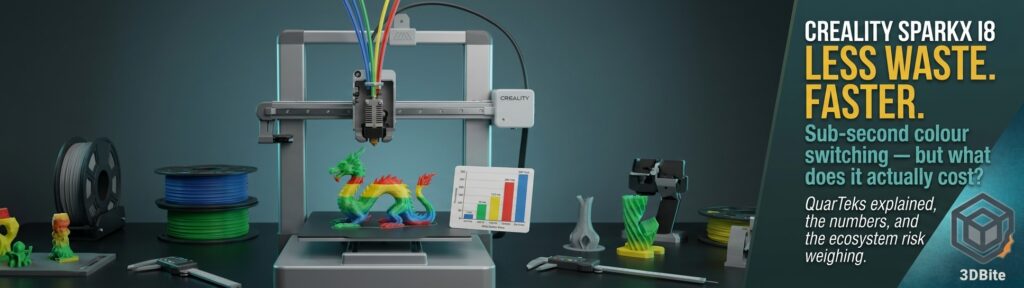
Creality announced the SparkX i8 on August 19, 2026, and it takes a genuinely different approach to the multicolour waste problem than anything else this site has covered — not a toolchanger like the Vortek H2C or InfiMech MX Pro, not an IDEX hybrid like the Sovol M1D, not four fully independent heads like the LightMake L4. Instead, all four filament channels converge inside a single toolhead, merging just 1.7mm above the nozzle tip. Creality’s own claim is a colour change in under one second and a genuinely dramatic reduction in purge waste compared with every other multicolour architecture currently on the market. The idea is good. Whether it is good enough to justify committing to yet another new, proprietary filament path — from a company with a track record of moving on to its next architecture within a couple of quarters — is the actual question, and it is one this post takes seriously rather than glossing over.
What QuarTeks actually is
QuarTeks is Creality’s name for the underlying mechanism, and the core idea is genuinely elegant once you understand what it is doing differently from every competing system. On a Bambu AMS, four filament colours are routed from an external unit through a comparatively long shared path before reaching the melt zone — the purge cycle exists specifically to clear that long shared path of the previous colour before the new one can print cleanly. On a toolchanger like the Vortek system, the entire hotend swaps out, which eliminates cross-colour contamination but introduces its own overhead in heat-up time and mechanical complexity. QuarTeks does something different again: it keeps four separate filament channels running independently almost all the way to the nozzle, merging them into a single shared path only 1.7mm from the tip. That is a dramatically shorter shared distance than any AMS-fed single-nozzle system, and it is the entire reason the purge volume and the switching time both drop so significantly — there is simply far less shared tube length for a residual colour to contaminate.
The printhead carries 13 intelligent sensors monitoring filament status in real time specifically to support faster, more reliable colour changes with fewer interruptions — a genuinely sensible design response to the fact that four independent channels converging into a tiny shared space is a more delicate mechanical proposition than a single AMS-fed path, and needs correspondingly more monitoring to catch problems before they become failed prints.
The waste and speed numbers, and how Creality is presenting them
Creality’s own benchmark uses a test dragon model printed in black, orange, green, and white across 3,000 colour changes, and the comparison figures are worth laying out properly because they show genuinely meaningful differences between architectures rather than marginal ones. On the i8, that dragon prints in 14 hours and 41 minutes. The same job on a system using four fully separate toolheads takes 18 hours and 24 minutes. A seven-colour toolchanger system takes over 32 hours. A conventional single-nozzle four-colour AMS-style system — the architecture this site’s own A1 uses daily — takes just under 50 hours for the identical job. Across that same 3,000-colour-change test, Creality calculates a saving of more than 400 spools and 438kg of filament compared to a conventional system, which the company values at approximately $1,500 in material cost alone. Creality’s overall headline claims are up to five times higher speed and 2.7 times less material waste for multicolour printing specifically.
These are Creality’s own figures rather than independently verified numbers, and it is worth treating them with the same appropriate caution this site applies to any manufacturer’s launch-day benchmark — a test dragon chosen and run by the company selling the printer is not neutral testing. But the underlying mechanism genuinely does support a real waste reduction, for the same structural reason the Sovol M1D and LightMake L4 both achieve their own waste claims: shorter shared filament paths and independently maintained channels simply have less material to purge than a system routing everything through one long shared tube.
The full specification sheet
| Spec | Detail |
|---|---|
| Build volume | 260 × 260 × 255mm |
| Frame type | Open frame, bed slinger |
| Colour channels | 4, converging 1.7mm from the nozzle tip via QuarTeks |
| Colour switch time | Under 1 second (manufacturer claim) |
| Max print speed | 500mm/s |
| Max acceleration | 10,000mm/s² |
| Max hotend temperature | 300°C |
| Max bed temperature | 100°C |
| Bed levelling | 81-point automatic, with automatic Z-offset and localised micro-levelling |
| Camera | 720p, AI-assisted print monitoring |
| Nozzle changeover | 5-second quick-release, interchangeable diameters |
| Pre-assembly | 90% pre-assembled, claimed 5-minute setup |
| Connectivity | Creality Cloud, LAN, offline SD-card printing |
| Software | Creality Print 7 or newer (Windows, macOS, Linux) |
| Storage included | 8GB microSD card |
| Price | Not yet announced — early-bird registration only at time of writing |