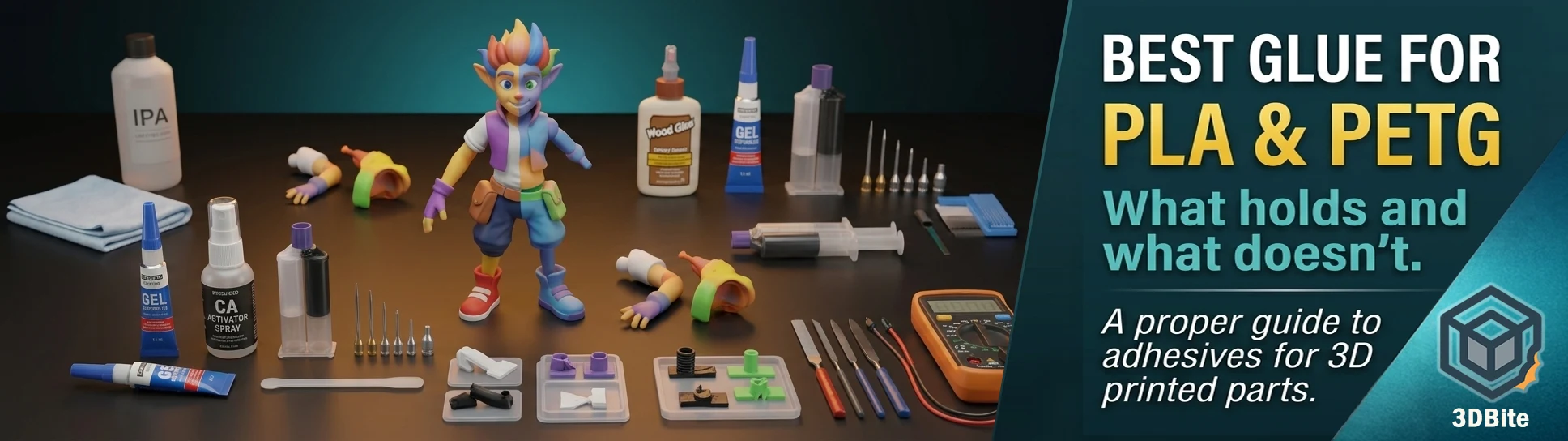
Multi-part models make up a significant portion of what I print. The Mario, Luigi, Yoshi, and Grinch projects all involve assembling multiple individually printed parts into a finished figure. The festive lampposts screw together. The Nespresso pod dispenser clips. But anything that relies on a permanent bond — where the join needs to be invisible and structurally reliable rather than mechanical — needs glue. Choosing the wrong adhesive means a joint that looks fine on first assembly and fails three weeks later when someone picks the model up. Choosing the right one means a join that is stronger than the surrounding printed material and invisible at normal viewing distance.
This post covers every adhesive option worth knowing about for PLA and PETG, how each one works chemically, when to use which, and the specific products I use myself with links for anyone who wants to follow the same approach.
Why gluing 3D printed parts is different from gluing other plastics
Two things make bonding 3D printed parts different from standard plastic fabrication. First, the surface geometry: FDM parts have layer lines — a textured surface structure that affects how adhesives grip. The microscopic ridges and grooves of a layer line provide mechanical adhesion keys that a completely smooth injection-moulded part would not have, which is why some adhesives that struggle on smooth plastic perform well on printed parts. Second, the joint surfaces are rarely perfect. Unless you have sanded the mating faces flat, there will be gaps — small ones, but gaps nonetheless. An adhesive that cannot bridge gaps will fail before it has been properly tested.
The other distinction worth understanding upfront: adhesive for assembly and adhesive for bed adhesion are completely different products serving completely different purposes. Glue sticks, hairspray, and the water-soluble liquid glues used on build plates are temporary, weak, and designed to release at room temperature. Using a regular glue stick to assemble parts will cause your model to snap under the slightest pressure. This is worth stating explicitly because the glue stick is one of the most familiar pieces of 3D printing kit and it is emphatically not an assembly adhesive.
CA glue (superglue): the daily workhorse
Cyanoacrylate — CA glue, superglue — is the right answer for the majority of 3D printed part assembly. It works on both PLA and PETG without degrading either material, cures in seconds, creates a hard rigid bond, and is available everywhere. CA glue cures in seconds, creates strong chemical bonds with thermoplastics and resins, and won’t add bulk to precision joints.
CA works by polymerising on contact with moisture — the trace moisture on the surface of the plastic and in ambient air triggers the reaction. The bond it creates is a crystalline structure that is genuinely strong in tension — pulling the parts straight apart — but has an Achilles heel in shear and impact. Super glue creates a hard, brittle crystalline structure when cured. Under pure tensile force, a high-quality CA holds remarkably well. However, its Achilles’ heel is shear stress and impact shock. A joint that is unlikely to be dropped or twisted performs very well with CA. A joint that will take mechanical loading in multiple directions needs something else.
Viscosity matters: thin, medium, gel
CA glue comes in three main viscosities and the choice affects the result significantly.
Thin CA (5–20 CPS) is water-like. It wicks into tight joints by capillary action — if you hold two parts together with a tight fit and apply a drop of thin CA to the seam, it draws itself into the joint. It cures very fast and creates an almost invisible bond line on snug-fitting joints. The downside: you get no working time, it runs freely and will wick into places you do not want it, and it bridges no gap. The parts must fit tightly for thin CA to work properly.
Medium CA (around 700 CPS) is the workhorse. It has enough body to stay where you apply it, can bridge minor gaps, gives a few extra seconds of working time before it grabs, and is the right choice for most standard assembly work. Medium CA glue is the workhorse for most 3D printing applications, ideal for PLA, PETG, and ABS with light sanding or layer adhesion challenges.
Gel CA is the thickest formulation and the one I use for most assembly work. It does not run, it bridges larger gaps, it gives more control on vertical surfaces, and it is more forgiving of imperfect mating faces. To prevent the common issue of white “frosting” or blooming around the seam, apply the superglue sparingly in a well-ventilated workspace and use a gel formula. Gel CA is also the right choice for decorative pieces where any cosmetic blemish around the join is visible — the thicker body means it is less likely to wick onto the surrounding surface and create the white frosting effect that thin CA can produce.
CA activator: the upgrade worth buying
CA activator — also called accelerator — is a spray that triggers instant CA curing on contact. Apply CA to one face, spray activator on the other, press together, and the bond is set in seconds rather than in thirty seconds or a minute. This approach creates an almost instantaneous structural bonding effect. Be warned: you get exactly one chance to align the parts. Once the activated faces touch, the plastic repair adhesive grabs tightly, making later adjustments impossible. For assemblies with many parts to join in sequence — a multi-part seasonal figure, for example — the activator is what makes rapid assembly practical. Without it you are waiting at each join. With it, the assembly is fast and the positioning discipline simply has to be built in before you start.
Baking powder is a well-known DIY alternative to commercial CA activator — it provides the base chemistry to trigger rapid curing and has been used by modellers and prop makers for decades before commercial activator sprays became widely available. It also works as a gap filler when combined with CA: pack a small amount of baking powder into a gap, then apply CA on top, and the mixture cures almost instantly into a sandable solid that fills the void. This is a useful technique for hiding join lines on curved or detailed surfaces where gap-filling is needed before finishing.
The frosting / blooming problem
White frosting or blooming around a CA joint — a milky haze on the surrounding printed surface — is caused by CA vapour curing on the surface adjacent to the joint rather than just in the joint itself. It is more common with thin CA in enclosed spaces and with fast-curing formulations. The mitigations: use gel CA which does not vapourise as readily, apply sparingly, work in a ventilated space, and do not breathe directly over the joint as you press it. If frosting does occur on a model you care about, it can be reduced by careful sanding and polishing of the affected area, or prevented entirely by applying a thin coat of mould release or petroleum jelly to the surrounding surface before gluing — which stops CA vapour from bonding there.
Epoxy: the structural choice
For load-bearing parts — anything that will take mechanical stress, carry weight, or be handled repeatedly — two-part epoxy is the correct adhesive. Epoxy forms a strong bond that handles stress well and performs better than CA in gap-filling situations. This makes epoxy an excellent option for structural assemblies and parts that need to carry weight.
Epoxy works by combining a resin and a hardener in equal proportions. The chemical reaction between them creates a cured polymer that is inherently gap-filling — it does not require tight-fitting surfaces and will bridge substantial voids while maintaining structural strength. Independent testing by MakerBuildIt confirmed that among super glue, 3D Gloop, and JB Weld tested on PLA parts, all three performed well with in many cases the PLA itself breaking rather than the adhesive bond. JB Weld is specifically engineered for plastic bonding and handles twist and shear forces that would crack a CA joint.
The working time of epoxy — typically five to thirty minutes depending on the formulation before the mix begins to set — is both an advantage and a consideration. It allows careful positioning and adjustment of complex multi-part assemblies, which CA does not. It also requires mixing, which adds a step to the workflow. The full cure time is typically twelve to twenty-four hours, during which the assembly should not be stressed. For parts that are going on a shelf and are assembled once, this is not a meaningful constraint. For parts needed the same day, CA may be the more practical choice despite its lower structural ceiling.
The hybrid approach used by many experienced assemblers combines both: use CA for initial positioning and quick tacking of the parts together, then reinforce the joint with epoxy applied around the outer seam once the alignment is confirmed. A common workshop approach is two-stage bonding: use CA for quick positioning, then reinforce with epoxy for long-term strength.
PETG-specific considerations
PETG is more chemically resistant than PLA, which affects how it bonds. PETG and TPU are notoriously chemically resistant. Solvents and smoothing agents won’t melt them. Your best bet for bonding PETG or TPU is a high-quality CA glue or a flexible polyurethane adhesive.
CA still works on PETG — it creates a surface bond that is adequate for most display and light functional applications. The bond is not as strong relative to the material as on PLA, because PETG’s surface resists the mechanical grip that makes CA so effective on the slightly more reactive PLA surface. For PETG parts that need to carry load, epoxy is the more reliable choice — it fills gaps and cures to a structural polymer regardless of the substrate’s chemical reactivity.
3D Gloop! PET version is the dedicated solvent weld option for PETG — best overall strength for PETG is epoxy, best for fast and easy bonds is CA, and the closest to a plastic weld is PETG 3D-Gloop! It softens the PETG surface and fuses the parts together as the solvent evaporates, creating a bond that is stronger than the surrounding material when applied to well-fitted surfaces that can be clamped. The fume profile requires good ventilation. The shelf life after opening is approximately 90 days. For most hobbyist PLA/PETG assembly work, CA or epoxy is the more practical choice — 3D Gloop is the premium tool for specific applications where maximum joint strength is the priority.
Adhesives to avoid
Several commonly available adhesives are poor choices for printed part assembly and are worth naming explicitly.
Hot glue is a non-starter for anything structural. It produces a bulky, flexible bond that has no place in a precise assembly. It is useful for temporarily tacking large pieces for dry-fit assessment and little else in a serious printing workflow.
Original brown Gorilla Glue (polyurethane foam glue) is specifically worth calling out because it is widely available and widely misunderstood. Avoid the original brown Gorilla Glue — it expands into a messy foam that pushes parts apart. The foam expansion during curing physically forces the joint apart rather than holding it together. The Gorilla Super Glue Gel — an entirely different product from the same brand — is excellent. The original brown version is not suitable for this application.
PVA and craft glue produce weak, moisture-sensitive bonds that are not adequate for any structural or semi-structural assembly. Fine for children’s cardboard crafts. Not suitable for anything you want to last.
Acetone on PLA is a common misconception. Acetone is the standard solvent weld for ABS — it chemically melts the ABS surface and fuses parts when applied to mating faces. Standard PLA is highly resistant to acetone. To physically melt and fuse PLA parts, you must use a specialized solvent like 3D Gloop! Applying acetone to a PLA joint produces no meaningful bonding effect.
Surface preparation: the step most people skip
The single most impactful thing you can do to improve any glue joint is prepare the surfaces properly before the glue goes anywhere near them. Two steps, neither optional.
Clean with IPA first. Finger oils, release agent residue from the build plate, and ambient dust all reduce bond strength. Clean both mating faces with 99% isopropyl alcohol to remove finger oils. Wipe, allow to dry completely, and do not touch the bonding surfaces again before the glue is applied. Handling the cleaned surface even briefly re-introduces oil contamination.
Light sanding improves mechanical grip. A quick pass with 120–180 grit sandpaper on the mating surfaces creates a slightly roughened profile that gives the adhesive more surface area to grip. This is more important for CA on PETG — where the smooth surface limits adhesion — than for PLA, but it improves results on both materials. Do not over-sand to the point of removing material that affects the fit geometry. The goal is texture, not material removal.
Precision nozzles: the accessory worth buying
The standard nozzle on a superglue bottle is not designed for the kind of precise, contained application that multi-part 3D printed assembly requires. Applying CA with the standard nozzle on a small joint produces excess glue, flooding, and — inevitably — CA on a surface you did not intend to bond. Precision needle nozzles are the solution: fine metal tips that fit standard CA bottles and reduce the bead size to a fraction of a millimetre, allowing precise placement in tight joint areas without spillage onto the surrounding surface. For small assembly work — facial features on figurines, eye placements, detail joins on miniature-scale models — precision nozzles are the difference between a clean join and a frosted mess.
What I use
For the Mario, Luigi, Yoshi, and seasonal build assemblies, I use a gel CA as the primary adhesive for most structural joins — it stays where I put it, does not run, and the working time is long enough to get positioning right before the bond sets. For eye placements and the finest detail work where precision application matters most, I use precision needle nozzles which allow me to place a minimal amount of adhesive exactly where it needs to go without affecting the surrounding painted or coloured surface. For joins that will take repeated handling or any mechanical stress, I reinforce with epoxy after the initial CA tack.
- Gel CA superglue — Amazon UK — the primary assembly adhesive. Gel formula, controlled application, no running.
- CA superglue with activator — Amazon UK — for rapid tacking on multi-part assemblies where working speed matters.
- Precision needle nozzles — Amazon UK — essential for small detail work. Fit standard CA bottles and reduce bead size dramatically for precise placement on fine joins.
Quick reference: which glue for which job
| Scenario | Best adhesive | Notes |
|---|---|---|
| Standard PLA figure assembly — display piece | Gel CA | Fast, clean, adequate for non-stressed display work |
| PETG functional part assembly | Epoxy or medium CA | Epoxy for load-bearing. CA adequate for light-duty |
| Rapid multi-part assembly, many joins in sequence | Gel CA + activator | Apply gel to one face, activator to other — instant set on contact |
| Structural bracket or tool that carries load | Two-part epoxy (JB Weld Plastics) | Gap-filling, shear-resistant, load-rated |
| Fine detail joins — eyes, small accents, tiny parts | Thin CA with precision needle nozzle | Wicks into tight joints. Apply minimally |
| Gap filling before finishing | CA gel + baking powder | Baking powder fills the gap, CA cures it solid. Sandable after cure |
| Maximum strength PETG structural join | PETG 3D Gloop! or epoxy | Gloop produces solvent weld. Requires clamping and ventilation |
| Parts that may flex or vibrate | Polyurethane adhesive (not original Gorilla Glue) | Flexible cure tolerates movement better than brittle CA |
Summary
Gel CA superglue covers the majority of PLA assembly work quickly, cleanly, and with adequate strength for display and light functional applications. Add an activator for multi-part assembly sessions where speed matters. Use two-part epoxy when the joint needs to carry load, resist twist, or survive repeated handling. For PETG, lean toward epoxy over CA for anything structural given PETG’s chemical resistance. Always clean surfaces with IPA before any adhesive application, and sand lightly if bond strength is a priority. Add precision needle nozzles to your kit if you are doing any fine detail work — they cost almost nothing and make a significant practical difference on small joins.
The right glue is invisible in the finished result. A well-glued join on a multi-part figure should not be detectable at normal viewing distance — the colour boundary is determined by the print colours, not the adhesive. Getting there requires the right product applied correctly with prepared surfaces. None of it is complicated once the principles are understood, and the assembly process itself is one of the more satisfying parts of a multi-part build.