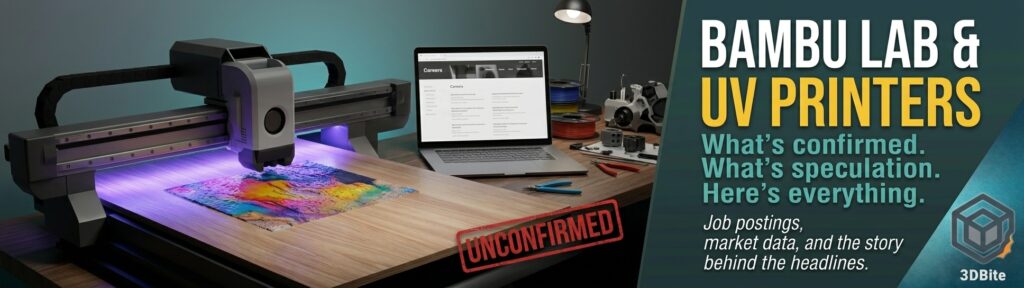
Two weeks after the R1 laser teaser landed, a second and genuinely different Bambu Lab expansion story broke — this time into UV printing, a technology that has nothing to do with FDM or laser cutting at all. The reporting on this has come from a genuinely wide spread of sources over the past couple of weeks, ranging from careful, sourced trade journalism to a Chinese-language report that some of the community is treating with real suspicion. This post pulls all of it together, separates what Bambu has actually confirmed from what is still speculation, and explains what UV printing even is for anyone whose workshop, like this one, has never touched it.
What UV printing actually is
This is worth explaining properly because it is a genuinely different manufacturing process from anything covered on this site so far, including resin printing. All3DP’s Carolyn Schwaar describes it accurately: UV printers jet UV-curable ink directly onto the surface of an object — acrylic, wood, glass, metal, almost any rigid material — and cure that ink instantly with ultraviolet light as it is deposited. It is not building an object layer by layer the way FDM or resin printing does. It is applying full-colour, textured decoration directly onto an object that already exists, using an inkjet printhead rather than a nozzle or a laser.
Fabbaloo’s Kerry Stevenson adds the detail that makes this genuinely interesting rather than just “a fancy printer”: the technology can build up full RGB colour objects with real texture, because successive passes of cured ink stack on top of each other, and industrial machines use this specifically to produce raised, textured surface finishes rather than flat colour alone. This is why one of the specific technical challenges named in Bambu’s own job postings, according to Makers101’s coverage, is “texture stacking precision” — getting successive layers of cured ink to build up cleanly into a controlled surface relief rather than a flat printed colour, which is a genuinely different and harder problem than colour accuracy alone.
Until recently this has been squarely industrial and small-business equipment — sign shops, packaging companies, promotional product printers — using machines that are large, expensive, and require trained operators. That is starting to change: RTM World’s coverage names Anker’s eufyMake E1 and xTool’s O1 Omni as the products that have already begun bringing UV printing down to a genuinely desktop, consumer-facing scale, alongside Longer’s ePrint. All3DP prices these three specifically at $1,899 (xTool O1 Omni), $2,499 (Longer ePrint), and $2,359 (eufyMake E1) — genuinely comparable pricing to Bambu’s own H2D and R1 territory, which is presumably exactly why Bambu is looking at this market now rather than five years ago.
What Bambu has actually confirmed
This is the section worth reading most carefully, because the confirmed facts are narrower and earlier-stage than a lot of the surrounding headlines suggest. On August 19, 2026, Bambu Lab confirmed directly to All3DP that a UV printer is in development — that is a genuine, on-the-record confirmation from the company itself, not a leak or a third-party report. RTM World’s independent coverage corroborates the same date and the same confirmation.
Beyond that direct confirmation, the evidence is entirely job-posting-based, and it is genuinely substantial as that kind of evidence goes. Makers101’s coverage — the most careful and specific piece of reporting found for this post — establishes that nine UV-related engineering roles appeared on Bambu’s own careers site between August 3 and August 19, 2026, eight of them based in Shenzhen and one in Shanghai. The listed requirements name printhead technology, FPGA development, inkjet control, ink-path systems, material validation, and software integration as the areas being staffed, and the job descriptions specifically seek engineers with experience working with printheads from Epson, Ricoh, and Xaar — three of the established names in industrial inkjet hardware — alongside broader experience in mass production of industrial or commercial inkjet equipment. RTM World’s reporting adds that the postings mention three distinct ink channels: colour, white, and varnish — a combination consistent with genuine full-colour, textured UV printing rather than a simpler single-colour marking device.
36Kr’s Chinese-language reporting, picked up and translated by several Western outlets, adds market-sizing context rather than new product detail: citing Mordor Intelligence, it puts the global UV printer market at approximately $1.1 billion in 2026, projected to reach $1.58 billion by 2031 at a 7.59% compound annual growth rate. That figure appears consistently across the 3Druck, RTM World, and 36Kr coverage, suggesting it traces back to the same original Chinese source report — likely the Star Market Daily piece that Fabbaloo’s Kerry Stevenson references as the origin of this story.
What is genuinely still speculation
This is the part of the story worth being deliberately sceptical about, and Makers101’s own coverage makes exactly this case directly and usefully. No product name exists. No price has been announced — Makers101 notes that comparable machines start around $1,600, with crowdfunded full-colour models running past $3,500, but any specific number attached to a hypothetical Bambu machine right now is pure guesswork. No release date exists either, not even a teaser page or a vague “coming” window like the R1’s “coming September” — this genuinely sits earlier in the announcement pipeline than any previous Bambu product this site has covered.
There is also a specific, separate claim circulating that deserves being kept distinct from the confirmed UV printer story rather than merged into it. A single Chinese trade report, which Bambu has not confirmed, describes a genuinely different and earlier-stage research effort into a full-colour 3D printer — not a flatbed UV decoration device for existing objects, but a machine that would build a full-colour object from scratch the way an industrial multi-jet-fusion or polyjet machine does. Makers101’s framing is the correct one here: the flatbed UV printer described in the actual job postings is not the same machine as the full-colour 3D printer the community has been asking for, and conflating the two — treating job listings for inkjet printhead engineers as confirmation of a long-hoped-for full-colour FDM or resin successor — is exactly the kind of wishful-thinking leap that has fuelled a fair amount of the online excitement around this story.
Makers101 also flags something worth taking seriously as a media-literacy point rather than a product detail: a chunk of the Reddit discussion around this story insists the whole thing is fabricated, and their scepticism has some basis — the only original reporting is in Chinese, an English summary circulating on r/BambuLab reads suspiciously like AI-generated chatbot output, and when commenters asked the original poster for a source, they were pointed to a WeChat link rather than anything independently verifiable. Bambu’s own careers site is the detail that actually settles the core question, according to Makers101 — the job listings are real, publicly visible, and dated, which is a considerably more solid form of evidence than an unverifiable social media repost, even if it tells you less than the more excitable headlines imply.
The strategic pattern, and why this fits Bambu’s established playbook
36Kr’s analysis makes the framing point most explicitly, and it is worth taking seriously regardless of how the specific UV product eventually turns out: for Bambu Lab, the key to entering this market is not simply building a UV printer, but whether the company can repeat the exact product logic it already applied to consumer-grade 3D printers — downsizing equipment that was previously the domain of trained professional operators, lowering the operational threshold considerably, and making a genuinely complex manufacturing process accessible to an ordinary home user. That is precisely the pattern this site has traced through the A1’s automated calibration, the H2D’s laser integration, and now the R1’s standalone laser positioning — Bambu’s consistent competitive strategy has never really been about inventing new manufacturing categories. It is about taking an existing, established, professional-grade category and making it dramatically more approachable, at a price and complexity level the original professional equipment never offered.
RTM World’s framing situates this within a genuinely deliberate three-pronged strategy rather than a single opportunistic side project: Bambu Lab is now pursuing 3D printing, laser processing, and UV printing in parallel, with the laser division alone reportedly having grown to more than 100 employees since being formally established in late 2025. That is not the scale of a speculative research skunkworks — it is the scale of a company building out a genuine second and third product category alongside its core 3D printing business, and the “comprehensive hardware enterprise” framing that 36Kr’s own release quotes directly is consistent with a company that intends all three of these categories to be real, ongoing product lines rather than one-off experiments.
Where I land on this
Having gone through this properly, my own read is close to Makers101’s careful framing rather than either the breathless “Bambu is about to disrupt UV printing” headlines or the Reddit dismissal that the whole story is fabricated. Bambu has genuinely and directly confirmed a UV printer is in development. The job postings are real, specific, and consistent across multiple independent outlets’ reporting. What does not yet exist is a product, a name, a price, or a date — and treating job listings for inkjet engineers as equivalent to an imminent launch is getting ahead of the actual evidence. This is genuinely earlier in the pipeline than the R1 was when this site first covered it, and the R1 itself was already a fairly bare teaser at that stage.
What is worth watching for specifically as this develops: whether Bambu confirms which of the existing desktop UV printer competitors — the xTool O1 Omni, Longer ePrint, or eufyMake E1 — it is actually positioning against, whether the separate full-colour 3D printer research effort ever surfaces as anything more concrete than one unconfirmed trade report, and whether the “texture stacking precision” challenge named in the job postings translates into a genuinely differentiated product feature once something ships. Given how directly this connects to the R1 and the broader “personal manufacturing hub” positioning already covered on this site, it is a story worth revisiting properly once Bambu moves from confirming a research project to actually showing hardware.