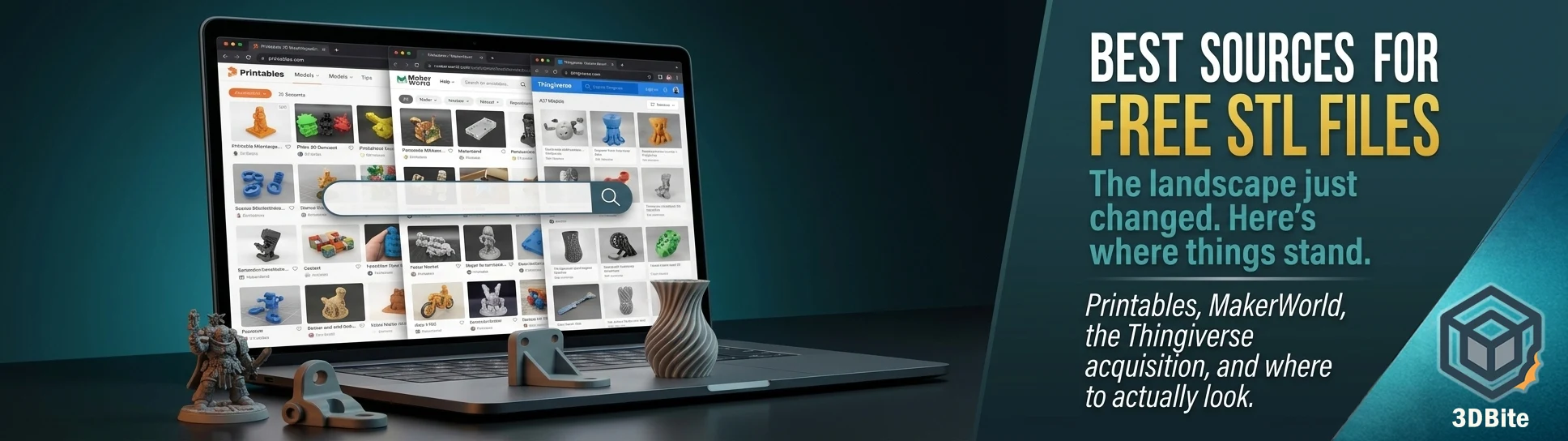
The model repository landscape has shifted meaningfully in the past year, and if you have not been paying close attention, some of what you think you know about “where to get free STL files” is now out of date. Thingiverse — the site that essentially defined this category for over a decade — was acquired by MyMiniFactory in 2026 and folded into a platform called SoulCrafted, with a stated public commitment that existing free models remain free. MakerWorld has grown into one of the two dominant general-purpose repositories rather than a niche Bambu-only add-on. And several newer entrants, including one backed by Elegoo with a genuine creator fund, have appeared in the past year. This post covers where things actually stand now, organised by what you are trying to print rather than as a flat list.
Best overall, general-purpose: Printables and MakerWorld
These two are the sites that come up first in essentially every comparison guide published in 2026, and the consensus is consistent enough to trust. Printables — Prusa’s platform — is described repeatedly as an excellent starting point for its clean design, verified models, and active community moderation. MakerWorld, covered extensively across this site’s Bambu-focused content, is the platform built specifically around printability optimisation and multi-colour AMS workflows, with one-click print-ready profiles that reduce setup time to almost nothing for Bambu hardware specifically.
The important clarification for anyone not on Bambu hardware: MakerWorld files are not locked to Bambu printers. Anyone can browse and download the files, and most print perfectly well on any machine once sliced in whatever software you normally use. The one-click print profiles and reward system are tuned specifically for Bambu, but the underlying STL or 3MF geometry is universal. This is a common misconception worth clearing up — MakerWorld is a general repository with Bambu-optimised extras, not a Bambu-exclusive walled garden.
Both platforms are free, with per-model licensing that varies — check the specific licence on any model before assuming commercial use is permitted, a topic covered in full in the legal guide to selling prints. Most models on both platforms default to personal use only.
The Thingiverse situation: still there, now under new ownership
Thingiverse’s acquisition by MyMiniFactory in 2026 is the most significant structural change in this space in years, and it is worth understanding rather than just noting in passing. Thingiverse has the deepest historical back catalogue of any platform by a wide margin — over a decade of accumulated, remixed, battle-tested community designs that no newer site has had time to replicate. That depth remains its core value: for common functional prints, obscure replacement parts, and the sheer breadth of what has been designed and shared since the earliest days of consumer FDM printing, nothing else comes close in volume.
The acquisition folds Thingiverse into MyMiniFactory’s SoulCrafted platform rather than shutting it down, with existing free models publicly committed to staying free. What this means for the platform’s interface, moderation, and future direction going forward is still settling, and it is genuinely worth checking in on directly rather than relying on older reviews that describe the pre-acquisition Thingiverse experience. The historical archive is the reason to still use it. Whether the newly integrated experience improves on the notoriously dated interface that Thingiverse has been criticised for over the years remains to be seen.
Best for miniatures and tabletop gaming: MyMiniFactory and Cults3D
MyMiniFactory’s specific guarantee — every file on the platform has been test-printed before publication — is a genuine differentiator for anyone tired of downloading a promising-looking miniature only to discover it does not actually print cleanly. This matters disproportionately for miniatures and terrain, where fine detail failures are common and hard to diagnose after the fact. The platform’s strength in tabletop gaming, collectibles, and curated character models is consistent across every comparison found for this post.
Cults3D operates on a mixed free-and-paid model with a reputation for artistic and niche designs that skew more creative than the purely functional content that dominates some other platforms. The trade-off, consistently flagged, is that a meaningful proportion of the best content on Cults3D sits behind a paywall rather than being free — useful to know before assuming it fits a “free STL sources” search the same way Printables or MakerWorld does.
For dedicated miniature collectors building a themed army or matching set, several guides note that most serious hobbyists eventually move toward subscribing to a specific sculptor on Patreon or joining a MyMiniFactory “Tribe” — paid but curated, high-consistency sources rather than piecing together mismatched free files from multiple designers with different styles.
Best for engineering and functional parts: GrabCAD
GrabCAD, owned by Stratasys, sits in a genuinely different category from the hobbyist-focused platforms above. It hosts millions of free CAD files with a strong lean toward engineering and mechanical design rather than decorative or hobby printing. For functional parts, mechanical assemblies, and anything where you want the actual parametric CAD file rather than just a fixed STL mesh, GrabCAD is the site the community consistently points to. It is less relevant for figurines and display pieces and more relevant for the kind of functional bracket and jig work covered in the heat-set inserts post and similar functional printing content on this site.
The newer entrants worth knowing about
A platform launched in August 2025 with a stated $1 million creator fund, backed by Elegoo, has entered the space — notably open to any printer rather than being Elegoo-exclusive, and integrated with both Elegoo Slicer and OrcaSlicer. It is described consistently as early-stage relative to the established leaders, which is the honest framing: a creator fund and manufacturer backing are meaningful signals of intent, but the library depth and community size that make Printables and MakerWorld genuinely useful take years to build, not months. Worth watching rather than treating as a primary source yet.
Thangs.com has carved out a specific and genuinely useful niche as a 3D search engine rather than a repository in its own right — it indexes and searches across multiple platforms simultaneously, and its geometric search feature (upload a model to find visually or structurally similar designs elsewhere) is a capability none of the primary repositories offer natively. For power users who want to compare a design across several sources before committing to one, or who are trying to find something specific without knowing which platform it lives on, Thangs is the tool rather than a destination in itself.
The search engines: for when you do not know where to look
Yeggi.com is the meta-search approach — it indexes results from Thingiverse, Cults3D, MyMiniFactory, and other sources simultaneously, letting you search once and see matching results across multiple repositories rather than checking each site individually. STL Finder performs a similar aggregating function across Thingiverse, Cults3D, CGTrader, and others. For a specific, well-defined search — “phone stand for a specific model,” “replacement part for a specific appliance” — starting with a search engine like Yeggi rather than browsing individual platforms one at a time is usually the faster route to a result.
The warning worth repeating: paid file “packs” on Etsy
This is a specific and consistent warning across multiple guides and worth stating plainly: cheap STL file “packs” sold on Etsy — bundles of dozens or hundreds of popular designs for a few pounds — are almost always pirated content, scraped from free platforms and repackaged for resale without the original designer’s permission or knowledge. Buying these does not support the actual creators whose work is inside the pack, and it directly undermines the free-model ecosystem that makes platforms like Printables and MakerWorld sustainable in the first place. If a model is genuinely free on a proper repository, there is no reason to pay a stranger on Etsy for the same file bundled with a hundred others of dubious origin. If you specifically want to pay to support a designer, buying directly from their own Cults3D listing, MyMiniFactory shop, or Patreon puts the money where it is supposed to go.
What to check before printing anything downloaded
Regardless of source, a few checks are worth doing before committing plate time to a downloaded model. Read the print feedback and comments if the platform has them — MyMiniFactory’s test-print guarantee and Printables’ community feedback both surface real print experience that a polished render on the model page does not. Check the licence terms if there is any chance of selling the print, gifting it commercially, or using it beyond personal display — the default across almost every platform is personal use only unless explicitly stated otherwise. And run the model through the mesh check in Bambu Studio or OrcaSlicer before committing to a long print — downloaded files, particularly from older or less curated corners of Thingiverse’s back catalogue, occasionally carry mesh errors that a quick pre-slice inspection catches before they cause a failed print rather than after.
The quick reference
| Need | Best source |
|---|---|
| General everyday prints, best overall quality | Printables or MakerWorld |
| Deepest historical archive, obscure/older designs | Thingiverse (now under SoulCrafted/MyMiniFactory) |
| Miniatures and tabletop terrain, test-printed guarantee | MyMiniFactory |
| Artistic and niche creative designs | Cults3D |
| Engineering, mechanical, functional CAD files | GrabCAD |
| Searching across multiple sites at once | Yeggi or Thangs |
| Bambu-optimised multi-colour, one-click AMS profiles | MakerWorld |
None of these platforms are mutually exclusive, and the models used across this site’s projects — the Mario series, the seasonal builds, the World Cup keychains — have come almost entirely from MakerWorld and Printables. But the landscape genuinely has shifted this year, and treating “just check Thingiverse” as the whole answer, the way it might have been five years ago, misses most of what is actually available now.