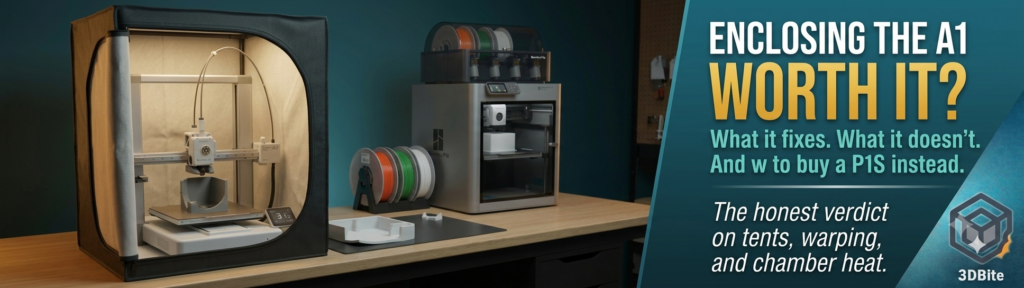
The A1 is an open-frame bed slinger and Bambu built it that way deliberately. No enclosure, no chamber heating, no sealed environment — just a printer sitting in open air. This is fine for PLA and generally fine for PETG, which is why the A1 has worked so well on this desk for two years without an enclosure ever entering the conversation. The question of whether to add one only becomes interesting the moment ABS, ASA, or another temperature-sensitive engineering material enters the picture — and it turns out the answer is more nuanced than either “yes, just buy a tent” or “no, don’t bother” that most quick takes on this settle for.
Why the A1 struggles with certain materials in the first place
ABS and ASA warp because they cool unevenly. As the outer surface of a print cools faster than the interior, the shrinkage differential pulls the corners and edges upward, and on a large flat print that pull is strong enough to lift the whole piece off the plate mid-print. The fix that industrial and enclosed consumer printers use is to keep the whole build chamber warm enough that the print cools slowly and evenly rather than rapidly and unevenly — essentially removing the thermal gradient that causes the warping in the first place. An enclosed chamber does this passively: the heated bed radiates heat upward and the hotend contributes some warmth too, and with nowhere for that heat to escape, the chamber settles at a stable elevated temperature. Community documentation puts the X1 Carbon and P1S at roughly 35-45°C chamber temperature during ABS printing purely from these passive sources, with no active chamber heater at all on either machine.
The A1 has no chamber to trap that heat in. Whatever warmth the bed and hotend produce simply escapes into the room. This is precisely the advantage the A1 has for hot-weather PLA printing, covered in the hot weather post — no enclosure means no trapped heat compounding an already warm room. It is the same open architecture, working against you rather than for you, the moment the material changes from PLA to ABS.
What a third-party enclosure actually achieves on the A1
Adding a fabric tent enclosure or a rigid panel enclosure around an A1 gives the machine a version of what the P1S has by default — a semi-sealed space where heat from the bed and hotend can accumulate rather than dissipate immediately. The honest numbers from community testing put this at roughly 28-35°C chamber temperature inside a typical tent enclosure during ABS printing. That is a real improvement over completely open air and it does help. It is also meaningfully cooler than the 35-45°C that a genuinely enclosed printer like the P1S achieves passively, because a fabric tent is not sealed the way a purpose-built chamber is, and warm air escapes through zip seams and material gaps that a rigid enclosed printer simply does not have.
What this means in practice: an enclosure genuinely reduces ABS warping on the A1 compared to printing it in completely open air. It does not eliminate the problem the way a properly enclosed machine does. One documented account describes a large ABS print left overnight in a tent enclosure that was significantly warped by morning regardless of the enclosure — a reminder that ABS’s sensitivity to temperature fluctuation is severe enough that a partial improvement in chamber temperature is not the same as solving the underlying problem. For small ABS parts printed quickly, a tent enclosure on the A1 may well produce entirely usable results. For large flat ABS prints running many hours, the gap between “warmer than open air” and “warm enough” can be the gap between success and a ruined print.
ASA and PETG: the picture changes by material
ASA behaves similarly to ABS in terms of chamber requirements — it needs a comparably warm environment, though it is somewhat more forgiving of warping than ABS in absolute terms. It still benefits meaningfully from an enclosure and the same caveats about a tent’s partial rather than complete heat retention apply.
PETG is a different story entirely, and this is worth being clear about because it changes the calculation for a large proportion of what actually gets printed. PETG is far more forgiving of drafts and temperature fluctuation than ABS — the A1 handles PETG well in open air, and reviewers note that large PETG prints in drafty rooms may show only slight warping, described consistently as “not a dealbreaker.” An enclosure is not required for PETG on the A1 in the way it genuinely is for ABS. If PETG is the most demanding material in your regular rotation, the enclosure question mostly does not apply to you.
TPU deserves a specific mention because it is the one material where an enclosure can actively make things worse. TPU does not warp and does not need chamber heat. Printing it inside a warm enclosure can make the material more fluid than intended, which increases stringing rather than solving any problem. The community guidance is consistent: print TPU with the enclosure door open, or simply on an open-frame machine like the A1 without adding one at all.
The fumes problem an enclosure does not solve
This is the point that gets glossed over in a lot of “just buy a tent” advice and deserves to be stated plainly, connecting directly to the fumes and ventilation post. Printing ABS releases styrene, a compound the IARC and EPA both flag as a carcinogen concern at meaningful exposure. A standard fabric tent enclosure traps heat effectively but does nothing to filter the air inside it — unless it specifically includes an active carbon filtration system with proper extraction, the styrene concentration inside a sealed tent during an ABS print is higher, not lower, than it would be printing the same material in open air with a window cracked. A fireproof, flame-retardant fabric enclosure addresses fire risk from the heat source; it does not address air quality, and conflating the two is a genuine safety gap in a lot of enclosure marketing copy. If ABS is going into a tent enclosure regularly, that enclosure needs active carbon filtration and a proper exhaust path, not just a sealed fabric box that happens to also trap the fumes alongside the heat.
The alternative that most reviews land on: buy the P1S instead
This is the conclusion that comes up with striking consistency across independent A1 reviews, and it is worth taking seriously rather than dismissing as a manufacturer upsell. Several separate reviewers arrive at the same specific number: at current street pricing, the P1S is often only $150-240 more than the A1, and for that difference you get a genuinely enclosed CoreXY machine that handles ABS, ASA, and nylon reliably without any aftermarket enclosure, tent, or DIY fix. One review puts it bluntly: “if the A1 and P1S are within $50 of each other when you check pricing, the P1S is the better machine at price parity.” Another frames it as: “if ABS is important to you, the P1S is the minimum recommended model,” full stop, ahead of any enclosure discussion for the A1 at all.
The logic here is that a proper enclosed CoreXY machine solves the warping problem completely through passive chamber heating that a tent can only partially replicate, and it does so without introducing the air quality question that an unfiltered fabric enclosure raises. For anyone who has concluded that ABS or ASA is going to be a regular part of their printing rather than an occasional experiment, the maths genuinely favours buying the right tool rather than retrofitting the wrong one.
So when does an A1 enclosure actually make sense
There is a real answer here, and it is narrower than the broad “enclosures are good” framing that a lot of accessory marketing implies. An enclosure on the A1 is worth adding if: you print ABS or ASA occasionally rather than as a primary workflow and are willing to accept a partial rather than complete improvement in warping resistance; the parts you print in those materials are small to medium rather than large flat pieces most prone to warping; you specifically want the enclosure for noise reduction, dust protection, or keeping curious pets and children away from a running printer, independent of any material consideration; or you already own the A1, do not want to buy a second machine, and understand the enclosure is a compromise rather than a complete fix.
An enclosure is probably not worth it, and a P1S or equivalent enclosed machine is the better answer, if: ABS or ASA is going to be a regular and significant part of your printing rather than an occasional test; you print large flat ABS or ASA pieces where warping risk is highest; you care about the fumes question and are not prepared to add proper carbon filtration alongside the enclosure; or the price gap between an A1 plus a decent enclosure and simply buying a P1S turns out to be small once you actually add up the enclosure cost.
The practical recommendation if you do add one
If the decision lands on adding an enclosure rather than a second machine, choose a fireproof, flame-retardant model specifically — the fibreglass-lined polyester construction that reputable brands use will melt or char rather than ignite in a worst-case thermal event, which matters given the unattended printing discussion in the safety post and the documented A1 AC board thermal issue covered there. Do not run ABS or ASA in a sealed enclosure without active carbon filtration and an exhaust path to outside air — a fireproof box that traps unfiltered styrene is solving one safety problem while creating another. Watch chamber temperature during the first few ABS or ASA prints rather than assuming the enclosure alone has fixed the warping problem, and be prepared to accept that large or long prints in these materials may still need the genuine chamber heating that only a properly enclosed CoreXY machine provides.
For PLA, PETG, and TPU — which, on this site, has covered the overwhelming majority of everything printed on the A1 over two years — none of this applies. The open frame remains an advantage rather than a limitation, and an enclosure would be solving a problem that was never actually present.