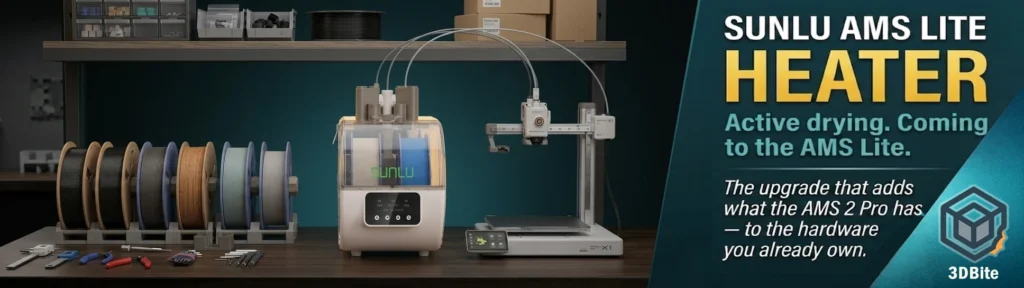
Sunlu has quietly announced something that a significant portion of Bambu AMS Lite users have wanted since the AMS Lite launched: active heating and drying built into the AMS Lite itself, without replacing the unit or upgrading to the AMS 2 Pro. The SUNLU AMS Lite Heater is a coming-soon product at $129.99 USD that wraps the existing AMS Lite in a heated enclosure with real-time humidity monitoring, dual-airflow drying, and automatic moisture venting — all while retaining the AMS Lite’s four-colour multi-material printing functionality during the drying process. It is not yet available to buy at time of writing, but it is listed and close enough to launch that the product images and full spec listing are live.
What the AMS Lite has always been missing
The AMS Lite ships with the A1 and A1 Mini and is a capable, compact, reliable four-colour switching unit for those machines. What it has never had is any active management of the filament condition inside it. The AMS Lite is an open system — spools sit in their holders, exposed to the ambient humidity of whatever room the printer lives in. For short print sessions with PLA in a dry environment, this is not a meaningful problem. For extended printing sessions, for PETG and PA which are meaningfully hygroscopic, or for any printing in a UK workshop where ambient humidity is not your friend, filament loaded in the AMS Lite for extended periods slowly absorbs moisture and begins to print with the symptoms that wet filament produces: surface bubbling, inconsistent extrusion, stringing that was not there when the spool was fresh.
The workarounds currently available are either passive — silica gel desiccant in the general vicinity, airtight storage when spools are not loaded — or active but separate, with a standalone filament dryer feeding the AMS Lite rather than drying the spools inside it. Neither is ideal. A filament dryer feeding into the AMS Lite requires an external spool holder and PTFE tube routing that adds desktop complexity. Silica gel manages rather than reverses moisture absorption. The AMS 2 Pro — the AMS Lite’s more capable sibling — addresses this with built-in active drying, and it is widely acknowledged that the AMS 2 Pro’s drying capability is one of its defining advantages over the AMS Lite for users who print materials beyond standard PLA. The Sunlu AMS Lite Heater is making the same argument: you should not need to buy a whole new AMS unit to get active drying.
What the product actually does
The AMS Lite Heater is described as an enclosure — it fits over and around the existing AMS Lite, turning it from an open spool holder unit into a sealed heated chamber. The AMS Lite itself stays in place with all its original functionality intact. Filament still feeds through to the printer, colour switching still works, the RFID tag reading for Bambu’s own filament still functions. What the enclosure adds is an active heating and humidity management layer around the spools while they sit in the AMS Lite.
The temperature ceiling is 70°C, with adjustable temperature and timing settings. For context on what this means for filament compatibility: PLA dries effectively at 45–55°C for 4–6 hours. PETG prefers 65°C for a longer cycle. PA (nylon) needs 70–80°C, which puts the AMS Lite Heater’s 70°C ceiling at exactly the upper limit for nylon. ABS and ASA dry at 60–70°C. The supported materials listed are PLA, PETG, ABS, ASA, PA, and PC, which covers the full range of what the AMS Lite can handle mechanically — the temperature ceiling is clearly set to match the most demanding of those common materials rather than being an arbitrary specification.
The dual-channel airflow design is described as ensuring uniform heat distribution throughout the chamber. This is the engineering challenge of AMS Lite drying specifically: the AMS Lite holds four spools side by side, and ensuring that the drying airflow reaches all four positions evenly rather than concentrating heat near the element and leaving the far corners cooler is what determines whether all four loaded spools dry equally or only the ones nearest the heat source dry properly. Dual-channel airflow addresses this directly — two airflow paths distributing heat across the full width of the four-spool chamber rather than a single source creating a gradient.
The automatic moisture venting system releases humid air during the drying cycle — the evacuated moisture needs somewhere to go, and an enclosure without active venting simply recirculates the humid air it has extracted from the filament. The intelligent humidity monitoring adds automatic activation: if the humidity inside the chamber rises above a set threshold while the printer is not actively drying, the system triggers a drying cycle automatically. This is the feature that makes it a set-and-forget system rather than one you have to remember to activate before every print session — in principle, the humidity inside the AMS Lite stays managed continuously rather than requiring manual intervention.
The door sensor and triple safety protection is a safety layer specific to the heated enclosure design. A heated sealed chamber with filament inside it has a meaningful thermal management responsibility — overheating PLA inside a sealed environment that reached 70°C would produce a mess at best. The door sensor means the system knows when the AMS Lite is being accessed for spool changes and can manage the heating cycle accordingly. The triple safety combination of door detection, temperature monitoring, and additional safety mechanisms is the kind of specification that matters for a product that runs unattended and produces heat in close proximity to plastic.
The price question
$129.99 is the launch price. Converting to sterling at current rates puts this around £100–105, though the product listing currently shows US and Canada availability only — Europe, UK, and Australia are listed as unavailable at launch. For UK buyers, the availability question is the first obstacle before the price question even becomes relevant.
The price comparison that immediately presents itself: the Bambu AMS 2 Pro retails at approximately $149–180 depending on region and bundle. The AMS 2 Pro includes active drying as a built-in feature alongside improvements to the spool handling, RFID, and colour management compared to the AMS Lite. If you already own an AMS Lite and want active drying, the Sunlu AMS Lite Heater at $130 versus upgrading to an AMS 2 Pro at $150–180 presents a genuine decision point — particularly for anyone who has an AMS Lite that is otherwise functioning well and represents an existing hardware investment they would rather not make redundant.
The AMS Lite Heater preserves the existing AMS Lite. Everything you have configured, the filament already loaded, the wear profile on the unit — all of it continues unchanged. Buying the AMS 2 Pro means re-establishing that setup on new hardware. For an owner whose AMS Lite is reliable and well-used, the retrofit approach has practical appeal beyond the pure price comparison. For an owner who is considering replacing the AMS Lite anyway — or who wants the other AMS 2 Pro improvements beyond just drying — the price difference shrinks enough that upgrading makes more sense than retrofitting.
It is worth noting that Sunlu already makes an AMS Heater for the full-size Bambu AMS (not the Lite), so this is an established product line they are extending rather than a first attempt at the concept. The AMS version’s community reception has been broadly positive, which provides some confidence in the design approach even without independent testing of the AMS Lite variant yet.
Why this matters for the filament storage conversation
The filament storage discussion on this site has been consistent: moisture management matters more than most new users expect, and the AMS Lite’s open architecture is one of the more commonly overlooked sources of print quality degradation for anyone who leaves spools loaded for extended periods. The filament dryers guide covers the standalone dryer options in detail, and the long-term ownership post covers how filament storage discipline develops over time. The AMS Lite Heater is a more integrated answer to the same problem — active moisture management at the point where the filament actually lives during printing, rather than a separate step that requires the filament to be moved to an external dryer before loading.
For the multi-colour workflow covered in the hidden workflow cost post, moisture management across four loaded AMS Lite slots is one of the background operational tasks that adds to the total overhead of AMS-based printing. A heater that manages that automatically, without requiring you to monitor individual spool dryness across four positions, removes a real operational friction point.
Caveats worth noting
The product is listed as coming soon — no ship date is published at time of writing, the stock status is “sold out” (implying a pre-order window may have already cleared or that the product is not yet shipping), and availability is currently limited to US and Canada. UK and European buyers are explicitly listed as unavailable at launch. The timeline for wider availability is unknown.
There are no independent reviews yet — the “tested by creators” language on the product page suggests early access creator testing has happened, but published third-party results are not available at time of writing. The product specifications are compelling on paper. Whether the real-world drying performance, the uniformity of the dual-airflow across all four spool positions, and the humidity sensor’s accuracy in practice match the specification is something that will become clear from community testing once units are in the field.
The compatibility statement is also worth repeating clearly: this is for the Bambu Lab AMS Lite only. It is not compatible with the full AMS, the AMS 2 Pro, or any non-Bambu AMS-style unit. If your A1 is running an AMS 2 Pro or a BCMU rather than an AMS Lite, this product is not relevant to your setup.
The verdict so far
The concept is sound and the gap it fills is real. Active drying integrated into the AMS Lite is a meaningful capability improvement for anyone who regularly prints PETG, PA, or other hygroscopic materials through the AMS Lite — or for anyone who has experienced the print quality difference between a freshly dried spool and one that has been sitting in the AMS Lite through a humid week. The price is positioned reasonably relative to the AMS 2 Pro upgrade alternative, particularly for AMS Lite owners who have no other reason to change units. The feature set — dual-channel airflow, automatic humidity activation, 70°C ceiling, door sensing — reads like a product that has been properly thought through rather than a quick enclosure with a heater element thrown in.
Watch store.sunlu.com for availability updates, and keep an eye on the community testing that will follow once units reach creators. If the real-world performance validates the specification, this is one of the more useful AMS Lite accessories to have appeared in the Bambu ecosystem — and coming from Sunlu, whose filament has been part of this site’s regular workflow for two years, it is a brand whose broader product quality track record gives some confidence in the execution even before independent reviews are available.