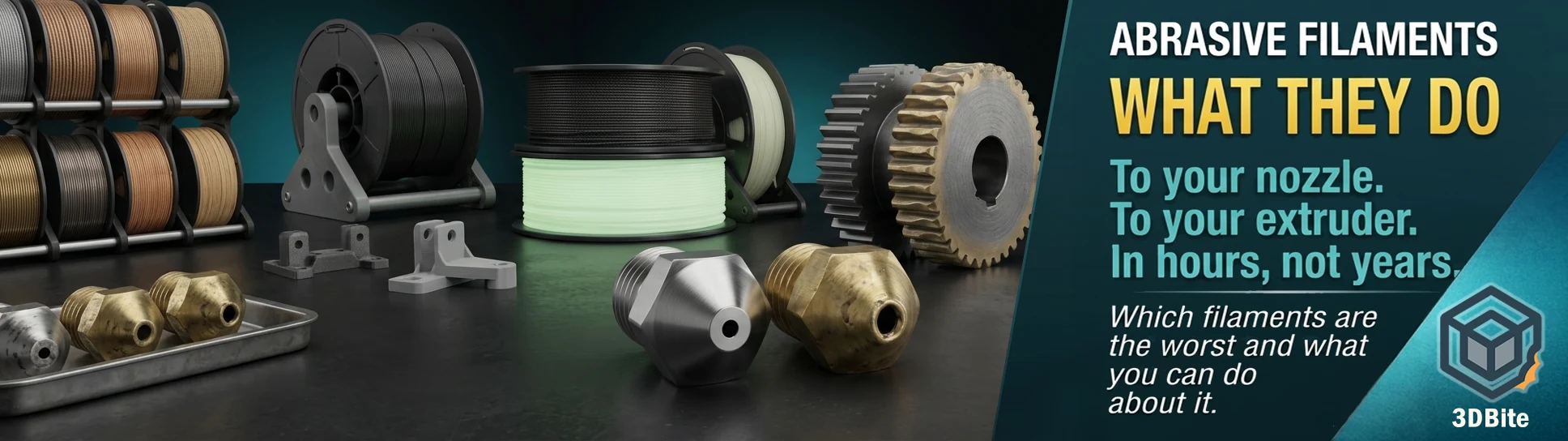
I will be transparent about my own position before this post goes anywhere: I have used carbon fibre and specialty filaments occasionally over the years and not noticed any particular wear on nozzles or extruder components. That experience is, as it turns out, a reflection of how infrequently I reach for these materials rather than evidence that the wear does not happen. It does happen. In some cases it happens fast enough to be remarkable, and if you print abrasive materials regularly on a machine with standard nozzles, you will damage your hardware in ways that are gradual, mostly invisible, and cumulative — until suddenly the print quality deteriorates and the cause is not obvious unless you know what to look for.
This post covers which filaments are genuinely abrasive and why, what the wear actually does to the nozzle and the extruder drive gears, how to recognise that it is happening, and what the practical mitigation options are — from the essential nozzle upgrade through to the Bambu-specific extruder gear considerations that are worth knowing about before loading your first carbon fibre spool.
What makes a filament abrasive
Standard PLA, PETG, and ABS are not abrasive. The polymer itself is softer than the brass that standard nozzles are made from, and the extruder drive gears that grip and push the filament through are made of steel that is substantially harder than the plastic filament. None of these materials cause meaningful hardware wear at normal print volumes. The calculus changes entirely when a filament contains hard particles suspended in the polymer matrix — solid inclusions that are harder than the surfaces they contact and that act, when forced through a narrow orifice at printing temperature, like a continuous abrasive flow against the nozzle bore and the extruder gear teeth.
The hardness of the abrasive particle relative to the nozzle material is what determines how damaging a filament is. A phosphorescent particle in glow-in-the-dark filament is harder than brass. Chopped carbon fibre is significantly harder than brass. Fine metal powder in a metal-fill filament is harder than brass. Glass fibre is harder than brass. Any filament that contains particles harder than the nozzle material will, over time, erode it. The variables are how hard the particles are, how many there are per unit volume of filament, how fast the filament is pushed through the nozzle, and how many hours of contact accumulate before the nozzle is assessed or replaced.
The abrasivity ranking
From least to most damaging, the filament categories that carry a meaningful wear risk:
Glow-in-the-dark filaments — moderate wear
Glow-in-the-dark filaments use strontium aluminate as the phosphorescent pigment. This compound is hard — harder than brass — and present in sufficient concentration that reports of nozzle wear after extended use on brass are well documented across the community. It is not in the same category as carbon fibre, but there are reports that glow-in-the-dark filament is abrasive and has worn out nozzles, and the consensus recommendation is a hardened steel nozzle as a sensible precaution, particularly for anyone printing these regularly or in large volumes. For the occasional glow-in-the-dark accent piece, most users get away with brass for a long time. For regular use or production volumes, the hardened nozzle is the correct call.
Wood and cork fill filaments — moderate wear
Wood-filled PLA uses fine wood dust, sawdust, or cork particles suspended in a PLA base. These particles are not as hard as carbon fibre or metal, but they are abrasive enough over time that the community consensus includes hardened nozzle recommendations for regular wood-fill users. The wear mechanism is more about the fibrous particle shape than extreme hardness — the particles are pulled along with the filament flow and drag against the nozzle bore rather than grinding it away. For occasional use, brass tolerates wood-fill reasonably well. For a build with extensive wood-fill printing, a hardened nozzle extends service life significantly.
Metal-fill and magnetic filaments — high wear
These are the cosmetic specialty filaments — iron fill, stainless steel fill, copper fill, bronze fill — that produce the heavy, metallic-looking prints used for replica props, jewellery, and decorative items. They typically consist of a high percentage of fine metal powder (sometimes 80–90% by weight) bound together by a polymer matrix, usually PLA. The metal powder is fine enough to pass through a standard nozzle but hard enough to erode it progressively. Magnetic iron PLA is particularly well documented as a nozzle-wear risk — the iron particles are abrasive and a hardened steel nozzle is a firm requirement before printing. The same applies to stainless steel fill and copper fill. Metal-fill filaments are not structural materials — the metal content actually makes them more brittle than standard PLA — but their cosmetic appeal is significant, and the nozzle upgrade is the price of access.
Carbon fibre composites — very high wear
Carbon fibre reinforced filaments — PLA-CF, PETG-CF, PA-CF, PC-CF — are the most commonly encountered genuinely abrasive filaments in the hobbyist market, and the wear they cause is dramatically faster than any of the categories above. Extruding a CF-filled filament through a standard brass nozzle is like sandblasting it from the inside out. A brass nozzle can be destroyed in a matter of hours. Independent tests have documented visible brass nozzle erosion after as little as eight hours of PETG-CF printing. For the most aggressive formulations — PA-CF (nylon with carbon fibre) — the nozzle can be damaged after a single print.
The mechanism is the chopped carbon fibre strands themselves. These are short-cut fibres embedded in the polymer matrix, and unlike a round metal particle that flows relatively smoothly, carbon fibre strands are angular, stiff, and abrasive at every point of contact with the nozzle bore. As they are forced through the melt zone and out through the nozzle tip, they are in continuous frictive contact with the bore wall, progressively widening and distorting it. The more CF content in the filament, the faster this happens. PA-CF formulations, which pair an already hygroscopic engineering polymer with high carbon fibre loading for maximum stiffness and strength, are at the extreme end of this spectrum and represent genuinely non-negotiable hardened nozzle territory.
Glass fibre composites — very high wear
Glass fibre reinforced filaments (PETG-GF, PA-GF, and similar) are less commonly discussed than carbon fibre composites but at least as abrasive. Glass fibre is hard, angular, and present in similar concentrations to carbon fibre in composite formulations. The wear mechanism is identical and the nozzle requirement is the same: hardened steel as a minimum, tungsten carbide or ruby for extended service life at high print volumes.
What the wear actually does
Nozzle bore erosion
A new 0.4mm brass nozzle has a precisely machined cylindrical bore of exactly 0.4mm diameter. Abrasive filaments erode this bore from the inside outward, enlarging and distorting it progressively. Bambu Lab’s own technical documentation illustrates this with a side-by-side comparison: a new stainless steel nozzle versus one used for ten hours of PETG-CF printing — the worn nozzle has developed a visibly larger orifice. The consequences of an enlarged bore are practical and immediate: inconsistent extrusion, because the same volumetric flow rate now emerges through an orifice of variable geometry rather than a precise calibrated opening; poor wall finish, because the nozzle is no longer depositing a consistent-width extrusion line; reduced dimensional accuracy, because the wider extrusion is effectively changing the line width without the slicer knowing; and eventual total nozzle failure if the bore distorts enough to cause unreliable extrusion altogether.
Extruder gear tooth wear
The extruder drive gears are the component that grips the filament and pushes it toward the nozzle, and they are in continuous contact with the filament surface at high grip force. On a standard stainless steel gear set, abrasive particles embedded in the filament surface — or shed from CF and GF filaments as they are gripped — progressively wear the gear tooth profiles. As the gear teeth lose their sharp edges and defined form, their grip on the filament weakens. The practical consequences: slipping under load, which produces under-extrusion and intermittent gaps; grinding marks on the filament from the worn gear teeth, which can clog the hotend; clicking sounds as the gear slips rather than feeding consistently; and, in severe cases, failed AMS feeds on Bambu machines where the AMS relies on consistent, reliable drive to push filament from the unit to the toolhead.
Bambu Lab’s own documentation for the P1 series is explicit about this: wear in the extruder gears can cause filament slippage, leading to under-extrusion or skipped layers. And it is clear that for the most abrasive filaments, the nozzle can be damaged after a single print. Both components — nozzle and extruder gears — are at risk, and protecting both is the complete mitigation strategy, not just replacing the nozzle.
The nozzle material hierarchy
Understanding the options makes the upgrade choice clear.
| Nozzle material | Hardness vs. abrasive filaments | Cost | Suitable for | Verdict |
|---|---|---|---|---|
| Brass | Softer than most abrasive particles — will wear | ~£1–3 | Standard PLA, PETG, ABS, TPU | Never use for abrasive filaments |
| Stainless steel | Harder than brass but still below CF/GF hardness | ~£4–8 | Food-safe applications — see relevant guide | Not for abrasive filaments — will still wear, just more slowly |
| Hardened steel | Significantly harder — resists CF, GF, metal-fill well | ~£8–25 | CF, GF, metal-fill, glow-in-dark, wood-fill | The correct everyday upgrade for abrasive materials |
| Tungsten carbide | Extremely hard — outlasts hardened steel significantly | ~£30–50 | All abrasive filaments, high-volume production | Worth the cost for regular or production CF printing |
| Ruby-tipped | Hardest available — exceptional longevity | ~£60–100 | All abrasive filaments, precision long-term use | Premium option — overkill for light CF use, justified at high volume |
The hardened steel nozzle is the right answer for the overwhelming majority of hobbyist situations involving abrasive filament. It costs around £10–25, lasts hundreds of hours with regular CF use against brass’s potential failure in a single print, and is widely available for Bambu machines through the official store and third-party suppliers. Tungsten carbide and ruby-tipped nozzles make sense if you are printing carbon fibre as a primary workflow material and want the longest possible service interval between nozzle changes — the ruby-tipped nozzle in particular is used for fine precision work at the upper end of the hobbyist market. For occasional abrasive printing, hardened steel is entirely adequate.
The extruder gear situation on Bambu machines specifically
This is where the Bambu machine picture becomes more nuanced than a simple “upgrade your nozzle” recommendation.
The A1 and A1 Mini ship from the factory with hardened steel extruder gears as standard — this is documented in Bambu’s own product pages, which describe the extruder unit as featuring dual gears made of hardened steel to feed filament into the hotend, with the hardened steel gears providing increased extrusion force, filament slip prevention, and abrasion resistance. For A1 owners, the extruder gear situation is already handled. The only hardware upgrade required before printing abrasive filaments on the A1 is the nozzle.
The P1 series — the P1P and P1S — ships with stainless steel extruder gears as the standard configuration, and Bambu explicitly acknowledges these can wear quickly on abrasive filaments. The upgrade path is well documented on the Bambu Lab Wiki: a dedicated Hardened Steel Upgrade Combo for the P1 Series replaces both the extruder gears and provides hardened nozzle access. Bambu’s own documentation makes clear that stainless steel components may need to be replaced often when printing abrasive materials, increasing maintenance costs and downtime — which is unusually candid for a manufacturer and reflects the genuine severity of the wear on a stainless gear with CF filament. P1 owners intending to print carbon fibre should either upgrade to the hardened steel gear set before their first CF spool or accept that the stainless gears will need periodic replacement.
The third-party market has also responded to this gap. The BIQU Panda Claw — a golden RNC nano-coated hardened steel drive gear with a CNC-machined aluminium idler arm — is a community favourite upgrade for both the A1 and P1 series, offering improved wear resistance over stock P1 gears and a helical tooth profile that the standard straight-cut gears lack. Trianglelab’s nano-coated hardened steel alternative covers the same machines at a similar price point. Both are documented drop-in upgrades requiring no modifications beyond the gear swap itself.
How to tell if wear is happening
The signs of nozzle wear and extruder gear wear overlap enough that diagnosing which component is failing requires some systematic thinking. The common indicators:
- Inconsistent extrusion or under-extrusion — the most common symptom of both worn nozzle bore and worn extruder gears. If the extrusion is inconsistent in ways that did not respond to the usual calibration fixes, hardware wear is worth investigating
- Poor surface finish on outer walls — a widened, distorted nozzle bore deposits an inconsistent extrusion bead that produces visible wall irregularity even with correct settings
- Grinding marks on filament — if you pull filament back out of the extruder and see regular, repeated bite marks in the filament surface rather than clean grip marks, the gear teeth are losing definition and slipping rather than gripping
- Clicking sounds from the extruder during printing — particularly during high-flow moments. The extruder motor is skipping because the gear is slipping rather than feeding consistently
- AMS feed failures on Bambu machines — if the AMS is experiencing more frequent load errors than normal, extruder gear wear is one of the causes worth checking alongside the more common filament and path issues
- Visually widened nozzle orifice — on a new nozzle the tip opening should look like a precise, round hole. On a worn brass nozzle used for CF printing, the distortion can be visible to the naked eye or with a basic loupe. Bambu’s own comparison photo of this before and after ten hours of PETG-CF on stainless steel makes the scale of the difference clear
The practical mitigation strategy
Reducing the use of abrasive filaments to occasional use — which is my own position — genuinely does limit the practical impact. A single spool of PLA-CF for a specific structural part that justified the material will not destroy a nozzle in any meaningful sense, though the brass nozzle is still the wrong choice even for a single spool if you want to maintain nozzle precision for the standard PLA jobs that follow. A more systematic approach covers the full picture:
- Identify your abrasive filaments before they go anywhere near the machine — anything with CF, GF, metal-fill, or phosphorescent pigment in the name needs a hardened nozzle before it prints. This is not a question of volume or frequency; it is a question of particle hardness, which is inherent to the material regardless of how many metres of it you push through
- Install a hardened steel nozzle before the first abrasive spool and keep it as your abrasive-duty nozzle — if you switch between standard and abrasive materials, a sensible workflow is to have one nozzle set aside specifically for abrasive duty. The hardened nozzle tolerates standard PLA and PETG perfectly well, but the standard nozzle should not be used for CF even once if you want to preserve it
- Consider a larger nozzle diameter for CF and GF filaments — a 0.6mm nozzle is recommended by multiple CF printer guides because the wider bore clears chopped fibres with less risk of clogging, produces less contact pressure on the bore wall per unit length of extrusion, and generally handles the flow demands of fibre-filled filaments better than a 0.4mm bore. The trade-off is reduced fine detail, but CF and GF materials are chosen for structural properties rather than fine surface detail in almost all practical applications
- For P1 series users: upgrade the extruder gears before sustained CF printing — the Bambu hardened steel extruder gear combo for the P1 series addresses the stainless steel gear wear risk that the standard P1 extruder carries with abrasive materials
- Inspect the nozzle periodically if printing abrasive materials — for standard PLA on brass, a nozzle can last hundreds of hours. For abrasive materials, expect to replace nozzles more frequently, sometimes after just tens of hours. Even a hardened nozzle wears eventually with carbon fibre, just far more slowly than brass. Treat it as a consumable and keep a spare
- Dry abrasive filaments, always — CF and GF filaments are hygroscopic. Wet filament causes under-extrusion and wear that compounds with the mechanical wear already being introduced by the abrasive particles. Dry before the first print and use a dry box or dryer during printing for long jobs with nylon-based CF formulations in particular
My honest position
The fact that I have used these materials sparingly and not noticed wear is entirely consistent with the data. Occasional use at low volume does not produce the catastrophic nozzle failure that a full PA-CF print run on brass would. But it does contribute wear that is cumulative and real, and the correct response to that knowledge is to switch to the appropriate hardware before the next abrasive print rather than to take the fact that nothing has obviously broken yet as evidence that nothing is happening. Brass nozzles are cheap enough that a precautionary replacement after any extended abrasive use is sensible housekeeping. A hardened nozzle dedicated to abrasive duty is the cleaner long-term answer and costs £10–25 across the range.
The broader point worth taking from this topic is that the filament type fundamentally determines the hardware requirements, not the machine specification. The A1 has hardened steel extruder gears by design, which puts it in a better default position for abrasive filament use than the P1 series stainless standard. Neither machine is immune to nozzle wear. Both need the right nozzle for the material, and the nozzle upgrade is the cheapest, most impactful single hardware change you can make before reaching for a spool of carbon fibre.