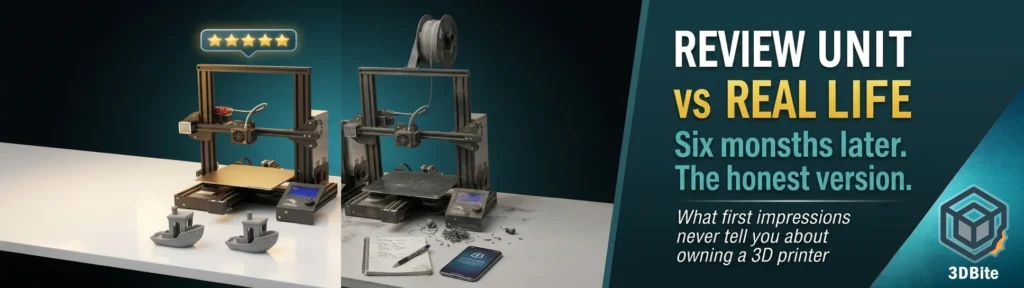
Professional printer reviews are useful. They are also, by their nature, incomplete. A reviewer who receives a machine, spends two to four weeks with it, and publishes their findings is telling you something real and worthwhile — but they are telling you about a printer in its honeymoon period, running in controlled conditions, operated by someone who is paying close attention to it because they have a deadline. That is not the same as owning the machine for six months. Or two years. Or longer.
The gap between the review experience and the ownership experience is real, it is consistent across brands and price points, and it is underserved by the existing coverage landscape. This post is an attempt to close that gap — to talk honestly about what changes when the novelty wears off, the maintenance accumulates, and the printer has to fit into a real workflow rather than a review workflow. Some of it comes from my own two years with the A1 and first weeks with the Kobra X. Some of it comes from the community testimony of people who have been at this longer than I have. All of it is more useful to a prospective buyer than another first-impressions summary.
The first week is not representative
The first week with a new 3D printer is almost always good. This is not a coincidence and it is not entirely the placebo effect of new equipment excitement. There are structural reasons why the early experience is the best experience a printer reliably delivers.
The build plate is new and clean. Adhesion on a pristine PEI surface is excellent — the first layer grips cleanly, releases cleanly, and the whole process feels effortless. Six months later the same plate has accumulated invisible residue from dozens of prints, developed microscopic glazed areas where the coating has been gradually worn by heat cycles, and possibly a couple of small scratches from scraper misjudgements. Adhesion becomes inconsistent. You start adding a glue stick. You wonder if you need a new plate. The answer is often yes, and you buy one, and for a week the machine feels new again. The cycle repeats.
The nozzle is new. First-week extrusion on a fresh nozzle with factory-set flow calibration produces clean, consistent lines. The orifice is precise, the geometry is sharp, and the output reflects it. Eight hundred hours of PLA later, the orifice has widened slightly, the interior surface has accumulated carbonised residue, and you are chasing print quality problems that will only fully resolve when you replace the nozzle. The problem is that nozzle degradation is gradual and invisible — you cannot see it wearing, and the quality drop is too slow to notice day-to-day. You adjust settings, tweak temperatures, blame a filament spool, and eventually change the nozzle and wonder why you did not do it sooner.
The filament is fresh. A new spool opened specifically for the first print is as dry as it will ever be in your possession. The prints it produces reflect the filament at its best. Six months later, the spool that has been going in and out of the AMS for weeks has absorbed ambient moisture, and the same settings produce surface bubbling or inconsistent extrusion that you have to chase back to the root cause. Filament management discipline — sealed storage, desiccant, a dryer for sensitive materials — is a skill developed over ownership time that a review window does not develop.
None of these degradation factors are mentioned in first-impressions coverage. They are not present in first-impressions coverage because they have not happened yet. They are the reality of owning and using the machine at volume, and they shape the experience in ways that no amount of benchmark testing in week one reveals.
What annoyances emerge over time
Every printer has a list of things that would not be in a review but would definitely be in a twelve-month ownership retrospective. These are the friction points that are too minor to flag in a two-week test but too persistent to ignore in real ownership.
On the A1 specifically: the AMS Lite’s purge chute fills up and needs emptying. This is a thirty-second job every few prints, but it is a job that did not exist in the first week because the chute was empty. It requires you to be aware of it, to check it, and eventually to develop the habit of clearing it at the start of every session. A small thing. A permanent thing. The kind of thing no review mentions.
The AMS Lite is also more susceptible to filament tangles than the larger AMS units. The spool holders allow some spool movement, and occasionally a partially-used spool feeds unevenly and causes a mid-print feed failure. This has never happened to me in the first week with a new spool. It has happened multiple times over two years with spools at various stages of use. The fix is usually straightforward — re-seat the spool, clear the feed path, resume. But the event itself is invisible in a review window.
With the Kobra X, the week one frustrations are fresher and more acute. The slicer stability issue — AnycubicSlicerNext crashing repeatedly during model slicing — is the most persistent. It has not resolved in week one. Whether it resolves in week four or month three depends entirely on Anycubic’s update cadence, which is something a first-impressions review cannot assess. The filament loading fussiness has also been inconsistent — sometimes the ACE Gen 2 registers filament on the first feeding attempt, sometimes it requires two or three. Again: invisible in the unboxing experience, visible in the daily workflow.
Most spec sheets don’t reflect real-world use anymore. The differences show up in the stuff companies don’t highlight. This is exactly right, and it applies to review units as much as spec sheets. The differences that matter long-term show up in the things that are too mundane to include in an enthusiastic first-impression post.
The maintenance burden nobody talks about
3D printers are presented as appliances — devices you switch on and use, like a microwave or a kettle. The marketing of modern machines, including Bambu’s, leans heavily into this framing: automated bed levelling, AI failure detection, one-tap printing from a phone. All of this is real and represents genuine progress from the days of manually tramming a bed and watching every print. But the appliance framing is misleading when applied to long-term ownership, because printers require maintenance that appliances do not.
Axis lubrication. The X and Y axis rods need periodic lubrication to maintain smooth movement and prevent wear. On the A1, Bambu recommends this every few hundred hours of printing. In practice, most users do it when they notice something rather than on a schedule. The machine does not remind you. The consequence of neglect is not immediate failure — it is gradual degradation of motion smoothness that eventually affects print quality in ways that are hard to attribute without knowing the maintenance history of the machine.
Belt tension. Both X and Y axis belts need periodic checking and occasional adjustment. Loose belts produce ringing and ghosting artefacts — the characteristic ripple pattern on vertical surfaces adjacent to sharp corners. On a CoreXY machine, both belts must be matched in tension. On a bed slinger, the two axes are independent. Either way, belt tension is a variable that changes over time and affects print quality, and reviewing a printer that has been running for two weeks with factory-set tension tells you nothing about how it behaves when the belts have stretched slightly after a year of use.
Hotend cleaning. Carbon residue accumulates in the nozzle over time. Print temperature, filament type, and print volume all affect how quickly this happens. A cold pull — feeding a specific filament through at low temperature and withdrawing it to pull debris from the nozzle — is a periodic maintenance task that improves print quality and extends nozzle life. It is not mentioned in product reviews. It is a real part of the ongoing ownership experience.
AMS maintenance. Sensors, cutters, and feed wheels in the AMS and AMS Lite accumulate debris from filament ends, dust, and cut fragments over time. Bambu provides cleaning recommendations in their wiki that are not communicated prominently at the point of purchase. Users typically discover the maintenance requirement when something stops working rather than as a proactive discipline.
None of this is burdensome if you know about it and approach it as part of the hobby. It is frustrating if you bought a machine expecting an appliance and discovered instead that it requires periodic attention to continue performing as it did on day one.
Ecosystem lock-in: the cost that compounds
The ecosystem argument for Bambu is real and I have made it on this site — the integration between Bambu Studio, Bambu Handy, and MakerWorld is genuinely excellent and meaningfully better than the alternatives I have used. But the ecosystem argument cuts both ways. Every benefit of integration is also a degree of lock-in, and lock-in has a cost that is not visible in week one.
The cost manifests in accumulated switching costs. Bambu filament profiles that have been tuned over two years of printing — precise temperature, pressure advance, and flow settings for every material in the collection — are not trivially portable to another slicer or another machine. MakerWorld’s library of pre-sliced files with Bambu-specific printer profiles is only useful on Bambu hardware. The investment in understanding Bambu Studio’s specific workflow and feature set is not entirely transferable to OrcaSlicer or PrusaSlicer. Two years of operating within the Bambu ecosystem is two years of building expertise and settings that are partially specific to that platform.
The OrcaSlicer controversy — covered in detail across two posts on this site — has made ecosystem lock-in a more visible concern than it was before. When a manufacturer demonstrates that it will take legal action to prevent users from accessing their own hardware through software of their choice, the lock-in question becomes more than academic. The best printer isn’t the one with the most impressive specifications — it’s the one that prints the parts you need without frustrating you in the process. A printer whose manufacturer’s long-term ecosystem decisions may constrain how you use the hardware you bought is a frustration that does not appear in any first-impressions review.
Proprietary consumables compound this. Bambu’s own filament is priced at a premium. Their build plates are specific to their magnetic bed system. Their nozzles use a proprietary fitment. None of these are unreasonable individually — the nozzle system is genuinely quick to swap, the plates are high quality, the filament is good. But collectively they represent a decision by Bambu to own the consumables relationship with their user base, and that decision affects the cost and freedom of long-term ownership in ways that do not feature in the purchase price calculation.
Slicer maturity: what a year of updates actually looks like
First-impressions reviews assess slicer software as it exists at the time of review. They do not — and cannot — assess how the slicer develops over time: whether updates are frequent, whether they fix the right things, whether the software team is responsive to community feedback, and whether the roadmap produces a product that improves toward the community’s actual needs or toward the manufacturer’s commercial interests.
Bambu Studio has developed well over the two years I have used it. The Filament Manager in 2.6.1 — the feature I wrote about in the recent update post — is a direct response to a community need that was being expressed in forum threads for years. Variable layer height improvements, the text-on-surface tool, ironing refinements, the expansion of supported materials — these are features that came from a team that is actively developing the software in directions users care about. The stability has been consistent throughout. I have had Bambu Studio crash twice in two years.
AnycubicSlicerNext has crashed approximately twelve times in my first week. That is a data point about where the software is right now, not a permanent judgement on where it will be in twelve months. Slicer software improves. The question is whether it improves at the rate the community needs, and whether the team prioritises the right things. Crash stability is a prerequisite before anything else matters — if the software terminates randomly during slicing, every other feature is academic. How quickly Anycubic addresses this will tell you a great deal about the kind of manufacturer they are. That answer takes time to emerge, and first-impressions reviews cannot provide it.
The slicer maturity question extends beyond stability. Feature parity, profile depth, calibration tooling, multi-colour workflow integration — all of these develop over time and all of them affect the ownership experience in ways invisible in week one. Bambu Studio’s pressure advance calibration process, now well-integrated and documented, was rougher in the early days. The profiles for third-party filaments have been refined by the community over years. New machines arrive with thinner community profile coverage and less institutional knowledge around their specific quirks. That coverage builds over ownership time, not over review time.
What reviewers cannot tell you
A competent professional review, conducted by someone who cares about accuracy and has real printing experience, tells you a lot. It tells you about out-of-box print quality, setup difficulty, noise level, physical build quality, software at launch, and rough benchmark performance. These are real and useful data points. But there is a list of things that a review structurally cannot tell you — not because of reviewer incompetence, but because of time.
How the machine behaves after five hundred hours. Whether the manufacturer’s firmware updates improve the machine or introduce new frustrations. Whether the slicer stability issues that appear in week one are addressed by week twelve. Whether the community support resources around the machine grow to the point where problems have documented solutions. Whether the manufacturer’s ecosystem decisions over the coming year make the hardware more or less valuable to own. Whether the AMS or equivalent multi-colour system becomes more reliable with firmware maturity or plateaus at its current level. Whether the company stands behind the product when hardware fails outside warranty.
These questions are answered by ownership, not by reviews. And the honest answer to most of them, for most machines, is: it depends on the manufacturer’s post-launch behaviour, which is not something you can evaluate from a product page or a review published in week two.
What this means practically
The practical implication is that buying a 3D printer — especially a new or recently launched model — is more of a bet on the manufacturer’s post-launch behaviour than the review coverage acknowledges. A machine from a manufacturer with a strong track record of firmware improvement, responsive community support, and honest communication about limitations is a safer long-term bet than a machine with identical specifications from a manufacturer with a weaker track record, even if the day-one review scores are identical.
Bambu’s track record on firmware development and feature improvement is strong. Their track record on community relations and ecosystem openness has become more complicated in 2025 and 2026. Prusa’s track record on both dimensions is excellent, at the cost of a slower hardware development cycle. Anycubic’s hardware has been improving faster than their software, which creates a specific kind of uncertainty about the long-term ownership experience that no first-week review resolves. These are the dimensions that matter for the twelve-month view, and they are exactly what review coverage underweights relative to benchmark scores and out-of-box print quality.
The Kobra X is currently a week into its life on my desk. In a month I will know considerably more about whether the slicer stability improves and how Anycubic’s update cadence treats it. In six months I will know whether the firmware maturation has closed the gap with Bambu or left it where it is. In twelve months I will have an opinion about whether it was a good long-term bet. That twelve-month opinion is the one a review published in week two cannot give you. It is also the one most worth waiting for before drawing firm conclusions. Consider this post the beginning of that longer assessment, not the end of it.