Between the Bambu Lab legal drama, the Kobra X landing on the desk, and the Grinch slowly accumulating parts on the print bed, this week has been fairly dense with 3D printing news. So it was a genuine relief to come across something that is just quietly, pleasantly interesting without any controversy attached to it whatsoever. A New Zealand company has made a filament coloured with wool. Not printed with wool. Not filled with wool fibres in any structural sense. Coloured with pigments derived from sheep. And it is a more interesting development than that sentence makes it sound.
What WoolyFil actually is
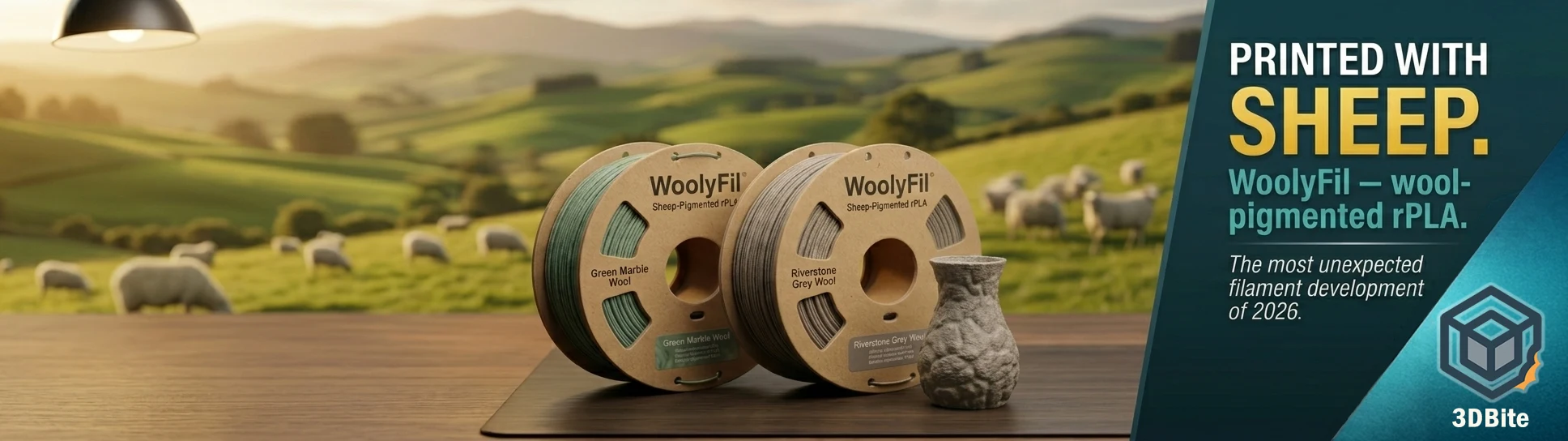
WoolyFil is a collaboration between two New Zealand companies: Wool Source, a Christchurch-based ingredients manufacturer that produces pigments from wool, and KiwiFil, a Tokoroa-based filament manufacturer. It is the world’s first commercial 3D printing filament to use a wool-derived pigment — no wool fibres appear in the filament itself. The base material is recycled PLA. The colour comes from Wool Source Pigments — fine coloured particles derived from strong wool fibre through a patented process — mixed into the rPLA during production.
The distinction between wool-pigmented and wool-filled matters and is worth being clear about upfront. A wood-fill filament contains actual wood particles that affect the material’s texture, weight, printing behaviour, and finish. WoolyFil does not work that way. Wool Source takes coarse wool fibres, known as strong wool, and converts them into fine coloured particles through a patented process. These particles are then incorporated into other materials as a pigment rather than a structural additive. The wool contribution is primarily to the colour and the sustainability profile of the filament, not to its mechanical properties or surface texture.
That said, there is a texture dimension. WoolyFil prints like regular PLA, but with a stone-like texture and look thanks to the inclusion of coloured wool fibres. So the 150-micron particle variant does transfer something to the surface — a slight visual texture reminiscent of natural stone that you would not get from a standard PLA formulation. There is also a 10-micron variant without this textural effect for anyone who wants the sustainability and colour credentials without the surface character.
Why the pigment question actually matters
The first reaction to “wool-coloured filament” is probably mild curiosity or mild amusement, depending on your disposition. The second reaction — once you understand what most conventional filament pigments are made from — is that this is a genuinely more significant development than the headline suggests.
Most modern filament pigments are synthetic, derived from petrochemical or coal-tar processes. Synthetic pigments can pollute millions of litres of wastewater during production and dyeing. They can contain toxic heavy metals and are often non-biodegradable. Some release Polycyclic Aromatic Hydrocarbons, which can damage aquatic ecosystems. Coal tar dyes are linked to carcinogenic effects. This is not alarmist framing — these are documented properties of industrial pigment production, and they apply to a proportion of the pigments used in the filament most of us print with every day. The specific pigments in any given spool of eSun PLA+ are not something most people ever think about, and the Material Safety Data Sheets for filaments frequently do not disclose detailed pigment information.
Wool Source’s pigments have 92–98% biobased carbon content , meaning almost all of the carbon in the pigment comes from a renewable biological source rather than fossil fuels. Both Wool Source products have achieved Cradle to Cradle Material Health Certification, recognising products designed for safe and circular supply chains. And uniquely, this bio-based, renewable pigment is fully traceable back to its New Zealand farm of origin. Farm-to-spool traceability for a 3D printing filament is not something any other product in this market can currently claim.
How the colour system works
Wool comes in a limited natural colour range. Sheep are famously not available in Green Marble or Riverstone. So how does Wool Source produce a full range of colours from wool fibre? Wool Source offers four pigment products: Yellow, Black, Blue, and Red — suspiciously close to CMYK, the basic colour standard from which all print colours can be generated. It is likely they simply mix different combinations to produce, for example, green. The four-colour base system is the same principle as ink printing — primary pigments combined in specific ratios to produce any colour in the gamut. The wool processing transforms the raw fibre into coloured particles, and the CMYK-equivalent set of base pigments can then be mixed to produce any target colour before being incorporated into the filament matrix.
This is also what makes the commercial case more interesting than a single novelty product. Wool Source is not just producing one filament colour from sheep. They have a system capable of producing any colour, which means WoolyFil’s current two-colour launch — Green Marble and Riverstone — is genuinely the beginning of a range rather than a promotional one-off.
Print settings and practical considerations
WoolyFil is available in 1.75mm diameter with a stated tolerance of ±0.05mm, in 250g and 1kg spools. It can be printed with a 0.4mm nozzle at 180–200°C, with a bed temperature of 50–60°C. Those settings are at the lower end of the standard PLA temperature range — a little cooler than the 220°C I typically run for eSun PLA+ on the A1. KiwiFil’s product page recommends standard PLA print settings across the board, which means the filament should drop into an existing PLA profile without significant adjustment.
The 150-micron wool particle variant has a surface texture that transfers to the print — described by KiwiFil as stone-like. This is relevant to model selection. The texture effect will be most visible on flat, smooth surfaces and least visible on detailed or organic geometry where the surface character is already complex. For the aesthetic to read well, clean flat-surfaced models — bases, plaques, pots, geometric objects, architectural models — are likely to showcase the wool texture more clearly than a detailed figurine where the texture competes with the model’s own surface detail.
One practical note from KiwiFil’s own transparency on the product: because this filament is made from 100% recycled plastics, properties can vary slightly from batch to batch. The filament diameter is controlled twice — both in the extruding process and in the re-spooling process. The dual quality check on diameter is reassuring, but batch variation is a real characteristic of recycled-base filaments that is worth knowing about before you commit to a long print that needs to match a previous spool exactly.
The packaging is part of the sustainability story
KiwiFil has thought about the full product lifecycle, not just the filament itself. Made in New Zealand, including the all-cardboard spool, the box, the heavy-duty zipper bag, the label, and the instruction card. An all-cardboard spool is a small thing in isolation, but the standard plastic spool that comes with every kilogram of filament from most manufacturers is rarely recycled, rarely reused, and accumulates fast. At 40-plus spools in my own collection, the plastic spool pile is a persistent background guilt. A cardboard spool that can go in the recycling bin after the filament is used is a genuine improvement to the end-of-life story of the product.
KiwiFil also runs a physical recycling programme. You can send discarded 3D prints back for recycling, along with empty spools. This is not something major filament brands offer — the cost and logistics of reverse logistics make it impractical at scale. For a smaller New Zealand manufacturer with a committed sustainability position, the closed-loop approach is both credible and meaningful.
Would I print with it?
Honestly, yes — I would try it. Not because sheep-derived pigments are the reason I open Bambu Studio on any given evening, but because the sustainability argument is more substantive than I expected going into this, the texture character is genuinely interesting for the right model types, and the novelty of being able to say a print is coloured with traceable New Zealand wool has a certain quality to it that is hard to manufacture by any other means.
The practical barriers are the ones that face any specialty filament from a small overseas manufacturer: availability and shipping. WoolyFil is available from kiwifil.shop, priced in New Zealand dollars with international shipping. At current exchange rates and shipping costs, a 1kg spool is more expensive delivered to the UK than eSun PLA+. That is a fair comparison — it is also more expensive than standard PLA in New Zealand, where KiwiFil’s primary market is. The premium reflects the recycled rPLA base, the wool pigment process, the sustainable packaging, and the farm-level traceability. Whether that premium is worth it is a personal call.
What I find genuinely interesting about WoolyFil as a development is not the specific product but what it represents as a direction. The filament market in 2026 is enormous and almost entirely built on standard synthetic pigments and virgin or partially recycled polymer bases that nobody thinks twice about. The fact that two companies in New Zealand have built a viable commercial alternative using a renewable, traceable, bio-certified pigment system — and that it is compatible with a standard 0.4mm nozzle at normal PLA temperatures — suggests this kind of approach scales. It does not need to be wool specifically. The framework of replacing synthetic industrial pigments with bio-derived alternatives in filament production is applicable to the whole market if the economics work.
And to add a bit of context: New Zealand was one of the first places in the world to sell filament for desktop 3D printers, through a company called Diamond Age — which still exists. It is nice to see New Zealand innovating in filament once again and developing something more sustainable for the market. There is something fitting about the country that helped start the desktop filament industry contributing something genuinely novel to how that filament is made.
WoolyFil is available in Green Marble and Riverstone now, with more colours in development. Find it at kiwifil.shop.