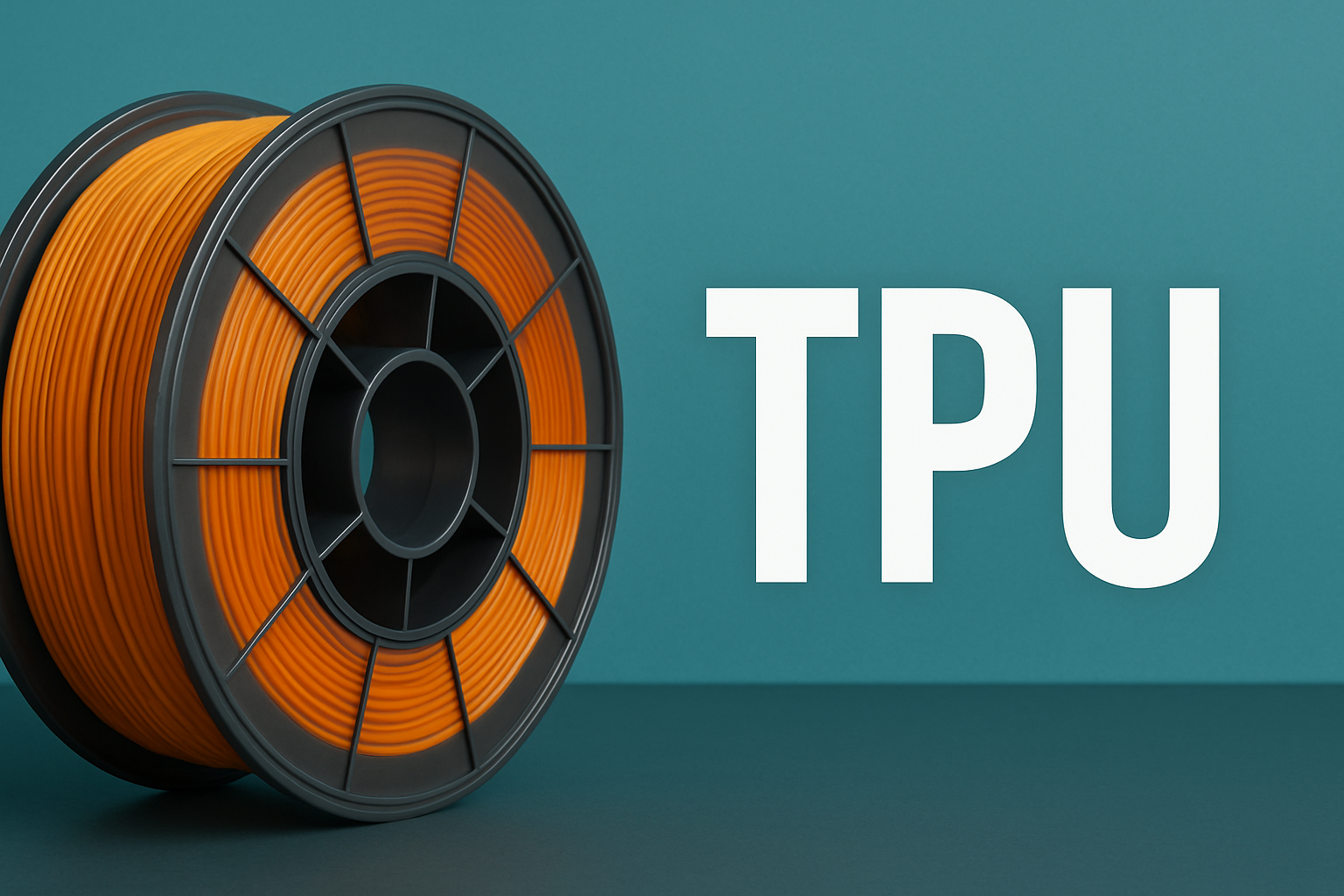
TPU is the flexible filament in the rotation — grips, bumpers, shock-absorbing parts, and anything that needs to compress or bend rather than hold a rigid shape. It prints more slowly and needs a steadier hand on retraction than PLA or PETG, but the A1 handles it well once the settings and, critically, the feed path are set up properly. This is the fully detailed version of what TPU actually is, which brands are genuinely worth buying, and the one hard mechanical limitation that catches almost everyone the first time they try it on a Bambu machine. For the grade-by-grade breakdown of Shore hardness and settings by hardness specifically, the TPU grades post covers that ground in depth and this post links out to it rather than repeating it.
What TPU actually is
TPU stands for thermoplastic polyurethane, and its defining structural feature is a block copolymer structure — a polymer chain built from two genuinely different segment types alternating along its length. Hard segments, typically formed from a diisocyanate reacting with a short-chain diol, provide structural rigidity and act as physical anchor points holding the material’s shape together. Soft segments, built from long, flexible polyol chains, give TPU its actual elasticity. Neither alone would make a useful printing material — the hard segments alone would be a rigid, brittle plastic, and the soft segments alone would be closer to an uncontrolled rubber. It is the alternating combination, chemically bonded into one continuous chain, that produces genuine rubber-like elasticity while staying melt-processable through a standard FDM hotend.
Recreus, a Spanish company, is credited with inventing flexible 3D printing filament in 2013, and their Filaflex 82A remains the benchmark reference for genuinely soft, high-elongation TPU — a fact worth knowing because it means “flexible filament” as a category is barely a decade old, considerably younger than PLA or ABS in FDM printing. Because TPU’s properties come from the ratio between hard and soft segments rather than a single fixed structure, manufacturers can tune that ratio to produce filament anywhere from genuinely soft and rubbery through to nearly rigid, all using the same underlying chemistry — which is exactly why the 82A, 85A, 90A, 95A, and 98A grades covered in the dedicated grades post are not different materials pretending to be the same thing. They are one chemistry, deliberately tuned along a single axis.
Key properties
| Property | TPU (typical 95A) | PLA (for comparison) | PETG (for comparison) |
|---|---|---|---|
| Elongation at break | 400-900% depending on grade (Filaflex 82A specifically reaches 650%) | 3-6% | 15-25% |
| Shore hardness range available | 82A (very soft) to 98A (near-rigid) | N/A — rigid only | N/A — rigid only |
| Impact/abrasion resistance | Excellent — genuinely rubber-like | Poor | Good |
| Print speed | 10-40mm/s depending on hardness grade | Full machine speed range | 150-200mm/s typical ceiling |
| Print temperature | 210-240°C, varies by brand and grade | 190-220°C | 230-260°C |
| AMS compatibility (Bambu) | Only specific HF-formulated products — see below | Yes, standard | Yes, standard |
| Moisture sensitivity | High — absorbs readily | Moderate | High |
The AMS problem: the single most important thing to know before buying
This needs to be stated plainly before anything else, because it catches new TPU printers on a Bambu machine constantly. The AMS feed path includes long tubes and sharp drive engagements that soft filament genuinely buckles inside — jamming is near-guaranteed with ordinary 95A TPU fed through a standard AMS unit. The material that compresses under a hand grip compresses just as readily inside a feed tube under the wrong conditions, and the AMS was not engineered around that compliance the way a direct external spool feed is.
There is exactly one product genuinely engineered to work around this on Bambu hardware: Bambu TPU 95A HF, a specifically high-flow formulation designed to be the flexible filament that actually runs through a Bambu AMS reliably. It is, by design, the only flexible material built for that specific feed path, and it is only available through Bambu’s own store. For everything else — Polymaker PolyFlex, eSUN TPU, SainSmart, NinjaFlex, Overture — the correct and only reliable setup on a Bambu machine is an external spool holder feeding directly to the toolhead, exactly as covered in the grades post. Polymaker’s PolyFlex ships on spool geometry that is dimensionally AMS-compatible, but the material itself still routes externally rather than through the AMS tubing — the spool fits the holder, the filament path does not go through the AMS mechanism.
Which TPU to buy
Polymaker PolyFlex TPU95 is named the best overall TPU across multiple independent 2026 tests, and the reasoning is consistent: Polymaker’s “Jam-Free” compounding combines vibration-resistant chemistry with a precisely controlled melt index, producing smoother extrusion and fewer feed issues than generic 95A competitors at equivalent speeds. It stretches to more than three times its original length before breaking, and surface finish on curves and overhangs is noticeably cleaner than budget alternatives, which tend to ooze and string in exactly those areas. For anyone who wants the least fuss on a first TPU spool, this is the one to start with.
eSUN TPU 95A is described repeatedly as the benchmark value TPU — consistent Shore hardness spool to spool, reliable layer bonding, and genuinely usable at 30-40mm/s on a direct-drive machine without drama. It is not the fastest option available, but it is forgiving and widely available, and it runs the largest colour range in the affordable tier, including translucent variants that print into genuinely glassy-looking flexible parts. Quality control is described as good rather than great — the occasional spool runs slightly thick, worth watching on the first layer of a new roll.
SainSmart 95A earns a specific and genuinely useful reputation: the widest tolerance for imperfect settings of any TPU tested. Over-retract it, run it slightly hot, print it on a stock bed-slinger with no tuning — it still produces usable parts, which is exactly the forgiveness a first-time TPU printer needs while learning the material. It has been a staple in the drone and RC community for years specifically for this reason. The diameter tolerance is looser than the premium picks, which is the trade for that forgiveness.
NinjaTek (NinjaFlex and Cheetah) is the pioneering brand in this category, and it remains relevant rather than merely historic. NinjaTek Cheetah at 95A is described as the single easiest flexible filament available, capable of working even in a Bowden setup where softer TPUs typically fail outright — a genuinely useful option for anyone on older or Bowden-fed hardware rather than a direct-drive machine. NinjaFlex itself, at a softer 85A, needs correspondingly more patience: NinjaTek’s own manufacturer guidance recommends 10-20mm/s for top and bottom layers and 15-35mm/s for infill, a meaningfully more conservative speed profile than the 95A grades tolerate.
Overture TPU earns a specific mention for abrasion resistance rather than just general reliability — one documented test printed tool handles in both Overture 95A and a softer 85A TPU, and after 50-plus hours of actual use, the Overture 95A handle showed minimal wear while the 85A equivalent developed visible surface scuffing. For anything that will see genuine repeated hand contact or friction over time, that data point is worth remembering.
Recreus Filaflex 82A is the specialist choice for genuinely maximum flexibility — wearables, insoles, very soft grips — where even 85A is not soft enough. At 650% elongation and a polyether-polyurethane base specifically chosen for hydrolysis resistance, it behaves closer to soft rubber or silicone than to a standard flexible filament, and it demands the most careful direct-drive setup and the slowest speeds of anything in this list.
When I use TPU
Protective feet and bumpers
TPU’s genuine shock absorption is the point here — a rigid PLA foot transmits an impact directly; a TPU one compresses and dissipates it. This is one of the few applications where no amount of clever geometry in a rigid material achieves the same result.
Phone stands, grips, and tool handles
The rubbery compliance provides genuine non-slip grip that a hard plastic equivalent cannot match, and the Overture abrasion test above confirms 95A specifically holds up to sustained hand contact over real use rather than just looking good on day one.
Cable organisers and strain reliefs
TPU flexes repeatedly around a cable without cracking, which connects directly to the fatigue resistance covered in the orientation for strength post — TPU tolerates a repeated bending cycle that would eventually crack a rigid material at its weakest layer bond.
RC and drone components
This is a genuinely established use case rather than a niche one — SainSmart’s forgiving 95A specifically built its reputation in this community, where soft mounts and impact-absorbing frame elements need to survive repeated crashes rather than a single drop.
Weather seals and vibration pads
TPU’s compressibility seals a gap or damps vibration directly, a job no rigid plastic geometry can achieve regardless of how cleverly it is designed.
Printing settings
| Setting | Value | Notes |
|---|---|---|
| Nozzle temperature | 210-240°C | Brand and grade specific — Cheetah runs hotter at 230-240°C, NinjaFlex prefers 225-235°C, and some budget 95A options print cleaner at the lower end. Run a temperature tower for a new spool rather than assuming |
| Bed temperature | 50-60°C | Works consistently on both textured PEI and glass |
| Layer height | 0.20mm | — |
| Cooling | Fan 50-70% | — |
| Retraction | 3-4mm at 35mm/s as a starting point on a direct-drive machine | Reduce further if buckling or clogging appears |
| Print speed | 10-40mm/s, grade-dependent | Softer grades need the lower end; 95A-98A tolerate the upper end |
| Infill | 15-25% | Gyroid remains the sensible default here too, per the infill patterns post |
Tips for best results
Reduce retraction to prevent clogging — TPU’s flexibility means it can buckle and jam in the extruder path if retraction is set as aggressively as PLA, the same underlying mechanism covered in the retraction settings post, just more pronounced given TPU’s softness. Keep filament dry for cleaner extrusion, since TPU absorbs moisture readily and the drying process in the filament drying post applies directly. Use slow outer walls for crisp detail. And avoid tight filament paths or sharp bends in the feed route, since TPU binds on a tight bend far more readily than a rigid filament.
Where TPU sits in the wider materials picture
TPU is the only genuinely flexible material covered in this series, and it earns that distinct role because nothing else in the PLA-PETG-nylon-PC lineup can substitute for a part that specifically needs to compress, flex, or absorb shock. Choosing the right product matters here more than with most materials — the difference between Bambu’s own HF formulation and a standard third-party 95A is the difference between a print that runs cleanly through the AMS and one that jams it outright, and the difference between Polymaker’s Jam-Free chemistry and a budget spool is a real, tested difference in surface quality and feed reliability rather than a marketing distinction. Understand the hard-soft segment chemistry behind the material, pick the product that matches your actual hardware setup, and TPU becomes one of the most genuinely useful materials in the collection rather than the one spool that only gets used once out of frustration.